

.
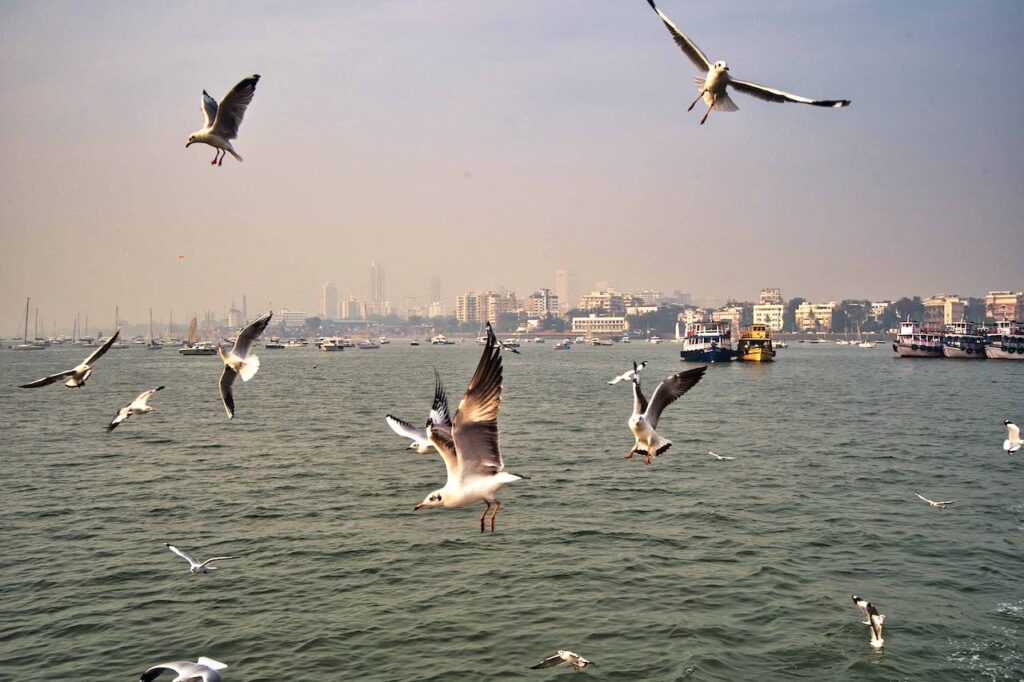
I have been a frequent visitor to Mumbai, more so because of actively participating in the sport of yachting. On two occasions I have even been posted at Mumbai during my army career. However, as with most Mumbaikars, a visit to Elephanta caves has always eluded me, though it’s been one of the items on my bucket list. The caves and the iconic Trimurti bust with its enigmatic expression has always evoked a feeling of mystery. It is unfortunate that the icon of Mumbai is the Gateway of India, and not this ancient 2000-year old marvel hewed out of basalt, which continues to be sidelined in popular projection. Even though it is a UNESCO World Heritage Site, a sad reminder of the prevading colonial influence. Thus on my last trip to Mumbai to participate in a national sailing championships in December 2021, after the event I took off to the Gateway of India to catch a ferry to visit this island 10 km away – an island outpost which has been a witness to Mumbai’s ancient origins.
.

.
Introduction
.
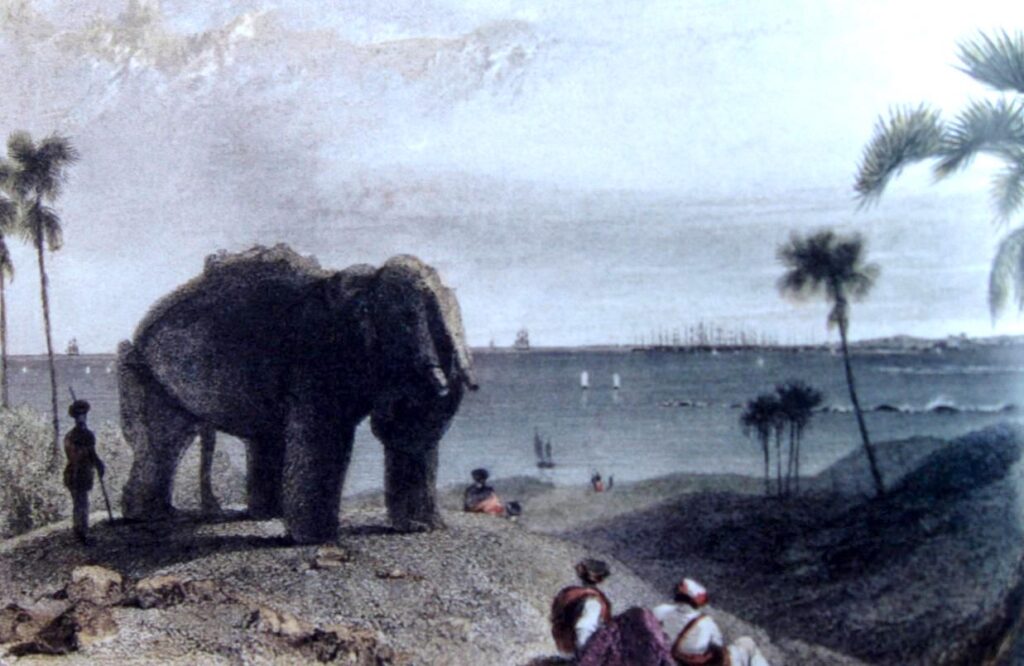
The Elephanta caves are situated on Elephanta Island of great scenic beauty, which has been a witness to history for over two thousand years. The island was named Elefante – which morphed to Elephanta by the Portuguese after a colossal stone elephant was found on the island, the original name being ‘Gharapuri’ – although an even older version was Agraharpuri. Initially, Buddhists erected stupas here in the 2nd century BCE. The small island is dotted with numerous ancient archaeological remains that are the sole testimonies to its rich cultural past. One has to remind oneself that these caves and sculptures have been carved from rock, not built. You cannot but admire the genius of engineering and the hands that created them. These caves were a worship place for Hindus where once chanting, prayers and offering took place regularly. Unfortunately, today the place is just a tourist spot and only the festival of Shivratri is celebrated, as permitted by the government.
.

.
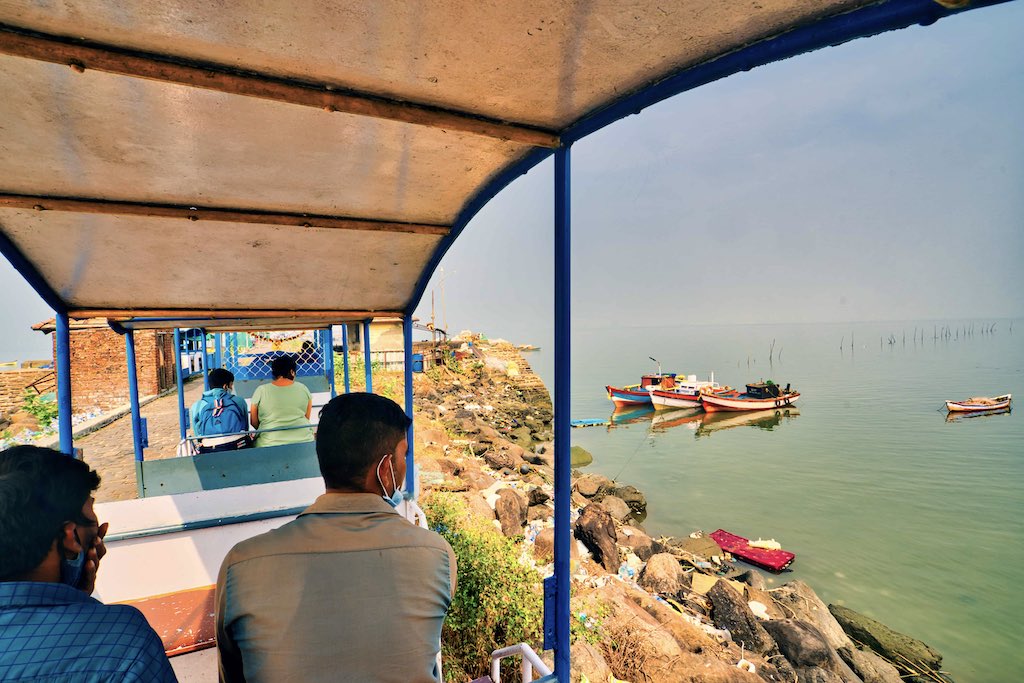
On the way to Elephanta, one crosses Butcher Island, known as such because at one time it was where all butchers carried out their trade, to supply meat to Bombay. Now one can see huge oil storage tanks and oil jetties on the island where tankers off-load their supplies.
.
.
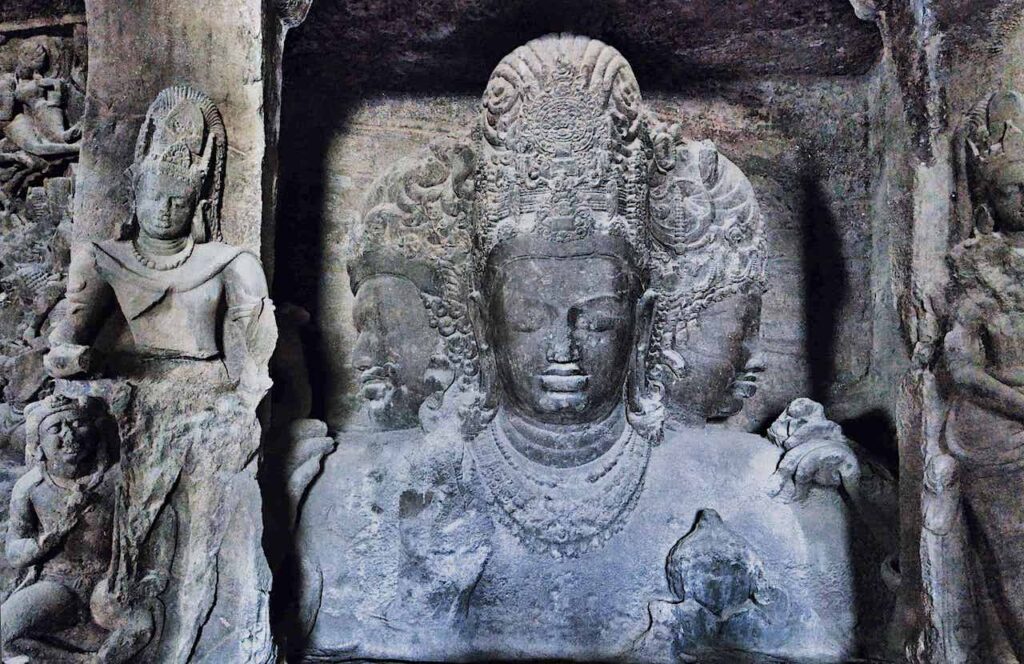
In mid-6th century CE during the rule of the Konkan Mauryas, Hindus hewed giant chambers in the solid cliff and adorned them with some of the most magnificent stone carvings known to be made by man. The caves are embellished with elegant sculptures, gigantic in proportion, and narrating Puranic stories associated with Shiva. They are carved in deep recesses and are characterised by tremendous force and vitality. The central figure, an enormous 20-foot high three-headed bust of Shiva is amongst the finest creations of Indian genius.
One of the first reactions on entering the caves are of shock and disbelief – at the savage manner in which the beautiful sculptures have been deliberately smashed, many of them beyond recognition. The unimaginable cost of colonisation by Islamic and Christian invaders. I had visited Goa just a month back and the wonton destruction of temples across the region was still fresh in my mind. As it turned out, the guilty in Elephanta were the same as in Goa – the Portuguese! Who left no stone unturned to erase every figment of our ancient civilisation. Those wanting to read my blog on Goan temples, can click here.
.

.
The Elephanta artwork was inspired by itihaas, concepts and spiritual ideas found in the Vedic texts, the epics, the Puranas and the Pashupata Shaivism literature corpus of Hinduism composed by the 5th century. The panels reflect the ideas and stories widely accepted and well known to the artists and cave architects of mainland India by about 525 CE. The itihaas varies significantly in these texts and has been distorted by later interpolations, but the Elephanta Cave panels represent the narrative version most significant at that time.
.

.
There is an alternative view regarding the dating of the caves. There is even one theory that the caves were built by powerful spirit beings, rather than humans. This is based on the fact that the excavations that needed to be made are of such an enormous scale that it is deemed almost impossible for humans without the equipment that modern technology has produced. In addition, the sculptures themselves are of such a high quality that some have thought it unrealistic to imagine that human hands could have produced them.
.
.
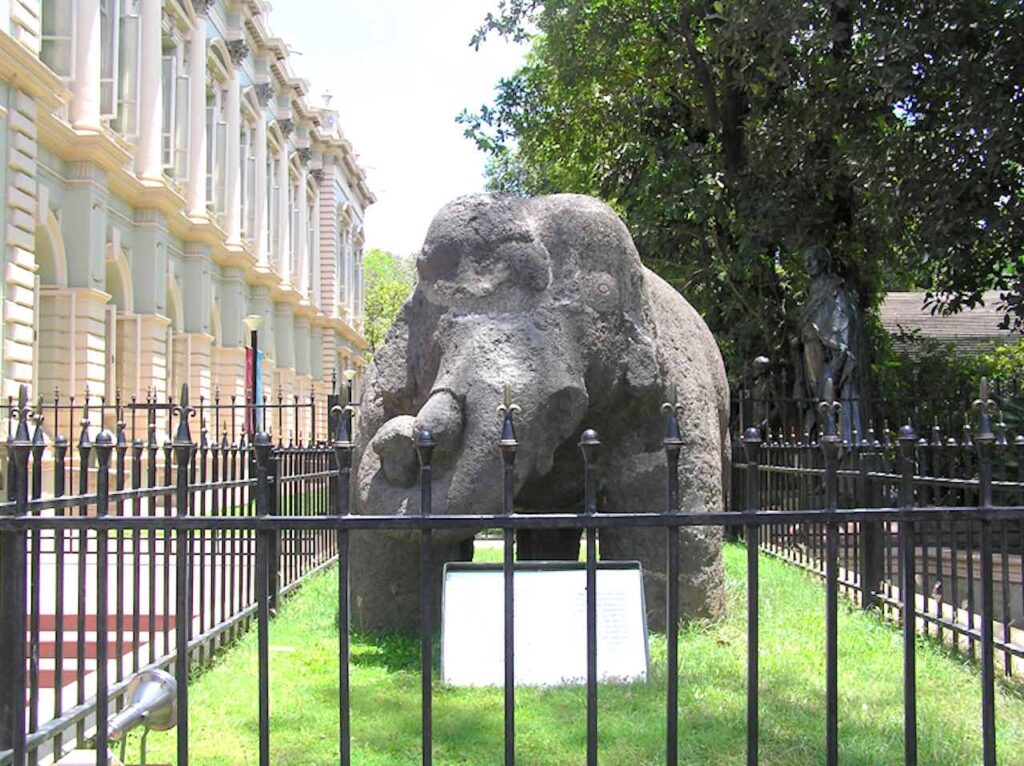
The stone elephant which gave the island its name was 13 feet in length and seven feet four inches in height and dominated the southern tip of the island. The Portuguese tried to destroy it but failed; the British then tried to ship it to Britain in 1864. In the process the crane broke and the statute shattered. The mutilated mass of stone was removed to the Victoria Gardens in Bombay and the recovered pieces reassembled. At present, the disfigured statue of the elephant is displayed outside the Bhau Daji Lad Museum in Mumbai.
.
.
History
.
Stylistically, the caves can be assigned to the middle of the 6th century CE. There was a large inscribed stone on the island near the cave, which was taken to Portugal by the Portuguese viceroy Dom Joao de Castro in 1540 for decipherment but what happened to it is not known. Later inquiries revealed that the stone inscription is not traceable in Portugal. Dom Castro found the caves so impressive that he could not believe it was the work of human hands, and therefore it was thought that it must have been done by demons (asuras). Gone with the stone tablet is the singular piece of historic artefact that could throw light on the circumstances that led to the execution of these caves, and more importantly who were its patrons.
Maharashtra was a part of the Mauryan empire as is evident from Ashoka’s edict at Sopara (ancient Surpdraka), which is now a suburb of Mumbai, where there are also the remains of a Buddhist stupa which was originally built by the emperor himself in the 3rd century BCE. After the decline of the Mauryas, the Satavahanas ruled over the Deccan from about 200 BCE to 200 CE when all the early Buddhist cave temples of Western India were excavated. Later the Vakatakas, who were matrimonially related to the Imperial Guptas of north India, were dominant. The magnificent group of the Mahayana caves at Ajanta were excavated during their reign. They were followed by the Vishnukundinas for a time who were probably driven out by the Kalachuris of Central India and who ruled from Mahishmati, (present Maheshwar, MP) in the 6th century CE. They were great devotees of Shiva and were the followers of the Pasupata order, which was founded by Lakulisa who lived at Kayavarohana (present Karwan, Gujarat) in the 2nd century CE. His images have been carved in the Jogeshwari cave in Mumbai as also at Ellora (Dumar Lena) but their identification at Elephanta is doubtful.
.

.
There is still a small village known as Gharapuri on the island which is identified with ancient Puri, the capital of the Mauryas of Konkan who ruled here in the 6th and 7th century CE. They were not related to the Imperial Mauryas of north India of the 4th and 3rd century BCE, but were probably vassals of the Kalachuris and later of the Western Chalukyas as is evident from the Meguti temple inscription at Aihole of Pulakesin II dated from 634 CE. It states that Puri was besieged by the Chalukyan monarch “with hundreds of ships”, indicating that the place is none else than Gharapuri. Moreover, the record refers to it as “The Goddess of Fortune of the Western Sea”, leaving no doubt about its identification. It was referred to in the 11th century as Sripuri during the rule of the Silaharas, and later in the medieval times as Puri. More important is the reference in Pulakesin’s record that his father Kirtivarman, who ruled from 567 to 598 CE, had also conquered Konkan.
It is interesting to note that the name Sripuri also occurs in an inscription engraved on a copper vessel which was recovered during the clearance of the cistern in the west wing of Main Cave; it is dated 1068 CE. It also deserves mention that sometime back hundreds of copper coins of King Krishnaraja were found at Elephanta.
Different dynasties held their sway over this island, namely, the Konkan-Mauryas, Trikutakas, Chalukyas of Badami, Silaharas, Rashtrakutas, Kalyani Chalukyas, Yadavas of Deogiri, Muslim rulers of Ahmedabad and then by the Portuguese from 1534. The Marathas also had this island under their control and from them it passed into the control of the British. In 1661 the cluster of islands that formed Mumbai came to the British Crown as dowry of the marriage treaty of Charles II of England and Catherine of Braganza, daughter of King John IV of Portugal. However, Elephanta Island was excluded and came under British control only on 28 December 1774.
Although many European visitors were impressed by the colossal sculptures at Elephanta, the Portuguese rulers did their best to destroy them. Their rule was disastrous for Elephanta. The population on the island declined and after thousand year-long worship, the Shiva temples in the caves were abandoned – it was an active place of worship till their arrival. The only religious event which has survived to this day is the festival of Shiva – Maha Shivaratri. Even worse, the Portuguese used the beautiful sculptures in ancient cave temples for target practice and bullet marks are still visible at places. They damaged the temple sanctuaries and defaced the sculptures. This explains why the lower portions of the panels have been totally destroyed, hands broken and faces mutilated. Even later, under the British, the situation did not improve much. The Trimurti sculpture was almost intact up to 1865, when attempts were made to disfigure it. The Prince of Wales, later King Edward VII, was given a banquet inside the cave in November 1875 in which 400 people attended, disregarding all sensitivities.
.

.
However, from 1890 the Public Works Department of Bombay began to take conservation measures to improve the miserable condition of the caves. The Ancient Monuments Preservation Act was passed in 1904, and the caves were declared as a protected monument in 1909. Since Independence, the condition of the caves has considerably improved. Presently they are well maintained and were declared a UNESCO World Heritage Site in 1987.
.
It is difficult to write with any degree of temper on the dismal mutilations of this princely cavern, the stone of which is of such a durable nature as to have in a great measure baffled the ravages of time . . . and had it not been for the ingenuity of human madness, the caves of Elephanta would at this hour have been not only a valuable key to many inexplicable appearances in the other caves, but a noble monument of ancient architecture and sculpture. But what the hand of time has not been able to deface, the blind zeal of bigots and the childish tricks of fools have very nearly destroyed. . . . But what shall we say of those, who neither fired by bigotry, nor actuated by the rage of making proselytes, have wantonly displayed their ingenuity in lopping off heads, legs and arms from many of the most curious statues ; and unable to do any more mischief by mutilation. . . wisely leaving their names behind them, as testimony of their profession, and the most satisfactory proofs of their stupidity and Gothic barbarism.
Hector Macneil, 1783; Excerpts from the book “Rock Temples of Elephanta or Gharapuri” by J Burgess, 1871
.
Evolution
.
Hindu temple architecture reflects a synthesis of arts, the ideals of dharma, values and the way of life cherished under Hinduism. The temple is a place for Tirtha—pilgrimage. The form and meanings of architectural elements in a temple are designed to function as the place where it is the link between man and the divine, to help his progress to spiritual knowledge and truth, his ultimate liberation (moksha). The architectural principles of Hindu temples are described in Shilpa Shastras and Vastu Shastras.
Rock-cut architecture is a distinctive feature of ancient Indian art, more particularly that of Maharashtra where, of about 1500 rock-cut caves, some 1200 are located. For a millennium and half, from the 2nd century BCE to the 13th century CE, the Sahyadris and its hill ranges were humming with the activity of stone cutters, and the temples which they have hewn out of solid rock are truly architectural marvels. This art idiom was practiced all over the world, but it flourished nowhere else as in India as Indian artists far surpassed their counterparts with their skill.
.

.
The rock-cut activity started in north India in Bihar in the 3rd century BCE. There are seven rock-cut caves, four in the Barabar and three in the Nagarjuni hills which are located 19 km north of Gaya. Some of them were donated by Ashoka (272 – 232 BCE) to the ascetics of the Ajivika sect.
In Maharashtra the rock-cut activity can be broadly divided into three phases viz. the Buddhist (BCE 200 – CE 600), Hindu (CE 600 – 1000) and Jaina (CE 800 – 1100). Of the 1500 or so rock cut caves, nearly 1000 are Buddhist, 300 Hindu and 200 Jaina. The trap rock of the Sahyadri ranges is suitable for carving and hence a large number of caves came to be excavated here.
.

.
In Maharashtra, the earliest Hindu rock-cut shrine is in Mumbai itself. The Jogeshwari cave is believed to be the first Hindu cave temple which introduced a new layout. It consists of a large squarish hall, with a square shrine in the centre, surrounded by massive pillars, and has a colonnaded portico. The sanctum has four doors on all four directions, like the structural Hindu temples of the early period. The cave can be assigned to the first half of the 6th century CE.
The main cave at Elephanta, which is placed in the middle of the 6th century CE, marks a further stage of development. Here the shrine is not in the centre of the hall, but in the rear half of it, along the major axis. It has entrances on three sides, except in the south, and the rows of pillars divide the hall into transepts. It resembles in all essential details the arrangement in the Dumar Lena at Ellora (Cave 29), which is of slightly later vintage. The caves were hewn in solid basalt – hard work even for contemporary tools. Initially, they were painted in bright colours – now the paint is gone and only traces of it remain at places on the roof.
.

.
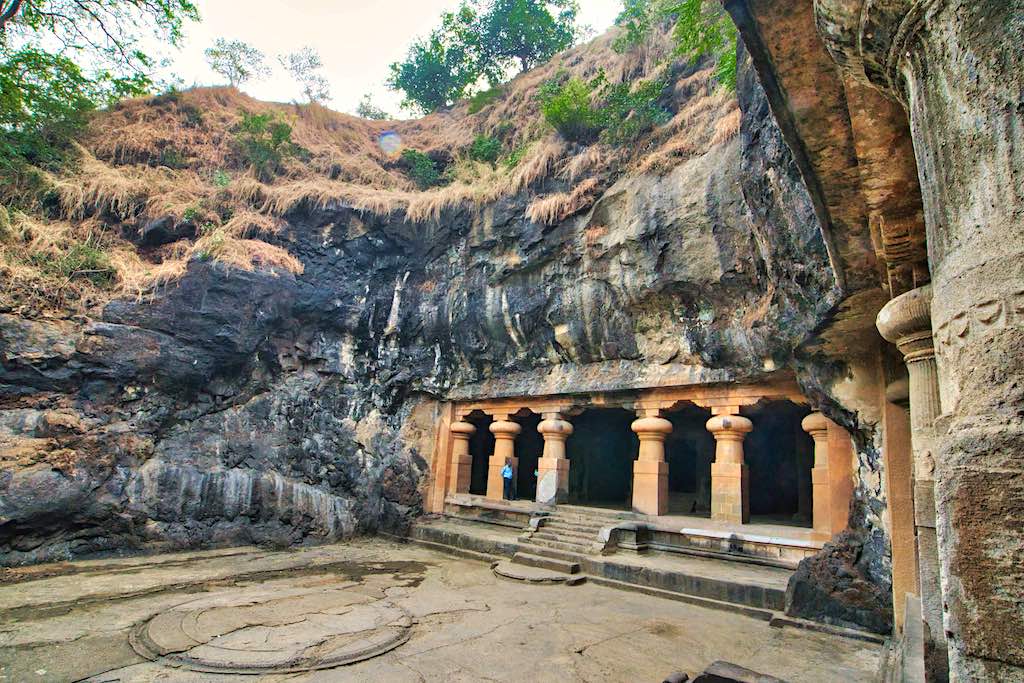
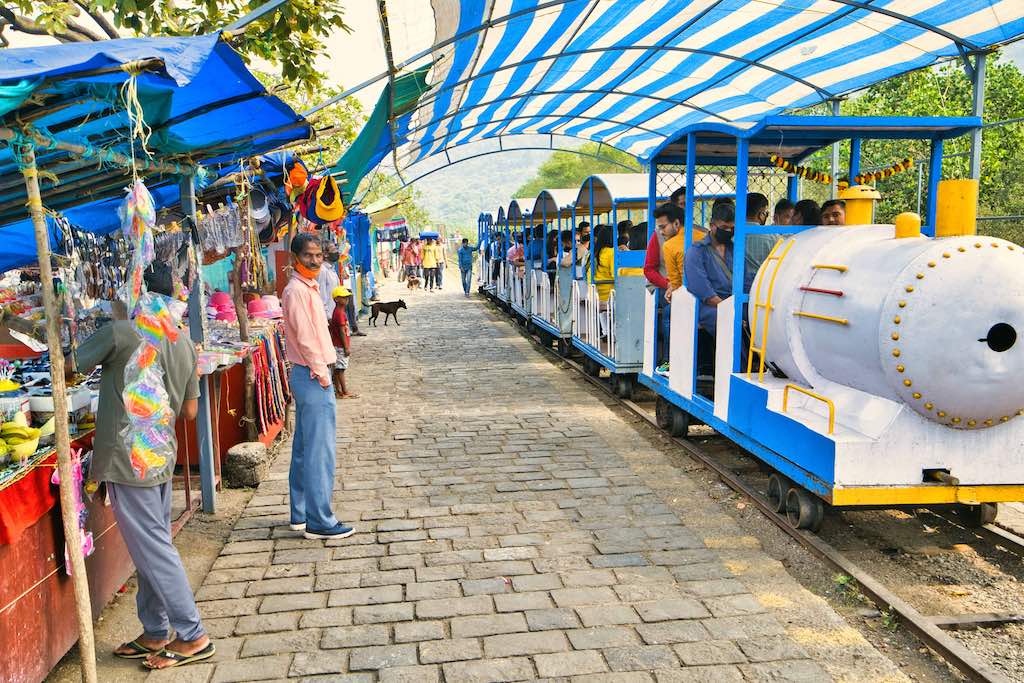
There are seven caves in the Elephanta group and these are datable from circa 6th – 7th centuries CE. The northern entrance to the main temple (cave) has 120 steep steps starting from the jetty. There is also a toy train which can be taken from the jetty to the base of the steps. Entry into the cave temple leads through an impressive portal with massive columns. The entrance is aligned to the north-south axis which is unusual – in general, Shiva temples have an east-west orientation. This is because the original entrance was probably from the eastern side, where in the open court in front of the entrance, there is a slightly raised circular platform on the floor where the Nandi, Shiva’s mount, was placed; it has since vanished.
.

.
In total there are 15 enormous panels having art value in the caves. These large reliefs surrounding the lingam shrine in the main cave not only constitute one of the greatest examples of Indian art but also one of the most important collections for the cult of Shiva. The caves are the most magnificent achievement in the history of rock-architecture in western India.
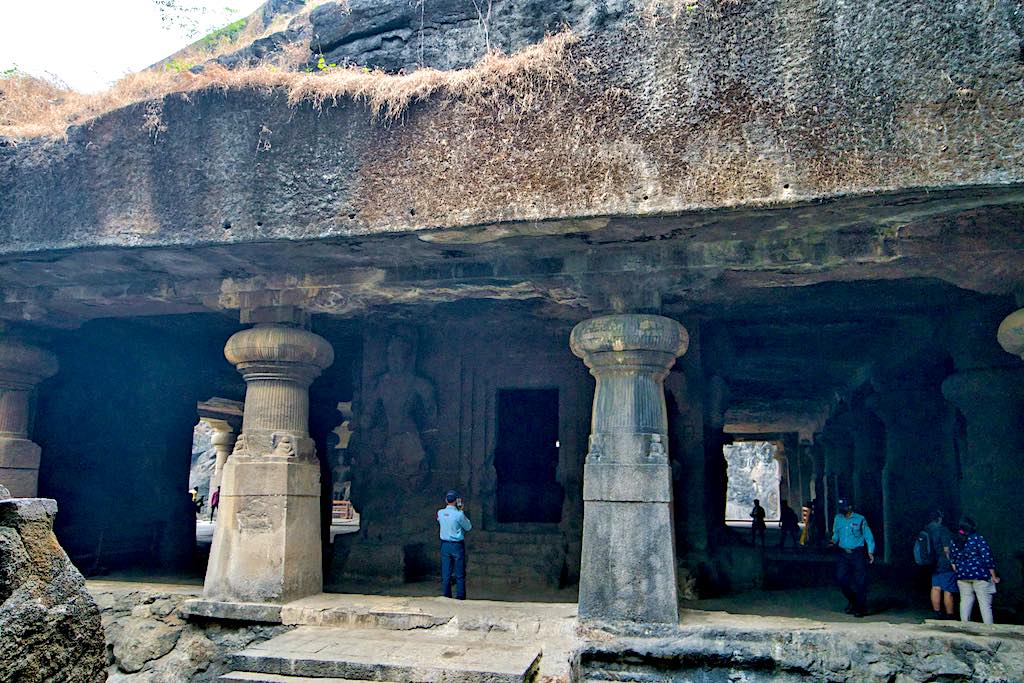
The portico of the eastern wing of the main cave is guarded by seated lions with a raised forepaw – resembling later seated lions popular up to the 19th century in European manor house designs.
.
The Main Cave (Cave No 1)
.
.
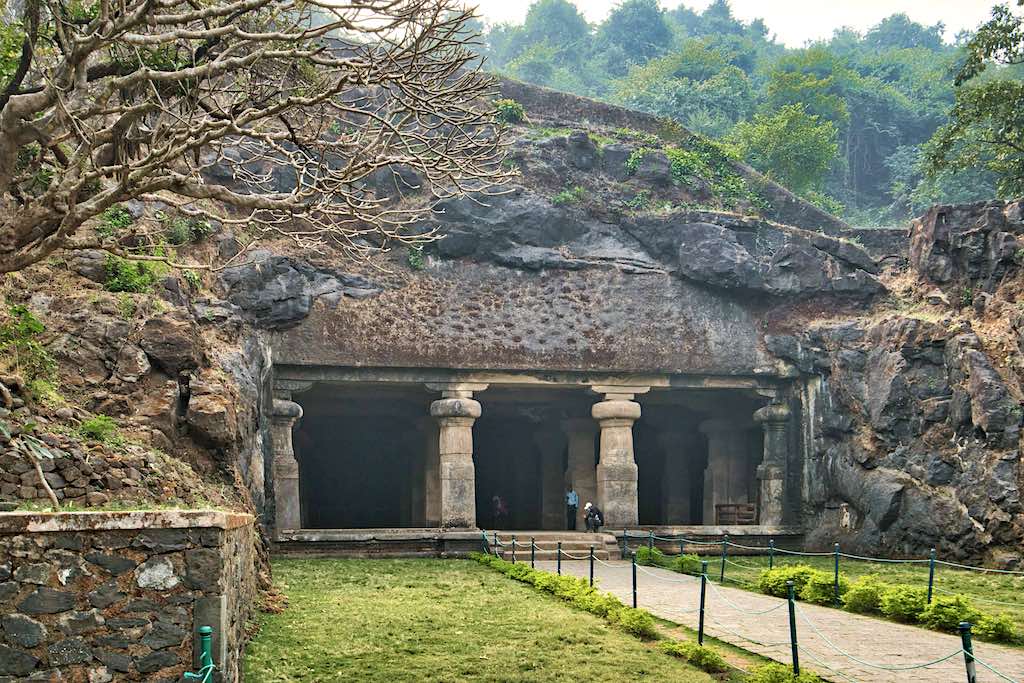
The main cave at Elephanta is among the most impressive Hindu temples in India. The temple is enclosed in the cave, it has interior walls but no exterior wall. The cave unites the elements of Chalukyan architecture – like the massive figures of the divinities and guardians and square pillars with custom capitals, which in turn have Gupta architectural features – depictions of mountains and clouds, and women’s hairstyles.
.

.
The layout of the caves, including the pillar components, the placement and division of the caves into different parts, and the provision of a sanctum or Garbhagriha of sarvatobhadra plan, are important developments in rock-cut architecture. The Elephanta Caves emerged from a long artistic tradition, but demonstrate refreshing innovation. The combination of aesthetic beauty and sculptural art, replete with respondent Rasas, reached an apogee at the Elephanta Caves. Hindu spiritualistic beliefs and symbology are finely utilized in the overall planning of the caves.
.

.
The main chamber (mandapa) is approached by a flight of steps leading to a portico in the north beyond which is a vestibule which forms part of the hall, set apart by rows of impressive pillars. In the east and west, the flights of steps straight lead into the hall. The three entrances admit a flood of light in the hall where large sculptured panels have been carved. The mandapa recesses into a pillared vestibule (ardha-mandapa) on the south side, while a pillared portico (mukha-mandapa) connects it to the main entrance at the north. The colossal Trimurti of Siva, the presiding deity, is carved on the southern wall. The cave is a large squarish hall with its longer axis in the east-west direction; each side of the mandapa is approximately 27 m long.
.

.
The hall is quite spacious and the available wall space has been used by the artists very intelligently. The themes have been selected with great care and have been executed in huge panels which are most impressive not only because of their beauty but their very size. The cave therefore looks like a mysterious cavern from the depth of which emerge gods and goddesses. Beautiful carvings with Shiva in several forms cover each wall in the mandapa, each carving is more than 5 m high. The principal figures are marked by forceful gestures and postures. The hall is divided into thirty-six squares, each measuring 5.5 square m., by six rows of pillared columns, six in each row except on the western corner, where a lingam shrine is provided. This arrangement corresponds to the mandalas or symbolic diagrams representing the Universe which plays an important role in the sacred Vedic temple architecture.
.

.
The pillars are squarish in the lower half, and have a cylindrical fluted upper part crowned by a fluted cushion capital. The roof of the hall has concealed beams supported by these stone columns. The pillars create space and symmetric rhythm as they support the weight of the hill above. Exactly similar pillars are to be seen in the Dumar Lena at Ellora.
As already observed, the cave is almost identical with Dumar Lena of Ellora (cave No. 29) so far as its plan, the style of pillars and their disposition as also the sculptured panels are concerned, but the latter lacks the elegance and refined quality as also the dynamism and subtlety of Elephanta; even its spiritual quality is missing. In fact Elephanta can be said to be superior to all others of its class.
Embedded within the Great Cave are dedicated shrines, the largest of which is the square-plan Shiva linga shrine (see Serial 8 in figure). It is a square garbha-grihya with four entrances, located in the right section of the main hall. Steps lead from the four doorways into the sanctum, which has a linga in the mulavigraha style. Each doorway is guarded by a dwarapala on either side, for a total of eight dwarapalas, their heights spanning floor to the ceiling. The shrine is surrounded by a mandapa and circumambulation path (pradakshina-patha) as is customary in temples. The pillars are similarly aligned east–west to this shrine and have an east entrance. Overlaid, as if fused, on the architecture of this temple is another open temple aligned to the north–south direction with the three-faced Sadashiva (Trimurti) as its focal centre.
.

.
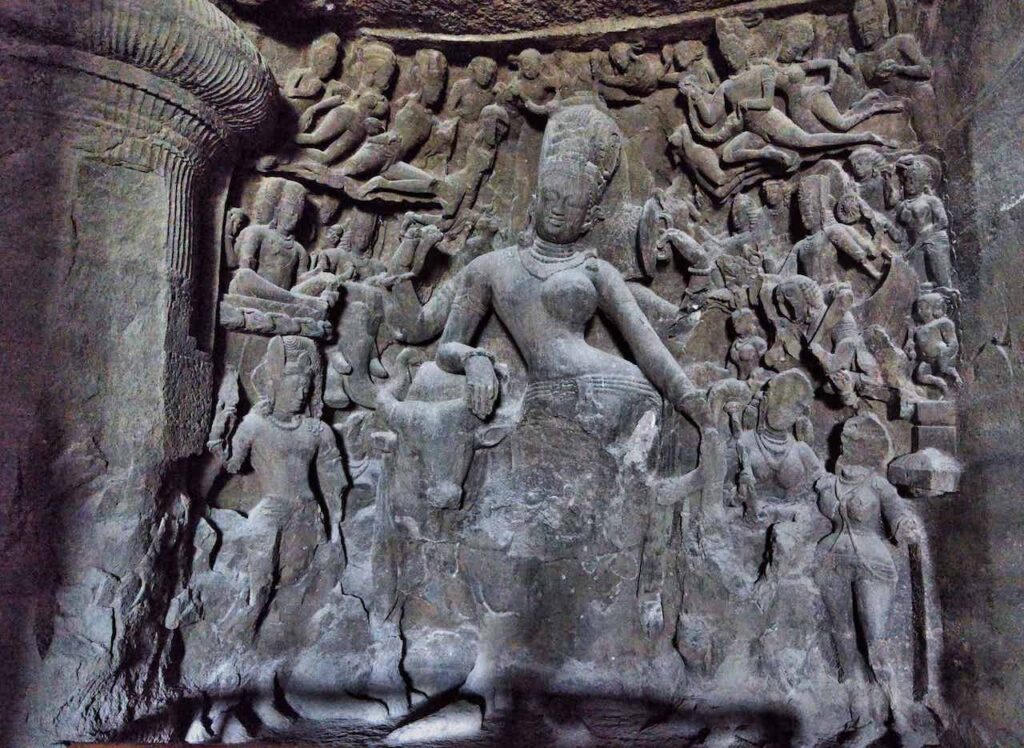
The Trimurti is flanked by sculptural groups called Ardhanarisvara on its left and Gangadhara to its right. Gangadhara is 5.2 m high and 4 m wide. It shows divinities assembled around Shiva and Parvati. The 5.11 m high Ardhanarishvara depicts a four-armed Shiva shown as a half male – half female.
Representations of the cosmic dance of Nataraja, Yogishvara, Andhakasuravadha, Ardhanarishwara, a form of Shiva with the combined energies of male and female, on the east; Kalyanasundara murti depicting the wedding of Shiva-Parvati; Gangadhara murti showing Shiva bringing Ganges down to earth; and Ravanaanugraha murti; Shiva as Mahayogi, Lakulisa; and, on the west figures of Shiva and Parvati playing chausar are also noteworthy for their forms, dimensions, themes, representations, content, alignment and execution. A panel depicting Saptamatrikas near the eastern opening is also remarkable.
.
Layout of Panels in Cave No 1
.
.
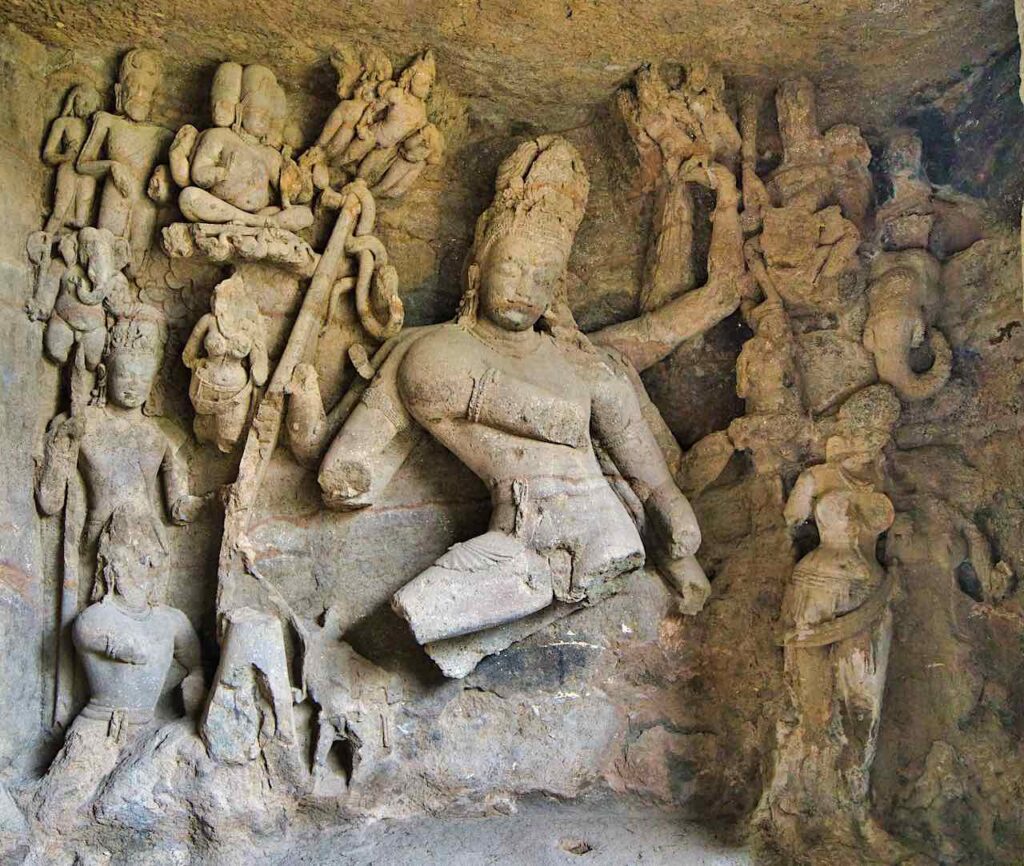
At the entrance to the cave, one is automatically drawn to the sublime panel depicting the famous pose of Nataraja, on the right side.
.
Nataraja – Lord of Dance
.
On the northern entrance – on right side. (Mentioned at Serial 10 in the diagram above). This represents the Tandava dance of Shiva. The niche is 13 feet (4.0 m) wide and 11 feet (3.4 m) high. The lower part of this statue is completely destroyed and only one of four hands remains. Shiva is depicted with eight arms, and with one of his right hands he is holding Agni, symbolizing creation and destruction; and the lower figure is a woman — it is now damaged — and on her left is a skeleton representing Death. On Shiva’s left is Parvati, who is dead but not yet disposed of, and above her head is Indra riding the celestial elephant Airavat, and on Indra’s right hand is Vishnu on Garuda’s shoulders. On Shiva’s right hand is Brahma, sitting on his throne carried by five swans, and in the corner is Ganapati.
.
Andhakasura Vadh

.
Shown at Serial 9 in the diagram. Facing the wedding panel, is seen Shiva, shown in his Bhairava (frightful) avatar, killing the demon Andhaka. Shiva is seen wearing a crescent and a necklace. He has eight arms, though this sculpture has undergone destruction and two of four hands and the lower half are missing. Yet, the rage in his expressions is evident with raised eyebrows swollen eyes and tusk. In his right hand he holds a sword, and in his left the body of the demon. In one of the other hands he holds a bowl in which to catch the blood with the cobra coiled around the hand.
.
Shiva-Parvati

.
Shown at Serial 9 in the diagram. This represents Shiva and Parvati seated together on a raised floor on Kailash mountain. Parvati is seated at the left of Shiva, and behind her right shoulder stands a nurse with Shiva’s son, Kartikeya astraddled on her left hip. On Parvati’s left stands a female figure, and farther off a larger male figure. Behind Shiva’s right shoulder is another female with a chamara, and at his feet is his faithful skeleton-appearance attendant and worshipper, Bhrinji. Directly under Parvati is the bull, Nandi, and on his left shoulder a face with wig appears to be Garuda. Shiv-Parvati are playing the game of dice. Shiva wears the crown, a ‘Janeu’ or the sacred thread that goes from left to right, and is dressed up till his knee. Parvati is dressed in fine accessories with her hair falling in front. Upset with the Lord, she looks away as she lost the game of chousar (dice). Unfortunately, this sculpture has undergone massive destruction, nothing much of anything remains, it has been identified by similar sculptures found in Ellora caves.
.
Kalyanasundara

.
Shown at Serial 7 in the diagram. This panel depicts the marriage of Shiva and Parvati, in which she stands at his right hand, a position which the wife occupies on the day of her marriage. She slightly inclines her head, with a bashful expression, and is supported by Himalaya, her father. At Shiva’s left is Brahma, who is the priest in the ceremony. Behind stands Vishnu. In his right hand he holds a lotus, and the back left hand a chakra. On the extreme right hand stands Mena, the mother of the bride, and the female figure over the bride’s head is, perhaps, Sarasvati. On Parvati’s right hand stands a female chamara bearer, and behind her is Chandra, the Moon god, bearing a pot of water for the marriage ceremony. Above Shiva’s head is a male figure between two females, and above them two smaller figures.
.
Ravananugraha

.
Shown at Serial 2 in the diagram. This panel represents Kailash, the abode of Shiva, on which are seated Shiva and his wife Parvati. The ten-headed Ravana, the demon-king of Lanka, gets under the mountain attempting to carry it to Lanka so as to have Shiva all to himself. Parvati, perceiving the movement, called to Shiva, “Some one moves the hill, we shall be overthrown.” On which Shiva, raising his foot, pressed down the mountain on Ravana’s head, and trapped him under it for ten thousand years. Understanding what he did, Ravana starts to sing songs praising Shiva after which he is forgiven and freed. You will notice that Ravana, who has twenty arms, and a sword is stuck in his waist-band, sadly, his heads are entirely obliterated, and only a few of his twenty arms are traceable. Above Shiva are numerous figures, one appears a skeleton probably one of his ganas (attendants), and on his left is Vishnu on Garuda, while in the recess is Parvati’s tiger, couched on his paws. Near Shiva’s feet is Bhrinji, the skeleton, and on his left is Ganesha. All these figures are more or less defaced.
.
Yogishwara – Lord of Yoga

.
At the northern entrance on left side – opposite the Nataraja panel. Shown at Serial 1 in the diagram. Shiva is sitting in padamasana, the lotus pose of yoga in the Himalayas, supported by Nagas or snakes. His eyes are closed and distant – deep in meditation after the death and loss of his first wife Sati.
Sati killed herself as her father disrespected and didn’t honour her husband Shiva. Ashamed of her father’s act she remembered her husband and prayed to Aadishakti to burn her body, to be reborn to the father who she could respect. She was later born as Parvati, who Shiva remarries. Shiva became angry after Sati died and performed the Tandava with Sati’s charred body on his shoulder. Shiva’s Rudra Tandava would lead the world to destruction and Vishnu had to intervene by cutting Sati’s body into pieces with his chakra.
Surrounding Shiva are divinities in the sky and attendants below. There is a plantain tree, and above it is Vishnu on Garuda’s shoulders; above that, again, is a small figure on horse-back, who is Kartikeya, Shiva’s second son. At Shiva’s right hand top corner is Brahma sitting on his throne, carried by five swans. There is the faceless figure of the Moon carrying a water container. There are three identical figures of a male flanked by two females, and the skeleton of a sage who came to calm Shiva suffer destruction too.
.
Gangadhara

.
To the right of the Trimurti is another beautiful panel, broken in pieces, telling the story of holy river Ganga descending to earth from Shiva’s matted hair. It is shown at Serial 6 in the diagram. The carving is 13 feet (4.0 m) wide and 17.083 feet (5.207 m) high. This sculpture can be seen in many places across India. What makes this one unique is the three-headed female representing Ganga, Yamuna, and Sarasvati on top of Shiva’s head. On the left hand side of Shiva is Brahma sitting on his throne carried by five swans, and to the left of Brahma is Indra, who is King of the Firmament, riding on his celestial elephant Airavat. On the right top side of Parvati is Vishnu riding Garuda. The figures on each side represent divinities, and at the bottom are two dwarfs and two female attendants; the latter are on the left.
.

.
Ardhanarisvara
.
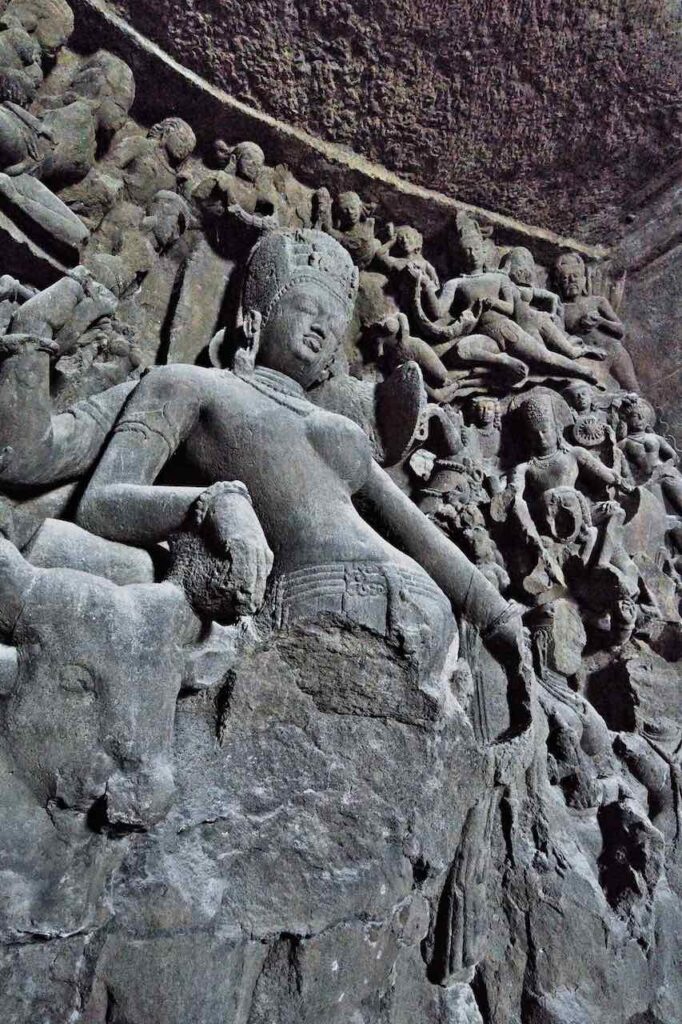
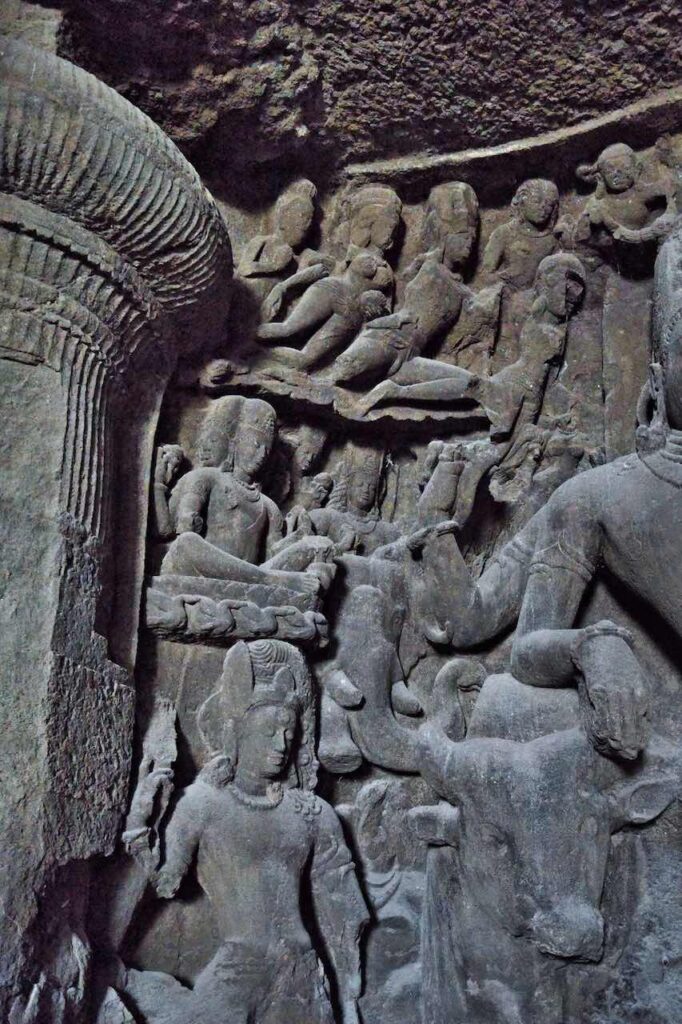
To the left of the Trimurti is probably the best sculpture, a masterpiece signifying men and women as complementary, whose existence remains incomplete without the other. ‘Ardhanarisvara’ literally means half-man-half-woman, split from down the middle. It is 16.75 feet (5.11 m) in height. Is is shown at Serial 4 in the diagram.
.
.
This figure has four arms ; namely, two of a male and two of a female. Ardhanarishvara sculpture is broken from below the legs. Shiva is on the right (left to the viewer), whose one hand is on Nandi. Parvati is on the left (right to the viewer), depicted in a delicate feminine pose. She holds a looking mirror in one hand. Details of both Shiva-Parvati are rendered in respective halves. On the left hand side of Shiva is Brahma, sitting on his throne carried by five swans; in the recess is Indra, the King of the Firmament, who is riding on the celestial elephant Airavat. On the right hand side is Vishnu, sitting on Garuda, or Suparna, the king of the feathered tribes, half eagle and half man, and the small figures which you see above represent divinities. At the bottom on the right hand side are two females, one with a mirror in her hand, and the other with a cow’s tail fan.
.
Sadashiva – Trimurti
.
The 6.1-metre-high (20 feet) masterpiece “Sadashiva” (Trimurti) dominates the entrance to the main cave. It is considered a ‘masterpiece of Gupta-Chalukyan art’ and it is the most important and impressive sculpture in the cave. It is shown at Serial 5 in the above diagram. The vastness of this figure is intimidating. The sculpture excludes calmness and serenity, which permeates those watching it, it was easily experienced when I stood before the celestial sculpture. It’s the only sculpture that has not suffered much in terms of destruction. This sculpture actually is a Panchmukhi Shiva, depicting the five facets of his nature. The bust is misunderstood as a Trimurti as only three faces are visible.
.

.
The sculpture represents three aspects of Shiva: the Creator, the Preserver, and the Destroyer. Aghoraor Bhairava or Rudra (left half), is shown as a young, moustached man, holding a snake and filled with rage – a symbol of destruction; Taptapurusha or Mahadeva (central full face) is soothing, meditative, a yogi praying for the preservation of humanity, he is master of positive and negative principles of existence, holding a pomegranate in his left hand, which signifies creation; and, Vamadeva, resembling Brahma (right half), depicted as young, lively, with sensuous lips carved to show a slight smile, holding a lotus in the hand – a symbol of preservation.
.

.
The Trimurti was also the royal insignia of the Rashtrakutas.
.
Shiva shrine

.
This shrine has a door on each side of it, four in all, and two dwarapalas to each. In the centre of the garbh griyah stands a base, in the centre of which is placed the Linga. This symbol representative of Shiva as the male energy, or source of the generative power in Nature. There are two holes in the upper and lower part of each door, sockets for door-posts to fit in. When this temple was in use, DeCouto tells that the four gates of this shrine were never opened, except once a year, on the day of the greatest festivity on the festival of Shivaratri. The shrine is shown at Serial 8 in the above diagram.
.

.
East Wing
.

.
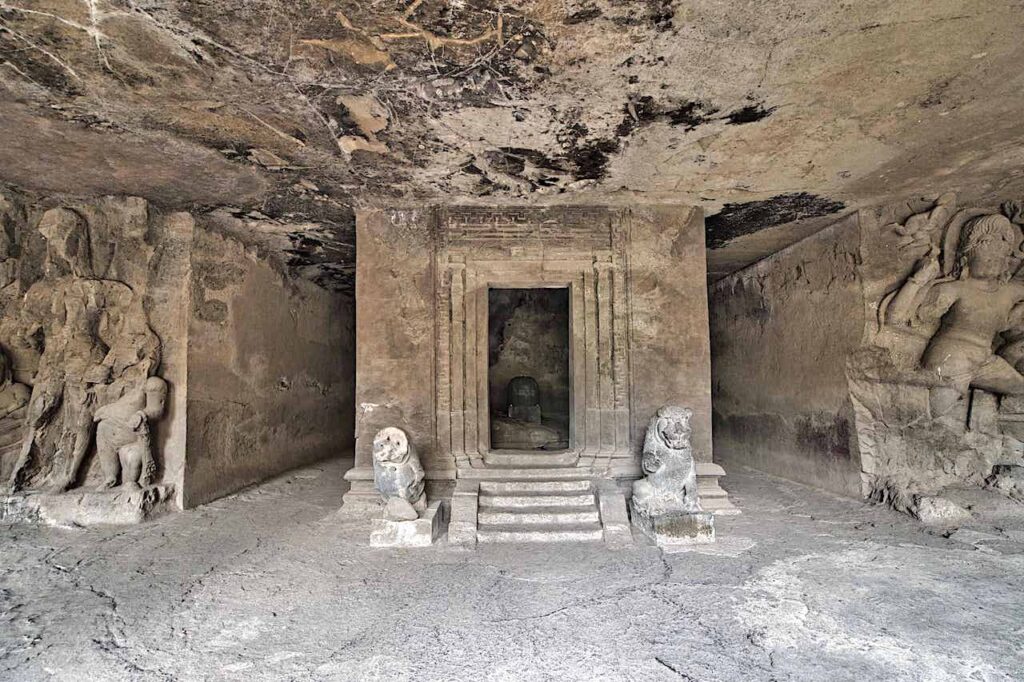
On the circular platform in the courtyard in front of the Eastern shrine steps was originally placed a stone Nandi, which always faced the Linga shrine in the Main Cave. It is now missing. These are called East-wing Caves. The smaller Shivalinga shrine in the East Wing is guarded by two animals, representing a seated lion with a raised forepaw; they are not part of the solid rock, but were sculpted separately. One lion is totally disfigured.
.


.
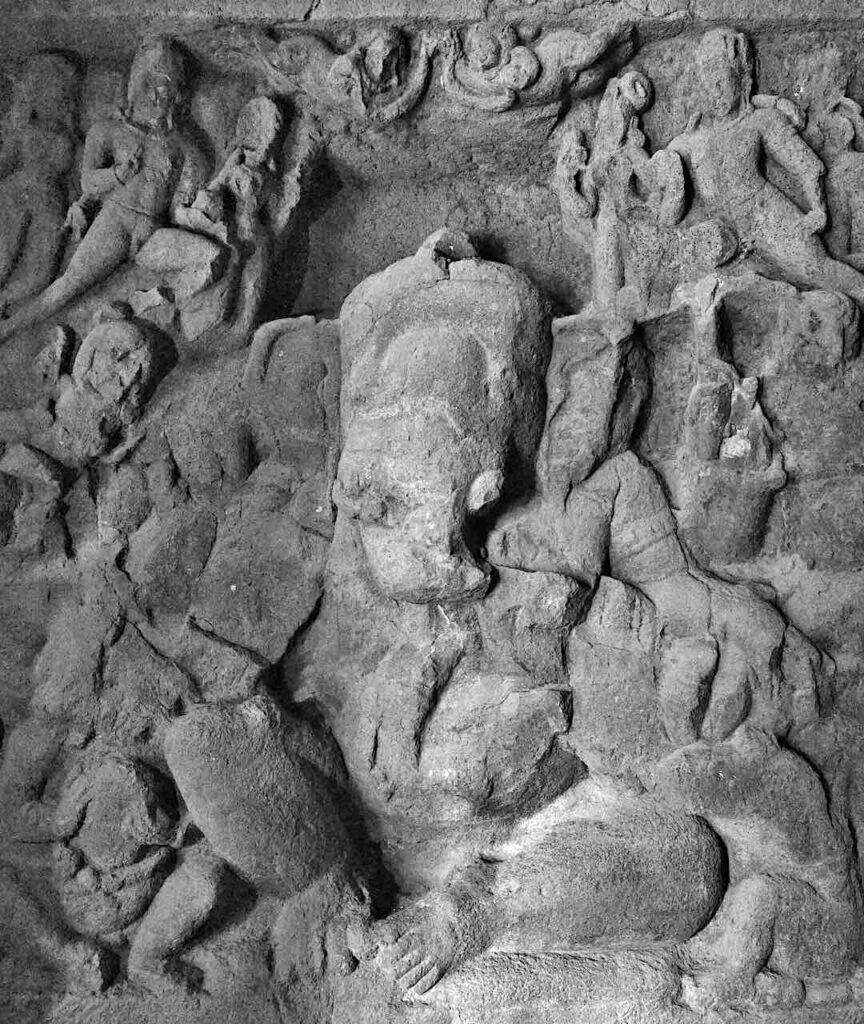
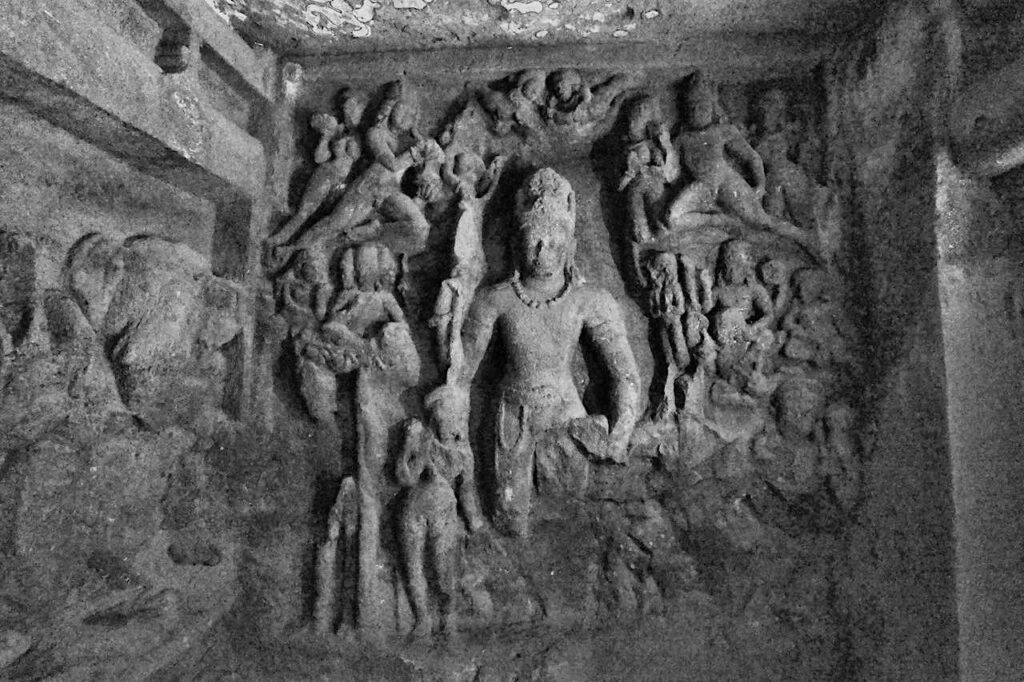
On the right of the entrance hall is the Ganesha panel. He is sitting on the South side, and the eight figures represent sapt matrikas protecting him (the eighth is Parvati). The panel at the north end is Kartikeya; on his right is depicted Brahma, and on Brahma’s right is Hanuman. On Shiva’s left is Vishnu on Garuda’s shoulders.
.

.
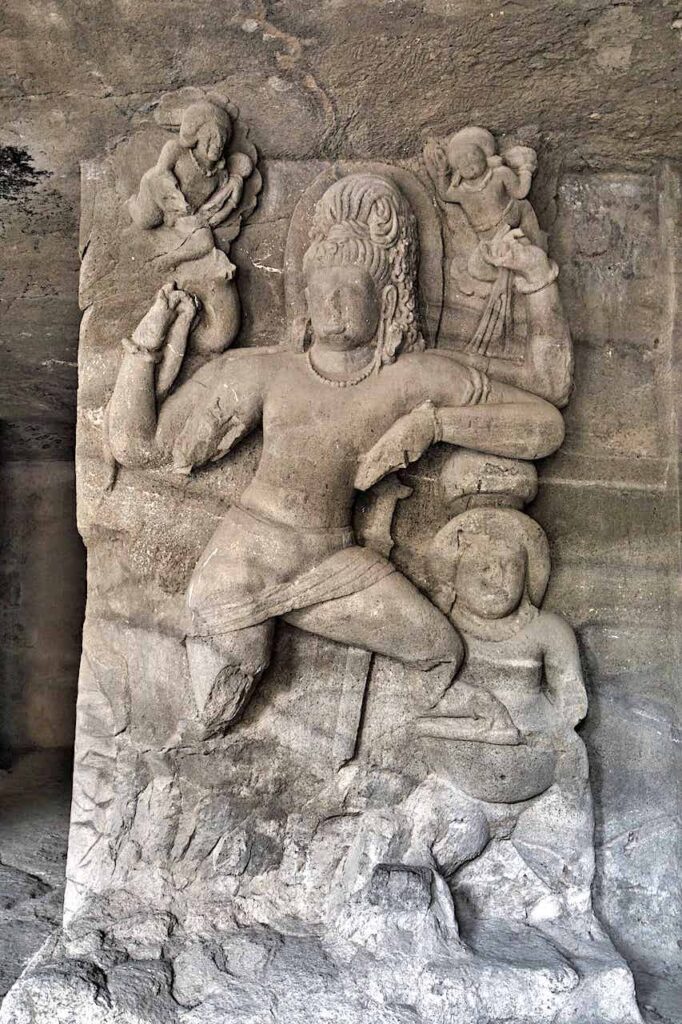
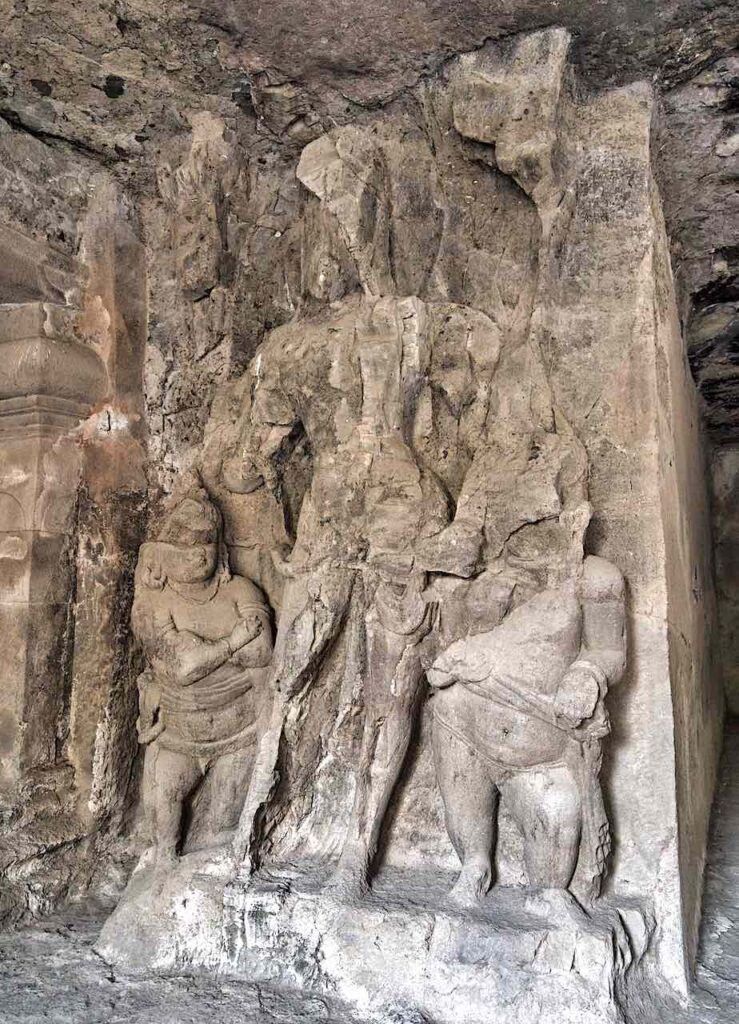
The sanctum door has Shaiva dwarapalas, the door-keepers, each with two attendant dwarfs.
.
.
West Wing
.
.
The West Wing also has an underground cistern, which even today holds water considered holy and folklore traces its source to the Ganges River.
.

.
The centre room is a Linga shrine, with a dwarapala on each side of the doorway, each with their attendants. At the north end is Shiva depicted as Yogishvara, seated on a lotus throne, supported by figures. To the right of Shiva is a seated figure, and above is Brahma with three faces and some other forms. To the south of the Linga door Shiva is seen with six arms, and the third eye in his forehead. In the front right hand he holds a cobra, at his right is a plantain tree, and above is Brahma on his lotus seat borne by the swans. On Brahma’s left is a male riding on a bull.
.

.
Cave No 2
.
.
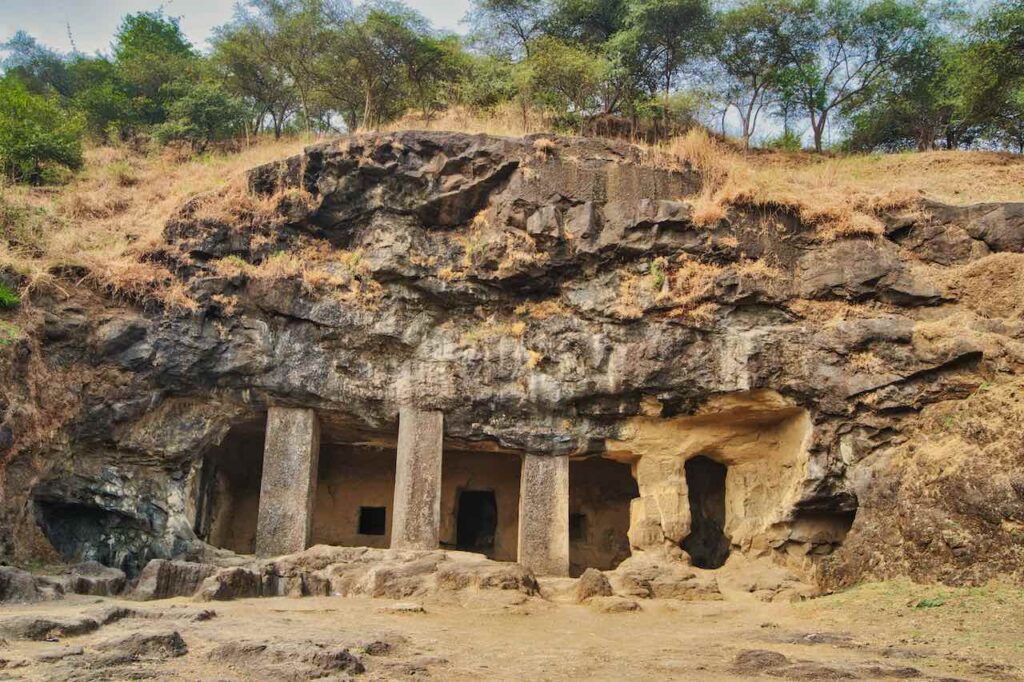
Cave No 2 is located to the south-east from the Main Cave. It is facing east, with a shrine in its northern end. The portal of the cave is destroyed, the interior has been damaged by water. The irregular shrine is supported by 4 eight-cornered columns and 2 demi-columns. Traces of sculptures remain but most of the previously rich artwork has perished.
.
Cave No 3
.
.
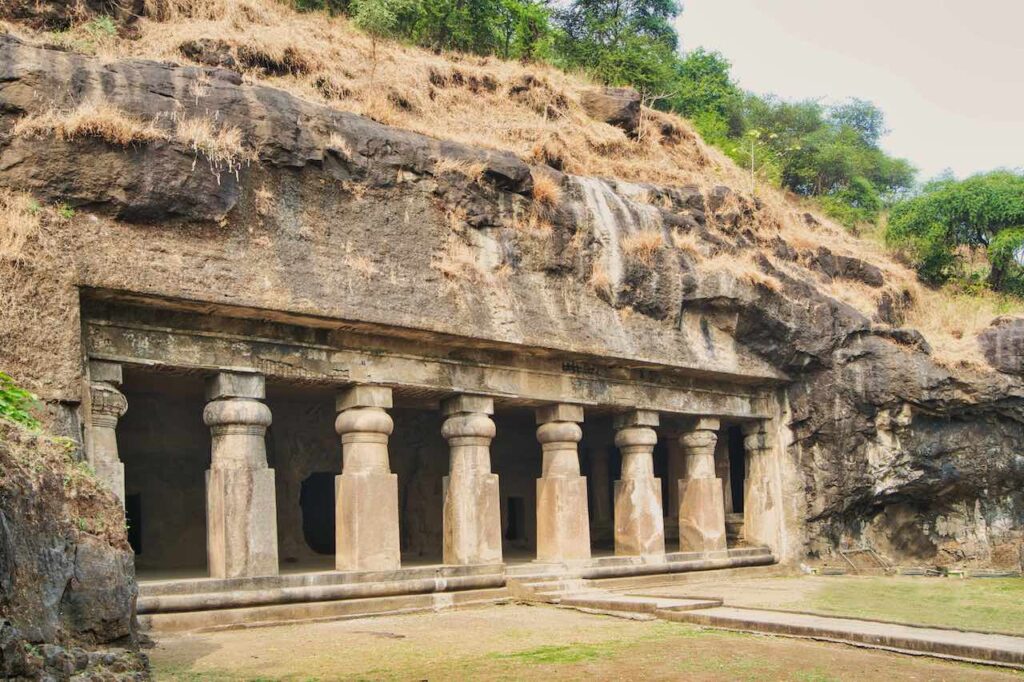
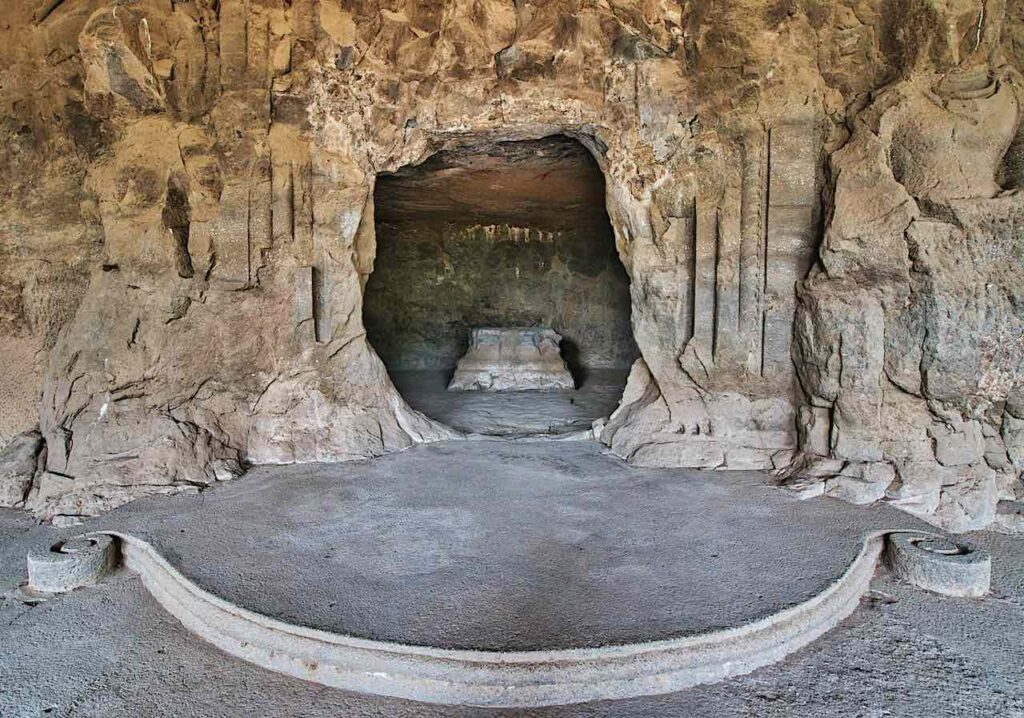
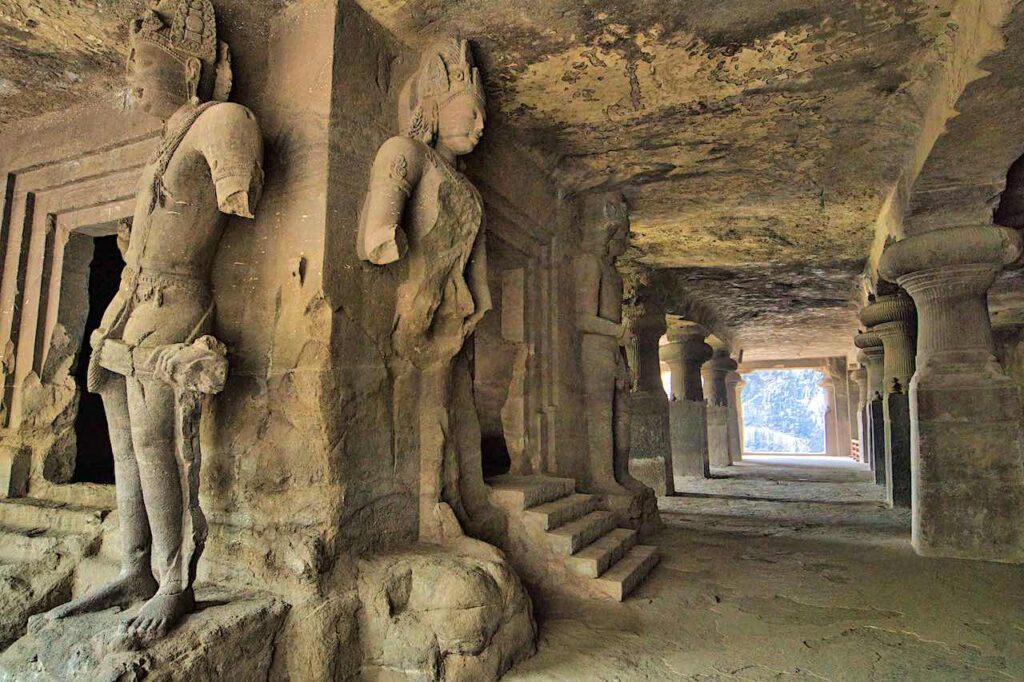
A little further to the south there is Cave No 3. The cave has been restored to a large extent and the pillars in the front of rooms have been preserved; however, sculptures of door-keepers of the shrine are nearly destroyed. The cave has a portico with six pillars. The portico is 26 m (85 ft) long and 11 m (36 ft) deep and is supported by the reconstructed pillars. At the back of the portico are three chambers.
.
.
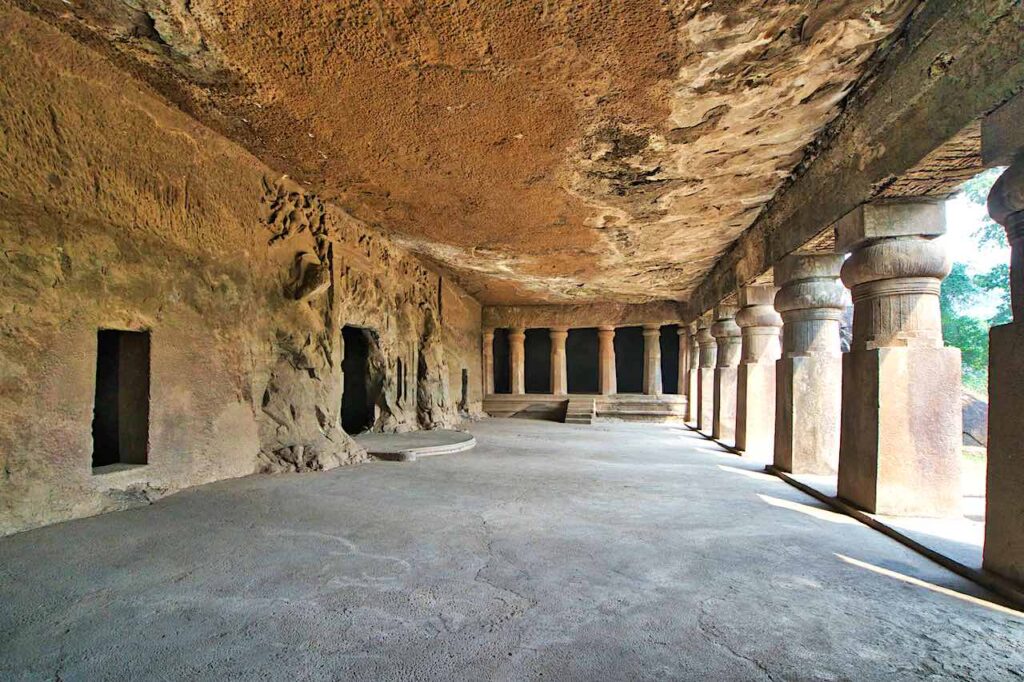
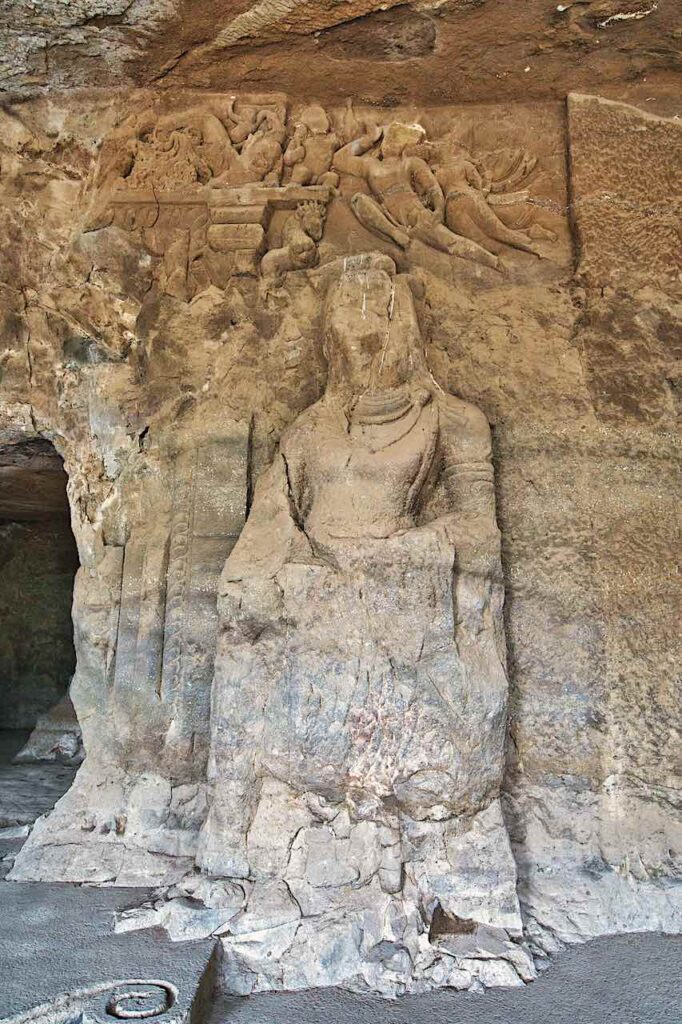
The central door at the back of the portico leads to a damaged shrine, the sanctum seems to be for a Linga, but that is missing. The shrine is a plain room 6 m (20 ft) deep by 5.7 m (19 ft) wide with a low altar. The shrine door has some traces of sculpture, but these are mostly defaced/mutilated.
.
.
The dwarapalas on each side, leaning on dwarfs with flying figures over the head, are now in fragments. There are two other chambers, one on each side of the shrine used for meditation.
.

.
Near the caves, in earlier times there had been found some sculptures – one of them was a large sculpture of a horse which disappeared in the middle of the 18th century. Probably taken away by the British secretively.
.
Cave No 4
.

.
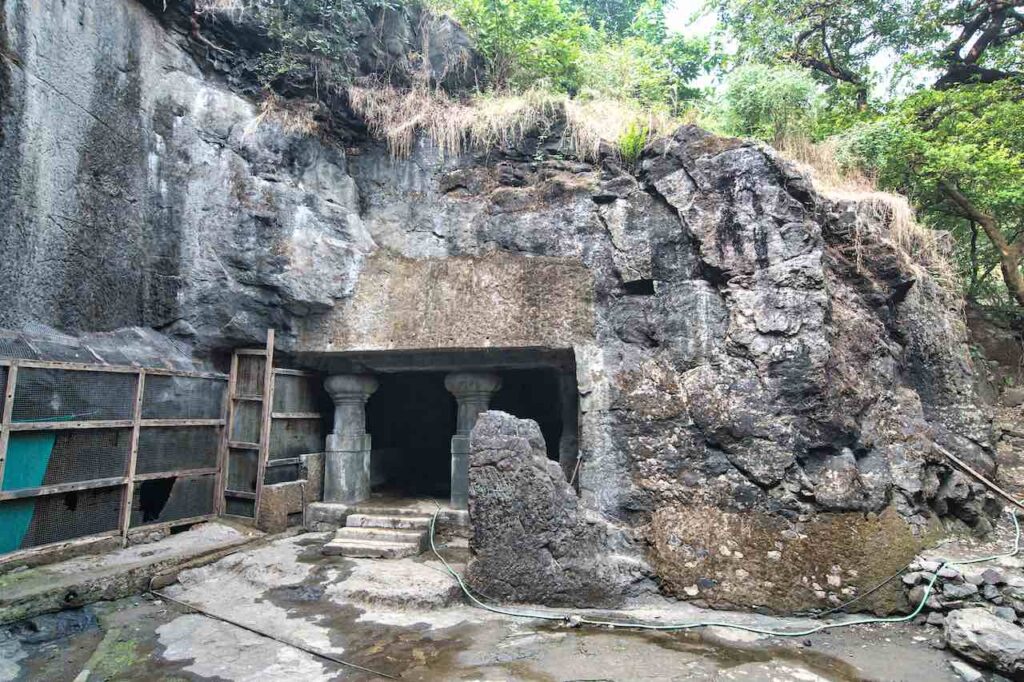
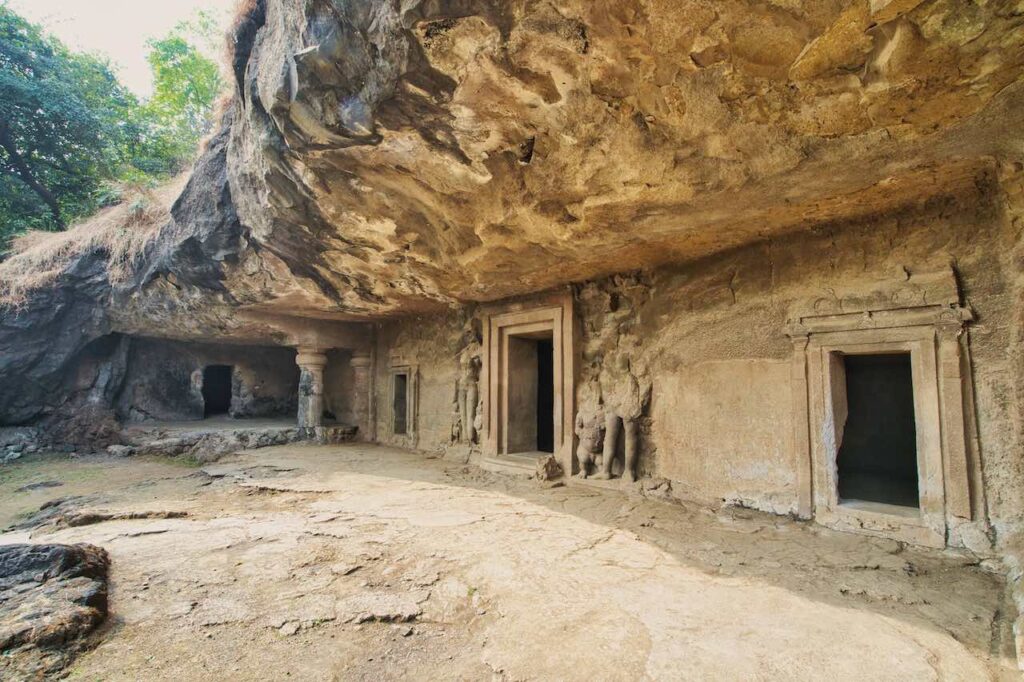
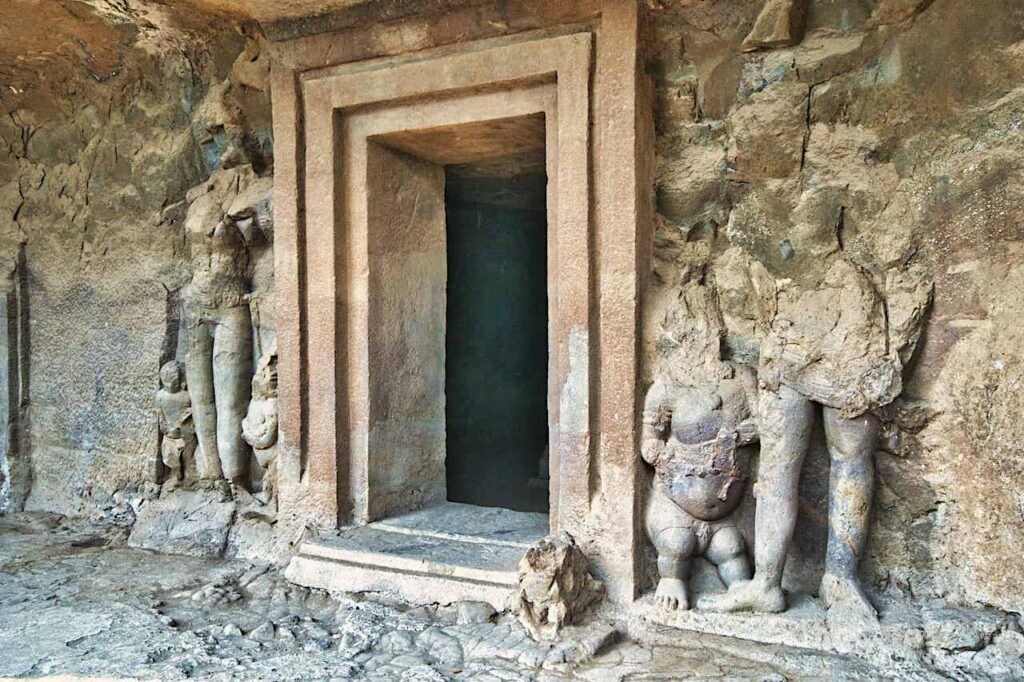
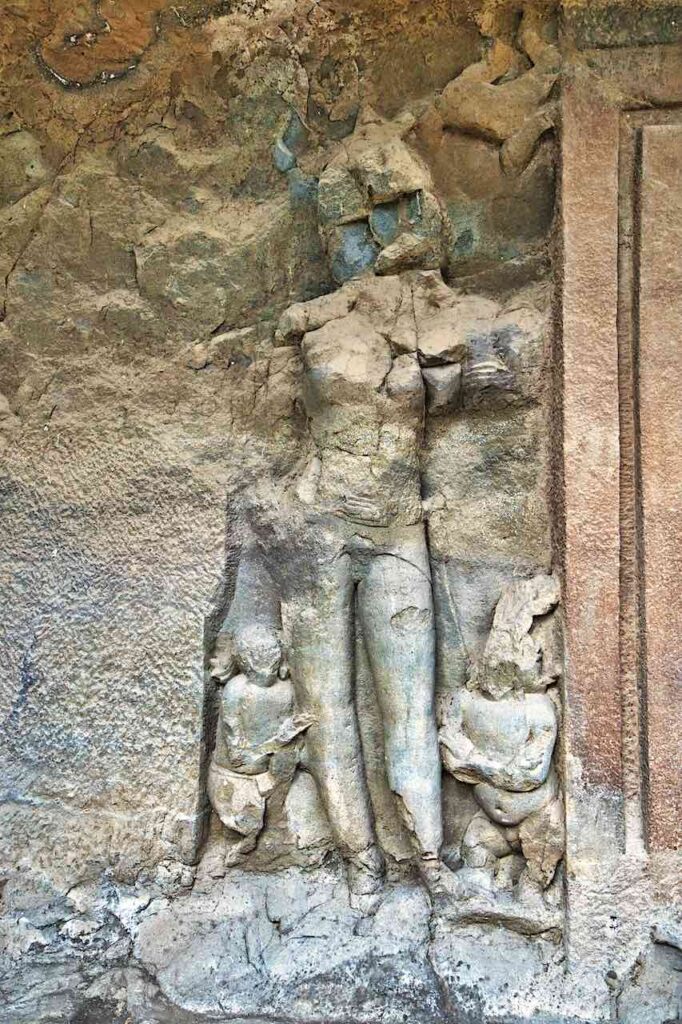
Cave No 4 is in a damaged condition, the large verandah lacking all its columns. The remains show that the cave was once a Shaiva temple as well. The shrine in the back contains a lingam. There are also three cells for meditation and a shrine at each end of the verandah.
.

.
The shrine doorway has been reconstructed and the dwarapalas have hardly survived mutilation.
.
Cave No 5
.
.
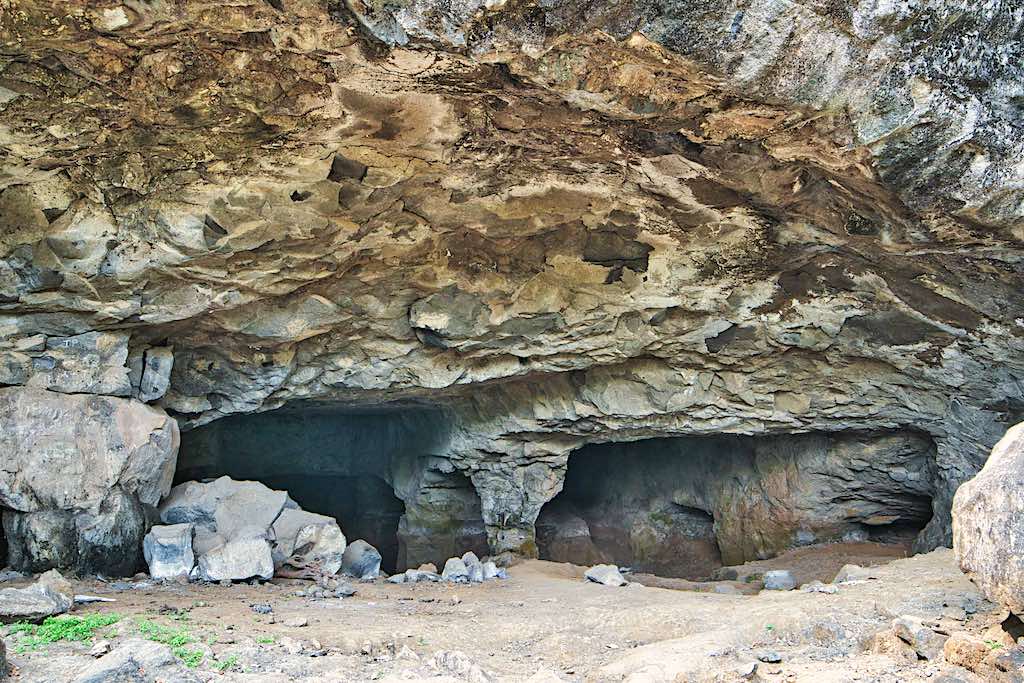
The last small cave along the row is Cave No 5 with veranda, which was been abandoned soon after the start of construction. It has no artistic remains.
.
In 1870 a small seal for a ring was found at the excavations on the east side of the island. It is an oval light ruby coloured cornelian 0.435 inch long by 0.35 inch broad, the length of the face 0.40 and its breadth 0.28 inch, on this is sunk an ellipse 0.37 by 0.26 inch, inside which is sunk characters that stamp the word Narayana in letters of the 5th or 6th century CE. It is now in possession of Dr. Bhau Dage (at the time of writing – 1901).
The island also has other remnants of buildings and artwork scattered across – after all this was a capital city in ancient times.
.
.
Development & Climate Change Warnings
.
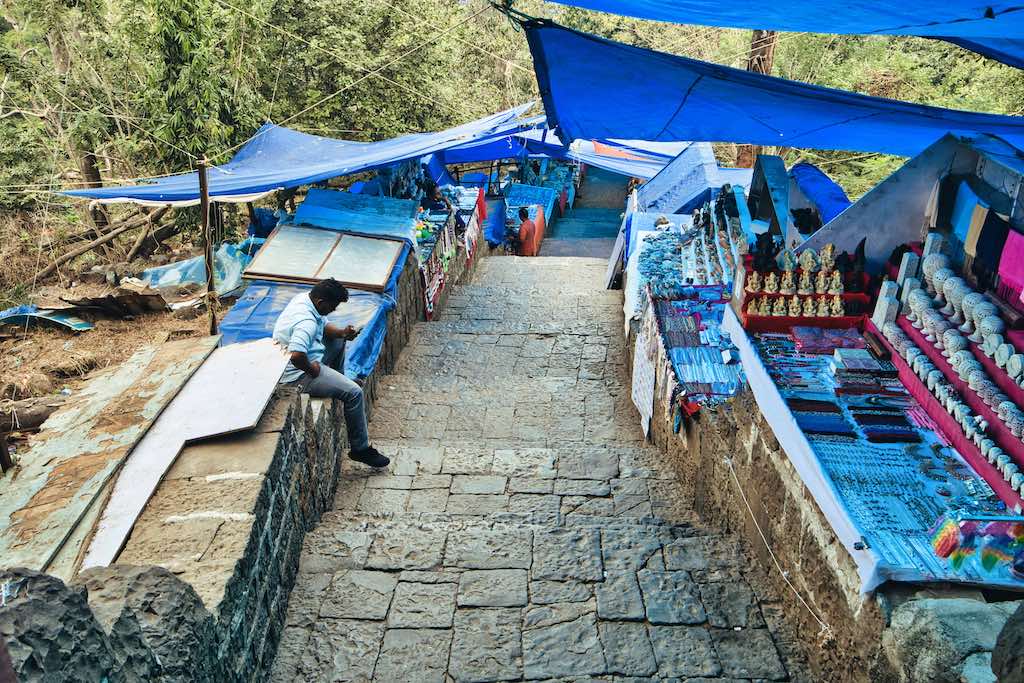
In recent years, the government has adopted several measures to boost tourism to the Elephanta Caves. The Mumbai-Elephanta Caves ropeway project has been planned to connect Mumbai and Elephanta Island via a ropeway system will reduce travel time between these destinations to only 14 minutes instead of an hour. The island was also electrified by an undersea cable as recently as 2018. Although such arrangements are expected to boost tourist footfall on the island in the near future and also raise the living standards of the Islanders, human-provoked nature’s wrath in the form of climate change, an acknowledged reality, might make the island inaccessible to all in the distant future.
.
.
According to projections, sea levels along the coast of India will rise varyingly by 3.5 inches to 34.6 inches by 2100. Mumbai is predicted to be one of the first victims of climate change in the country. Elephanta Island too will not be spared. Rising sea levels and the increased frequency of extreme weather events will not only cause great loss of lives and property in coastal Mumbai but also on its offshore islands including the Elephanta.
Currently, saline activity and general deterioration of rock surface are affecting the caves.
.
.
In Literature
.
In her 1834 poem The Caves of Elephanta, Letitia Elizabeth Landon laments the loss of the original spiritual purpose of this vast structure, so that now: ‘The mighty shrine, undeified, speaks force, and only force, Man’s meanest attribute’.
The Elephanta Caves are mentioned more than once in Herman Melville’s Moby Dick, and also feature in Somerset Maugham’s 1944 novel The Razor’s Edge.
.
.
References
.
- Elephanta Caves: UNESCO World heritage List https://whc.unesco.org/en/list/244
- Elephanta – World Heritage Series by MK Dhavalikar (Archaeological Survey of India) https://archive.org/details/elephanta00dhav/page/6/mode/2up
- The Rock Temples of Elephanta or Gharapuri (1871) by James Burgess https://archive.org/details/rocktempleselep00burggoog/mode/2up
- Elephanta Caves – Wondermondo: Wonders of the World https://www.wondermondo.com/elephanta-caves/
- History of Elephanta https://elephanta.co.in/history-of-elephanta
- Elephanta Caves https://en.wikipedia.org/wiki/Elephanta_Caves
- History of Mumbai https://en.wikipedia.org/wiki/History_of_Mumbai
- Forms of Shiva at Elephanta Caves & the Stories they Tell https://www.inditales.com/forms-of-shiva-at-elephanta-caves-mumbai/
- The Mystery behind the Shadows of Elephanta Caves https://www.makeheritagefun.com/the-mystery-behind-the-shadows-of-elephanta-caves/
- Climate Change: A Threat to World Heritage Sites https://www.worldatlas.com/news/climate-change-a-threat-to-world-heritage.html
- Elephanta caves: Celebrating Shiva https://www.livehistoryindia.com/story/monuments/elephanta-caves
- History of Elephanta caves (Gharapuri) by Captain WT De Burgh, Superintendent of Elephanta Caves, 1901 https://archive.org/details/b28710939/page/n1/mode/2up
.


12 Responses
Tremendous effort. Next time I visit Elephanta, I will go armed with your blog! Thank you for all your hard work. 🙏
Thank you for the comment. The caves are so magnificent.
I saw the caves in 1974 on a school trip from Delhi. And I have vivid memories of the magnificence of the sculptures and the caves. But with all the information from your blog now a visit would give an entirely new perspective. Painstaking effort 🙏🏼
I have also realised, that most earlier visits were as a “tourist”. There is so much history buried beneath the surface!
Amazing effort and a brilliant write-up. Transported my mind to the place. If only I could see it in its glory before the destructions…..in any case sir i look forward to your book filled with such stuff.
Alas, most of our destroyed heritage is not going to return. Nor can it be recreated. But the remnants does give a glimpse of the magnificence of the original.
Excellent work Ajai. Great details and wonderful photos. Now I need to revisit Elephanta with your blog as a guide. Hope one of these days you can give audio/video version of your blogs so that one can follow your steps and appreciate such minute details. Thanks.
Thanks.
I remember visiting Elephanta caves as a child many many years ago. It was so refreshing to visit it again through your lenses. very well written article and pictures.
Thank you for appreciating the write up.
I remember the image of Trimurti on a postage stamp affixed to letters from India which we received in Kenya. I grew up there, but was fascinated by the calmness portrayed in the image. To visit these caves is on my bucket list.
Thank you for the in depth explanation and description of cave features.
Thank you for going through the blog. Its one of the mostly unknown gems of our past! Must visit.