
पुराणमित्येव न साधु सर्वं न चापि काव्यं नवमित्यवद्यम्। सन्तः परीक्ष्यान्यतरद्भजन्ते मूढः परप्रत्ययनेयबुद्धिः॥ Kālidāsa, Mālavikāgnimitram
Not everything is good merely because it is ancient, nor is everything to be condemned merely because it is new. The wise examine and accept what is worthy; the foolish rely only on the opinions of others.
.
.
Introduction
.
.
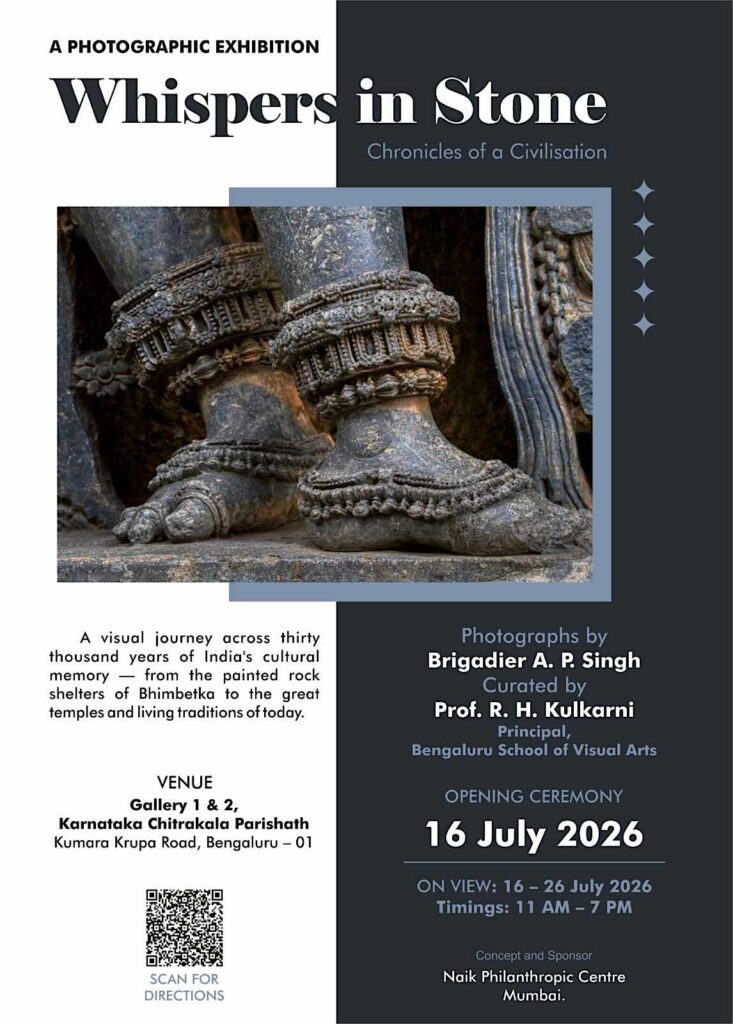
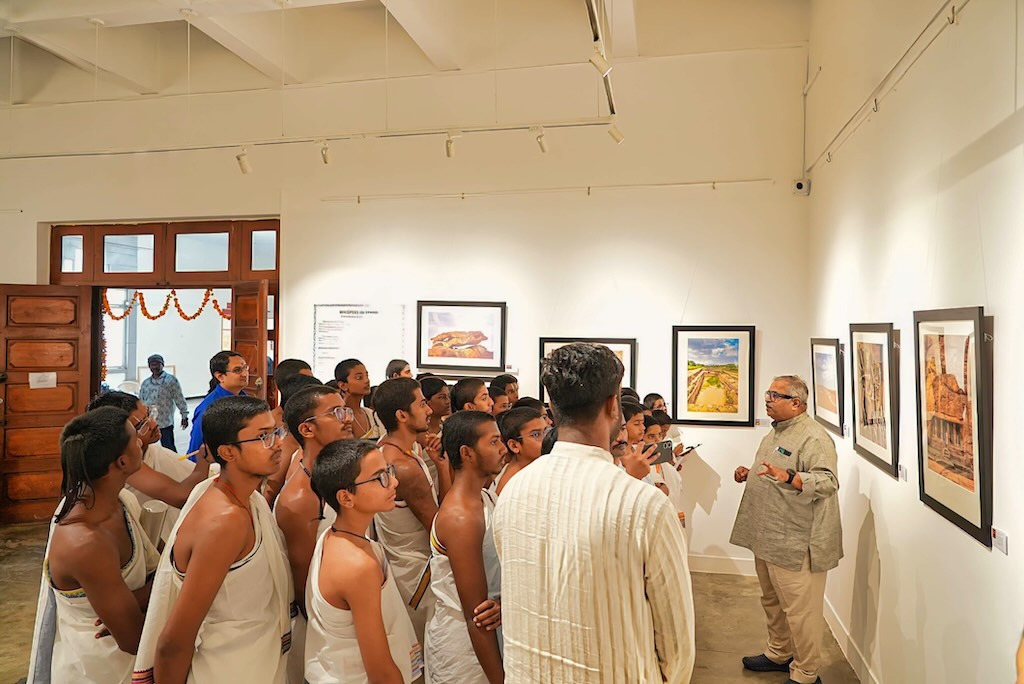
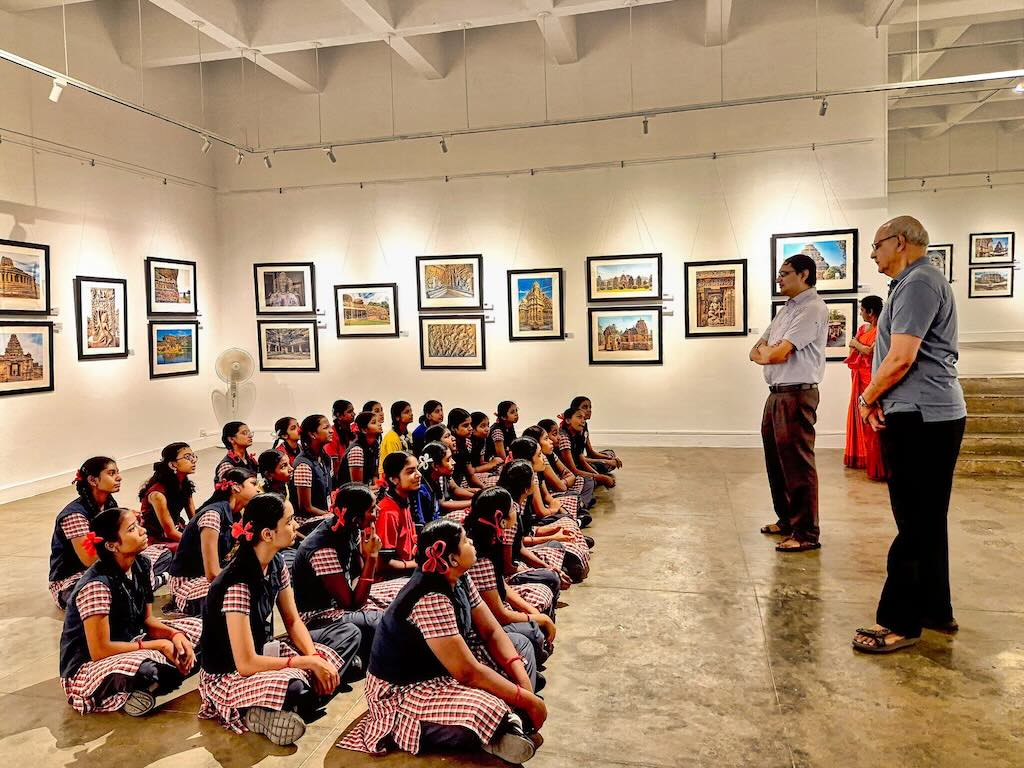
On the morning of 20 July 2026, a group of boys in crisp white dhotis walked into Gallery 1 at the Karnataka Chitrakala Parishath, sat down cross-legged on the gallery floor, and began to chant. They were students of the Om Shanti Dhama Veda Gurukula, a Veda Pathshala roughly 90 km from Bengaluru, and they had travelled that distance to see my photography exhibition.
.
.
Before they looked at a single print, they recited hymns from the Yajur Veda, their voices filling a white-walled room built for looking, not for sound. Around them hung photographs of temples and rock-cut shrines built by people who, three thousand years apart, might have chanted something not unlike this. For a few minutes, ancient word and ancient stone were in the same room at the same time.
.

To protect your personal data, your connection to YouTube has been blocked.
Click on Load video to unblock YouTube.
By loading the video you accept the privacy policy of YouTube.
More information about YouTube’s privacy policy can be found here Google – Privacy & Terms.
.
That moment captured something I had hoped for when I set out to build Whispers in Stone – Chronicles of a Civilisation, but could never have staged myself: proof that the past isn’t as far away as it looks from a classroom desk.
.

.
A Ladakh Road Trip, and an Idea That Wouldn’t Let Go
.
.
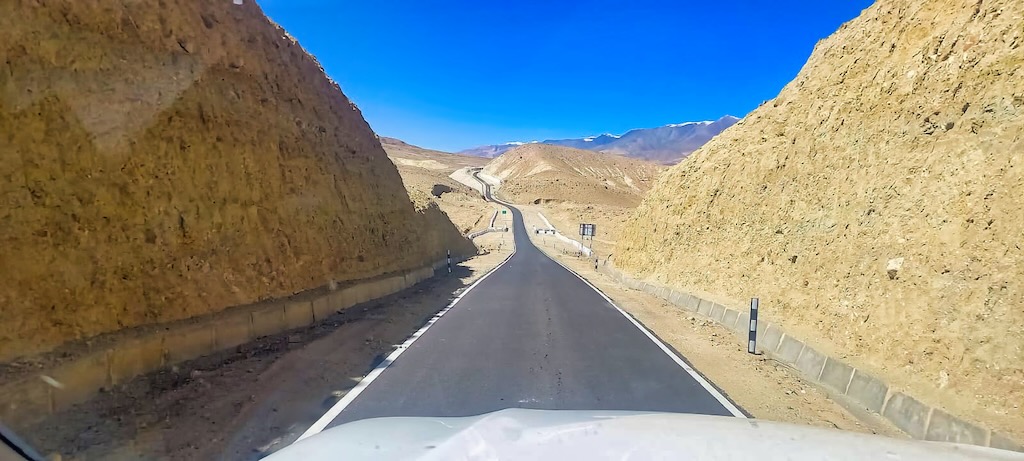
Every exhibition needs a spark, and mine came from an unlikely place: the high, empty passes of eastern Ladakh, in 2025, four friends on a road trip visiting India’s northern frontiers. Lt Gen S. Ravi Shankar, Prof. Karthik N, Lt Cdr Vikram Naik and I spent long hours on those roads talking, and the conversation kept circling back to the same frustration: India’s civilisational story is enormous, and almost nobody encounters it as a single, connected narrative. Schoolchildren get fragments. Tourists get postcards. Scholars get monographs which nobody outside their field reads.
.

.
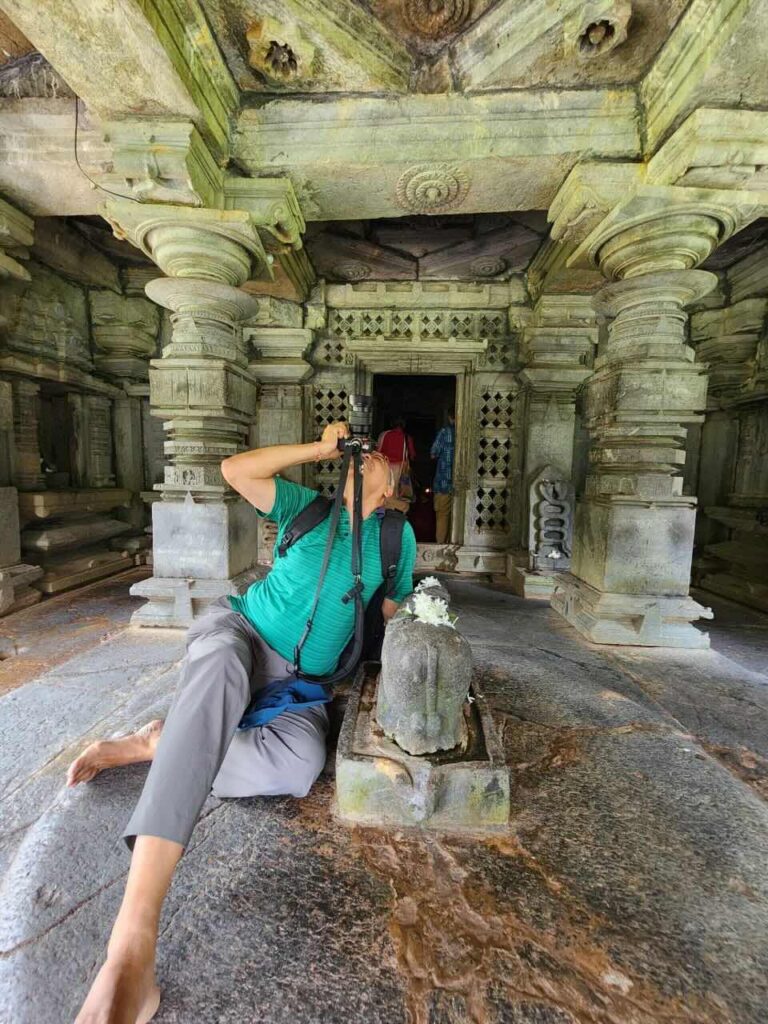
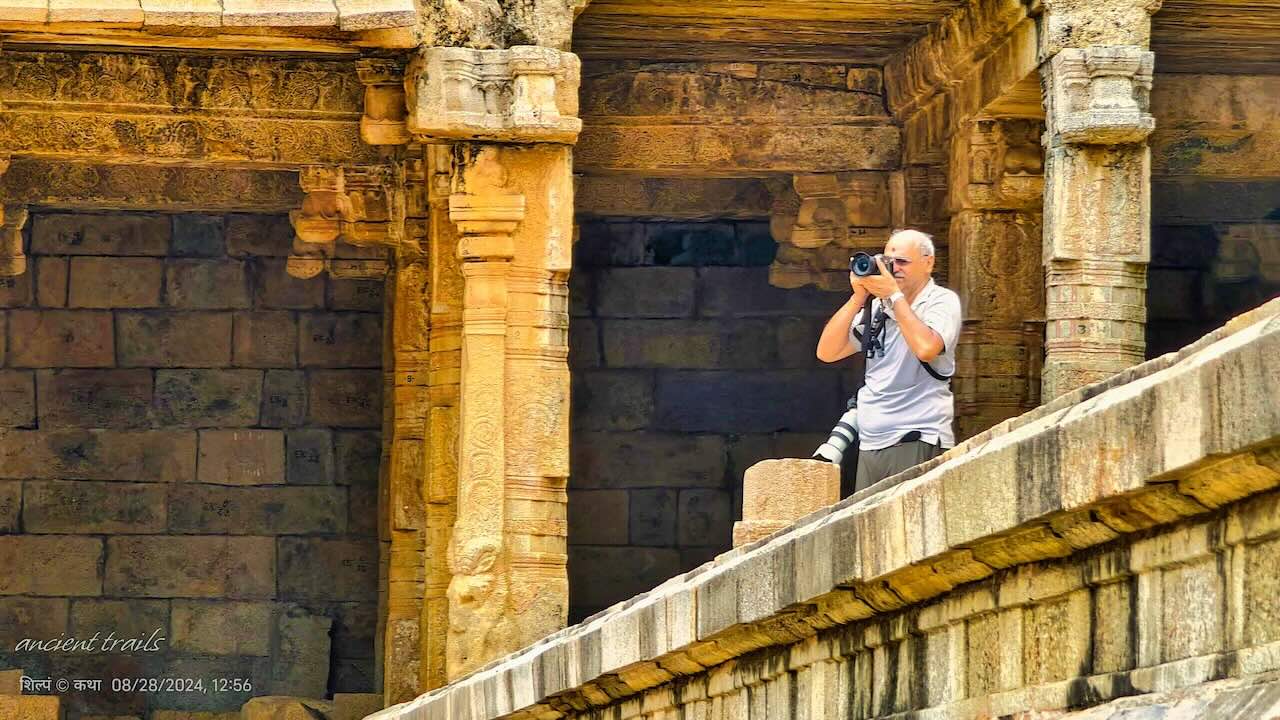
A decade and a half spent travelling and documenting India’s heritage
.

.
By then I had spent the better part of fifteen years photographing exactly this story, travelling to temples and rock-cut sanctuaries that most Indians will never see in person, and publishing the results as photo-essays on my website and two books.
.

.
Earlier that same year, Lt Cdr Naik and I, on another road trip across the southern part of India, had visited the Karnataka Chitrakala Parishath at Bengaluru and met Prof. R.H. Kulkarni, an art historian and an authority on South Indian temple architecture and currently Principal, Bangalore School of Visual Arts. I had been accompanying Prof Kulkarni on temple trips for over a decade. So when the idea of an exhibition came up on that Ladakh drive, the venue, in a sense, was waiting for me. Later, as preparations for the exhibition picked up momentum, Prof Kulkarni offered to curate it, which resolved any anxiety about how it would finally turn out.
.
.
What began as four friends talking on a mountain road became, over the following year, an exhibition with 74 photographs, a curator, an institutional home, and a sponsor in the Naik Philanthropic Centre, Mumbai. The four of us who dreamed it up on that drive did the unglamorous work of building it too.
.

.
What Visitors Actually Walked Through
.

.
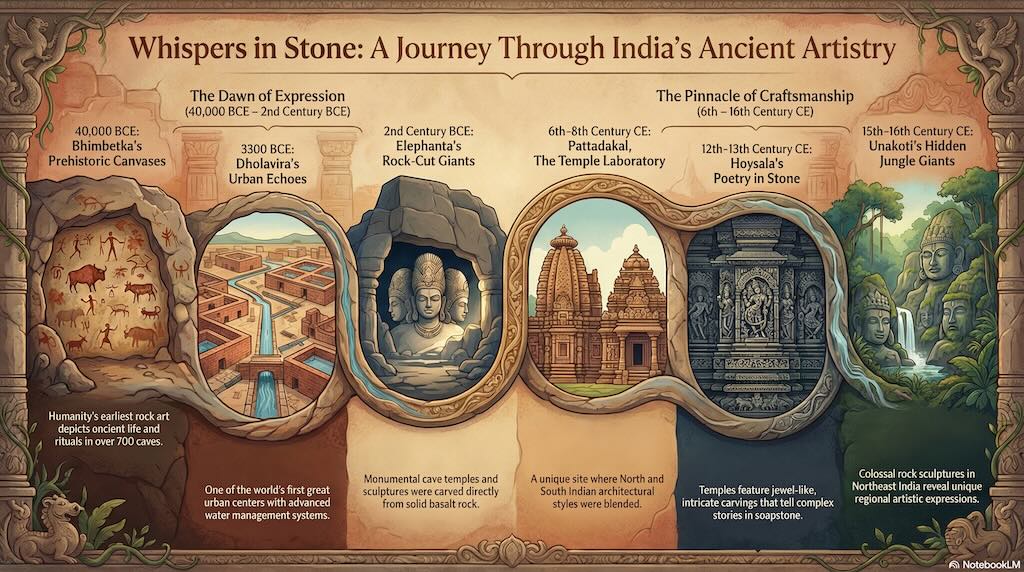
Here is the part that made Whispers in Stone more than a collection of beautiful pictures, at least to my mind: it was sequenced. Walk through the gallery from one end to the other, and you weren’t browsing 74 unrelated images. You were watching a civilisation evolve and teaching itself how to build.
.
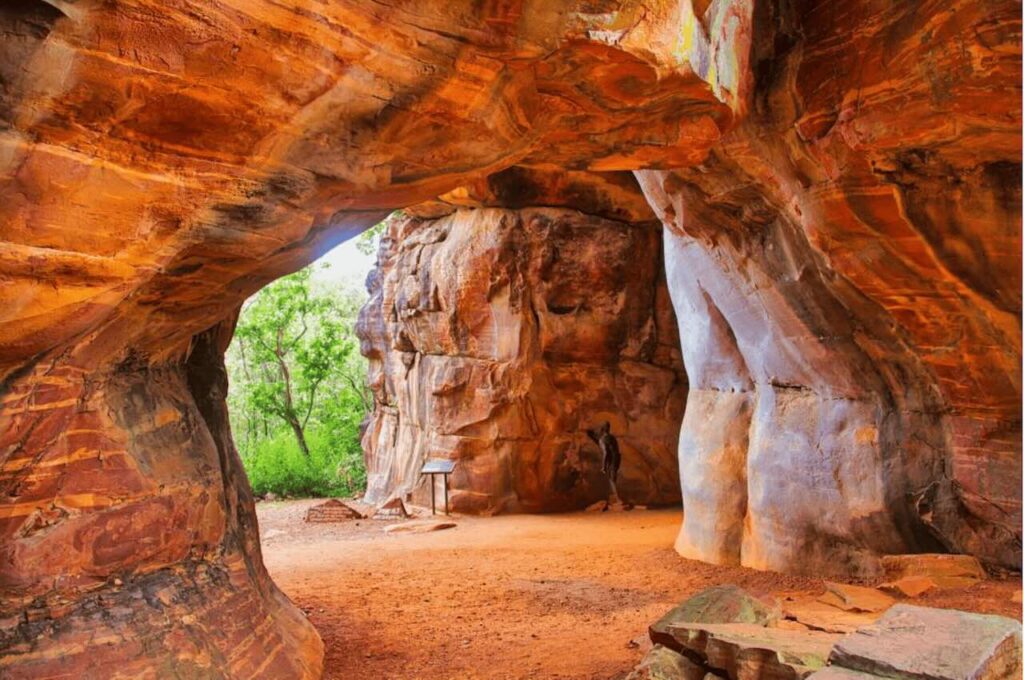
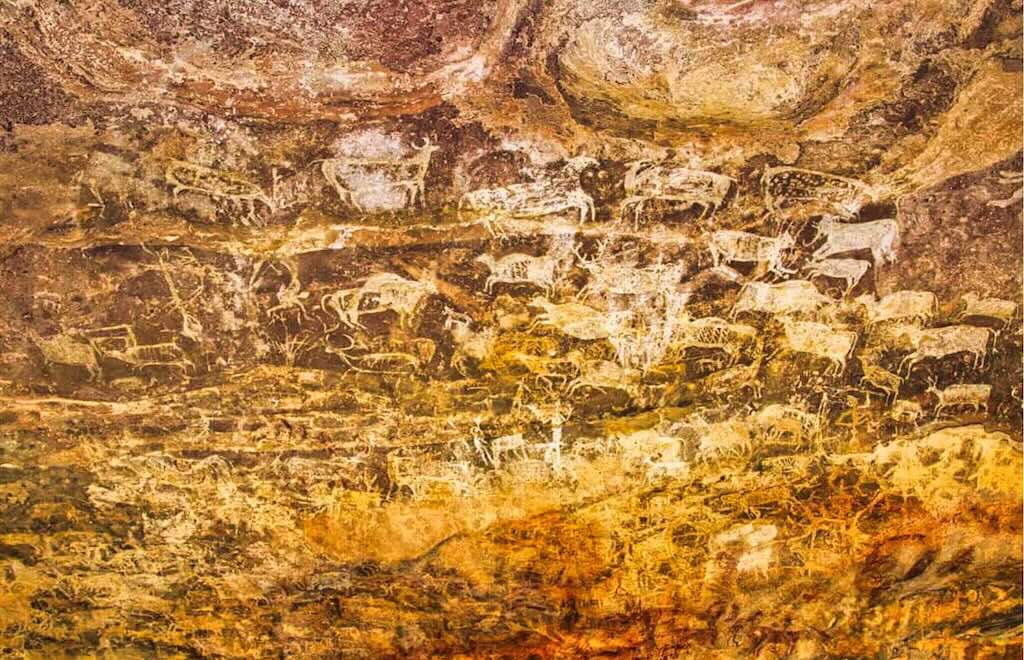
The journey starts from Bhimbetka, rock art dating to before 30,000 BCE documents the social and cultural life of inhabitants from that pre-historic era
.
It starts nearly 30,000 years ago. The first stop is Bhimbetka, in present-day Madhya Pradesh, where prehistoric artists painted on the walls of rock shelters long before anyone had thought of laying a single brick. From there the story jumps forward tens of thousands of years to the Indus-Saraswati Civilisation and its planned city at Dholavira, in Gujarat, where for the first time human beings weren’t just decorating rock; they were engineering settlements, with town planning and water management systems and a sense of order that still reads as startlingly modern.
.
.
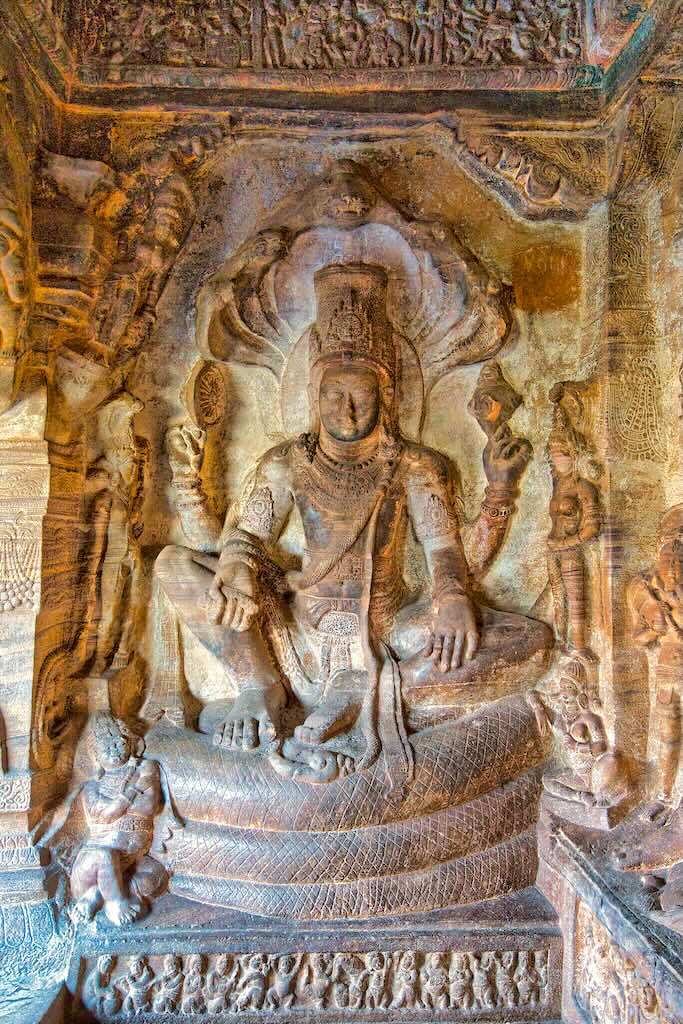
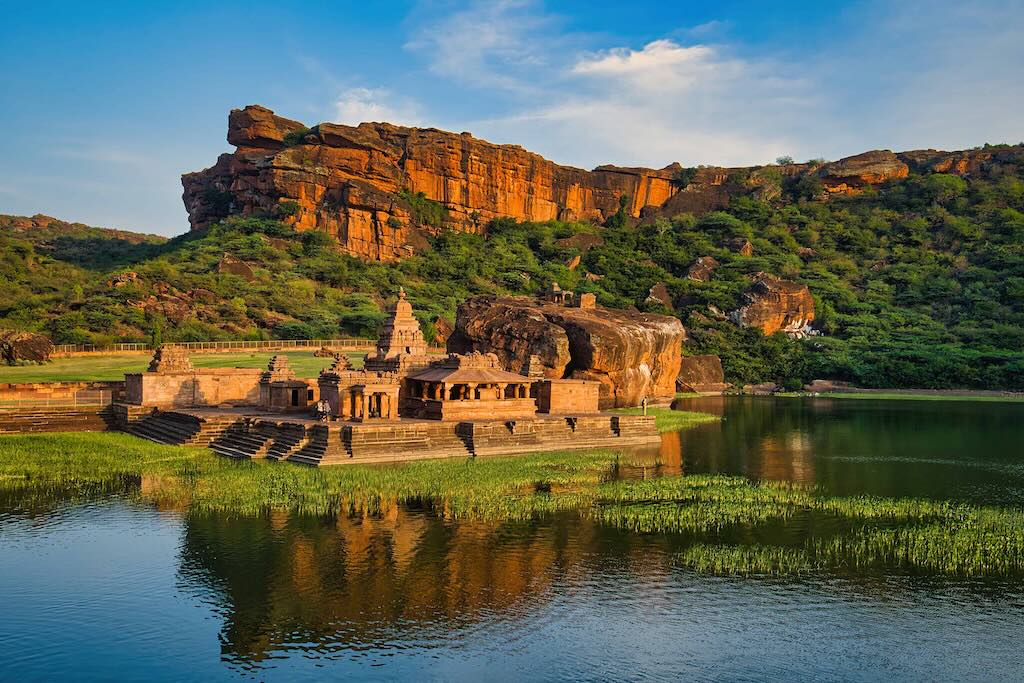
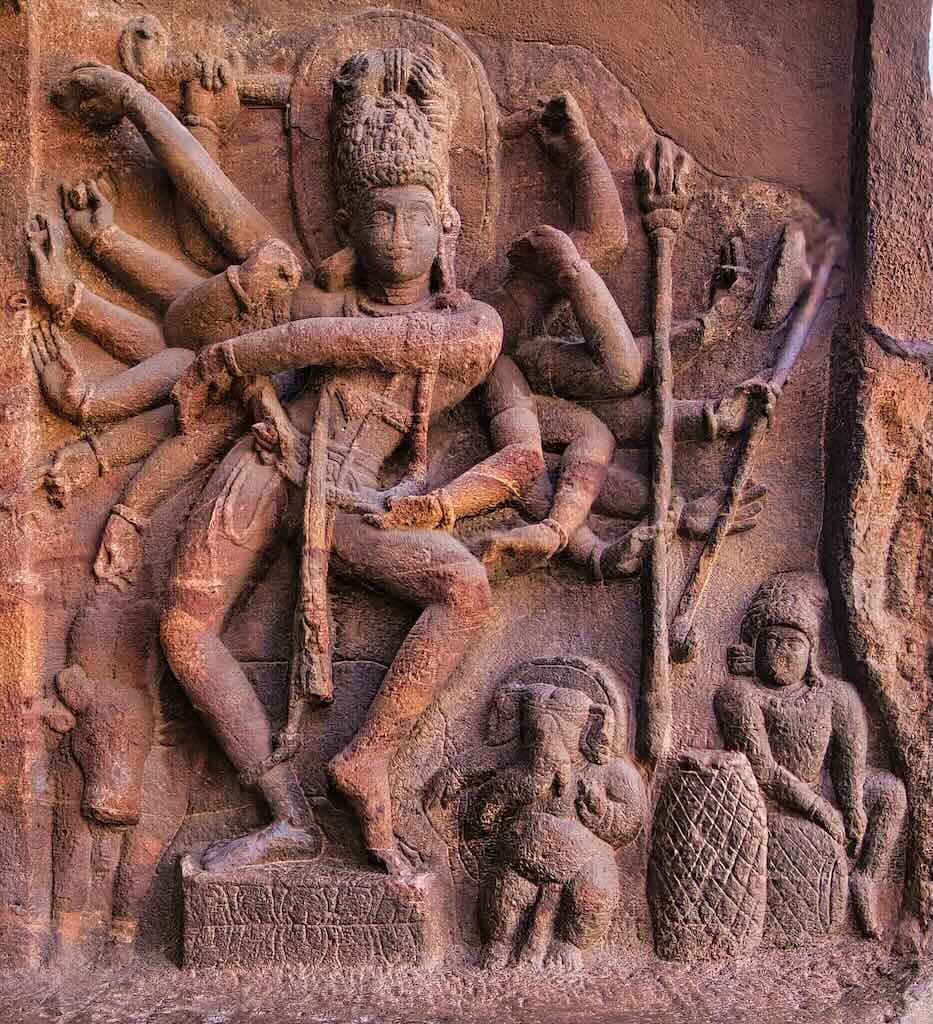
Then comes a genuine turning point, one I tried hard to capture with real precision: the shift from carving into stone to building with it. At Badami in Karnataka, artisans hollowed four large sanctuaries directly out of hillsides, leaving behind the rare eighteen-armed Nataraja and a serene Mahavishnu reclining on the coils of the serpent Ananta, Garuda at his feet.
.
.
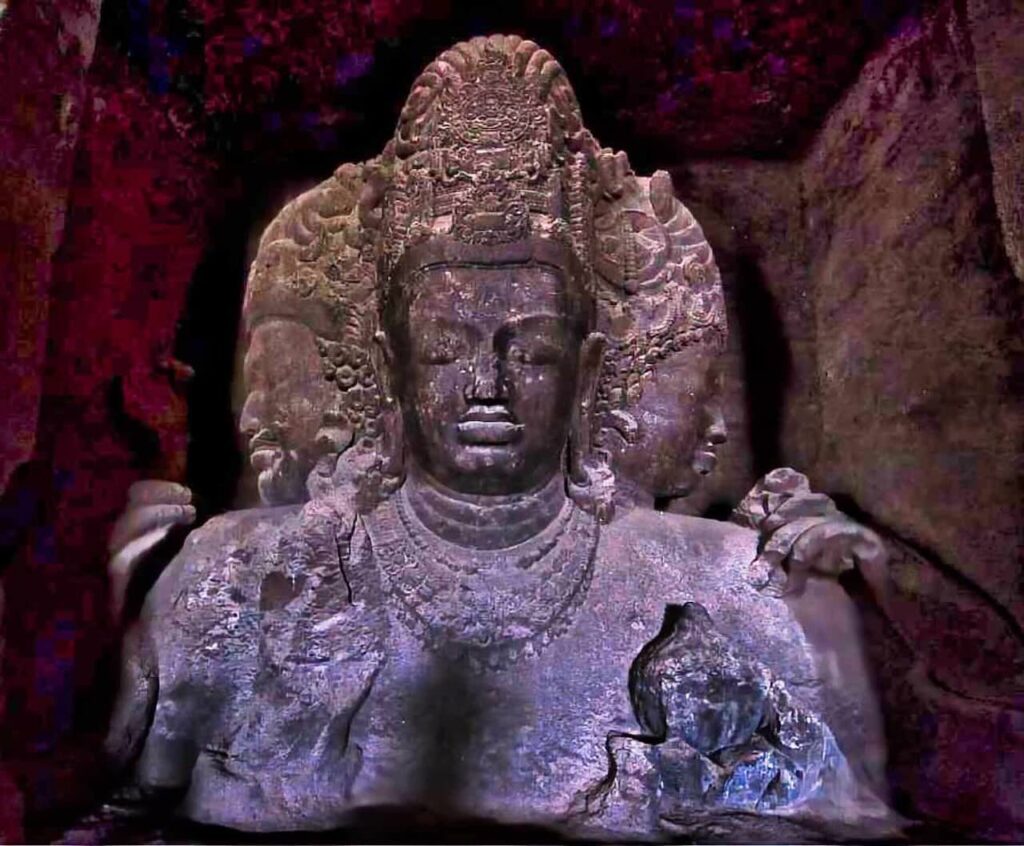
At Elephanta, off the coast of Mumbai, they carved the towering 20-foot Maheshamurti in even bigger caves excavated in basalt. At Mahabalipuram on the Tamil Nadu coast, they went further still, sculpting entire narratives into open rock faces, among them the Combating Durga panel and the vast Gangavatarana relief, a single boulder telling the story of Ganga’s descent to earth.
.

.
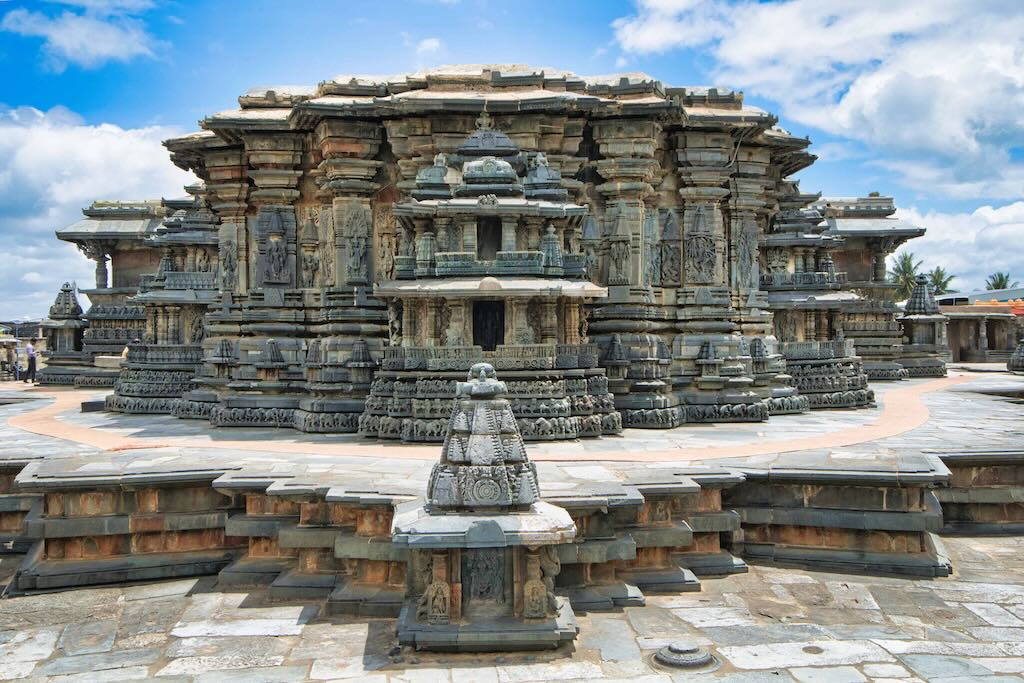
From there the exhibition follows architecture as it learns to stand on its own. The structural temples begin: the sculptural achievements of Pattadakal and Aihole under the Chalukyas, the soaring Kalinga-style shikharas of Bhubaneswar and Konark in Odisha, the unusual open-air circular temple at Hirapur, and the great dynastic traditions of the Hoysalas, Cholas and the Vijayanagara Empire across the Deccan and the south.
.
.
And then the country widens out. I didn’t want to stop at the classical temple belt, so the exhibition travels on to Kashmir, to the wind-worn ruins of the Sun Temple at Martand and the large complex at Naranag, built in a climate and a political history utterly unlike the south. It travels to Goa, where temples were destroyed under Portuguese rule and then, centuries later, revived. It travels to Tripura to showcase huge rock-cut reliefs that few visitors from other parts of India would recognise. It touches Gujarat again, and then the monasteries located at striking locations on top of the mountains of Ladakh, the very place where the whole project began.
.


The forgotten temples of Kashmir: (L) Naranag Temple complex; (R) Sun Temple at Martand
.
Stand back from all of it, and a shape emerges. North to south, my frames run from Kashmir’s ruined temples to Mahabalipuram’s shore carvings. East to west, they run from Tripura’s rock reliefs to Dholavira’s planned streets and Goa’s coastline. In time, they run from a rock shelter painted thirty millennia ago to a temple rebuilt within living memory. No single region, dynasty or century owns this story, and that was exactly the point I wanted to make.
.

.
Prof. Kulkarni sequenced the exhibits so that a viewer walking the gallery would feel the logic of it: paint, then carve, then build, then diversify, then endure. It’s a rare thing for a photography exhibition to actually argue something, rather than simply display something, and I like to think this one did.
.

.
Opening Night: Five Speeches, a Lamp, and a Book
.

.
The exhibition opened on the evening of 16 July 2026, and we didn’t underplay the occasion. Five of us addressed the gathering, and between us we represented every strand of what had made the exhibition possible: Dr B.L. Santosh, Chairman of the Karnataka Chitrakala Parishath, hosting the show in his own institution; Mr V. Nagaraja, Chairman of the Mythic Society, Bengaluru, lending the evening scholarly weight; Prof. R.H. Kulkarni, the scholar-curator, who had given 74 photographs a narrative spine; Lt Cdr Vikram Naik, whose Naik Philanthropic Centre had backed the project; Lt Gen S Ravi Shanker, a batchmate from NDA days, who provided sage advice and managed to persuade principal’s of local schools to send students to see a different India; and me, who had spent fifteen years taking these pictures.
.
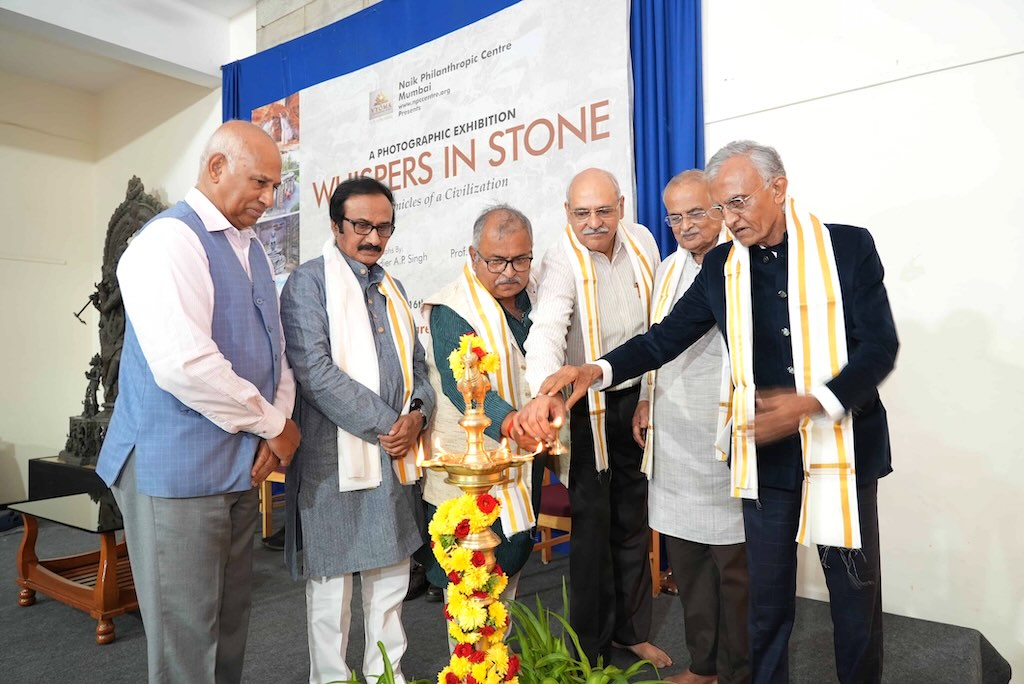
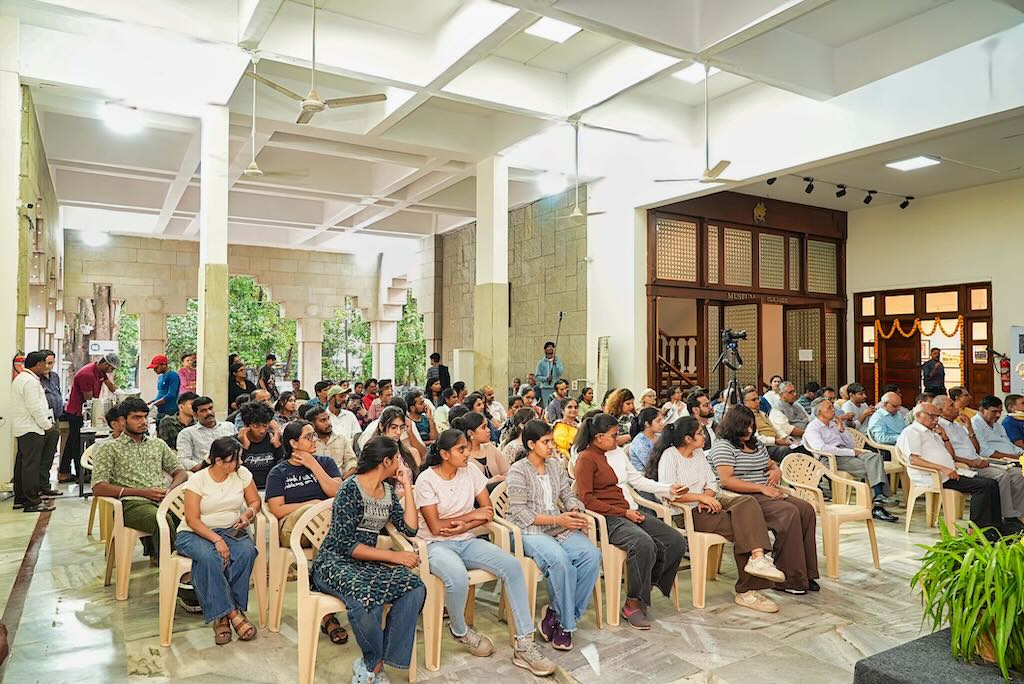
Lighting the lamp provides an auspicious commencement to the proceedings; the audience listens attentively
.
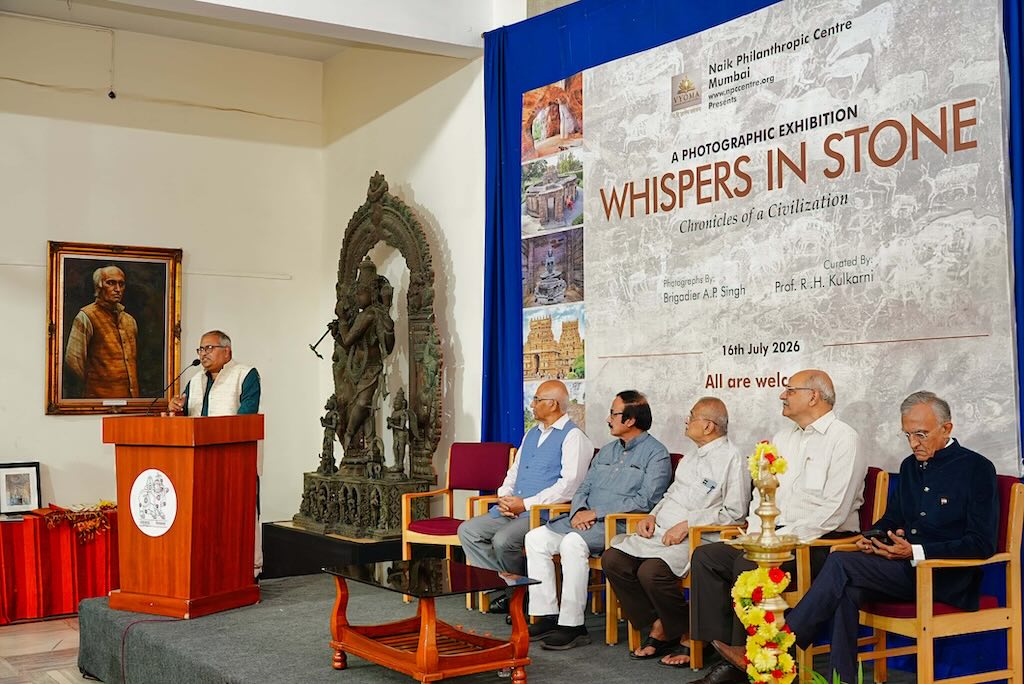

Prof R.H. Kulkarni (left) gives the opening address; Lt Gen S. Ravi Shankar (right) introduces the guests
.

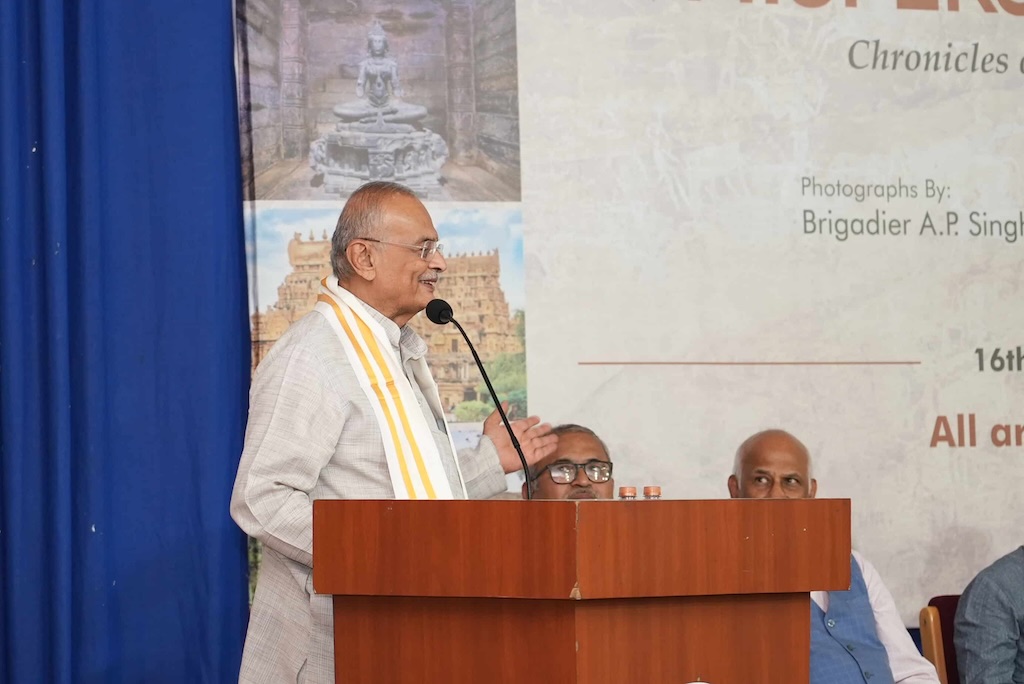
Dr B.L. Santosh, President, Karnataka Chitrakala Parishath (left); Shri V. Nagaraja, President, Mythic Society, Bengaluru (right), address the audience
.
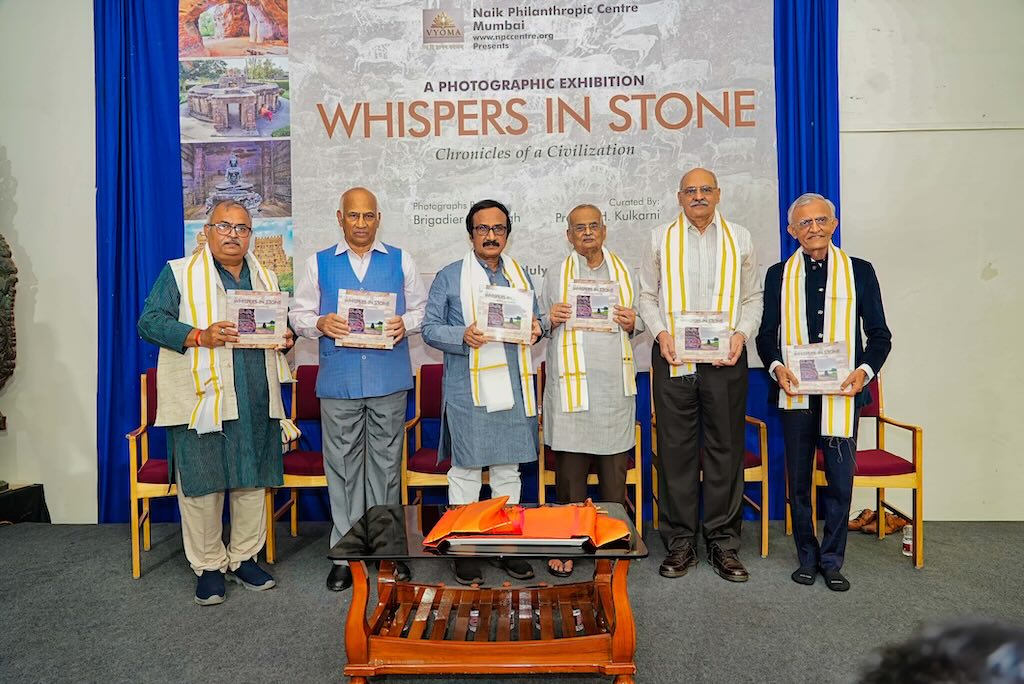

Release of the coffee table book, Whispers in Stone (left); launch of the picture postcards designed by PSOI (right)
.
My own speech circled back, inevitably, to the sea and the army before it got anywhere near a camera. I spoke about the discipline sailing had taught me, “the value of patient observation and the beauty of distant horizons,” and how that same patience later meant waiting hours in a rock-cut sanctuary for exactly the right light to fall across a thousand-year-old carving. I explained why I’d chosen stone as my subject at all: “our civilisation has expressed its deepest truths, its faith, its scientific temper, and its artistic genius most powerfully through stone.” And that I hoped visitors, especially the young ones, would carry out of the gallery with them, not just information, but “a deeper emotional connection to our heritage, and a sense of responsibility towards its preservation.”
.
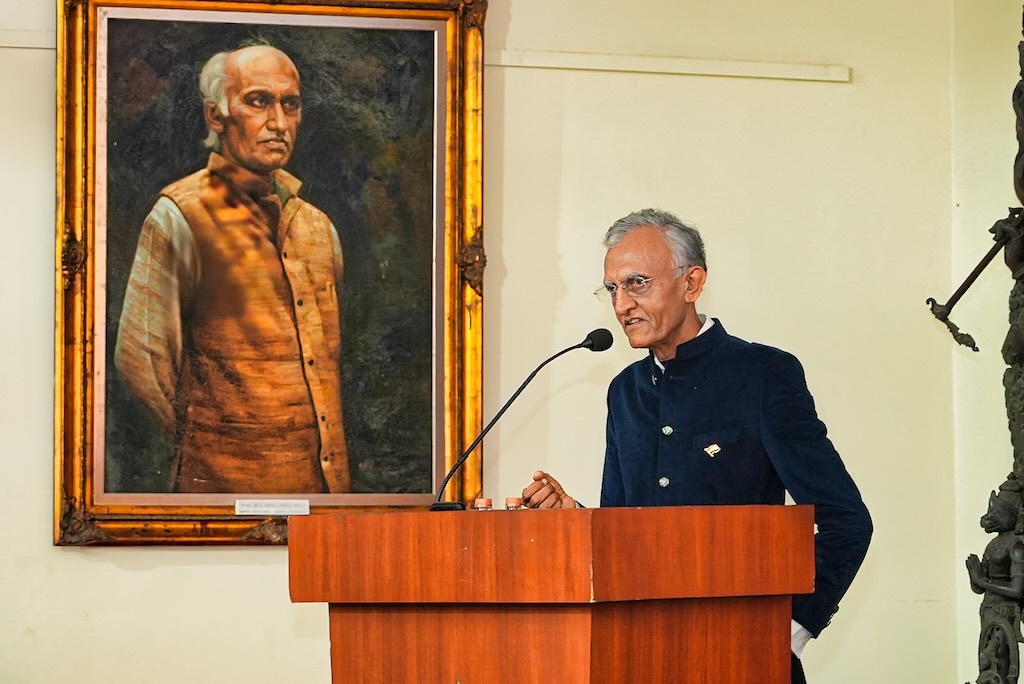

(L) Lt Cdr Vikram Naik gives out his vision behind the exhibition; (R) Brig A.P. Singh narrates his journey that culminated in this event
.
The formalities that evening went beyond speeches. A coffee-table book reproducing all exhibits with their captions was released on stage, giving the exhibition a life beyond the eleven days of the gallery run. Separately, the Postcrossing Society of India released a set of twelve postcards drawn from the show, tucked into a specially designed cover, that ends up mailed to a stranger in another country and quietly carries Bhimbetka or Badami somewhere the exhibition itself never travelled.
.
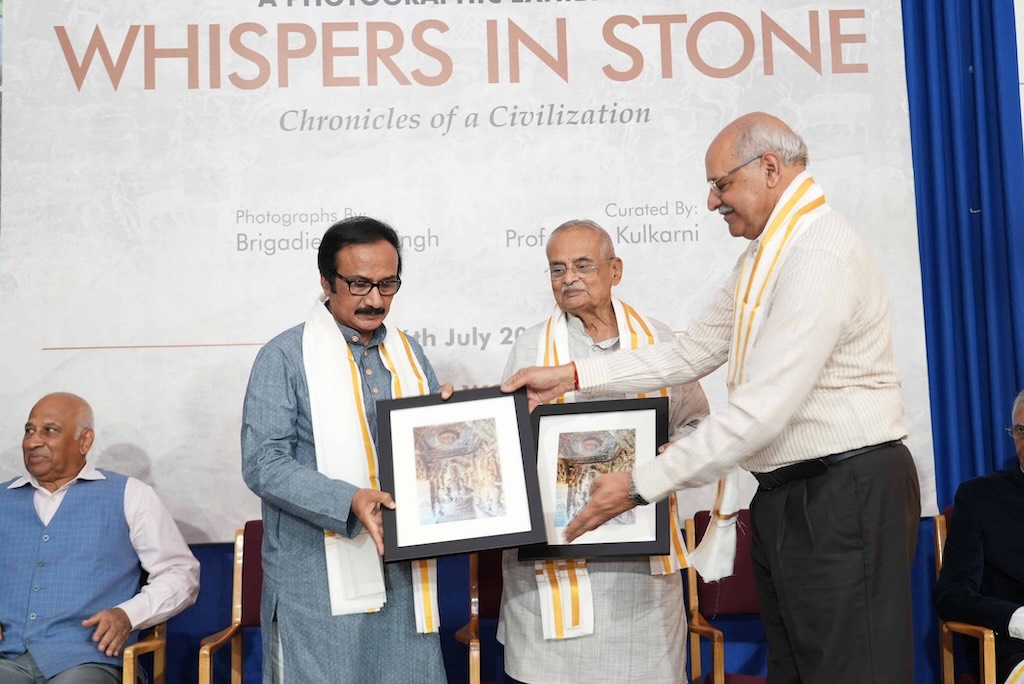
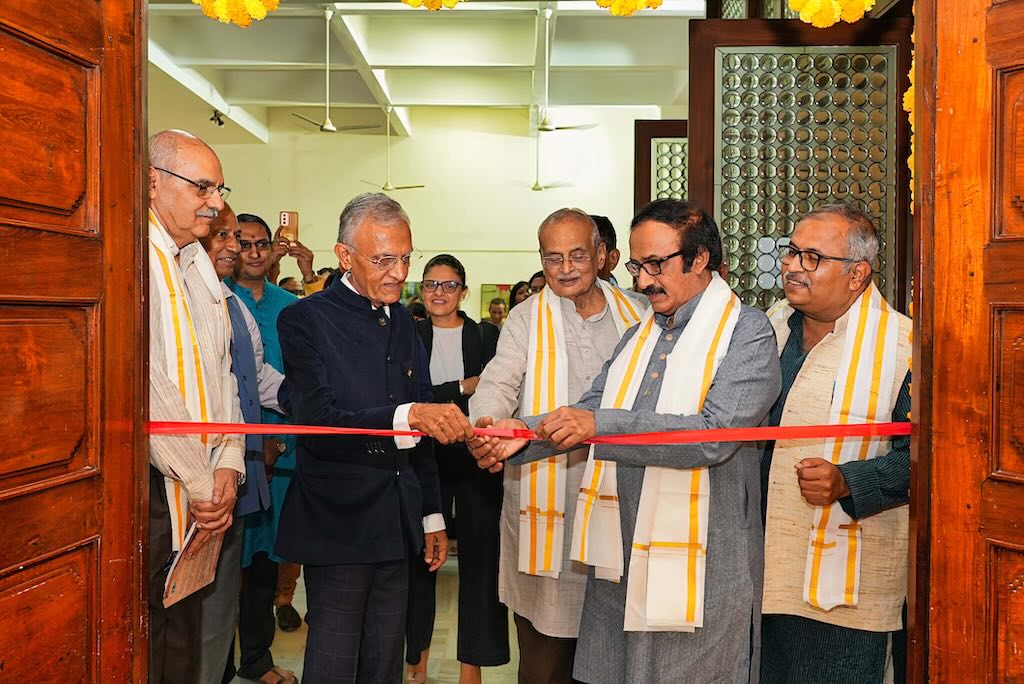
Felicitating the dignitaries (left); formal opening of the exhibition (right)
.

.
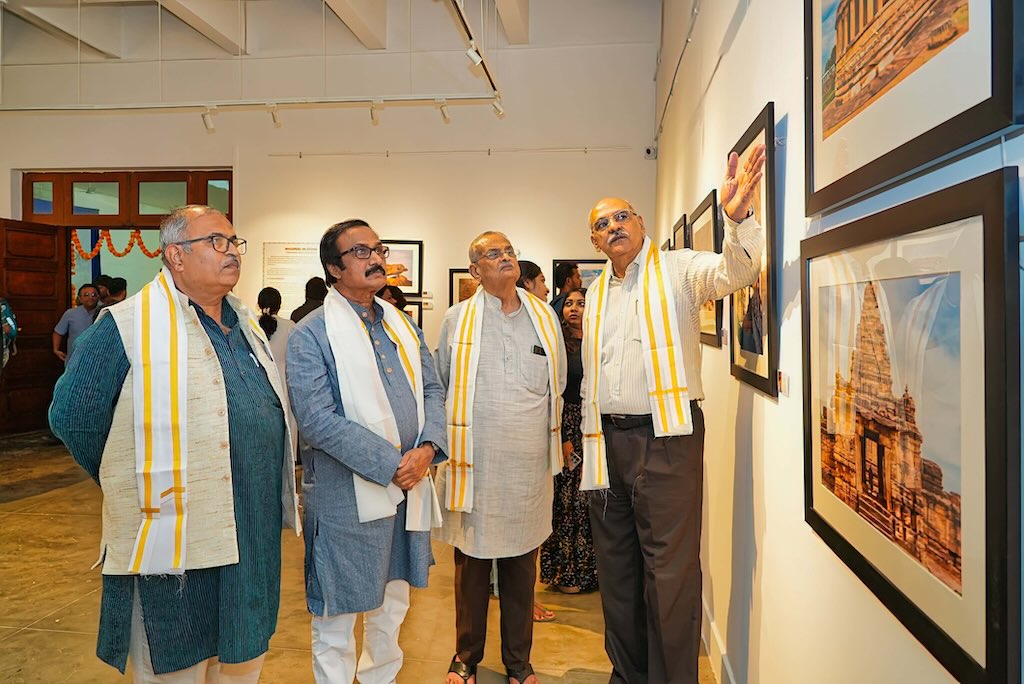
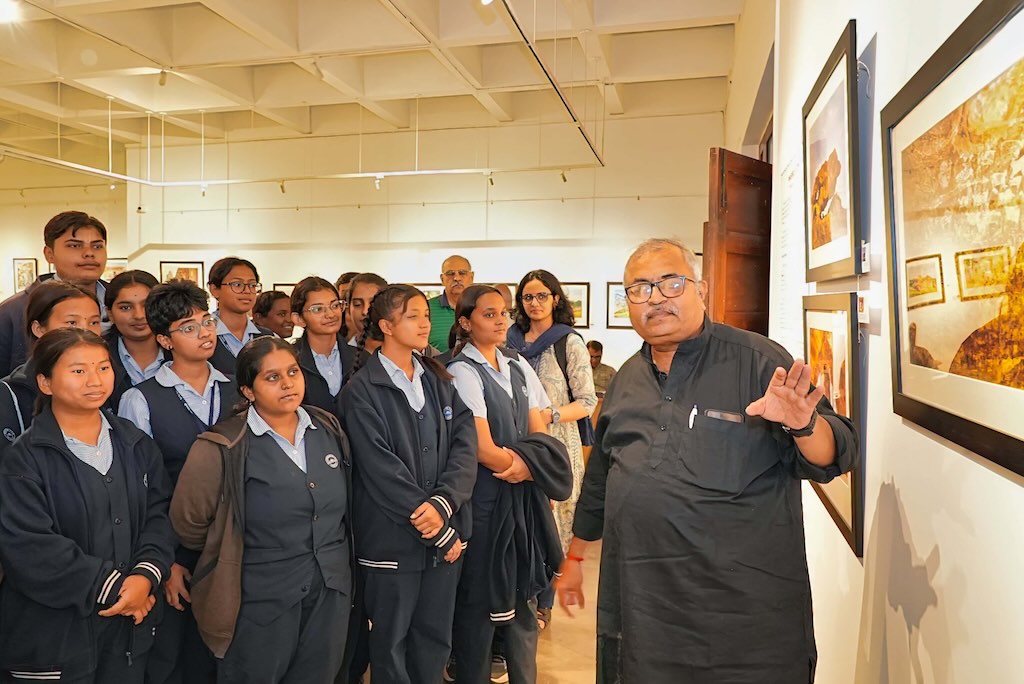
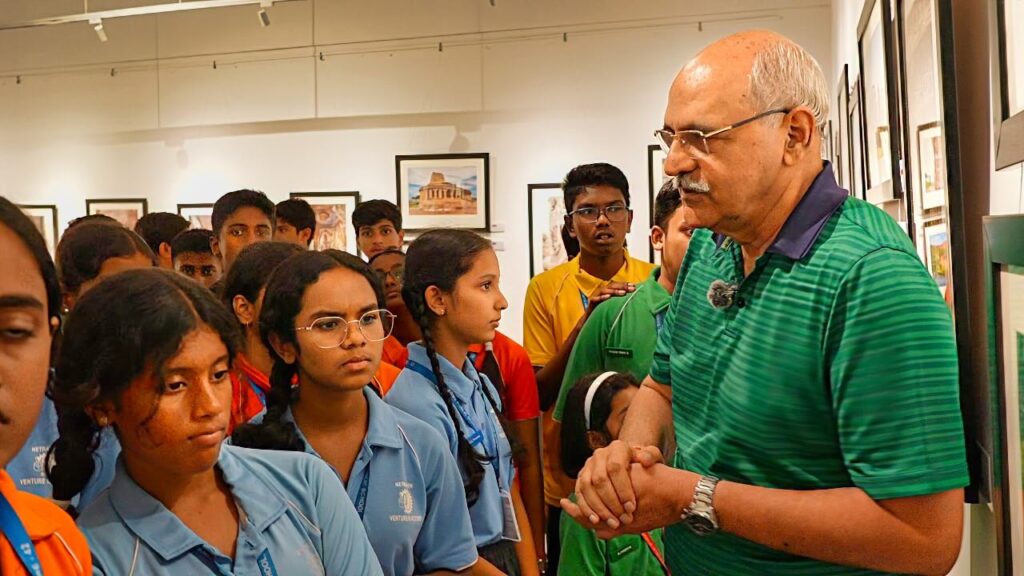
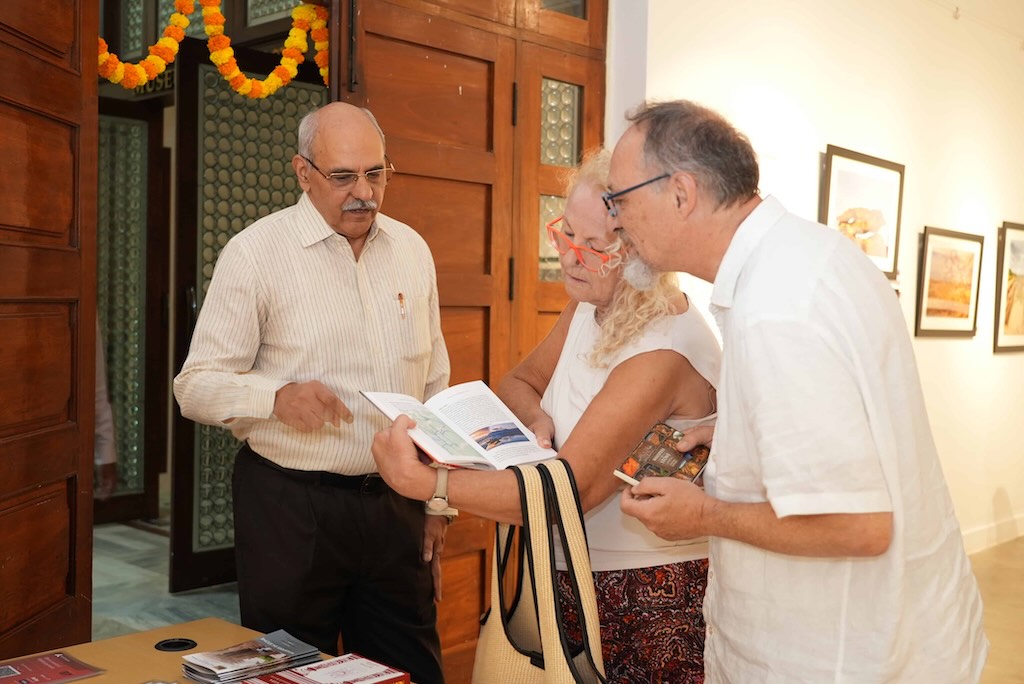
Once the ribbon-cutting formalities wound down, I walked the dignitaries through the galleries, stopping in front of individual frames to fill in the stories the captions couldn’t tell.
.
.
.
Eleven Days, Nearly a Thousand Students, and One School That Chanted Its Way In
.
.
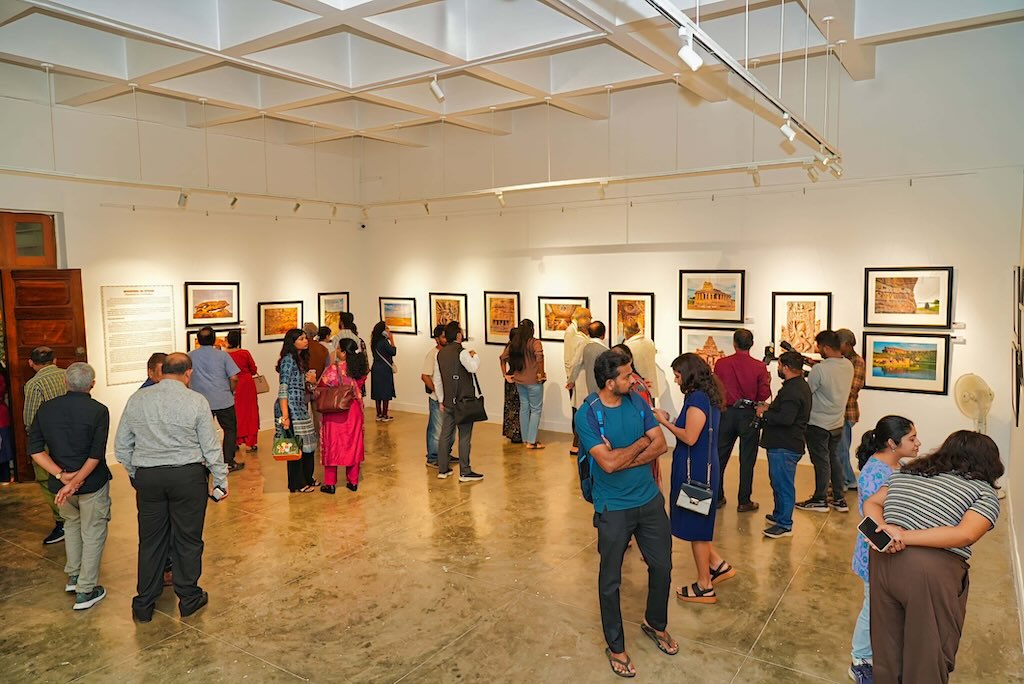
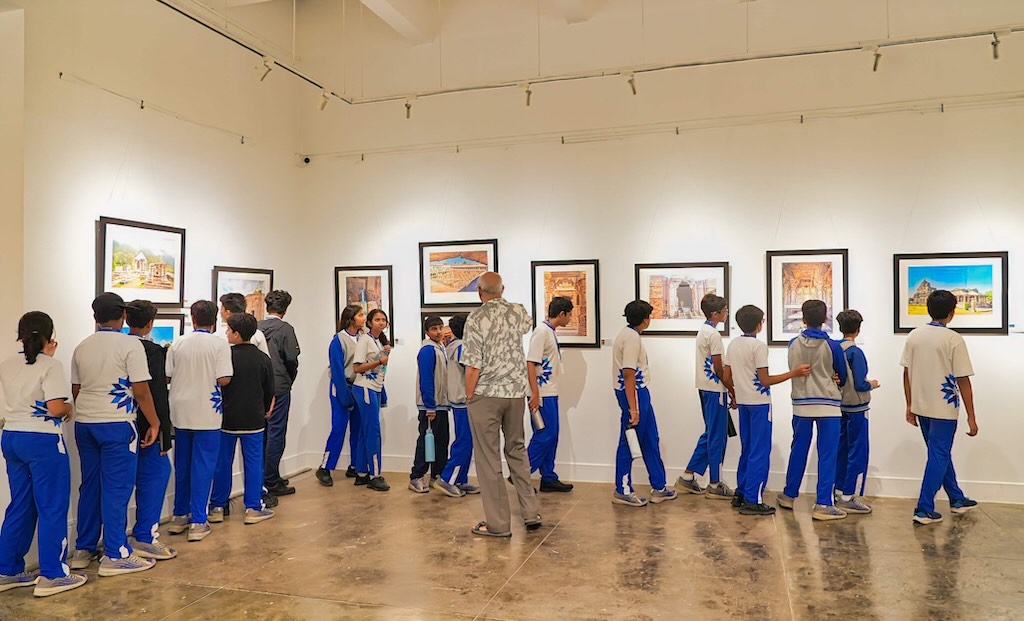
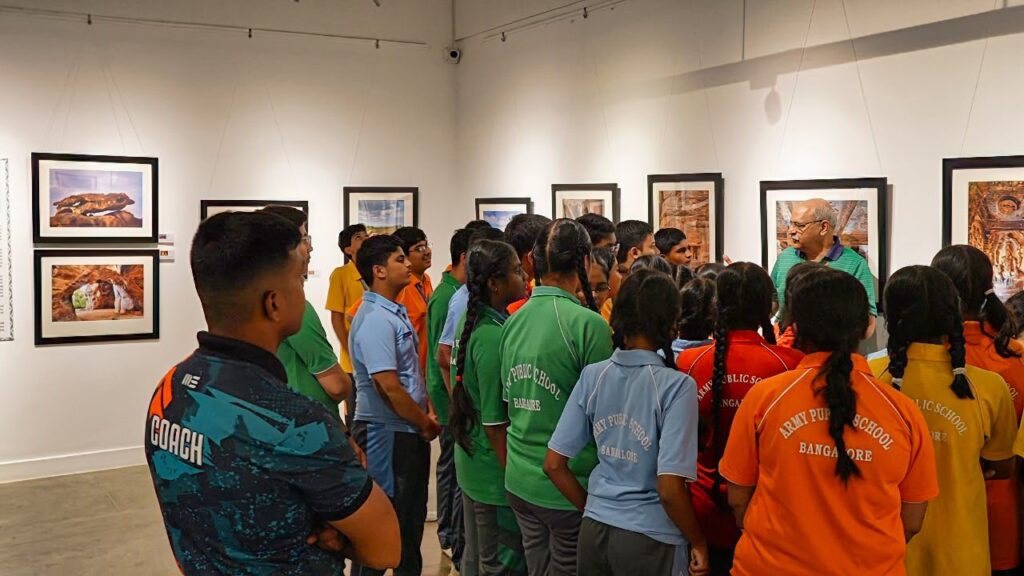
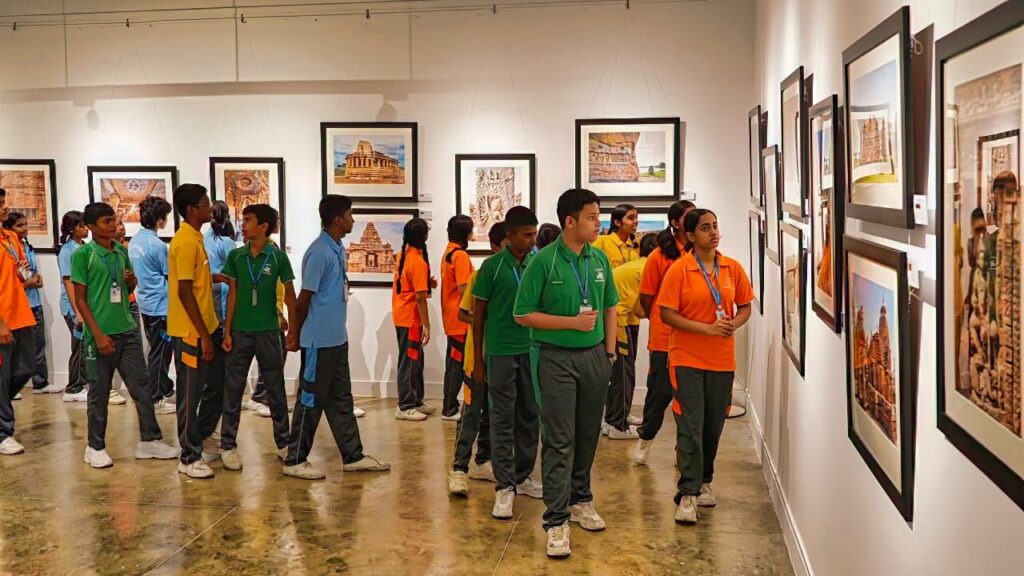
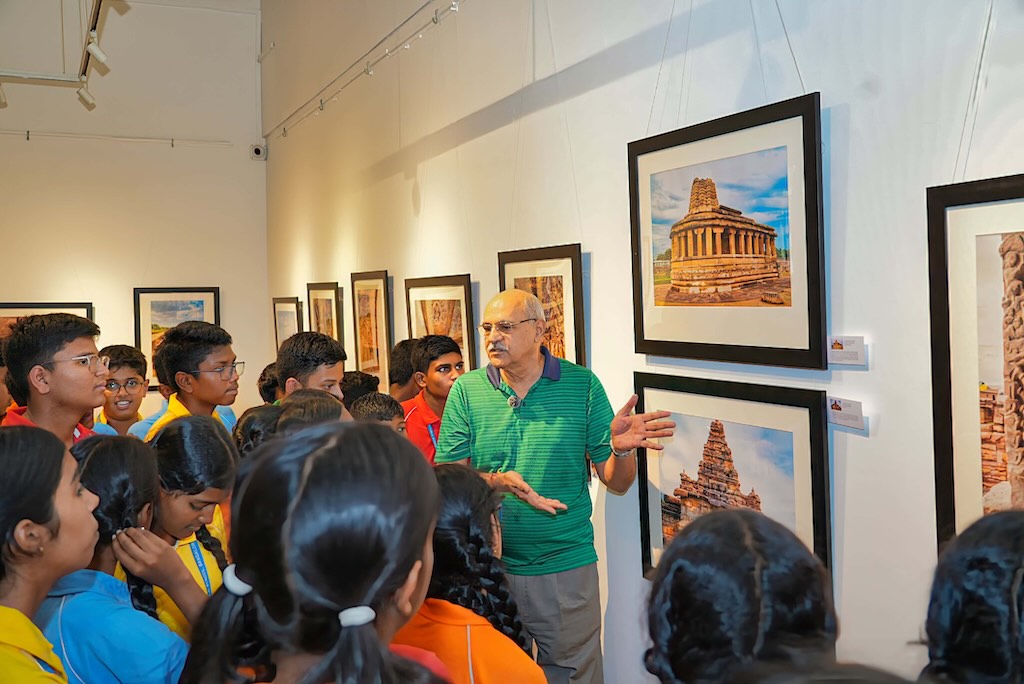
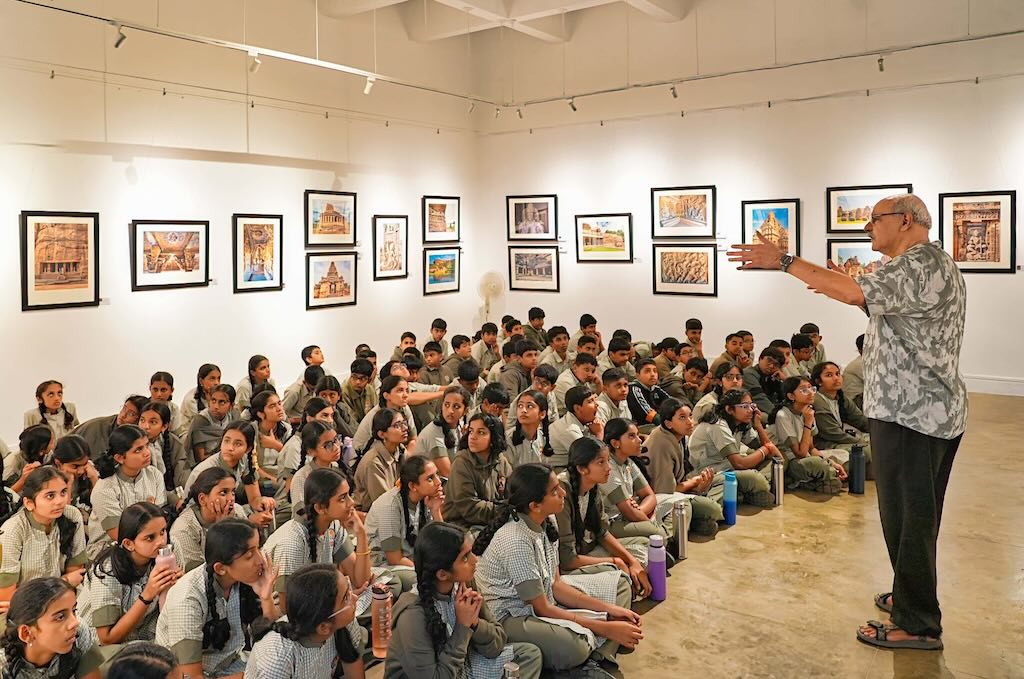
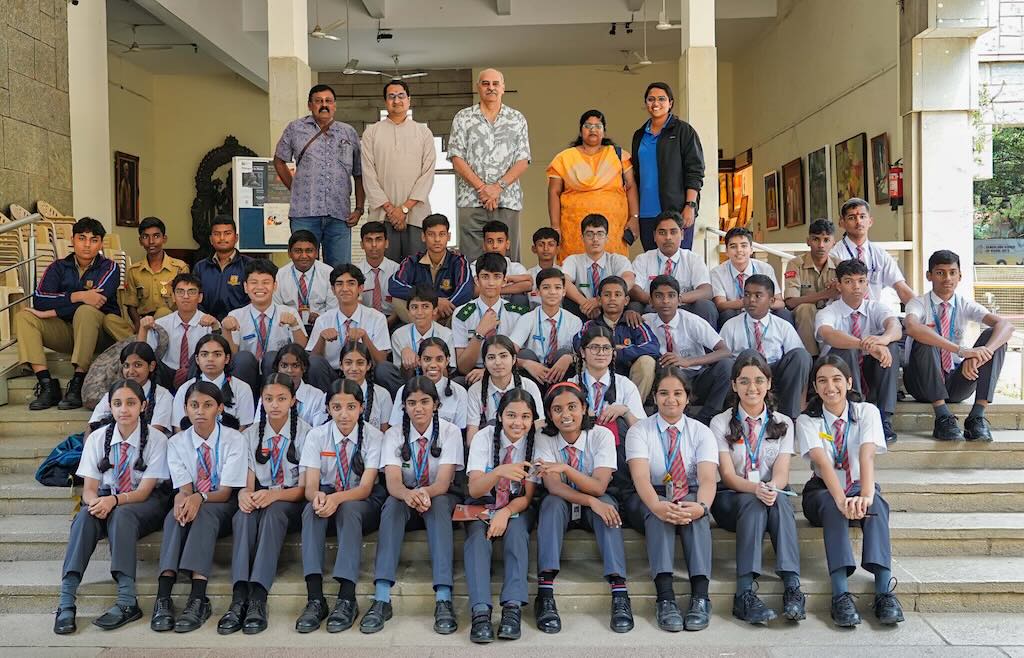
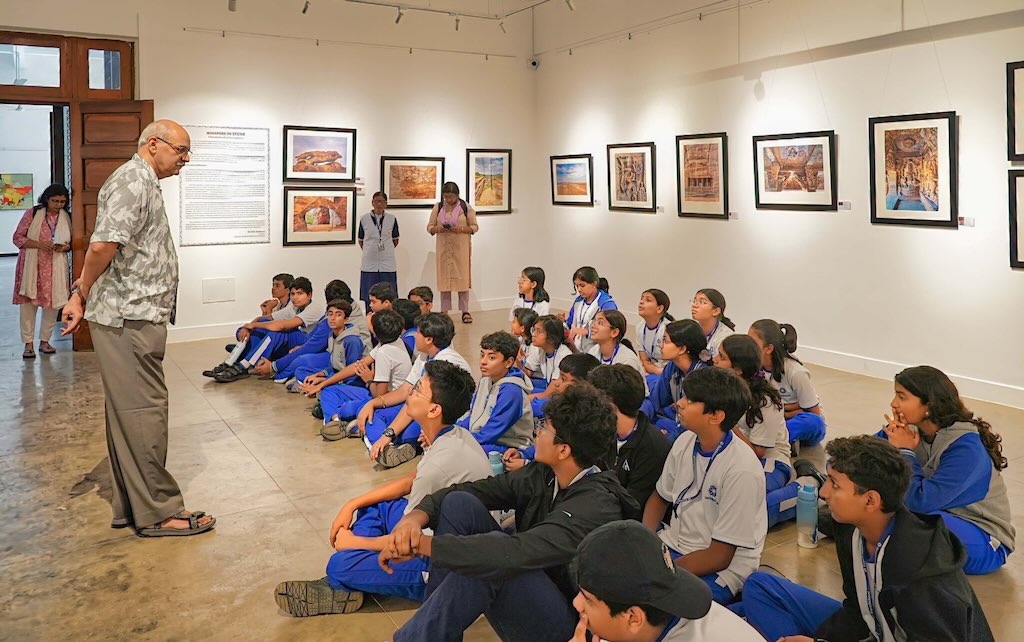
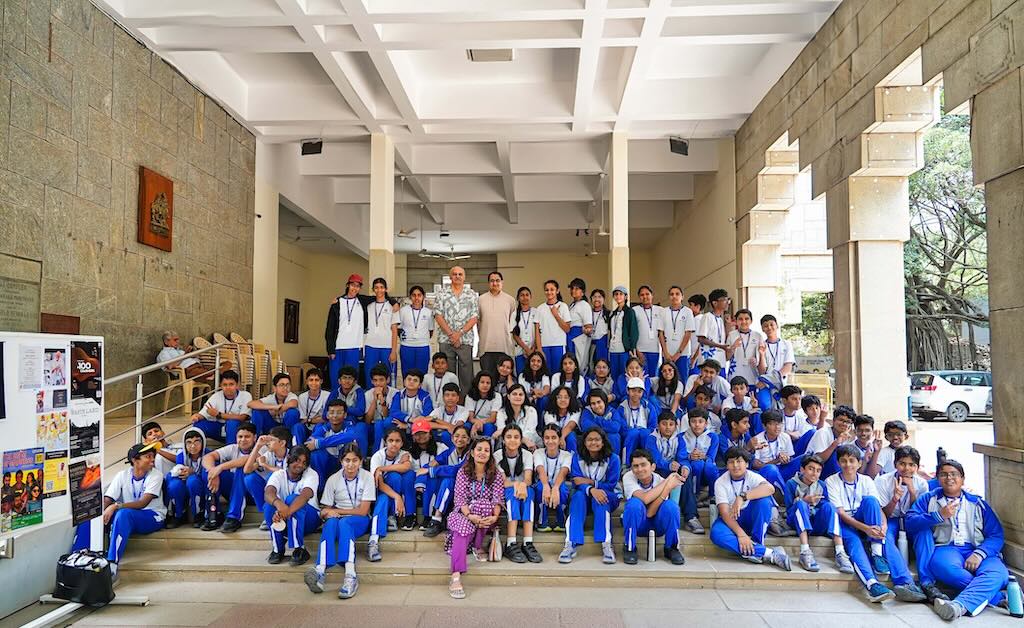
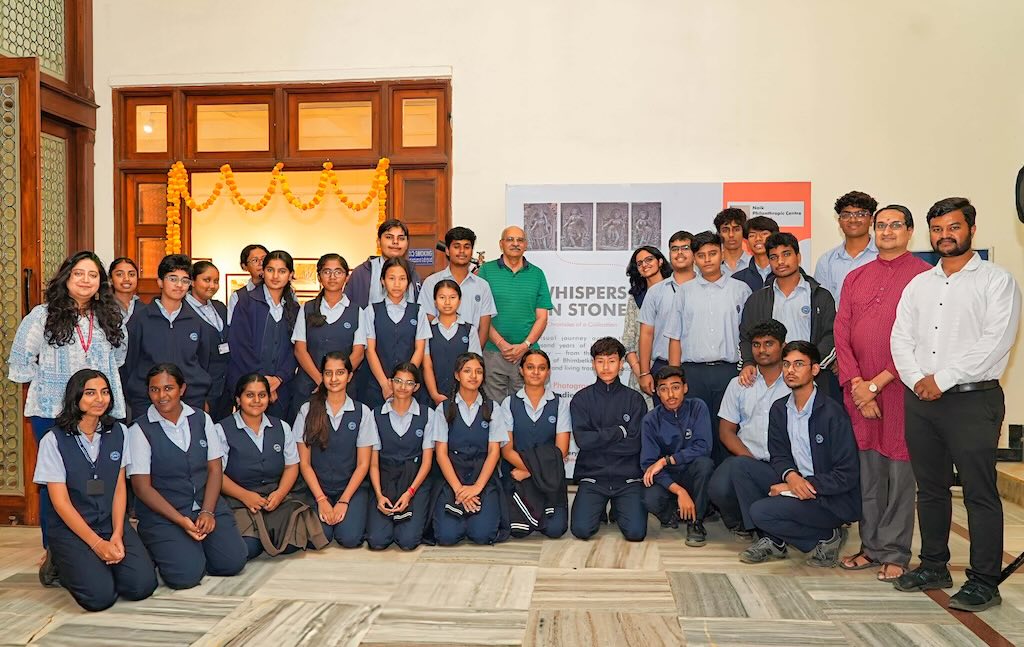
If the opening night belonged to dignitaries, the eleven days that followed belonged to schoolchildren, and the scale of it caught the organisers off guard. Over eight of those eleven days, seventeen separate school and college groups were briefed and walked through the gallery – close to a thousand students. On the busiest days, more than 200 children were on site at once, and eventually we had to start turning requests down, not because interest had dried up but because there simply wasn’t room to give every group the experience it deserved.
.

.
| Date | Institutions Visiting | Approx. Students |
|---|---|---|
| 17 July 2026 | SSRVM; Army Public School | 74 |
| 18 July 2026 | KV MEG Centre; Army Public School | 92 |
| 20 July 2026 | Om Shanti Dhama Veda Gurukula | 60 |
| 21 July 2026 | PSBB; Army Public School; Euro Kids Whitefield | 202 |
| 22 July 2026 | PSBB; Army Public School; BET College (B.Com) | 174 |
| 23 July 2026 | Army Public School; Euro Kids Whitefield | 150 |
| 24 July 2026 | MLA School; Army Public School | 120 |
| 26 July 2026 | Army Public School; South Korean Study Group (IISc) | 45 |
| Total | ~917 |
.


.
The range of institutions which came was itself a statement about who this exhibition reached. IB-curriculum schools sent students in on the same footing as the Om Shanti Dhama Veda Gurukula, whose Vedic chanting turned an ordinary Monday morning into something nobody in that gallery is likely to forget.
.

.
A hundred B.Com students from a Muslim college walked through with the same attentiveness, a detail I noted specifically at the time, because it said plainly that curiosity about India’s civilisational past doesn’t sort itself by community or curriculum. On the closing day, a group of South Koreans on a tour to the Indian Institute of Science wandered in and stayed, examining photographs of temples on the other side of the world from home.
.

.
Every school visit followed the same shape: a guided walk that Prof. Kulkarni or I led, followed by an interactive art activity run by the faculty and students of the Bangalore School of Visual Arts. Teachers repeatedly mentioned the change in their students: kids who might glance over at a textbook paragraph on the Chalukyas would stand in front of Badami’s rock-cut Nataraja and start asking incisive questions about the engineering of it, the iconography, the resources it must have taken to complete. And an oft-repeated question on the role of temples in society, considering the resources it took to build – the answer was often an eye-opener for the students, as this is a question most are unaware of.
.

.
Media Coverage
.
The coverage Whispers in Stone received was considerable, and it was sustained rather than a single day’s notice. Beginning ten days before the doors opened and continuing past the exhibition’s close, the show and its associated events were reported in print on at least twenty-one separate occasions across ten distinct publications, and appeared online at least fourteen more times — a run that spanned English-language, Kannada and Telugu press, national dailies and city listings, and carried the exhibition from advance previews through a full-page interview feature to on-the-ground photo coverage of the galleries themselves.
.
Building Anticipation: The Bangalore Mirror Countdown
.
Ten days before the opening, Bangalore Mirror’s daily ‘Things to Do in Bengaluru’ column began carrying Whispers in Stone as a recurring pick, giving it a fresh, punning headline nearly every time it appeared: ‘Carved in Culture’ on 6 July, ‘Fragments of History’ on 7 July, ‘Chronicles in Stone’ on 8 July, and ‘Historical Lens’ on 9 July, each paired with a single striking photograph from the collection. The paper picked the thread up again as the opening drew closer, with ‘Framed in History’ on 15 July and ‘Stories in Stone’ on the inauguration day itself. It then kept the drumbeat going for the entire run, returning with ‘Art of Ages,’ ‘Journey through the Lens,’ ‘Etched in Time,’ ‘Stone Saga,’ ‘Glimpse of History,’ ‘Picture Perfect,’ ‘Picture the Past’ and ‘Historical Journey’ on eight further days through to 25 July. In total, some version of the listing ran in Bangalore Mirror on fourteen separate days spanning the run-up and the duration itself — a level of sustained coverage more typical of a city institution rather than a single exhibition.
.

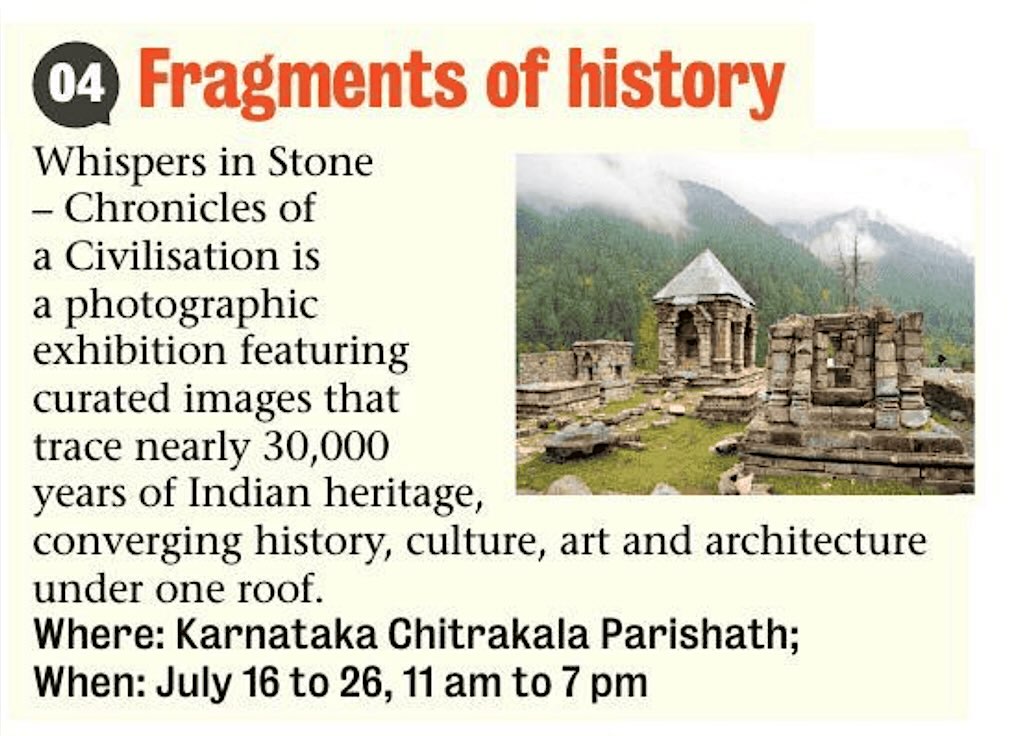
Bangalore Mirror ran a series of posts throughout the duration of the event
.
| Date | Headline | Date | Headline |
|---|---|---|---|
| 6 July 2026 | Carved in Culture | 18 July 2026 | Journey Through the Lens |
| 7 July 2026 | Fragments of History | 20 July 2026 | Etched in Time |
| 8 July 2026 | Chronicles in Stone | 21 July 2026 | Stone Saga |
| 9 July 2026 | Historical Lens | 22 July 2026 | Glimpse of History |
| 15 July 2026 | Framed in History | 23 July 2026 | Picture Perfect |
| 16 July 2026 | Stories in Stone | 24 July 2026 | Picture the Past |
| 17 July 2026 | Art of Ages | 25 July 2026 | Historical Journey |
.
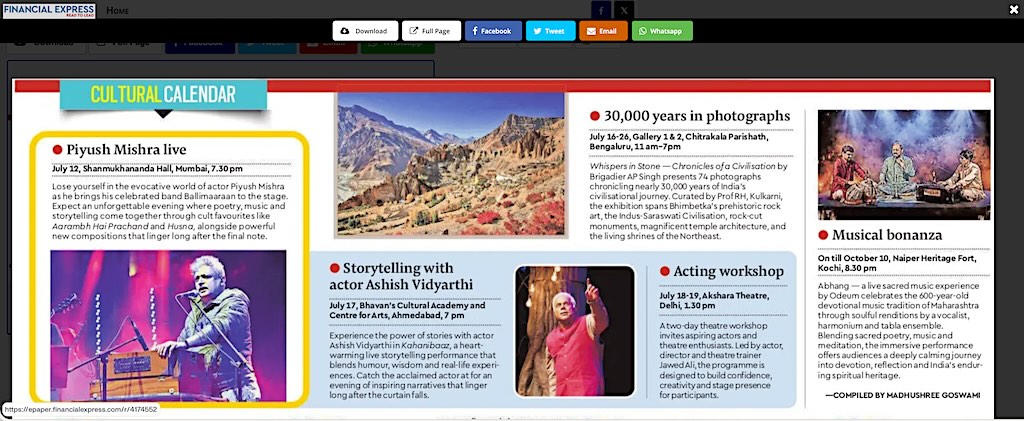
The Financial Express placed the exhibition in similarly good company. Its 12 July ‘Cultural Calendar’ page listed ‘30,000 years in photographs’ alongside actor Piyush Mishra’s live show in Mumbai and a storytelling performance by Ashish Vidyarthi in Ahmedabad — evidence that, editorially, Whispers in Stone was being read as a metro-level cultural event rather than a niche heritage listing.
.
.
The Indulge Interview
.
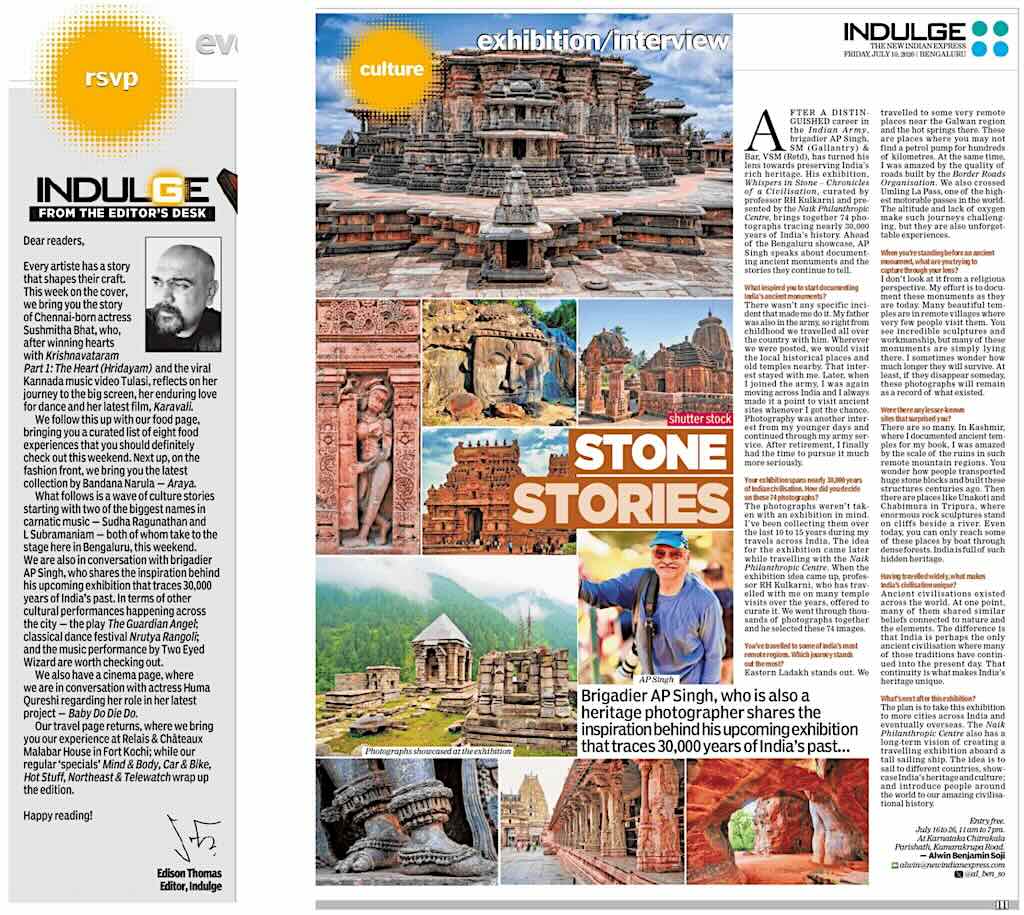
The richest single piece of coverage came from The New Indian Express’s Indulge supplement, which ran a full-page interview with Brigadier Singh on 10 July under the headline ‘Stone Stories,’ written by Alwin Benjamin Soji. The interview traced the exhibition’s roots to Singh’s childhood, travelling to old temples and historical sites with his army-officer father, and to fifteen years of photographs taken purely out of personal interest before Prof. Kulkarni, on a chance conversation with the Naik Philanthropic Centre, offered to sift through thousands of images and select the 74 that became the show.
“There wasn’t any specific incident that made me do it. My father was also in the army, so right from childhood we travelled all over the country with him. Wherever we were posted, we would visit the local historical places and old temples nearby.” — Brigadier A.P. Singh, to Indulge
.
.
Asked which journey stood out most among his travels to India’s remote regions, Singh singled out eastern Ladakh — the very region where the idea for the exhibition would later take shape on a road trip with friends — describing travel to places near the Galwan region “where you may not find a petrol pump for hundreds of kilometres,” his admiration for the roads built by the Border Roads Organisation, and crossing Umling La Pass, one of the highest motorable passes in the world. He was equally candid about what draws him to a monument in the first place:
“I don’t look at it from an exclusively religious perspective. My effort is to document these monuments as they are today. Many beautiful temples are in remote villages where very few people visit them… I sometimes wonder how much longer they will survive. At least, if they disappear someday, these photographs will remain as a record of what existed.” — Brigadier A.P. Singh, to Indulge
The interview also drew out two lesser-known sites that had particularly struck him — the remote temple ruins of Kashmir, and the rock sculptures of Unakoti and Chabimura in Tripura, carved into cliffs beside a river and reachable, even today, only by boat through dense tropical forests — and closed on a note that reached well beyond Bengaluru: asked what came next, Singh spoke of taking the exhibition to more cities across India and eventually overseas, and of the Naik Philanthropic Centre’s longer-term vision of a travelling exhibition aboard a tall sailing ship, carrying India’s heritage from port to port around the world.
.
National and Vernacular Reach
.

.
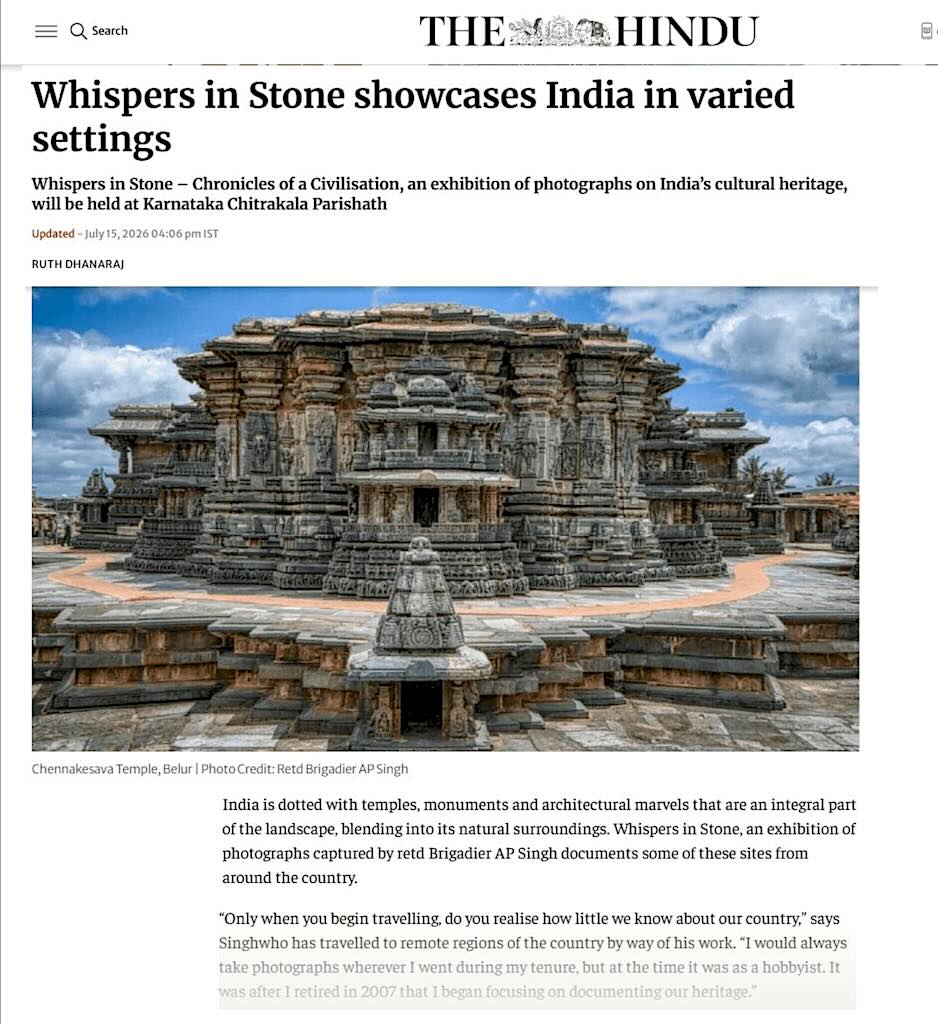
On 15 July, The Hindu carried a feature titled ‘Whispers in Stone showcases India in varied settings,’ by Ruth Dhanaraj, illustrated with Singh’s photograph of the Chennakesava Temple at Belur. The piece quoted Singh on what travel had taught him about his own country:
“Only when you begin travelling, do you realise how little we know about our country. I would always take photographs wherever I went during my army tenure, but at the time it was as a hobbyist. It was after I retired in 2007 that I began focusing on documenting our heritage.” — Brigadier A.P. Singh, to The Hindu
.
.
The Hindu’s own social media account posted the piece on X the same week; by the time it was archived for this report, the post had drawn over 10,000 views and a steady trickle of likes and reposts, carrying the exhibition to an audience well beyond Bengaluru’s readership.
.

.
Kannada-language coverage ran on a parallel track. Prajavani and Vijaya Karnataka’s Namma Bengaluru edition both carried advance listings on 16 July naming the inaugurating dignitaries and providing the venue and timing details, treating the ceremony itself as calendar-worthy news. The following day, Prajavani’s photo desk went further, sending a photographer to the venue and running a captioned press photograph from the gallery walkthrough — genuine on-the-ground reporting rather than a syndicated listing. On 18 July, the Telugu daily Eenadu carried a dedicated feature on the exhibition, extending its reach into a readership well outside Karnataka. On 22 July, The New Indian Express’s Bengaluru Express edition ran a striking photo feature titled ‘Echoes of the Past,’ credited to photographer Nagaraja Gadekal, capturing Brigadier Singh in conversation with visitors inside the gallery.
.

.
| Category | Publications | Items |
|---|---|---|
| Pre-event previews (6-16 July) | Bangalore Mirror (x6), The New Indian Express-Indulge, The Financial Express, Prajavani, Vijaya Karnataka | 10 |
| During-exhibition print coverage (17-25 July) | Bangalore Mirror (x8), Prajvani, Eenadu, The New Indian Express-Bengaluru Express | 11 |
| Online coverage (6-23 July) | The Hindu, The Financial Express (e-paper), Bangalore Mirror, Explocity, Cityscope Media, V (Twitter) | 14 |
.
Online and Social Reach
.
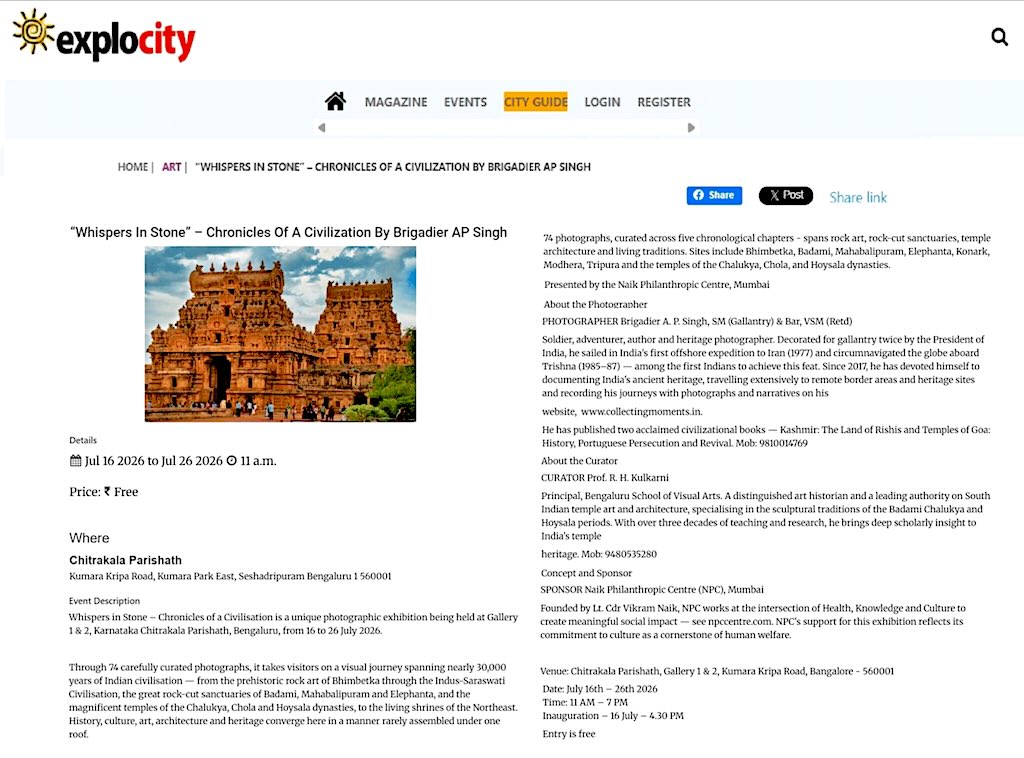
Beyond the newspapers, the exhibition was picked up by Bengaluru’s digital events platforms. Explocity ran a detailed listing with full biographical notes on the photographer, curator and sponsor, while Cityscope Media framed the show for its younger, app-based audience as offering “powerful before-after visual stories of ancient sites and their present-day reality. The Financial Express, Bangalore Mirror and The Hindu all mirrored their print coverage online, so that a reader searching for the exhibition after seeing a newspaper mention could find it again just as easily on a phone.
.
.
What the Numbers, and the Visitors, Actually Said
.
We ran a QR-code feedback system and collected 96 completed responses, a small enough sample for me to read individually and a large enough one to trust in aggregate. The average rating came in at 4.75 out of 5. Eighty percent of respondents gave it a perfect five; ninety-six percent rated it a four or five. The gallery layout and lighting scored just as well. A clear majority said the curator’s notes had genuinely added to their visit rather than just decorating the walls, and close to seventy percent said they’d consider buying prints of the photographs, a real vote of confidence for work that started as my own personal archive.
.
.
Ask visitors what stuck with them, and the pattern holds no matter who’s answering. The Badami and Chalukya photographs drew the strongest response, likely because of how directly they speak to Karnataka’s own regional pride. Close behind came Bhimbetka and Dholavira, the earliest chapters of the story, which seemed to trigger a kind of curiosity about origins that people don’t often get to indulge. Tripura’s rock-cut reliefs and the Elephanta caves, sites most visitors admitted they’d barely heard of before walking in, ranked surprisingly high too, proof that unfamiliar corners of the country can hold their own against famous ones when the photography is good enough.
.

.
In Their Own Words
.
“This is an absolutely mesmerising collection of photographs. Grateful for reintroducing these heritage locations and monuments to us.” — Sanjay Lavakare
“An excellent step in creating and spreading awareness about the rich culture and history of India.” — Jayanti Padmanabhan
“We don’t know that so many temples existed in Goa and Kashmir… absolutely delighted… very good initiative.” — Tejaswini Pradeep
“Very good! Students have benefitted from this experience.” — Tanya Aggarwal
“It was an amazing experience and very educational.” — Yuktha Sanath
“Really great experience, learnt so much about our culture.” — Mohammed Zaid Ali
.
The written comments read less like a survey and more like a conversation I’d started that visitors wanted to keep going. A student named Yuktha Sanath called it simply “an amazing experience and very educational,” which, from a teenager, might be the highest compliment an exhibition can hope for.
.
To protect your personal data, your connection to YouTube has been blocked.
Click on Load video to unblock YouTube.
By loading the video you accept the privacy policy of YouTube.
More information about YouTube’s privacy policy can be found here Google – Privacy & Terms.
.
A Story Still Being Told
.
By the time the doors closed on 26 July, Whispers in Stone had done much more than draw a crowd: it had turned fifteen years of my own solitary travel into a shared civic moment, one where a general, a professor, a naval officer and a scholar shared a stage, where a Veda Pathshala’s chanting and a South Korean tour ended up during the same eleven days, and where nearly a thousand children walked out having encountered their own country’s history as something continuous rather than fragmented – a narrative conveyed more convincingly than ever before to them.
.


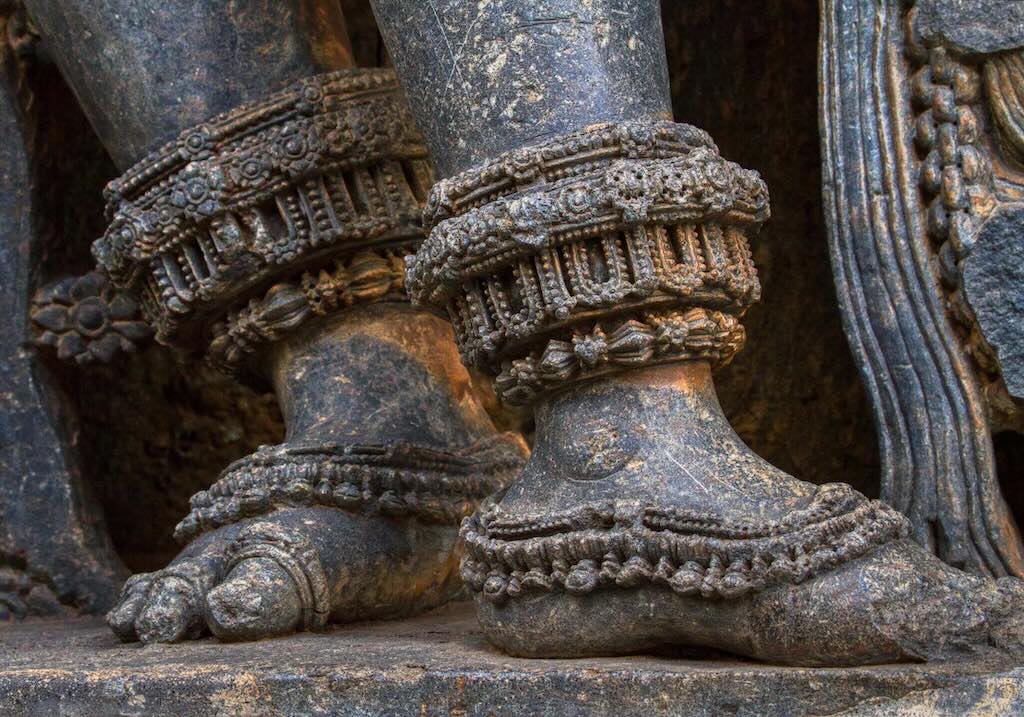
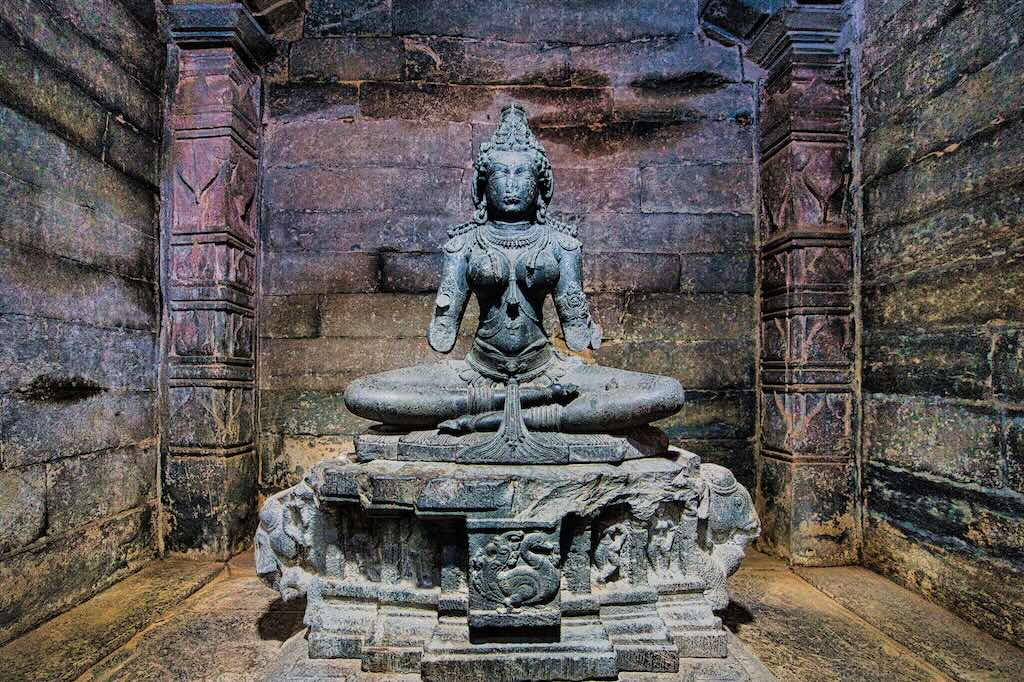
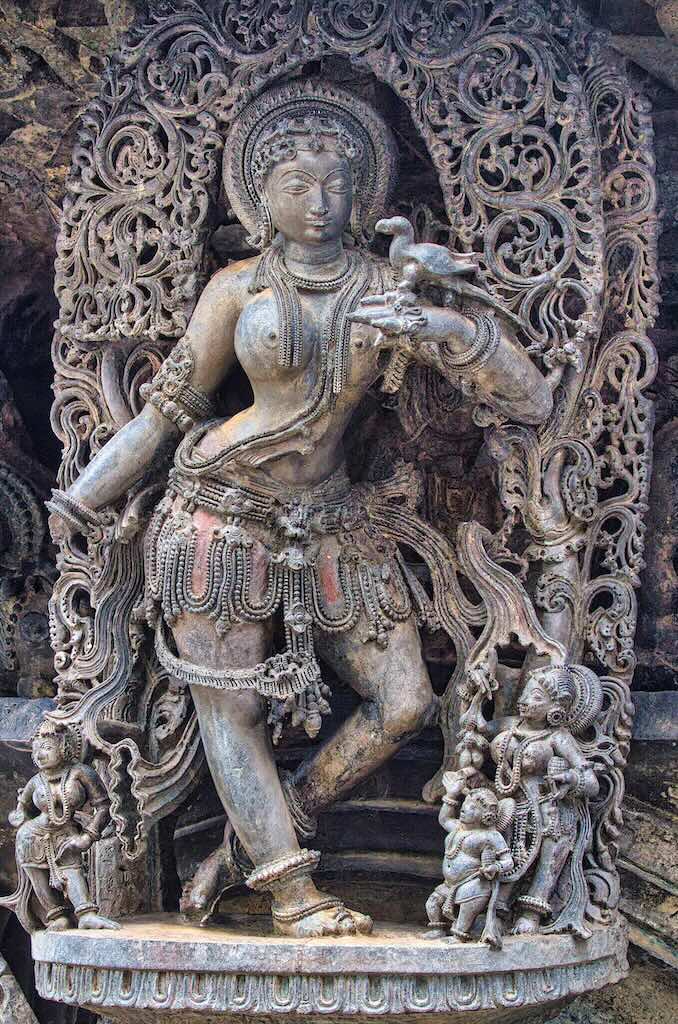
The Madanikas of the early 12th-century Chennakesava Temple at Belur are among the most celebrated sculptures in Indian art. Depicted as dancers, musicians, huntresses, and noblewomen, they capture moments of beauty and movement with remarkable realism. Carved beneath the temple eaves, these masterpieces showcase the artistic genius of Hoysala sculptors.

.
I’m not treating Bengaluru as the end of the story. Given the response, the sponsor plans to take Whispers in Stone to other cities, other museums, other schools, and let more of India meet the version of itself that thirty thousand years of stone have quietly been recording all along but has hardly received much space in popular discourse.
.
.
“Civilisations do not die when their monuments fall. They die when their children stop listening to the stones’ whispers.”
.
.
A list of all my blog posts can be seen at the link below:
.
Note: All photographs displayed above with watermarks are my exclusive property and copyright; their use is prohibited without explicit consent, in writing.
.


4 Responses
Remarkable in bringing to life the kaleidoscopic ‘dharohar’ of our history.
It shall be a pleasure to delve deeper and glean from your vast experience
Thanks. There is just so much we are unaware of about our heritage, and many engage in discussions with minimal knowledge of the subject.
What pictures ! What narration ! Amazing knowledge ! Almost giving life to the sculptures ! This is how education needs to be ! Brilliant, Sir !
Thanks. Hope more people visit these places to see the wonders our heritage has, which are hardly known to most people.