
.
“There is not a single place in Kashmir which is not holy”
Kalhana, 12th century Historian
.

.
Kashmir is known for its beauty and salubrious climate, especially in summer, and being a tourist’s paradise with its breathtaking and magical locales. Nature has generously sprinkled the region with mountains, forests, lakes, streams, and rivers, which have been enhanced with beautifully manicured gardens to attract visitors. Kashmir has unfortunately been affected by terrorist activity, which has somewhat dampened the enthusiasm of people from the rest of India from visiting the region. However, since 2019 the situation has been improving and the first five months of 2022 saw a record influx of 7,00,000 tourists flooding Kashmir, swamping the available facilities. I was one of that group, and despite the constraints on logistics, spent a lovely 10 days traveling to the remote regions without much difficulty.
.

.
The trip was not a run-of-the-mill sightseeing trip, but to visit the ancient temples of Kashmir, many of them located in remote and terrorist-affected areas. After my recent trips to visit the temples of Karnataka and Goa, this was icing on the cake for me, since managing the logistics for such a tour is not easy individually. I was lucky to learn about this trip and grabbed the opportunity which dropped into my lap. One has often read about Kashmir being Rishi Bhoomi and the land of Shaivism since ancient times, a place for learning and study which was traversed by great sages like Kashyap, among the progenitors of mankind.
.

.
Besides reading about the mostly-forgotten temples, most of which are in ruins, it will be instructive to know a little about the itihaas of the region, which have always played an important role in Sanatana Dharma, and in the history of Bharat. I had a foggy idea about Kashmir’s past like most other Indians, and it was only when I visited the places did the urge to know more push me to read about its past.
.

.
About this Blog: My visit to Kashmir has been divided into two blogs: Part 2 (this blog) is the itihaas of Kashmir and the itihaas/significance of the places we visited; while Part 1 is the travelogue. All shrines in Kashmir are ancient and each has its own itihaas, which makes for interesting reading and without which they would be another meaningless stone structure.
Note: Readers wishing to go directly to the travelogue, can skip this historical blog and go to “Kashmir – The Land of Rishis: Part 1 – Travelogue” by clicking the link here.
.
Itihaas of Kashmir
.
Vedic Text References
.
The Kashmir region has been a very important center of Sanatana Dharma since pre-historic times. Construction of beautiful temples dedicated to different deities was carried out during the reign of many Hindu Kings until the 13th century. Most of these ancient temples are dedicated to Shiva. Since the 9th century, Shaivism became the predominant religion. However, Islamic rulers invaded and ruled Kashmir from the 13th to the 15th century, which led to the eventual decline of Shaivism in Kashmir, which was coupled with the gradual destruction of most temples.
.

.
The earliest text which directly mentions the name Kashmir is in Ashtadhyayi written by the Sanskrit grammarian Pāṇini during the 5th century BCE. Pāṇini called the people of Kashmir Kashmirikas. Some other early references to Kashmir can also be found in Mahabharata in Sabha Parva and in puranas like Matsya Purana, Vayu Purana, Padma Purana, Vishnu Purana, and Vishnudharmottara Purana. The word has been referenced in a scripture mantra worshipping Sharada Devi where it is mentioned that she resided in the land of Kashmira, which is likely to be Sharada Peeth.
.
Etymology
.
The reader would have noticed that I use the term “itihaas” and not “history” while referring to the origin of places and shrines. This is because many Sanskrit words are “non-translatable” into English. The philosophy and many concepts of Sanatana Dharma do not exist in Abrahamic religions. Consequently, the meaning of many Sanskrit terms does not have any equivalent in English or other Western languages since that concept cannot be comprehended by them, being outside of their philosophy. This is the reason that Western language translations of scriptures suffer from gross infirmities and often convey incorrect meanings. Thus, itihaas and Puranas are NOT “history” and “myth”, as they are generally regarded. Thus, “aatma” is not “soul”, “maya” does not mean “illusion” or “praakriti” mean “nature”. The word itihaas etymologically means “so it has been”; Amarakosha (1:6:4) defines Itihaas as a text which narrates events that occurred in the past. Itihaas means “expansion or elaboration of an incident which happened in the past”. History is a chronological account of facts, whereas, itihaas is not merely history and the narrative may not be linear in time. The two famous itihaas – Ramayana and Mahabharata – have been used for pedagogical purposes. The Indian conception of Puranas and itihaas can be regarded as an interpretative account of past events in a cultural or spiritual context.
.

.
Kashmir derives its name from Kashyapa Rishi. According to Christopher Snedden, the name Kashmir could be a shortened form of “Kashyapa Mira“, or the “lake of sage Kashyapa”. Alternatively, it may come from a Kashmiri or Sanskrit term that means “to dry up water”. It could also have been derived from the term “Kashyapa Meru“, which means the sacred mountains of Kashyapa.
Kashyapa is one of the Saptarishis of this Manvantara. Saptarishis are regarded as the patriarchs of the Vedic religion. Kashyapa was the son of Marichi and the grandson of Brahma. He was the father of the Devas, Asuras, Aryaman, Mitra, Pusan, Varuna, Nagas, Garuda, Vamana, Agni, Adityas, Daityas, and all of humanity. Hence he is also referred to as the progenitor, Prajapati. His lineage continued as Ikshvakus, Raghuvamsha, leading to Bhagwan Rama. He was the author of the treatise Kashyapa Samhita, which is a classical reference book in the fields of Ayurvedic Paediatrics, Gynaecology, and Obstetrics.
.
Nilamata Purana
.
The Nilamata Puran is an ancient treatise on the geography, culture, and history of Kashmir. It begins with a dialogue between Rishi Vaishampayan and King Janamejaya who enquires about the absence of Kashmir Kings in the Mahabharat war. The Rishi mentions that following the death of Kashmir’s King Gonada (friend of Jarasandha) and his brother Damodar by Balarama and Krishna respectively, the pregnant queen Yashovati was crowned Queen as there was no heir yet. Yashovati’s son, King Gonada the Second, was still a minor during the Mahabharata war and was therefore debarred (or rather not expected) to participate. Regardless of its historicity, the Nilamata Puran is indispensable for references to Kashmir, war etiquettes, surprising phenomena like crowning a pregnant queen, geographical details (like Gandhara, present-day Afghanistan), and Kashmir’s natural beauty.
.

.
The Nilamata Purana narrates the story of the evolution of Kashmir. For six Manvantaras since the beginning of the kalpa, the region of Kashmir was a beautiful lake. In the exchange between King Gonanda and Sage Brhadasva, the latter gives an account of the time divisions, the destruction of the world, turning into a sea at the end of the manvantara, Mahadeva staying all around the world in the form of water, Sati assuming the form of a boat and the future Manu placing all the seeds in that boat, Vishnu assuming the form of a fish and guiding the boat to a mountain later on named Naubandhana, the end of the period equal to krta and then Manu bringing about the creation of beings as before, Sati becoming the earth and the emergence of a lake of clear water, known as Satidesa, and at the approach of the seventh (Vaivasvata) Manvantara, the origin of various tribes from Kashyapa, who was married to the thirteen daughters of Daksa. Of these, the Nagas are the sons of Kadru and Garuda the son of Vinata, both daughters of Daksa. Owing to their tribal conflict the Nagas were constantly harassed by the Garudas and sought the protection of Vishnu. He granted them and their chief, Vasuki, safety in Satisara and appointed Nila as their king.
.

.
The itihaas refers to the tribal warfare in which the Nagas seem to have been pushed towards the lake of Satisara. In the next phase of the conflict Jalodbhava, the Daitya chief of the water dwellers scares away the tribes of Darvabhisara, Gandhara, Juhundara, Sakas, Madras, etc., and threatened the very existence of the Nagas. Nila then approaches Kashyap for help. The two approached Druhina, Upendra, and Rudra (Brahma, Vishnu, and Shiva) and got the Daitya Jalodbhava killed. The land reclaimed from the lake was called Kasmira and the gods built their hermitages there.
Thus what had been an enrapturing lake for six Manvantaras since the beginning of the kalpa, became a beautiful territory (visaya) in the seventh Manvantara.
.
Rājatarangiṇī
.
One of the biggest criticisms that Indian historical tradition has faced is first, the absence of awareness around it, and secondly, the lack of an unbiased scientific approach in its writing. This is the result of the Western approach to writing “history”, and the Indian concept of “Itihaas”, which is completely alien to Western thought. However, one of the standout compositions that have somewhat managed to escape criticism is Kalhana’s history of Kashmir titled ‘Rājatarangiṇī’. Repeated efforts by historians both within and outside India have allowed us to analyze Rājatarangiṇī in its entirety and seek a glimpse into one of the oldest areas of Indian civilization, Kashmir.
In this regard, Shonaleeka Kaul states: “The Rajatarangini is an account of the many royal dynasties that ruled the ancient kingdom of Kashmir from its mythical origins down till the poet’s own time. It gained iconic stature ever since 19th and 20th century scholars labeled it as the first work of history proper to be found in the entire corpus of Sanskrit literature. They thought so mainly because of the deference the text shows to recording chronology, to historical causation, and to objectivity.” (Kaul: 2020)
.

.
Rājatarangiṇī comprises of 8 cantos (volumes). The book begins with the date of the crowning of King Gonada the First, which is contemporary to the accession of Yudhishthira in Mahabharata (653 Kali Age).
Rājatarangiṇī, literally meaning ‘river of kings’, is a connected narrative of dynasties that ruled Kashmir, beginning with well-known legends and then aligning with the chronological narrative. It isn’t focused on a particular dynasty or king and wasn’t financed by a court, which makes it free of bias on the author’s part. In fact, this is one of the main reasons why it still survives. The original author (Kalhana) was the son of the great Kashmirian minister Lord Canpaka who was appointed in the court of King Harsha of Kashmir. The book Rājatarangiṇī was written in the ‘Year 4224 of the Laukik Era’ or 1148-49 CE (12th century). Canpaka was the ‘dwarpati’ or commandant of the frontier defenses under King Harsha.
Regardless of his Shaivite background, Kalhana shows a friendly attitude to Buddhist traditions in Kashmir. He praises kings from Ashoka all the way down to King Meghavahana for building Stupas and Viharas in Kashmir that sadly barely exist today. For centuries before Kalhana’s time Buddhism and Shaivism had co-existed peacefully in Kashmir. Kalhana refers to Buddha as ‘the comforter of all beings’. Donors of the shrines of Buddha and Shiva/Vishnu were often shared. Kalhana mentions King Harshavardhana of Kannauj (who was also recorded by Hieun Tsang) and King Kumarpala of Gujarat as financers of Stupas and Temples alike.
One of the most well-known sources that Kalhana mentions in his epic is the Nilamata Puran. Further, Kalhana’s geographical viewpoint wasn’t myopic. He frequently mentioned places in the southern parts of the subcontinent, connections with Kamrup (present-day Assam), Gandhar, Iran, Iraq, Turkey, rivers, and places of Shaiva worship in mainland India. His commentary on Kashmir was very much based on reality.
.
Foreign References to Kashmir
.
In ancient texts of Greece, linked to the expedition of Alexander, this land has been called “Kasperia“, possibly a short form of “Kasyapamira“. Speaking of the geographical position of the country, which he calls by the name of Kaspeiria, Ptolemy remarks that it is situated “below the sources of the Bidaspes (Vitasta) and of the Sandabal (Chandrabhaga) and of the Adris (Iravati).” The word “Kaspapyros” appears in Greek geographer Hekataois’ text, and as “Kaspatyros” by Herodotus who states that Skylax and the Karyandian began in Kaspatyros while tracing the path of Indus river from the mountains to where it drained in the sea. Kaspatyros may be the same as Kaspa-pyrus or Kashyapa-pura (city of Kashyapa) in other texts.
The earliest Chinese reference which can be attributed to Kashmir is dated 541 CE. It describes the northern part of India as a country “enveloped on all sides like a precious jewel by the snowy mountains, with a valley in the south which leads up to it and serves as the gate of the kingdom.” But by far the greatest Chinese authority on Kashmir is the pilgrim Hsuan-Tsang, who visited Kashmir in 631 CE and spent two years there studying “the Sutras and Sastras.” A fairly detailed description of the country is contained in the itinerary and life of Hsuan-Tsang, who was accorded a princely welcome by the ruler of Kashmir. He entered Kashmir by way of Baramulla. He found Buddhism flourishing though not predominant during that time.
.
Shakti Worship
.
The earliest known shrine dedicated to Shakti worship in Kashmir is Sharada Peeth (6th–12th century CE), dedicated to Sharada Devi. It is a ruined temple and ancient center of learning located in present-day Pakistan-Occupied Kashmir. Sharada Devi worshipped in Sharada Peeth is a tripartite embodiment of Shakti: Sharada (goddess of learning), Saraswati (goddess of knowledge), and Vagdevi (goddess of speech, which articulates power). Kashmiri Pandits believe the shrine to be the abode of the Devi. In line with the Kashmiri Pandit belief that water springs which are the abode of Devis should not be looked at directly, the shrine contains a stone slab concealing the spring underneath. This is the spring in which Devi Sharada revealed herself to Rishi Shandilya. This advanced the importance of knowledge and education in Kashmiri Pandit culture, which persisted well after Kashmiri Pandits became a minority group in Kashmir.
.

.
As one of the Maha Shakti Peethas, Hindus believe that it represents the spiritual location of Sati’s fallen right hand. Sharada Peeth is one of the three holiest sites of pilgrimage in Kashmir, alongside the Martand Sun Temple and the Amarnath Cave. The later shrines dedicated to Shakti worship in Kashmir include the Kheer Bhawani and Vaishno Devi temples.
.
Shaivism
.
Kashmir Shaivism is an influential tradition within Shaivism that emerged in Kashmir in the 1st millennium CE and thrived in the early centuries of the 2nd millennium before the region was overwhelmed by Islamic invasions from the Hindu Kush region. The Kashmir Shaivism traditions became nearly extinct due to Islam except for their preservation by Kashmiri Pandits. Abhinavagupta was one of the most outstanding Acharyas of the Shaiva philosophy. We learn from references about him in Tantraloka and Paratrimshika Vivarana. He lived in Kashmir at the end of the 10th and the beginning of 11th centuries CE. The earliest ancestor of Abhinavagupta was a famous Brahmin, Attrigupta, who lived in Autarvedi, the ancient name of a tract of land lying between the Ganga and the Yamuna in the Gangetic plains. Attrigupta, a great Shaiva teacher, was invited by Emperor Lalitaditya. A spacious house was built by the orders of the king on the banks of the Jhelum (Vitasta) for Attrigupta and a big Jagir was granted to him for his maintenance.
.
Establishment of Muslim Rule in Kashmir
.
During the 8th century CE, the Kingdom of Kashmir was subjected to several attacks aimed at its conquest. Attempts to conquer Kashmir were made by the Arabs who had established themselves in Sindh (711-713 CE), under the leadership of Muhammad bin Qasim. But Muhammad bin Qasim was recalled by the Umayyad Caliph to Damascus, thus averting a possible invasion. In the reign of Caliph Hisham (724-743 CE), the Arabs again marched towards Kashmir under the leadership of the ambitious governor Junaid. Lalitaditya Muktapida, the Raja (ruler) of Kashmir, defeated Junaid and overran his kingdom. A last attempt at the invasion of Kashmir was made by Hisham ibn ‘Amr al-Taghlibi, the Governor of Sindh, appointed by Caliph Mansur (754-775 CE). Though he reached as far as the southern slopes of the Himalayas, which were a part of the Kashmir Kingdom, he failed to enter and occupy the valley. The decisive defeat of the Arabs ensured a period of peace in the region thereafter.
.

.
After the Arabs, it was the Ghaznavids who attempted to conquer Kashmir. Mahmud of Ghazni, defeated Raja Jaipal (1002 CE), the ruler of Waihand (near Peshawar, in modern-day Pakistan). Anandpal, the son and successor of Jaipal, also suffered a crushing defeat at the hands of Mahmud in 1009 CE and died a few years later. Anandpal’s son Trilochanpala, whose power of influence was now confined only to the Salt Range, appealed to Samgrāmarāja (1003-1028 CE), the king of Kashmir, for help against Mahmud. A large army contingent was sent by Samgramaraja, who joined Trilochanpala’s forces. However, their combined forces were defeated by Mahmud in 1014 CE. Mahmud advanced towards Kashmir and tried entering the kingdom via the Toshamaidan Pass. His progress was checked by the strong Loharkot Fort, which he besieged for a month. Owing to heavy snowfall, which cut off Mahmud’s communications, he was compelled to retreat. However, the Sultan again set out to invade Kashmir in September–October 1021 CE, but was again compelled to retreat due to bad weather conditions.
.

.
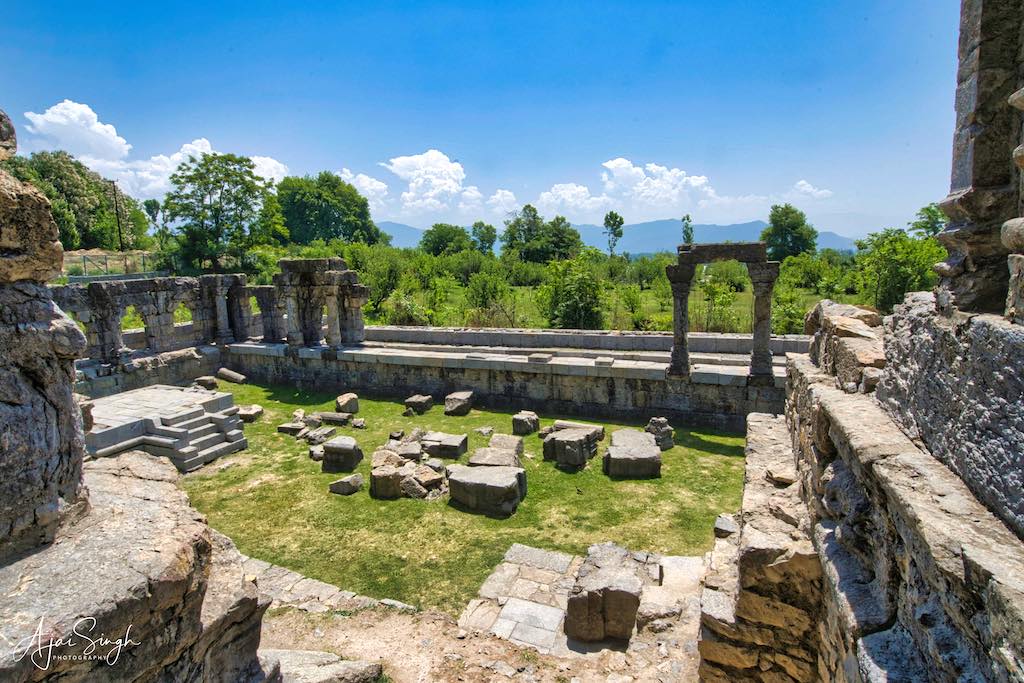
After Sultan Mahmud’s attempted conquests, Kashmir remained generally unaffected by invasions that remained aimed at the plains of India, up until 1320 CE. The Loharas (1003-1320 CE) ruled during this period, and they were the last of the Hindu dynasties of Kashmir. In the spring of 1320 CE, a Mongol chieftain by the name of Zulju invaded Kashmir via the Jhelum Valley route. Suhadeva (1301–1320 CE), the last ruler of the Loharas, tried to organize resistance but failed due to his unpopularity among the masses. The reason for this unpopularity was financial exaction and general misrule that prevailed during the end period of the Lohara Dynasty. Zulju’s invasion created havoc and Suhadeva fled to Kisthwar. Rinchana, the son of a Ladakhi chief, who was employed by Ramachandra (Prime Minister of Kashmir) to establish law and order, took advantage of the chaos. He got Ramachandra murdered, occupied the Kashmir throne by the end of the year 1320, and ruled until his death in 1323 CE. In order to gain the acceptance of Kashmiris, he married Kota Rani, the daughter of Ramachandra, and made Rawanchandra (Ramachandra’s son) his commander-in-chief.
.
.
Rinchana converted to Islam after coming into contact with Sayyid Sharfudin, a Sufi preacher commonly known as Bulbul Shah, who had come to Kashmir during the reign of Suhadeva. He changed his name to Sultan Sardarudin Shah after converting to Islam and thus became the first Muslim ruler of Kashmir.
.
Present Situation in Kashmir
.
Today, international media, secularists, and politicians from Kashmir are shouting that Kashmir is a Muslim-majority land and that the abolition of Article 370 is a conspiracy to alter this character. But a reading of its past and a glance at place names of Kashmir will show us how false these claims are. Kashmir has been a Hindu land for millennia and its Hindu character is still reflected in the place-names of Kashmir. Most of them are of Sanskrit origin. It is amazing how Kashmir has managed to retain the old Sanskrit place names despite direct Islamic rule from 1339 CE until 1819 and at least 7 exoduses of its Hindu population. This shows the strength and prevalence of Hindu roots in Kashmir. But these names have come under the target of Islamist Wahhabis in the Post-Independence era. In 1980, then Kashmir CM Sheikh Abdullah renamed 2500 villages. He erased the historic heritage of these places and replaced them with Islamic names. Anantnag became Islamabad. Hari Parbat (skt. Sharika Parvata) became Koh-I-Maran. It is unimaginable how such gross elimination of historic heritage and blatant Islamization did not come under the notice of anyone in Secular India. This incident happened right under the nose of then-PM Indira Gandhi.
While exploring the history of Kashmir, I did come across an anomaly regarding the population figures of the state. In the 1901 Census of the British Indian Empire, the population of the princely state of Kashmir and Jammu was 2,905,578. Of these, 2,154,695 (74.16%) were Muslims, 689,073 (23.72%) Hindus, 25,828 (0.89%) Sikhs, and 35,047 (1.21%) Buddhists, (implying 935 (0.032%) others). In the last census of British India in 1941, the total population of Kashmir and Jammu (which as a result of the Second World War, was estimated from the 1931 census) was 3,945,000. Of these, the total Muslim population was 2,997,000 (75.97%), the Hindu population was 808,000 (20.48%), and the Sikh 55,000 (1.39%). In the 2011 census, out of the 1.25 Crore population (including Ladakh), around 68.31% are shown as followers of Islam, 28.44% Hindus, 2.34 Lakhs, 1.87% Sikh, and 0.90% Buddhists. The population of Hindus and other minorities like Sikhs should have gone done after the genocide/exodus of the 1980s and 90s. Unless those who left are still being shown as Kashmiris.
.
Dating Adi Shankaracharya’s Visit to Kashmir
.
Most of the present-day literature states that Adi Shankaracharya was born in 788 CE. It was mostly European scholars who defined that date. However, Adi Sankaracharya was born in 510 BC as researched and published in The Theosophist magazine in 1883. Until the British came to India, Indian history was using Yudhistira yuga or Salivahana saka etc, and not Christian Era to record dates. Irrespective of the dates, one unquestionable fact is Adi Shankaracharya’s establishment of 4 peethas at 4 corners of India i.e., Sringeri in the South, Dwaraka in the West, Gowardhana Matha in the East and Jyothir Math in the North. Kanchi matha is another one set up by Sankaracharya. Their traditional lineage lists (guru-parampara) list the names and usually the dates of each successive pontiff of that particular matha. The list of the Dwaraka Peetha in the West gives the birth date of Sankara as 2631 of the Yudhisthira era, corresponding to 509 BCE. The list of the Sarada matha (at Kanchi) in the South gives the date 2593 of the Kali Yuga era, also corresponding to 509 BCE. It is significant that two different lineage lists from two widely separated mathas, having 77 and 68 successors respectively, both go back in an unbroken line to 509 BCE.
There is also epigraphic evidence supporting the date of 509 BCE for Sankara’s birth. This is a copper plate inscription addressed to Sankara by King Sudhanvan of Dwaraka, dated 2663 of the Yudhisthira era, corresponding to 477 BCE, the year of Sankara’s death. Since Sankara died at the age of 32, this correctly places his birth in 509 BCE.
The point which now rises is why Western scholars have been motivated to place Sankara’s date of birth in CE not in BCE. The traditional Western religious scholars, most of whom are Christian missionaries have been trying to change the dates of any philosophy to CE i.e., post-creation of Christianity. With this manipulated date information they want to create another theory that Sankara’s philosophy was influenced by the Bible and Christian teachings. However, had Sankara been born in 788 AD, it would have taken him no time to denounce the Christian teachings which by the 8th century had taken root in his native land (Kerala). It should be kept in mind that Adi Sankara was born in Kerala and the first Indian Christian roots also took place in Kerala. Adi Sankara traveled the length and breadth of India to debate and convert non-Vedic thoughts and definitely he wouldn’t have let off Christian groups near his place of birth.”
To read more details on dating, read Chapter 14 of the book “The Chronology of India from Mahabharata to Medieval Era Volume I” by Vedveer Arya. The link to the book is given below.
https://www.academia.edu/50944757/The_Chronology_of_India_From_Mahabharata_to_Medieval_Era_Volume_I
.
Emperor Lalitaditya Muktapida’s Akhand Bharat
.
Before I end writing about the history of Kashmir, I would be amiss if I did not make a special mention of Lalitaditya Muktapida, one of the mightiest emperors of Bharat and I daresay the world! His empire extended from Kashmir to Central Asia, from Uzbekistan to the Sundarbans. One of the few, if not the only one, who made Akhand Bharat a reality. He ruled for 37 years from 724 to 761 CE and the rule is considered the golden age of Kashmir when art, architecture, and learning flourished alongside his military achievements. He was the 5th of the Karkota Naga dynasty, which was founded by Durlabhvardan, an officer in the Gondaiya kingdom. Lalitaditya’s conquests have been chronicled in numerous texts, in renowned historian RC Majumdar’s treatise “Ancient India”; by Al Beruni, the Persian scholar, in his “Tarikh-I-Hind”; and in “Xing Tang Shu”, a book documenting the history of the Chinese Tang Dynasty.
.

.
Consolidating his empire in India by subjugating the Pashyabhutis (Kanyakubja), Rashtrakut (Vindhyas), Kalinga (Orissa), Gauda (Bengal), Konkan, Dwarka, Avanti, Punjab and Afghanistan, the mighty king then turned his attention to Central Asia. Folklore mentions that Bappa Rawal, another famous warrior from Mewar, joined him in some of his campaigns. He subjugated Ladakh and with Muhammed Bin Kasim having invaded Multan in 712 CE, Lalitaditya turned the Tang dynasty of China into an ally in his fight against the Arabs and Tibetans. This also let him extend his empire over the Ahoms (Assam) and other North Eastern states. He soon faced an attack by Junaid, the Arab governor of Sindh, who attacked Kashmir under the orders of Caliph Hisham. His Central Asian victories covered present-day Uzbekistan, Tajikistan, and Kazakhstan, and went on to the Caspian Sea and Aranyaka (Persia). The terror he struck in his adversaries ensured that no Islamic invader attacked India till 300 years after his reign when Mahmud of Ghazni invaded India between 1020-1025 CE. Not only in his military victories, but Lalitaditya also was a great builder and constructed numerous temples, including the famous Martand Sun Temple, Naranag temples, and Buddhist stupas, and established a magnificent capital at Parihaspur.
.
Itihaas of Places/Shrines Visited
.
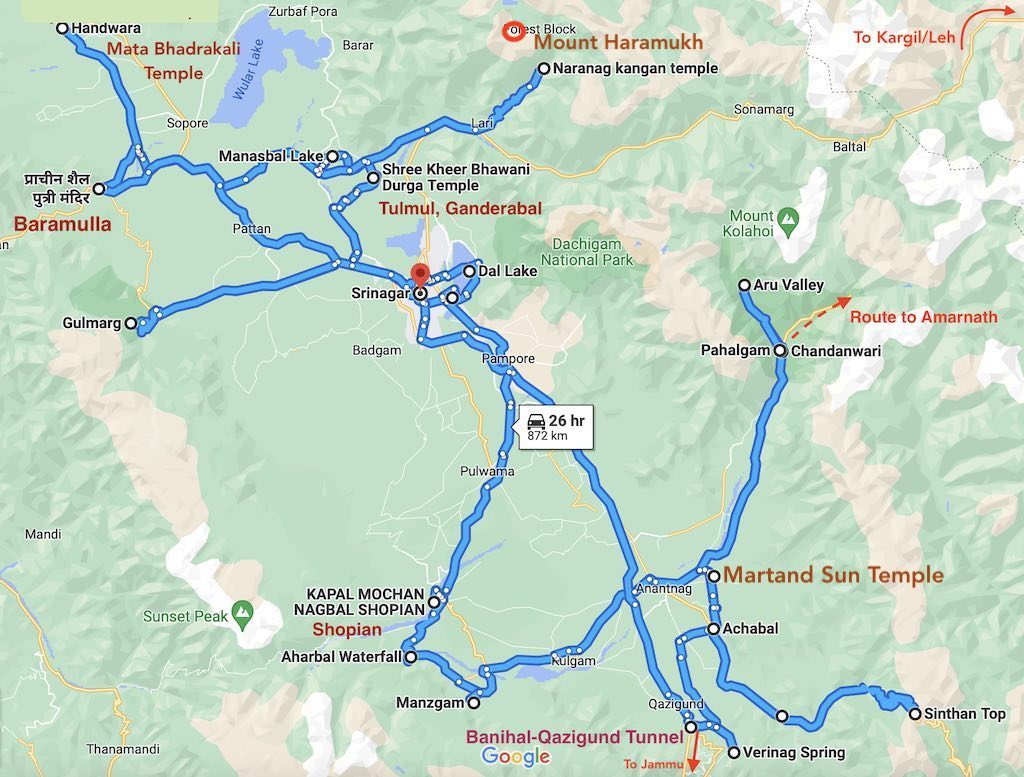
Route Map of Our Journey
.
The places we visited during our tour are marked on the map below. It gives an idea of the geography of the Kashmir Valley and the places mentioned in this blog.
.
.
Dal Lake
.

.
Dal is mentioned as Mahasarit (Sanskrit: महासरित्) in ancient Sanskrit texts. Ancient history records mention that a village named Isabar to the east of Dal was the residence of Durga. This place was known as Sureshwari on the bank of the lake, which was sourced by a spring called the Satadhara.
.

.
During the Mughal period, the Mughal rulers of India designated Kashmir, Srinagar in particular, as their summer resort. They developed the precincts of the Dal in Srinagar with sprawling Mughal-type gardens and pavilions as pleasure resorts to enjoy the salubrious cool climate. After the death of Aurangzeb in 1707, which led to the disintegration of the Mughal Empire, Pashtun tribes in the area around the lake and city increased, and the Afghan Durrani Empire ruled the city for several decades. In 1814 a significant part of the Kashmir valley, including Srinagar, was annexed from the Afghans by Maharaja Ranjit Singh to his kingdom, and the Sikhs grew in influence in the region for 27 years. During the Dogra Raj, Srinagar became the capital of Dogra territory. Although the Dogra Maharaja of Kashmir restricted the building of houses in the valley to enable controlling unfettered building activity, the British circumvented this rule by commissioning lavish houseboats to be built on the Dal. Creating the legacy of houseboats in the lake, which do not move and remain permanently anchored. Unlike elsewhere, like in the backwaters of Kerala where they move around.
.


.
Shankaracharya Temple
.
The structure is considered the oldest temple in Kashmir, historically and traditionally. The earliest historical reference to the hill comes from Kalhana. He called the mountain ‘Gopadri’ or ‘Gopa Hill’. Kalhana says that King Gopaditya granted the land at the foot of the hill to the Brahmins that had come from the “Aryadesa”. The land grant, an agraharam, was called ‘Gopa Agraharas’. This area at the base is now called Gupkar.
.

.
According to renowned historian, Pandit Anand Koul (1924), the temple was originally built by King Sandiman who reigned in Kashmir from 2629-2564 BCE. It was then extensively renovated by King Gopaditya (426-365 BCE) and then by King Lalitaditya. Kalhana also mentions that King Gopaditya built the temple on the top of the hill as a shrine to Jyesthesvara (Shiva Jyestharuda), which was completed around 371 BCE. This fact is also agreed to in the writings of Abdul Fazal. The temple was visited by Adi Shankara (early 3rd century BCE) and has ever since been associated with him; this is how the temple and hill got the name Shankaracharya. It is here that Adi composed his literary work, Soundarya Lahari.
.

.
As per legend, Adi Shankara visited Kashmir when Kashmiris were culturally & spiritually much advanced and believed strongly in the greatness of both Shiva and Shakti. On the other hand, Shankaracharya believed in Shiva, not Sakti. Shankaracharya camped with his disciples outside the city of Srinagar without any lodging facilities. A young Kashmiri woman was sent to meet Shankaracharya to determine their living conditions. She found them in a difficult situation as they were not able to cook as no fire was made available to them.
The young woman asked Adi why he was not able to produce fire despite being great. Then she picked two thin wooden sticks in her hand, recited mantras, and rubbed the sticks, and fire was produced, much to the surprise of Adi Shankaracharya. Later, a religious discourse was arranged between Shankaracharya and the woman. It went on for 17 days continuously. Finally, Adi Shankaracharya accepted defeat. He then realized the importance of the Shakti cult. After accepting the predominance of the Shakti cult, Shankaracharya wrote Soundarya Lahiri in praise of Shakti. There is a small room inside the stone platform below the temple where Shankaracharya stayed and performed his meditation/sadhanas.
.

.
The Jews and Persians used to call the hill as Bagh-i-Sulaiman, meaning the “garden of King Solomon”. Sikandar Butshikan (Sikandar the Iconoclast) did not destroy the temple for some reason. The Persian inscriptions on the temple mention the name of Yuz Asaf who visited the shrine, with some claiming he even renovated it. There is a popular belief of Jesus visiting Kashmir with the lost “thirteenth tribe”, with his tomb being the revered Rozabal Shrine in old Srinagar; a shrine claimed by both Muslims and Christians even today. This would add credence as to why the hill was named Solomon in local folklore. I visited Rozabal during one of my earlier trips and found the shrine sealed due to conflicting claims about it. I could only peep through the windows to see the tomb inside.
The present re-constructed structure of the temple is from the 6th century CE. The temple rests on solid rock with a 20 ft high octagonal base supporting the square building on top, which is 30 feet high. The temple has a circular sanctum sanctorum with two lintels supporting the load of the roof on four octagonal columns in the center. The dome-shaped ceiling and brick roof over the sanctum is of recent construction, though the base of the structure is ancient. The sanctum houses the presiding deity, Jyesthesvara, in the form of a Shiva Linga. The Linga is large and oval-shaped, made of reddish black stone, probably sourced from the Narmada River valley in Madhya Pradesh, and brought during the period of Sikh rule.
.
Gulmarg
.

.
Originally called Gauri Marg (meaning “the path of Devi Gauri”), its name was changed to ‘Gulmarg’ in the 1500s by Yousuf Shah of the Chak dynasty. The existing Shiva Mandir, or Maharani temple, was the site of an ancient temple dedicated to Shiva and Parvati. The temple was demolished during Islamist invasions. But Hindus continued visiting the tirtha and it was not forgotten. In 1915, Dogra king Maharaja Hari Singh built a new temple at that spot for his wife Maharani Mohini Bai Sisodia. It is now known as Maharani Temple (commonly known as Shiv Temple of Gulmarg). This shrine was the royal deity of the Dogra kings. This temple is situated on a slight hilltop with green meadows surrounding it and is visible from all corners of Gulmarg.
.
Kheer Bhawani or Rangnya Devi Temple, Tulmul
.
Situated in the village of Tulmul in Ganderbal [the original Sanskrit name was Gandharapura – ‘the place of Gandhara’ (Brahmins)]. It is dedicated to Kheer Bhavani and is constructed over a sacred spring. As is the custom, the devi has many names including Ragyna or Rajna, along with variations in honorifics such as devi, mata, or bhagavati. The term kheer refers to a sweet milk and rice pudding that is offered to propitiate her. Kheer Bhawani, an incarnation of Durga, is sometimes translated as ‘Milk Goddess’. The worship of Kheer Bhawani is universal among the Pundits of Kashmir, most of them who worship her as their protective patron deity (Kuladevi).
The temple is one of the most important temples for Kashmiri Pandits. The resident deity, Kheer Bhawani, is a favourite in this region. A heptagonal spring at the temple surrounds the devi. The sacred spring is known to change its colour with various hues of red, pink, orange, green, blue, and white. A black/red or dark shade of the spring water is believed to be inauspicious. During the visit of the British Settlement Commissioner in 1886, he witnessed the water to be of a violet hue. In more recent times, this colour change has been reported on numerous occasions – during the tribal raiders attacking Kashmir post-independence (turned red and then black); Indira Gandhi’s assassination and Sikh genocide (turned red); during the Hindu genocide in Kashmir in the 1990s (turned red), and again before the 1999 Kargil War.
.

.
According to itihaas, Ragyna was pleased with the devotion of Ravana and appeared before him. Subsequently, Ravana got an image of the Devi installed in Lanka. When Ravana completed his prayers to the goddess he offered kheer to her, which she acknowledged, and from that point, she is called Kheer Bhawani. However, the Goddess became displeased with Ravana’s non-Dharmic behaviour and asked Hanuman to remove her from Satisar (Kashmir). With his help from Hanuman, she was brought first to Manzgam to the Kheer Bhawani Temple there, and then to Tulmul. The night she reached is celebrated as Ragnya Ratri. Though Ragyna is a form or rupa of Durga, this one is a vaishnav form i.e. a manifestation of serenity and happiness. Ragyna, also known as Tripurasundari, while in Lanka she was called Shayama.
The mention of Kheer Bhawani is found in Kalhana’s Rājatarangiṇī. Kalhana writes that the sacred spring of Tula Mula is situated on marshy ground. Thousands of years ago, floods inundated the spring and temple. Kashmir’s Yogi Krishna Pandit Taploo of Bohri Kadal, Srinagar had a dream in which the Goddess appeared to him and directed him to the location of the sacred spring. The place is also mentioned in the Bhrigu Samhita.
.

.
Swami Vivekananda visited Kashmir. During this stay, while ritually worshiping Kheer Bhavani, the condition of the temple concerned him. In The Complete Works of Swami Vivekananda, the goddess tells Vivekananda, “It is My desire that I should live in a dilapidated temple, otherwise, can I not immediately erect a seven-storied temple of gold here if I like? What can you do? Shall I protect you or shall you protect me!”
.
Naranag Temples
.
The Naranag temples are a major attraction for tourists, though their remote location limits the number who can reach the place, except for trekkers. It is also known in texts as the Wangath Temple complex, from the name of the river flowing past, and is one of the important archaeological sites of the country. The site consists of a cluster of temples facing each other at a distance of about 200 meters. The temple is dedicated to Shiva and was built by Emperor Lalitaditya Muktapida, of the Kayastha Naga Karkota Dynasty in the 8th century CE.
.

.
Kalhana, in his text Rājatarangiṇī mentions that the Mauryan King Ashoka had built the city of Srinagari (present-day Srinagar) in the 3rd Century BCE. His son, Jaluka had built temples dedicated to Lord Bhuteswara, Jyestarudra, and Muthas (all forms of Shiva) at Wangat Valley near the sacred spring of Naran Nag during 220 BCE. These temples were in three groups, built around the same time the Shankaracharya Temple was built in Srinagar and the Bumazuv Temple near Mattan. Later Emperor Lalitaditya donated a large amount of money to develop these temple complexes. He is said to have built a temple dedicated to Shiva (Jyeshthesha). King Avantivarman (855 to 883 CE) built a stone pedestal with a silver conduit at the site for bathing the idol of Lord Bhuteswara. As per Kalhana, the treasures of the temple were plundered later by various kings.
.

.
The temples are also believed to be dedicated to the ancient Nagas. Hence, the name “Naranag”. It was built by the Naga Karkotas, who are said to be Hindu Kashmiri Kayasthas of the Naga sect, known for their reverence of serpents. They used to stay here and perform their sadhanas. According to the ancient Puranas, Wangat or Vangat was known as Vasishta Ashram, named after sage Vasishta. The sage is believed to have stayed at the place and consecrated the shrine of Jyestarudra at Naran Nag. The ancient spring at Wangat was also known as Sodara Nag.
.

.
According to the legend, Shiva saved Parvati or Jyestha from demons at this place. He married Parvati and took the name of Jyesthesa. In fact, Kashmiri Pundits believe that Mount Harmukh, which is not far from the mountain top above Naranag, is equivalent to Mount Kailash and is the abode of Shiva. Gangabal Lake, on the way to Harmukh, is also considered sacred, being equivalent to Mansarovar Lake. Harmukh derives from Haramukuta, the ‘diadem of Hara (Shiva)’.
The entire region is also known as Ramaradhan, as Parashurama had meditated on this mountain range.
.
Mata Bhadrakali Temple Handwara
.
Mata Bhadrakali, also called Siddhidhatri, is worshiped in Kashmir from the period of Nagas and Saraswat Brahmins as mentioned in Nilamata Puran. Shaivite Scholar Abhinav Gupt (933-1015 CE) was an ardent devotee of Mata Bhadrakali. Sir MA Stein, who stayed in Kashmir from 1843-1888 CE, made a mention of Mata Bhadrakali Asthapan. He recorded Bhadrakali Tirtha as a small village about 4 miles South-East of Kramhar marked by a spring and old lingas, which confirm the antiquity of Shila murti.
.
Mata Bhadrakali’s Arrival in Kashmir
.
The Demon Mahishasura (Buffalo demon) was used to terrorize the Rishis and Devatas in the North Kashmir area around Handwara. Rishi Muneshwar living in the jungle of Bhadharkal along with other Rishis of North Kashmir was repeatedly tortured by Mahishasura. Rishi Muneshwar (also known as Rishi Vishwamitra) approached Devi Shakti Kali at Kolkata, praying for Her intervention to end the atrocities of demons and preservation of Dharma in the area. The Devi assured the Rishis and made Her first appearance in Kashmir Mandla at Kotitirtha (Baramulla). She made Her first appearance in the form of BhadraKali, a fierce form of Kali, at Kotitirtha. As per legend, the Kotitirtha shrine was the residence of one crore Devtas (Koti-Thirtha means Crore tirtha). The Devtas greeted Kali with white tilak (bhadra) and as such she was called Mata Bhadrakali. They also handed over their powers to BhadraKali Mata to make Her all-powerful, to become Maha Shakti for vanquishing the Demons.
.

.
Mata Bhadrakali traveled across Kashmir, visiting Khanpur, Binyar, Lahsar, gave darshan to her devotees at Reshipora, Bhadra (the abode of the Sapt Rishis), Panditpora, Durushpora (called Durgapora originally), and Bhagatpora where She narrates the Bhagwat Katha on a hilltop. On hearing about the atrocities of the demons, She gave a war cry and commenced with the destruction of the demons at Handwara (Han=killing, dwara=door), killing Mahishasura. After this, She appeared in the form of Gauri. She lay down her weapons at a place called Wadipora (earlier known as Wazarpora, wazar=weapon) and finally reached Bhadrakal where she rested under a deodar tree on a hilltop. The Devtas, led by Vishnu reached the spot and thanked Mata Bhadrakali for vanquishing the Demons. That was when the murti (Shila) 6 ft in height, carved of rock stone was installed on the hilltop adjacent to a spring, under the shadow of the deodar tree. Besides this, three smaller rock murtis (Shila) of other Gods like Ganesha also were installed in front of the main Shila. As per the directions of Mata, Rishi Muneshwar settled at this location near Ganesh Kund. All the Shilas were antique and were worshipped with great reverence by the devotees till they were desecrated by the militants in the 1990s.
.

.
The Tirtha was somewhat neglected from the 14th to 19th century during the oppressive Islamic rule when the worship of Kuldevi remained confined to homes. It again flourished during the Dogra rule from 1846 onwards. Dogra King Maharaja Gulab Singh was known for his reverence towards Tirthas and once again pilgrimage resumed in all the tirtha sathals including Mata Bhadrakali.
.

.
An ashtdhatu murti of Goddess Mata Bhadrakali from Jaipur was installed near the Shila’s in 1966. This murti has an eventful history. It was stolen by miscreants in 1981, which led to strong protests by the Kashmiri Pandits. The Administration was shaken by these protests and hatched a conspiracy by giving it a communal tinge by hiring some local miscreants/goons to break the peaceful agitation. With the help of police, they assaulted the protestors violently followed by mass selective arrests. Many Pandits were put behind bars in Handwara, Kupwara, and Sogam (Lalpur) Jails. They were ruthlessly beaten and tortured by the police. Besides, Om Prakash Sharma (Saibaji) Pujari, was also arrested. However, the stolen murti of Mata Bhadarkali was recovered by the efforts of MM Khajuria, then Director General of J&K Police, from Hari Parbat Srinagar in 1983. Thereafter, the murti was shifted to Asthapan only during Navratra days and was kept under the custody of Sh Jagar Nath Ji at his residence at Handwara due to apprehension of theft. In 1990 due to the eruption of militancy and Pandit families leaving their homes, so did Sh Jagar Nath, Pujari of the Asthapan who migrated to Jammu. Later, he sold his house to a Muslim family who found the murti of Mata Bhadrakali in an almirah in the house and he handed it over to SHO Handwara. This Ashtdatu murti was later handed over to Adv. Bushan Lal Pandita, then President Sanatan Dharam Sabha Handwara by SHO P/S Handwara, who kept it with great reverence at his residence in Jammu.
.
Shailputri Temple, Baramulla
.

.
Baramulla was originally Varahamulla in Sanskrit (‘the place of Varaha incarnation’). It was here that Satisaras (Parvati’s Lake in Sanskrit) was struck by Vishnu in his Varaha incarnation, creating an opening for the water to flow out of the lake. The water was drained through a deep valley between two hills at Sheeri Narvaw resembling the mouth of Varaha, the Boar. This Varaha Muh changed its identity as Varmul and it started to be called as Varahamulla.
.

.
It has thus been a place of great reverence since ancient times, leading to numerous temples and monasteries being built here. The city of Varahamulla was founded by Raja Bhimsina in 2306 BCE. The city was the gateway to the Kashmir valley for the Mughal emperors. Baramulla sprung up around the shrine of Vishnu Adi-Varaaha which is located at the lower, i.e. northern, end of the town on the Vitasta (Jhelum) near the present Kotitirth. Apart from its strategic importance, being in control of the route leading from the valley to the outside world, especially Hazara, Gilgit, and Gandhara, the town enjoyed distinction for being a cultural center for the Hindus (at Varahakhetra) and the Buddhists at Hushkapora (present Vushkor) where Huien Tsang stayed for two nights. Later he mentioned that some copper plates, on which the proceedings of Kanishka’s council were engraved, lay buried here. The 6th Guru of Sikhs, Sri Hargobind also visited Baramulla in 1620.
It is interesting to see that the Sikh Gurus visited many of the ancient Hindu pilgrimage sites during their travels. This reiterates the commonality between the two religions and this point should be stressed in the present times when divisive forces are trying to create a divide between the two religions.
.

.
Shaktism accepts Shakti as Mother, who is the Absolute Power behind every act of manifestation. She is worshipped as the Mother. The worship of the Mother, in the form of Uma, is the most ancient form of worship in Kashmir. There are many shrines associated with the Mother Goddess. One of the most revered, Kheer Bhavani shrine of Ragyna Devi, Tullamulla we had already visited. Devibal, popularly known as Shailputri or Shaila Devi, is located on the left bank of Vitasta (now known as Jhelum) on the National Highway on the Baramulla-Uri road at Anapur (present-day Khanpur). The shrine is over 1000 years old, which can be testified from the remains of broken murtis and artifacts placed under a big chinar inside the shrine. These are six in number and include a unique Shiva Linga. After Sati’s self-immolation, Shiva’s anger cooled down after Vishnu had cut Sati’s body into 52 pieces, which fell at different places, and became the Shakti Peeths. Thereafter, the universe fell into disorder due to the absence of Shiva who went into a deep meditation. Sati was then reborn as Parvati to King Himalaya and with her devotion, she managed to break Shiva’s meditation and remarry Him, bringing back order in the universe. Shailputri symbolizes the Devi of the root chakra, Muladhara. Her awakening was toward establishing universal love with Lord Shiva that glorified her as the Devi of awareness. Upon awakening this Shakti, one begins their journey towards spiritual awakening and their purpose in life. Without energizing this chakra, one doesn’t have the power and strength to do anything worthwhile.
As the incarnation of Durga, Shailputri is worshipped on the first day of Navratri.
.
Koti Tirtha, Baramulla
.

.
There is another story as to how Baramulla came to be known as Varahamulla. There was a shrine of Lord Vishnu here called Adi Varaha. The shrine was located on the eastern bank of Vitasta (Jhelum) near Koti tirtha. The name Varahamulla is probably related to the shrine of Adi Varah, the Boar. It is held in great esteem since ancient times and has been repeatedly mentioned by Kalhana in Rājatarangiṇī. The temple was vandalized by Afghan ruler Sikander Buthshikan the Iconoclast. The ancient Shiva Linga and some stone images in Koti tirtha are said to belong to the ancient shrine of Adi Varah.
.
Kapaal Mochan Tirtha Devigam, Shopian
.
The valley of Kasmira with high mountain walls on all sides, is like a basin. The lowest point in the valley is 5200 feet above sea level and the lowest pass in the Pir Panjal range forming its outer boundary is 3000 feet above the level of the valley. The only outlet for the drainage of the water of the valley is the narrow rock gorge at Baramulla. Now, nearly half the area of this basin-shaped valley is occupied by the Karewas, which are flat-topped mounds composed of clay, loam, and slit with thin layers of greenish sand. Having a width from eight to sixteen miles along the south-west side of the valley, and extending for a length of some fifty miles these Kare extend from Shopian to Baramulla. Sometimes they are cut into strips but their flat tops are almost at the same altitude, indicating that they must have formed one large plateau later cut into isolated mounds by the streams descending from the mountains. One of these streams is called Rambiyara in Shopian on whose banks Kapaal Mochan is situated.
.

.
In Nilamata Puran, it is mentioned that one is honoured in the world of Vishnu by taking a bath at Narayanasthana, and similar merit is stated to accrue at Rambiyara (Ramathirtha) at Supiyan (Shopian).
Kapaal Mochan means the redemption of the skull. Shiva got deliverance from the Kapaal or skull of Brahma at this place and that is why it is called Kapaal Mochan. It is a famous place of pilgrimage at the foothills of the Pir Panjal range. Situated in Digam Nagbal of Shopian district, it is about a mile to the west Shopian on the left bank of the Rambiyara, a tributary of the Vitasta (Jhelum). Digam is the corrupted form of Dvigram. Kalhana has made its mention in Rajatarangini. There are some ruins of old structures around the place. Nagabal is thus known due to the presence of Nag (spring) of Kapaal Mochan. There is an ancient 1,000-eyed Shivalinga on the west bank of the spring. A temple was constructed over the linga, without a roof, called the Kapaaleshwara Shiva. Snow falls on the linga straight, as there is no roof to cover it. It is a unique place of pilgrimage. However, when we visited the place, we found a roof covering over the linga, probably a later addition.
Brahma once lied to Shiva, and Shiva cut off Brahma’s fifth head and used the skull as a pot. Later, he became conscious of this action and the sacrilege he had committed – the murder of a Brahmin, Brahamhatya. He had to perform penance to ward off the consequences. He visited many places of pilgrimage but the skull remained stuck and did not fall from Shiva’s hand. At the end of 12 years of pilgrimages, he reached Varanasi and there he finally got rid of the sacrilege. Then he bathed at Manikarna. There the skull dropped from his hand while riding Nandi with the Rudraganas. Shiva then went to the Himalayas and reached Shopian. The sacrilege that had dropped from his hand at Varanasi reappeared here. He wondered how this had happened and he became furious, spurring Nandi to run faster. The bull ran at a furious speed and one of its hoof’s got stuck in a rock. Nandi tried to pull it out with force. The moment he did so, the other hoof penetrated deep into the earth due to the great pressure. He pulled out this hoof with full force and a spring oozed out from the ditch. The sun appeared and Surya saluted Shiva. The sacrilege disappeared and the skull also fell from Shiva’s hand. Surya praised the glory of Shiva and requested that the spring formed by the hoof of Nandi be called KAPAAL MOCHAN because Brahma’s skull bone and the sacrilege had disappeared at this spot. Thus Kappal Mochan is a place of pilgrimage of great importance. By performing religious rites here a dead person gets redemption from their past deeds and they attain a place in Vaikuntha. A Shiva Linga then sprouted at this place and became known as the 1000-eyed Linga.
The tirtha is especially revered for performing the last rites of those who have died due to accidents and of those who die at an early age (children). People from across north India used to come in large numbers for this purpose, till militancy hit the area, with Shopian being one of the worst affected places. Now the number of pilgrims coming to this tirtha has reduced to a trickle.
.

.
Holy Springs & Surya Temple, Mattan, Anantnag
.
‘Martand’ is presently known by the names of ‘ Mattan’ or ‘Bavan’. The modern name of the village ‘Mattan’ seems to have evolved from the Sanskrit ‘Martanda’ which means ‘Sun God’ or ( Mart=dead; anda=egg), whereas ‘Bavan’ is derived from the Sanskrit word ‘Bhavana’ meaning sacred habitation. Thus, the modern shrine of ‘Martand’ now bears the name of ‘Mattan’ whereas the locality around it is popularly known as ‘Bavan’. The site of Martand was known in ancient times as ‘Vishnu Bhawan’ or ‘Macch (fish) Bhawan’.
There are many religious texts available that tell us in detail about Surya Bhagwan and his abode at Mattan. According to the Martanda Katha related in the Markandyapuran and other texts, Martanda (Surya) was born from Aditi, the wife of Kashyap Rishi. Earlier, Aditi had given birth to twelve off-springs in the form of eggs which produced 12 sons. However, Aditi gave birth to a 13th son before time in a fit of anger after an argument with her husband Kashyapa. She abandoned this son in the waters of Satisar (Kashmir). The 13th son in the form of a lifeless egg remained in Satisar for a long period of time. To kill a demon called Jalobhava, who was living underwater, Kashyapa with the blessings of Brahma, Vishnu, and Mahesh made a cut in the mountains near Baramulla and drained off the waters of Satisar. Thereafter, he found an egg in the deep waters that he recalled as his 13th son Martanda, left by his wife Aditi. As soon as he tried to hold him, he was warned by his son of dire consequences. Kashyapa visualized the situation and prayed to Brahma, Vishnu, Mahesh, and Parvati to help him. Mata Parvati asked Lord Vishnu to help, who with his Sudarshan Chakra (discus) cut the egg into two parts. These parts transformed into springs known as Vimala and Kamala. In the process, mysterious glowing flames beamed from the broken egg. The light came to be known as Martanda whereas the flames hit four places, which are known to be four great Shaktis – Bhargshika, Bheema Devi, Baswati, and Shree Bhawani.
.

.
Mattan has another revered place, Sangam, near Tika Bagh. At this place, the waters of Lamboderi (River Lider), which originated from Shesh Nag, and Chaka Nadi from Martand mingle. The place is considered very pious for Hindus as it is this place where the shradas of departed souls are performed. According to various texts like Nilamata Puran, Brhamavarat, Martand Katha, Martand Puran, etc., Martanda was made the supreme Malmass by Brahma, Vishnu, and Mahesh after the prayer of Kashyap Rishi. The most popular and sacred religious festival Malmass is held at Mattan after every two and a half years.
.
Martand Sun Temple
.
SN Dhar in his book “Kashmir: Eden of the East” (1945) mentions that Raja Ramdev of the Pandava dynasty first built the original Martand temple in 3007 BCE, devoted to Surya Bhagwan. This conforms with the local folklore, which still refers to the temple as Pandav Lou. Many subsequent kings and monarchs repaired and renovated the original temple complex. However, it goes to Emperor Lalitaditya (8th century CE) who gave a complete facelift to the ancient temple and made it known all over the world. A second base exists under the existing temple base, giving credibility to an older temple having existed at the site before the one built by Lalitaditya. According to Kalhana’s Rājatarangiṇī, the main image of Surya made of copper was destroyed by a King named Kalasa in 1075 CE. He replaced it with a gold image, which was ultimately plundered by Sikandar.
.

.
Surya is also known by the Sanskrit-language synonym Martand. The temple was destroyed by Sikandar Shah Miri (1389-1413 CE) in a zeal to Islamise society. Historian Ajit Bhattacharjee writes, “Sikandar (1389-1413) equaled the most blood-thirsty and iconoclastic Muslim conquerors anywhere in his zeal to obliterate all traces of the Hindu religion and convert its followers to Islam on pain of death. Temples were leveled and some of the grandest monuments of old (were) damaged and disfigured. Thousands of Hindus escaped across the borders of Kashmir, others were massacred.” He further records, “Hindu temples were felled to the ground and for one year a large establishment was maintained for the demolition of the grand Martand temple. But when the massive masonry resisted all efforts, the fire was applied and the noble buildings cruelly defaced.” According to M. Mujeeb, Sikandar the iconoclast of Kashmir, made forcible conversions a sustained political policy.
.


.
According to Walter R. Lawrence, the noted historian and a Kashmir expert of his times,“The ruins of the Hindu temple of Martand, or as is commonly called, the Pandav-Koru House – the Cyclopes of the east are undoubtedly, occupying the finest position in Kashmir. This noble ruin is the most striking in size and situation of all the existing remains of Kashmir grandeur”.
.


.
The Martand temple was built on top of a plateau (udar) from where one can view the whole of the Kashmir Valley. From the ruins and related archaeological findings, it can be said it was an excellent specimen of Kashmiri architecture, which had blended the Gandharan, Gupta, Greek, and Chinese forms of architecture.
.

.
Cunningham, another historian, commented on the location of the temple: “It overlooks the finest view in Kashmir and perhaps in the world. Beneath it lays the paradise of the east, with its sacred streams, orchards and green fields, surrounded by vast snowy mountains, seem to smile upon the beautiful valley below.”
.
Verinag
.
As per itihaas, Devi Vitasta (Jhelum) wanted to rise from this spring, but it happened that when she came Shiva was present here, whereupon she had to go back and she appeared from Vithavatur (Vitastatra), a spring about a mile to the north-west of this place. Virah in Sanskrit means to ‘go back’ and nag means a water spring and, as Vitasta had to go back from this place, it came to be called Virahnag or “Vernag”.
.

.
This spring is also considered to be the abode of Nilanaga, which is placed by ancient tradition at the head of all Nagas or spring deities of Kashmir. Thus this spring is also known as Nilakunda or Spring of Nila. Nags (Sanskrit for serpent), were the earliest inhabitants of Kashmir. They are Lord Shiva worshippers. It is interesting to note that the Kashmiri name for spring is Nag. It is believed that these springs were the abodes of the Nags. The springs and fountains are thus associated with individual serpent-deities: Nilnag (Verinag), Anantnag, Vicharanag, Sukhnag, Kokarnag, and Vaishakhnag (a distortion of Vasuki, the mythical serpent with whom Garuda, the divine bird, is in eternal conflict). Even the great lake, Wular, the largest natural freshwater lake in Asia, was the abode of Mahapadma.
According to Nilamata Purana, the valley of Kashmir was once a lake called “Satisara” or Lake of Parvati. Near this spring, Vishnu is said to have first placed the point of the plow with which Satisara was drained and here Parvati was brought to light from the netherworld in the form of the river Vitasta by the stroke of Lord Shiva’s trident.
In Kalhana’s Rājatarangiṇī, this spring is known by the name Nilakunda. The account of Verinag Spring in this text is given as follows:
That (land, meaning Kashmir) is protected by Nīla, the lord of all Nāgas, whose regal parasol is formed by the circular pond (of the Nīlakunda) with the Vitastā’s newly rising stream as its stick. There Gauri, though she has assumed the form of the Vitastā, still keeps her wonted inclination.
.

.
There is an interesting episode in Nilamata Puran about populating Kashmir after the waters of the Satisar Lake had been drained off. Once the dry land was available in the valley, Kashyapa Rishi expressed the desire that it should be inhabited by the Nagas as well as by the descendants of Manu (humans). The Nagas, however, refused to have Manavas as their co-habitants. Nil Nag being the son of Kashyap dishonoured him by refusing his desire. Filled with rage, Kashyapa cursed Nil Nag and his descendants to live with the Pishacas. At the request of Nila, the curse was modified to the extent that the Pishacas would go every year for a period of six months to the sea of sand and the Manavas would live in the land jointly with the Nagas during that period. Vishnu further assured the Nagas that the occupation of Kashmira Valley by the Pishacas would last for four ages only. After the passing of the four ages, the Manavas, as usual, had gone out for six months. However, an old Brahmana, Chandradeva did not accompany them and decided to continue living there. Troubled by the Pishacas, he approached the Naga King Nila and begged him to ordain that ‘Kasmira’ might henceforth be inhabited by Manavas without the fear of emigration. Nila complied with this request on the condition that the Manavas should follow his instructions revealed to them by Keshava (Krishna). Chandradeva lived for six months in the palace of Nila and was initiated into the mysteries of rites or ceremonies prescribed by Nila. These are the rituals that are still being followed by Kashmiri Pandits as per the pact between Chandradev and Nil Nag.
.

.
Conclusion
.
The valley of Kashmir is famed around the world for its mystical and magical beauty. Christened as “Paradise on Earth”, Kashmir is admired for its lush green valleys, rolling woods ringed by snow-capped mountains, crisscrossed by rivers and studded with lakes, and its rich profusion of trees, flowers, and fruits. The mystical beauty of Kashmir is enhanced by the story of its creation from a lake, deep as the sea. To give credence to the story, paleontologists have discovered coral and other marine fossils from the valley.
Owing to its sacred origin, the valley is also known as Rishi Wari and abounds in temples and other places of worship. But time, iconoclast invaders, and natural calamities have left many of the beautiful temples in ruins. Today, the temples lie in various stages of ruin but nonetheless exude evidence of their glorious past.
.

.
The Himalayan valley of Kashmir has been the abode of human civilization from times immemorial. Ancient texts mention this region being the first to be populated after the Great Flood. The concrete and abstract aspects of Kashmiri culture have been shaped by the civilizations that developed in and around it. The continuous waves of invasion from the West brought in new ideas that reflected themselves in manners, rituals, traditions, and architecture. The ancient chronicler of Kashmir, Kalhana while praising Kashmir, states that Kashmir from ancient times had saffron iced water, high dwelling houses, and grapes that were common here were not to be found even in paradise.
A traveler’s sojourn to Kashmir is as much about taking in the natural grandeur as it is about completing the spiritual journey. Since Vedic times the Valley was the seat of Kashmiri Shaivism, alongside Shakti worship. Many centuries ago Buddhism arrived and thrived with the existing religions. However, with the arrival of Islam, these religions got pushed to the verge of extinction. Though Buddhism has nearly disappeared from the Valley, Sanatana Dharma has managed to survive, mainly due to the sacrifices and efforts of the Kashmiri Pundits left in the Valley.
.

.
Kashmiri architecture is different from the rest of India as most temples are square or oblong in design. Temples are typically constructed with one kind of material from the base to the summit. We visited many of these “lost temples” of Kashmir, which stand testimony to the rich cultural and architectural heritage of Bharat. On the large-scale destruction of temples of Kashmir, writes historian Ajit Bhattacharjee, “Sikandar (1389-1413) equaled the most blood-thirsty and iconoclastic Muslim conquerors anywhere in his zeal to obliterate all traces of the Hindu religion and convert its followers to Islam on pain of death. Temples were leveled and some of the grandest monuments were damaged and disfigured. Thousands of Hindus escaped across the borders of Kashmir, others were massacred. ” He further records, “Hindu temples were felled to the ground and for one year a large establishment was maintained for the demolition of the grand Martand temple. But when the massive masonry resisted all efforts, the fire was applied and the noble buildings cruelly defaced.”
This is the sad commentary on the ancient heritage of the “land of the Rishis”, once the seat of learning and contemplation of Bharat.
.

.
Book
.
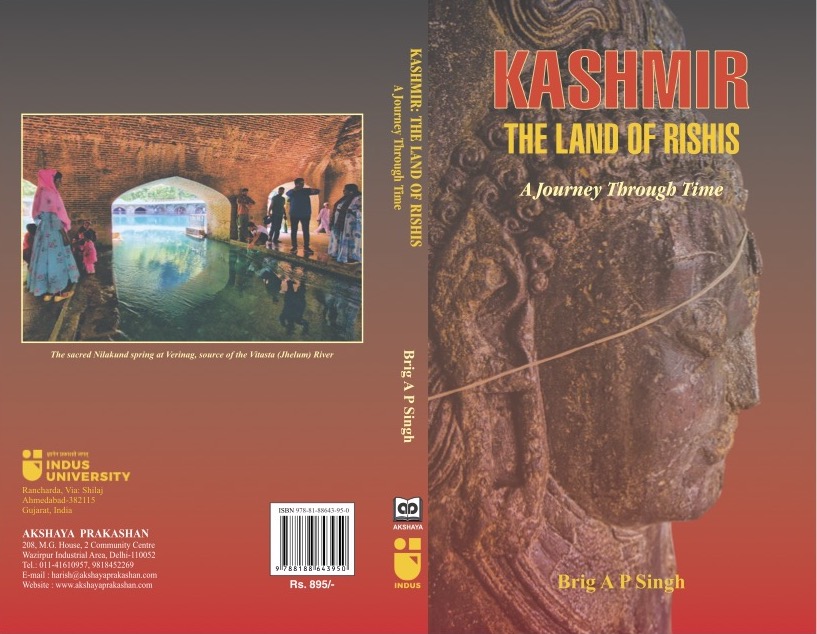
My blogs have formed the basis for my book on Kashmir, which goes by the same name, and was published in 2023. It went in for its second reprint in 2025. The book can be viewed on my website (link below).
https://iauthored.com/brigapsingh
.
.
References
.
- https://en.wikipedia.org/wiki/Kashyapa
- https://en.wikipedia.org/wiki/Kalhana
- https://www.indica.today/long-reads/kashmir-history-rajatarangini-kalhana/
- https://archive.org/details/in.ernet.dli.2015.282687/mode/2up
- https://en.wikipedia.org/wiki/Rajatarangini
- http://ikashmir.net
- https://shodhganga.inflibnet.ac.in/handle/10603/321385
- https://www.india.com/travel/articles/kashmirs-temples-ruins-of-a-glorious-past-3241487/
- https://en.wikipedia.org/wiki/Kashmir
- https://en.wikipedia.org/wiki/Sharada_Peeth
- https://en.wikipedia.org/wiki/Islam_in_Kashmir
- https://en.wikipedia.org/wiki/Kheer_Bhawani
- https://www.culturalindia.net/indian-temples/kheer-bhawani-temple.html
- https://matabhadrakali.org
- https://www.sanskritimagazine.com/events-festivals/shailputri-the-first-form-of-mother-goddess-durga/
- https://www.dailyexcelsior.com/ancient-shrine-of-martand/
- https://kashmirasitis.com/shiv-temple-verinag/
- https://trueindologytwitter.wordpress.com/2020/04/19/erasing-kashmirs-hindu-past/
- https://hindutemples-india.blogspot.com/2021/10/martand-sun-temple-anantnag-jammu-and-kashmir.html
- https://en.wikipedia.org/wiki/Martand_Sun_Temple
- https://www.sanskritimagazine.com/hindu-temples/the-legend-and-destruction-of-martand-the-sun-temple-in-kashmir/
- https://en.wikipedia.org/wiki/Verinag
- https://www.facebook.com/tkmbatapora/
- References mentioned in Part 1 of the blog
.
Note: All watermarked photographs displayed above are my exclusive property and copyright; their use is prohibited without explicit consent, in writing.
.


6 Responses
True!
Even our Ramayanaand Mahabharat are not actually stories, but actual events….
“The reader would have noticed that I use the term “itihaas” and not “history” while referring to the origin of places and shrines. This is because many Sanskrit words are “non-translatable” into English. The philosophy and many concepts of Sanatana Dharma do not exist in Abrahamic religions”
Unfortunately, most Indians do not understand the difference between “itihaas” and “mythology, leading to this confusion.
Looks interesting ! Will read more
Thanks. My book on Kashmir will also soon be out in print.
Very nice and thought provoking narration, in this context i would like to know the ancient ( piraña period)name of POONCH/PUNCH in Kashmir
Rajatarangini mentions Poonch as Paranotsa.