
Introduction
.
Cradled amidst the mesmerizing Shringa Giri hills of the Western Ghats, on the banks of River Tunga, tower the imposing ancient temples of Sri Sharadamba and Sri Vidyashankara. They mark the center of Sringeri Peetham, foremost of the theological centers founded by Adi Sankara in the 8th century CE (this dating has been questioned later in this blog). Unmatched serenity surrounds this holy place. “Sacred vibrations of this place awaken your dormant spiritual nature,” say devotees who visit Sringeri regularly.[1]
.

.
Sringeri (IAST: Śṛngēri) is a hill town and Taluk headquarters located in Chikkamagaluru district in the state of Karnataka. It is the site of the first maṭha (Dakshinamnaya Sringeri Sharada Peetham) established by Adi Sankara, Hindu theologian, and exponent of the Advaita Vedanta philosophy, in the 8th century CE.[2]
.

.
The name Sringeri is derived from Rishyashringa-giri, a nearby hill that is believed to have had the hermitage of Rishi Vibhandaka and his son Rishyashringa. In an episode mentioned in the Balakanda of the Ramayana, Vasishtha narrates how Rishyashringa brought rains to the drought-stricken kingdom of Romapada.
.

.
Origins and History
.
Sringeri, regarded as the “seat of learning,” was the first Advaita matha that Adi Sankara founded. A matha is more than an ashram. It is the home of a pre-eminent spiritual leader, a theological seminary and training school for priests, a library of rare texts, and often, as in the case of Sringeri, includes several ancient famed temples. Advaita here refers to the non-dualist teachings of Adi Sankara.
.

.
The period of Adi Sankara’s birth was an age of unrest and strife characterized by spiritual and intellectual bankruptcy and also political and social discord. Religion in India, based on the Vedas, the Upanishads, the Epics, the Puranas, and the Sutras, was seriously challenged by atheism, agnosticism, and nihilism. Sanatana Dharma was in danger due to vamachara or tantric practices of the debased offshoots of the originally pure Jain, Buddhist, and Shakta cults. Adi Sankara accepted the worship of six divine forms – Siva, Devi, Vishnu, Surya, Ganapati, and Kumara. For having brought the devotees of these six divine forms under the banner of one faith, he has rightly been called Sanmata-sthapaka”.[3]
.

.
Sri Adi Sankara is said to have selected the site as the place to stay and teach his disciples because when he was walking by the Tunga River, he saw an unusual sight. Under the scorching heat of noon, a cobra had spread out its hood to give shade to a frog in labour pain. This came as a divine inspiration to Sankara. On inquiring from a sage nearby, he was told this place was sanctified with the rare phenomenon of all species of animals living in perfect harmony, shedding their natural enmities. Sankara intuited this must be the home of Sri Sharadamba. As evidence of this episode, even today one can see a sculpture called Kappe Sankara on the steps to the river Tunga, which depicts this incident.
.

.
It is said that Shiva gave a crystal Chandramouleshwara Linga to Shri Adi Shankaracharya in the form of a blessing. Even today, Chandramouleshwara Pooja is performed to the linga every night at 8:30 PM.
An institution was born, and Sringeri became South India’s western seat of Advaita philosophy. Thus the Peetham he founded at Sringeri in South India for fostering the Vedas and the sacred tradition of Sanatana Dharma came to be known as the Dakshinamnaya Sri Sharada Peetham.
The Madhaviya Sankara Digvijayam describes that the Acharya came across many virtuous people at Sringeri and taught them the doctrine of Advaita. He then invoked the Divinity of Knowledge, Devi Sharada, and consecrated an icon of Devi Sharadamba made of sandalwood on a Sri Chakra which he carved on stone, a mystical diagram. The Sri Chakra of Devi is the perfect synchronization of Universal Reality and the Individual Soul.
.

.
The Acharya appointed his prime disciple, Sri Sureshwaracharya, who was Maṇḍana Miśra in his purvashrama, as the first Acharya of the Peetham. Since then, the Peetham has been blessed with an unbroken Guru Parampara, a garland of spiritual masters and Jivanmuktas representing Sri Adi Shankaracharya. The succeeding Acharyas have led a life of such austere penance that it has led disciples to adore in them the radiance of Sri Adi Sankara Himself.
After twelve years of stay at Sringeri, Sankara continued on his mission to establish centers at the three other corners of India. The four mathas established by Jagadguru Sri Adi Shankaracharya in the four corners of India were for the sustenance and propagation of Sanatana Dharma in the country. Each of these Amnaya Peethams had their divinities, tirthas, sampradaya, and so on.[4]
.

(Courtesy: https://www.csus.edu/indiv/d/duboisj/sringeri/map.html)
.
Four disciples of Sri Adi Shankaracharya were installed as Acharyas of the four Mathas by Sri Adi Shankaracharya himself.
- Sri Hastamalakacharya as the Acharya of the Govardhana Math in the East.
- Sri Sureshwaracharya as the Acharya of Sringeri Sharada Peetham in the South.
- Sri Padmapadacharya as the Acharya of the Dwaraka Math in the West.
- Sri Totakacharya as the Acharya of Jyotir Math in the North.
A fifth prominent Advaita matha, at Kanchipuram in Tamil Nadu, also traces its lineage to Adi Sankara. The fact that all these Maths have continued to flourish to this day without any break shows the vigour of the movement started by Sankara for the propagation of Advaita Vedanta and Sanatana Dharma as a whole.
.

.
From the time of Sankara, Sringeri became a rejuvenating source for Sanatana Dharma, integrating various Hindu sects. This center has seen an unbroken succession of gurus, each one a scholar of repute and a philosopher with a high degree of spiritual attainment. The matha holds a strong influence on other mathas and has played a major role in providing scholarly and traditional input.
.

.
In the 14th century, royal patronage of the Peetham began with the founding of the famous Vijayanagar empire under the divine guidance of the 12th Acharya, Jagadguru Sri Vidyaranya.
Sringeri Matha was patronized and protected not only by the regional kings and rulers but also by those from far off, irrespective of their religion and political leanings. They generously gifted precious ornaments and lands, which provide a major source of income to the matha. The matha was also granted the privilege to collect taxes from certain villages – otherwise a common practice for Buddhist monasteries. The Muslim ruler, Tipu Sultan once wrote to the pontiff of Sringeri asking him to return from his pilgrimage away from the area as a drought had struck after the pontiff’s departure. “We need your Divine presence for our lands to prosper with timely rains and harvest, and for the good health of people,” wrote Tipu. The center was also supported by other non-Hindu rulers, including the Adil Shahis of Bijapur, Hyder Ali, and Nizam, and later the British Commissioner’s Lord Cubbon and Bowring.
.
Sringeri – a Place of Learning
.

.
Besides being a center of spiritual power, Sringeri also came to be known as a great place of traditional learning owing to the presence of Devi Sharada and the erudition of the Acharyas of the Peetham. The Acharyas were instrumental in bringing forth commentaries on the Vedas and in further expounding the Bhashyas of Sri Adi Shankaracharya. The Acharyas also wrote a number of independent works related to Advaita besides producing a number of hymns underlining their ardent devotion to the non-dual Supreme worshipped in multifarious forms. The Peetham thus came to be regarded as the Vyakhyana Simhasana – the Throne of Transcendental Wisdom. Consequently, the Birudavali hails the Acharya as the occupier of this throne. Many regard Devi Sharada Herself to be moving in the form of the presiding Acharya of the Peetham.
.
Dating Adi Shankaracharya’s Birth
.
Most of the present-day literature states that Adi Shankaracharya was born in 788 CE. It was mostly European scholars who defined that date. However, Adi Shankaracharya was born in 510 BC as researched and published in The Theosophist magazine in 1883. Until the British came to India, Indian history was using Yudhishthira yuga or Salivahana saka, etc, and not the Christian Era to record dates. Irrespective of the dates, one unquestionable fact is Adi Shankaracharya’s establishment of four peethas at the four corners of India i.e., Sringeri in the South, Dwarka in the West, Gowardhana Math in the East and Jyothir Math in the North. Kanchi matha is another one set up by Shankaracharya. Their traditional lineage lists (guru-parampara) mention the names and usually the dates of each successive pontiff of that particular matha. The list of the Dwarka Peetha in the West gives the birth date of Sankara as 2631 of the Yudhishthira era, corresponding to 509 BCE. The list of the Sarada matha (at Kanchi) in the South gives the date 2593 of the Kali Yuga era, also corresponding to 509 BCE.[5] It is significant that two different lineage lists from two widely separated mathas, having 77 and 68 successors respectively, both go back in an unbroken line to 509 BCE.
There is also epigraphic evidence supporting the date of 509 BCE for Sankara’s birth. This is a copper plate inscription addressed to Sankara by King Sudhanvan of Dwarka, dated 2663 of the Yudhishthira era, corresponding to 477 BCE, the year of Sankara’s death. Since Sankara died at the age of 32, this correctly places his birth in 509 BCE.
.

.
The point which now rises is why Western scholars have been motivated to place Sankara’s date of birth in CE and not in BCE. The traditional Western religious scholars, most of whom were Christian missionaries, have endeavored to change the dates of any philosophy to CE i.e., post the advent of Christianity. With this manipulation, they want to create a theory that Sankara’s philosophy was influenced by the Bible and Christian teachings. However, had Sankara been born in 788 CE, it would have taken him no time to denounce the Christian teachings, which by the 8th century CE had taken root in his native land (Kerala). It should be kept in mind that Adi Sankara was born in Kerala and the first Indian Christian roots in India also took place in Kerala. Adi Sankara traveled the length and breadth of India to debate and convert non-Vedic thoughts, and definitely, he wouldn’t have let off Christian groups near his place of birth. However, there is no mention of Christianity in any of his works.
To read more details on dating, read Chapter 14 of the book “The Chronology of India from Mahabharata to Medieval Era Volume I” by Vedveer Arya. The link to the book is given below.
https://www.academia.edu/50944757/The_Chronology_of_India_From_Mahabharata_to_Medieval_Era_Volume_I
.
Temples of Sringeri Matha
.
Sringeri is home to a number of historic temples. Of these, Sri Sharadamba Temple, Sri Vidyashankara Temple, and Sri Malahanikareshwara Temple are the most prominent.
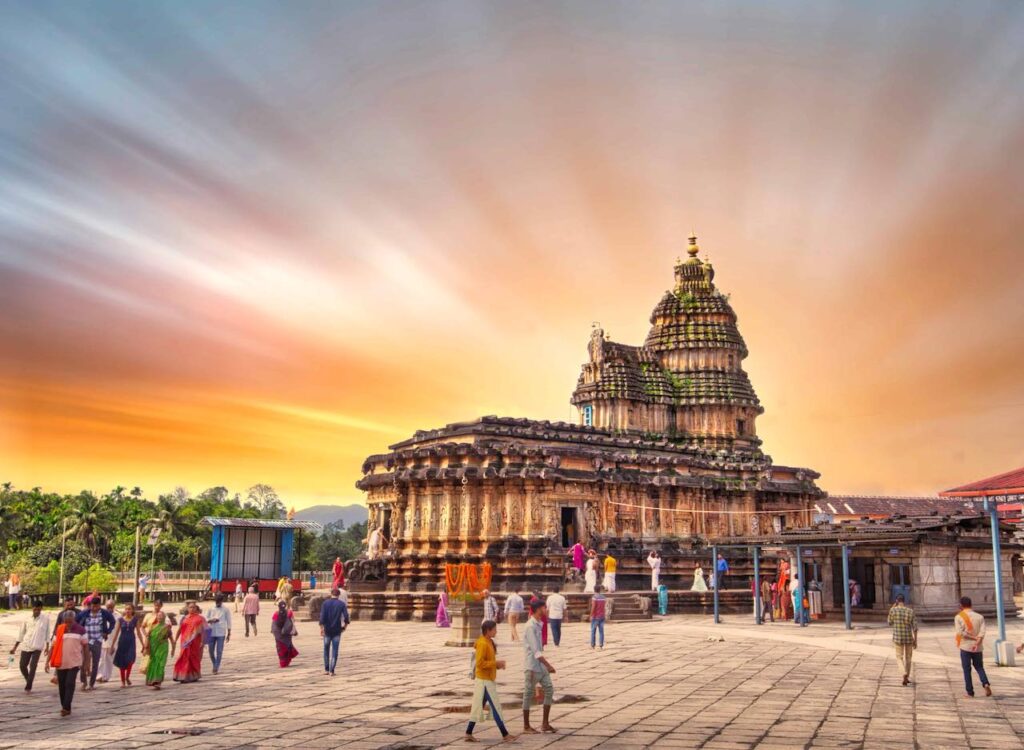
As you enter through the Sringeri temple complex Rajagopuram, you are led to a spacious tiled open-area housing the temples of Sri Sharadamba and an exquisitely carved masterpiece of architecture – the Sri Vidyashankara temple.
.

.
Construction of the 127-feet tall Rajagopuram entrance was completed in 2014 and its Kumbhabhishekam (grand inauguration) was performed by Sri Bharati Tirtha Mahaswamiji on 8 June 2014, the day of Jaya Samvatsariya Jyeshtha Shuddha Dashami.
.

.
Sri Shardamba is regarded as the form of Sarasvati, sometimes as a form of Parvati. Walking past the temples leads to the Tunga River where a bathing ghat has been constructed for the convenience of pilgrims. The matha has nurtured huge fish, which are a great attraction to young and old alike. A bridge across the river leads to Narasimhavan – the abode of the Jagadguru and the burial shrines of the previous pontiffs. To devotees, Sringeri is a source of divine inspiration and casts a tremendous influence on their lives.
.
Sri Sharadamba Temple
.
Sri Shardaamba is the incarnation of Devi Sarasvati who came to earth in the form of Devi Upaya Bharathi, representing the combined powers of Brahma, Vishnu, Shiva and of Durga, Lakshmi, and Sarasvati.[6]
.

.
The ancient temple of Sri Sharadamba, the presiding deity of Sringeri, has a glorious history that begins with the setting up of the Dakshinamnaya Peetham by Sri Adi Sankara. Originally it was an unpretentious shrine with the murti of Sharada made of sandalwood installed over the Sri Chakra that Sri Adi Sankara carved on a rock. Subsequently, in the 14th century, Sri Bharati Krishna Tirtha and Sri Vidyaranya had a temple built in the Kerala style, with a timber and tiled roof, and substituted the sandalwood idol with the present golden murti.
.

.
Sri Sacchidananda Shivabhinava Nrisimha Bharati raised the present structure in granite around the sanctum and Sri Chandrasekhara Bharati consecrated the new temple in May 1916. The mahamandapam has large stone pillars exquisitely carved with deities like Durga, Raja Rajeshwari, dwarapalakas, and Devis which are all sculpted according to the Shilpa sastras practiced in Tamil Nadu.
.
Sri Vidyashankara Temple
.

.
The Sri Vidyashankara Temple, located next to the Sri Sharadamba temple, was built in the year 1338 CE in commemoration of the pontiff Sri Vidyashankara, by Sri Vidyaranya, the patron-saint of Harihara and Bukka, the brothers who founded the Vijayanagar empire. Inscriptions in the temple record contributions made by several Vijayanagar emperors but the temple was probably built on an earlier Hoysala site as it combines Hoysala (Chalukya) and Vijayanagar (Dravida) architectural features. It is built entirely of granite and stands on a high plinth, more or less a rectangle with apsidal east-west ends. On the western side is the garbhagriha with a large Shivalinga made of black stone, known as Vidyashankara Linga, with Vidya Ganapati on one side and Durga on the other side. On the other three sides of the garbhagriha are shrines to Brahma, Vishnu, and Maheshwara with their consorts.
.

.
The Sri Vidyashankara Temple is a perfect example of an architectural marvel. In the eastern half of the structure is a large mantapa with twelve pillars (popularly known as rashi stambhas), marked by the twelve signs of the zodiac. Each pillar has a thick massive central shaft, in the front of which is carved a huge Vyala mounted on a crouching elephant. Inside the open mouth of the Vyalas, the stone has been skilfully removed leaving a ball that can be rolled inside, but not taken out. Vyalas, or Yalis, have a graceful cat-like body of a lion, the head of a horse, and the tusks of an elephant, and are considered more powerful than an elephant or a lion. They are the personification of the natural forces, stylistically rendered. They resemble the hippogryph and sphinx of ancient Mesopotamia and Egypt. The European counterparts are medieval creatures such as the griffin. Like all these divine creatures, the Vyala is a symbol of strength and vigilance.
.


.
The Unique Architecture of the Sri Vidyashankara Temple[7]
.

.
The Sri Vidyasankara Temple has a unique architectural plan and is built entirely of granite. The plan is almost elliptical, formed by the apparent union of two opposed apsidal parts (or chapa) which meet at their open ends, with the curved ends at their eastern and western extremities. The apse on the western side contains the vimana part of the temple, while shrines in the eastern apse comprising the makhamandapa enclose the navaranga, with its twelve distinctive zodiacal (rasi) pillars.
.

https://www.narit.or.th/files/JAHH/2011JAHHvol14/2011JAHH…14..136R.pdf)
.
The two apsidal parts are connected by an intervening north-south corridor (or transept). With its principal entrance at the eastern apse end and a similar entrance at the rear on the west, “… the orientation of the vrittayata structure is of the end-on type.” (Srinivasan, 1976: 5). The main interest astronomically is the navaranga, whose unique aspects have been commented on as follows by two famous archaeologists:
“The Navaranga is a structure having twelve highly ornate pillars of the Dravidian type. On the rear side of each pillar has an ornamental pilaster raising out of a Kalasha and bearing one of the twelve signs of the Zodiac. It is said that the sunlight falls upon the Ram pillar during the month of Aries and on the Bull pillar in the month of Taurus.” (Krishna, 1936: 293).
“Each of these twelve pillaikkals bears the image of a sign of the zodiac or rasi after which the pillar itself is called. It is said that sunlight falls in the early mornings upon the appropriate rasi pillar, during each of the twelve months of the solar year … As stated before these twelve rasi pillars are so arranged that the morning sun’s rays fall on one of them, through one of the three openings in the order of the twelve solar months, named after twelve rasis or houses which the Sun is said to occupy (aspect) in the course of the year according to Indian astronomy the rasichakra … The floor itself is marked by shadow lines in conformity with the Sun’s movement around the twelve rasi pillars.” (Srinivasan, 1976: 35).
.


.
In other words, the navaranga is devised as a calendrical device (or instrument) that can mark any particular day or season, etc. These were unique innovations of the Vijayanagara school. The master craftsmen combined astronomy and architecture to produce this marvel.
.

.
The central ceiling is an exquisite piece of workmanship with lotus and pecking parrots. The vimana over the garbhagriha rises with the shikhara, mahapadma, and stupa. The spire is an upward continuation of the inner wall enclosing the sanctum. It is a tall, cylindrical tower of three stories of gradually reducing circumference which terminates in the griva, or neck, that carries the shikhara with the finial on top. The rest of the roof is made up of sloping channeled slabs. The outer walls are elaborately sculpted with a series of pilasters with capitals and the intervening spaces accommodate niches, which display 60 sculptures, making the temple a museum of sculpture and iconography.
.

.
The sculptures include Shaiva, Vaishnava, and Shakta alongside Buddha and Jaina figures – animals, puranic stories, Shiva, Vishnu, Dashavatara, Kali, Shanmukha, and so on. Other intricate features include chains of joint-less stone rings and growling lions (vyalas) with stone balls inside the faces, which can be rotated. The temple is under the care of the Archaeological Survey of India.
.

.
The Tower and Doorways[12]
.
The tower is a remarkable architectural piece combining the features of the Chalukyan, Dravidian, and North Indian styles. It is made up of three sets of cornices rising in a step pyramid fashion. Each cornice has ornamental drops on its fringes and the topmost one has small stone bulls facing the cardinal points. The pyramid is broken by three stories of the Dravidian type. The Sikhara on top and its griva is too small according to Chalukyan proportions. There is a suggestion of a curvilinear outline with North Indian parallels. The finial is a large golden kalasa with four smaller ones around, unlike the stone ones of the Chalukyan period. The tower has a large frontal projection in front with a kirtimukha having an image of Siva standing as Sadásiva (abhaya, parasu, mriga, dana).
.

.
The building has six doorways, symmetrically placed, three in the east half and three in the west half or one each in the east and west and two each in the south and north. Each door is approached by a flight of seven steps supported on either side by a lion or a lion with a creeper emerging from its mouth. Each door is supported by an Avarapala and the jambs have vertical scroll and floral bands. Compared with the rest of the temple, their designs are not striking. On each jamb is a river goddess on a makara and on the lintel is carved Gajalakshmi. The three back doors lead into the pradakshina while the three front ones give access to the navaranga hall.
Each door has supporting dvârapalakas two of which are Saiva, two Sakta, and two Vaishnava.
.
Sri Malahanikareshvara Temple
.
Malahanikaresvara means “destroyer of the impurities of the soul.” This serene temple is located at the center of the Sringeri town, atop a small hill, and can be reached by a flight of about 170 steps. The temple structure is a fine piece of architecture in stone, consisting of navaranga, antarala, and garbhagriha. The ceiling has a lotus bud carving. The deities inside the temple include Malahanikaresvara, Bhavani, Chandikeshwara, Durga, and Sthambha Ganapati. The linga is said to have been worshiped by Sage Vibhandaka, son of Sage Kashyapa. After many years of penance, Vibhandaka had the vision of the Lord, which merged into the Linga. The Sthanbha Ganapati was created in stone by Sri Ahinava Narasimha Bharati (1599 – 1622 CE), the 24th Jagadguru, by drawing a figure of Ganesha with a piece of turmeric on one of the front pillars.
.
Sringeri Sharada Peetha
.
The Sringeri Sharada Peetha is located south of the Sri Sharadamba temple, across the Tunga River, in Narasimha Vana (forest). A footbridge, called Vidyatheertha Setu connects the two sides. The Sringeri Sharada Peetha, also called Dakshinamnaya Sringeri Sharada Peetam, is one of the four Advaita mathas established by Sri Adi Sankara. Following the tradition initiated by Adi Sankara, the matha is in charge of the Yajur Veda. The Krishna (Black) Yajurveda is more prevalent in South India, over which the matha has authority in the Smarta tradition. The head of the matha is called Jagadguru (teacher to the world) and also carries the Shankaracharya name as a title.
.

.
Temples Established in the Four Cardinal Directions by Adi Sankara[8]
.
It was customary to mark the boundaries of sacred spaces by placing temples in the four cardinal directions of the Khsetra or the region. Adi Sankara had set up four small temples in the four directions. All of them are located on small hillocks.
.

.
- Kere Aanjaneya Temple in the West – Can be visited on the way to Durgamba Temple.
- Kala Bhairav Temple in East – This is closest to the Sharada Peetham. It is approached via the suspension bridge.
- Durgamba Temple in South – This is the farthest temple, in the direction of Mangalore.
- Kalikamba Temple in North – It is a small temple located on the edge of a small hill within the town.
.
Sringeri as a Microcosm of Modern India
.
Millions of devotees of Sringeri Mutt have grown up under its strong influence and the message of Sanatana Dharma. Many vouch that their lives have been transformed for the better and that they have even seen miracles happen.
The town of Sringeri reveals considerably more about India’s dynamic history and contemporary life than its association with Sankara’s lineage and Sharadamba’s temple suggests. Sringeri is a microcosm vividly exhibiting the pluralism and social complexity of modern India, rooted in millennia-old traditions. The town reveals on a human scale the way that each new layer of India’s history coalesces with that which preceded it.
.

.
For example, the main temple complex, which sits above the Tunga River at the edge of the town, displays perhaps the most visible mark of this layered history. The majestic, three-tiered, 14th century Sri Vidyashankara temple is named after the Brahmin Acharya around whose samadhi the foundations are said to have been laid. The scholar Hermann Kulke points out, however, that in the period of the temple’s reconstruction, Jain culture was predominant at Sringeri. A large Jain temple, now hidden behind a watchkeeper’s shop on Sringeri’s main road, seems to have been built in the 11th century CE. Furthermore, the icon of the much smaller shrine immediately adjacent to the Sri Vidyashankara temple may have once represented a Jain saint.[9]
.
Sacking of Sringeri in 1791 CE
.
In 1791 the matha was pillaged by the Peshwa’s Maratha army and a number of priests sacrificed their lives trying to save it. The matha’s valuable antique treasures were looted. Tipu Sultan helped to resurrect the matha and he ordered the Asaf of Bednur to supply the Swami with 200 rahatis (fanams) in cash and other gifts and articles as relief material. However, this incident has been twisted from the actual circumstances leading to this incident and needs to be seen in the proper context.
In the course of the 1790-1792 campaign against Tipu, the Sringeri Shankaracharya matha was attacked, looted, and desecrated by a raiding party attached to the army of Maratha chief Raghunath Rao ‘Dada’ Kurundwadkar. The stigma of this attack has lingered to this day and the Marathas as well as Parshuram Bhau Patwardhan, who held overall command, have been held responsible. The Maratha letters of 1791 have eluded many commentators not familiar with the language and these throw a different light on this sordid episode.[10]
.

.
A letter written at the beginning of April 1791 from Neelkanth Appa (father of Raghunath Rao Dada) to Balasaheb at Miraj gives the first intimation of an attack on the Sringeri matha. The letter says:
‘…lamaan and pindaris from Dadasaheb’s army went and looted lakhs worth from the Sringeri math, including an elephant. I have written to Dada to confiscate the goods’.
This was followed by another letter in mid-April: ‘the looters have been apprehended and a jambura and elephant belonging to the math taken over. The principal ten or twenty culprits were arrested. Just then Dadasaheb wrote that he will take action against them as they are his men. The men and the elephant were then sent to him’.
The letter goes on to state:
‘When father learnt of this loot, he sent the cavalry to arrest the lamaan. The elephant was taken over. Remaining stolen items have not been found’.
The matter continued to fester and reached the ears of Nana Phadnis at Pune. A letter from his clerk reached Raghunath Rao in December 1791. It said:
‘…lamaans and looters looted the Sringeri math; this news reached the court. All details must be sought. You wrote ‘the looters came from all four directions. You have taken action and others must similarly act against the culprits’. Nana has sent this reply, ‘The Swami’s math was looted and the Swami is therefore fasting. This does not auger well for the kingdom; the Swami’s displeasure is not good….. Taking stern action the Swami must be compensated and his pleasure solicited….’
.

.
The pindaris in the Maratha army and the Bayed troops in Tipu’s army were irregular troops that performed mopping-up operations after a battle. They were not paid and made a living out of the loot collected. The Sringeri episode was neither a policy nor a battle plan for the Marathas. It was carried out by those predatory troops and lamaans (a caste dealing with grains) who do not take part in an actual battle.
Although the regular troops did not attack the matha, the pindari who did not act with ‘any check or control’ did. The Maratha polity was anguished over the act and efforts were made to compensate and appease the Swami. In 1791, Tipu seemed to have changed his approach to temples and Brahmins when faced with an all-round attack. The Sringeri matha attack was not representative of Maratha’s goals, policy, or plans. Equally Tipu’s newfound piety for Kanchi’s temple in 1791 was born out of political necessity. Present-day readers need to take both events in the context they occurred.
.
Post-Independence Period
.
After independence, the matha saw its revenues decline. It went through difficult times. Gowrishankar, the administrator, explained, “In 1959, the jagir [dedicated land act] was abolished and we could no longer collect taxes from the villages we were entitled to. The mutt also had to surrender some of its land holdings. The mutt underwent a lot of problems from the 50s to the 80s.” The 34th pontiff, Sri Chandrasekhara Bharati, once asked the temple administrator to organize a mass feeding. The administrator declined, owing to a lack of funds. Though this news saddened the Swamiji, he told the administrator to go ahead with preparations for mass feeding and said, ‘Devi Sharadamba will take care of everything.’ A few minutes later, a postman brought a money order, a princely sum remitted by a devotee.
.

.
“The 35th pontiff, Sri Abhinava Vidya Teertha, toured India three times and brought in a lot of devotees, and donations increased. For the past 10 to 12 years we have been doing well and are able to take up projects which are in the interest of the common man.”
The temple is also famous for Aksharabhyasa. It is a sacred ritual performed here, where a child at the age of 2-5 years will be initiated to learning.
.

.
Since Sringeri is situated in the heart of the Chikmagalur district, it is naturally blessed with rich flora and water bodies. The nearby attractions are Sirimane Falls and Hanumanagundi Falls.
.
Festivals at the Sringeri Matha[11]
.
Every year the temple witnesses a vibrant gathering at some of the well-known festivals celebrated here.
- Navratri is celebrated every year for 11 days, and the last day of Navratri, i.e. Mahanavmi, sees Shathachandi Homa Poornahuti.
- On Vaisaka Krishna Prathipath Mahabhishekam, an offering is given to Sharadamba Devi. In addition, a deepotsava is organized in the Sri Sharadamba Shrine on the day of Karthika Poornima.
- Lalitha Panchami is also celebrated along with a special puja that the Jagadguru performs. In addition, there are special pujas that take place on both Magha Krishna Dwithiya and Magha Tritiya.
.

.
.
References
.
[1] Nondualism is Alive and Well at Sringeri https://www.hinduismtoday.com/magazine/march-april-2001/2001-03-nondualism-is-alive-and-well-at-sringeri/
[2] Sringeri https://en.wikipedia.org/wiki/Sringeri
[3] The Records Of The Sringeri Dharmasamsthana by Dr. A.K. Shastry https://archive.org/stream/AKShastryRecordsOfSringeriMatha2009/AK%20Shastry%20-%20Records%20of%20Sringeri%20Matha%202009_djvu.txt
[4] History of Sringeri Sharada Peetham https://www.speakingtree.in/blog/history-of-sringeri-sharada-peetam
[5] Kanchi Kamakoti Peetham https://en.wikipedia.org/wiki/Kanchi_Kamakoti_Peetham
[6] Temples https://temple.dinamalar.com/en/new_en.php?id=98
[7] Aspects Of Observational Astronomy In India: The Vidyasankara Temple At Sringeri https://www.narit.or.th/files/JAHH/2011JAHHvol14/2011JAHH…14..136R.pdf
[8] Sringeri – The Temple Town Around Sharda Peetham https://www.inditales.com/sringeri-sharada-peetham-sharadamba-temple/
[9] Sringeri’s Dynamic History https://www.csus.edu/indiv/d/duboisj/sringeri/
[10] What Actually Happened at Sringeri Math in April 1791 https://swarajyamag.com/culture/what-exactly-happened-at-sringeri-math-in-april-1791
[11] Sringeri Mutt Chikmagalur https://chikmagalurtourism.org.in/sringeri-mutt-chikmagalur
[12] University of Mysore, Annual Report of the Mysore Archaeological Department for the Year 1936 https://ignca.gov.in/Asi_data/27275.pdf
[13] Sringeri https://en.wikipedia.org/wiki/Sringeri
[14] History of Sringeri Sharada Peetham https://www.speakingtree.in/blog/history-of-sringeri-sharada-peetam
.

.
.
Note: All photographs displayed above (except those sourced and acknowledged) are my exclusive property and copyright; their use is prohibited without explicit consent, in writing.
.


9 Responses
Loved the detailed blog on Sringeri. Well researched and commented, accompanied with photos of a high standard made for interesting reading.
Thank you. Most Indians are quite unaware of our heritage, and Sringeri is one of the most important.
Very nice collection and good effort to project our rich heritage.
Thank you. Every Indian must know about their rich heritage.
Beautiful photographs and thanks for projecting our rich heritage.
Amazing work
Thanks!
The Sri Vidyaranya Temple at Sringeri is commendable. The photograph beautifully captures the serene ambiance and architectural grandeur of the temple, reflecting its spiritual and historical significance
Thanks for going through the blog.