
.
The list of all my blogs has been compiled and can be seen at the link below. With a large number of blogs on my website, at times it is difficult to locate specific blogs.
.
Introduction
.

.
Goa always evokes wonder for any traveler, Indian or foreign, being one of the most recognized destinations to visit in India – its sunny beaches, beer, and party culture are an irresistible attraction. Few are aware of the hidden wonders waiting to be explored in the hinterland, just a short distance from the beaches – a treasure trove of ancient heritage and traditions that in many instances has remained unchanged for millennia. These have generally been overlooked by tourist operators who miss most of these hidden gems, leaving visitors unaware of the cultural heritage of Goa. For a majority of those visiting Goa, its history starts with the Portuguese since the pre-colonial period has been mostly wiped clean from common discourse. It is rarely known that Gomantak (the original name of Goa) has a heritage from pre-historic times and has been mentioned in the Puranas, the ancient texts of India. I have briefly covered the period since pre-historic times in my first blog on the history of Goa.
I have made a number of visits to the region to uncover these hidden treasures, the last one in September 2023. This was as a part of the heritage tours organized by Ancient Trails, which take visitors to ancient sites in India and abroad. The tour was accompanied by renowned writer, newspaper columnist, and social media influencer Shefali Vaidya was a bonus and sparked my interest in the tour. The hunch proved correct as, during the course of the few days spent with her, one learned many nuggets of information about the places we visited which only a local could provide. Her historical knowledge further embellished the available information about Goa.
I have written two blogs earlier on the history and temples of Goa, which can be accessed at the links given below: –
.
.
.
Though this visit covered some of the temples visited earlier, I have only mentioned those here which have not been covered in the earlier blogs. The history of the worship of some of the popular deities in Goa has also been covered in detail, like those of Shri Śāntādurgā and Shri Saptakoteshwar.
.
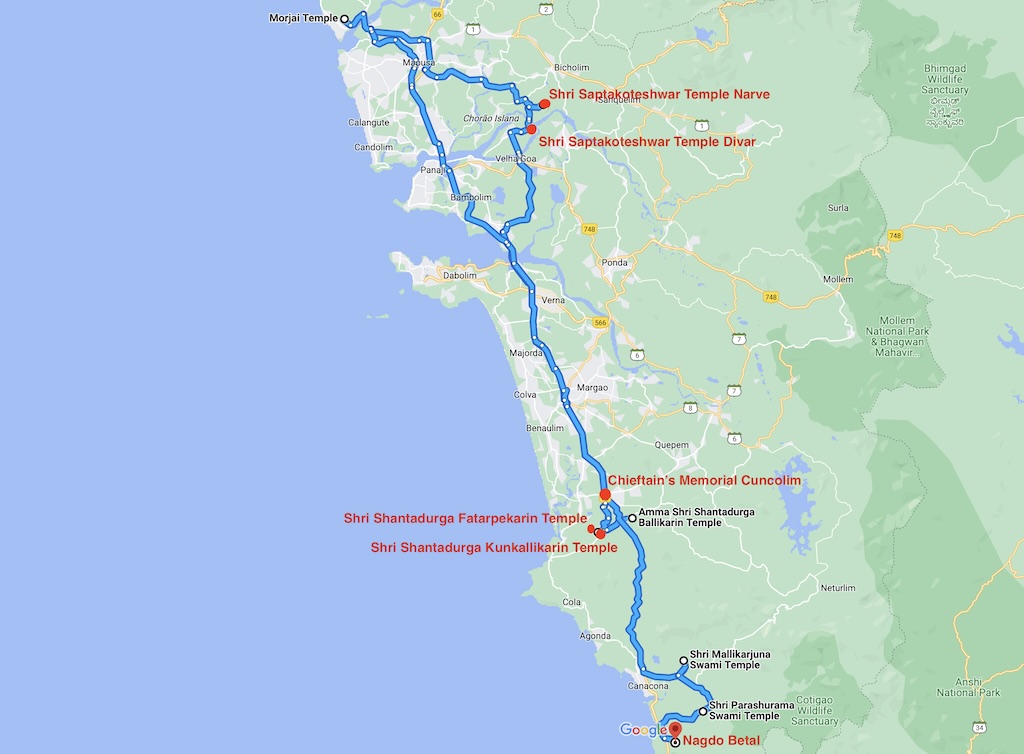
The map showing the temples covered in this blog is below.
.
Śāntādurgā Worship in Goa
.
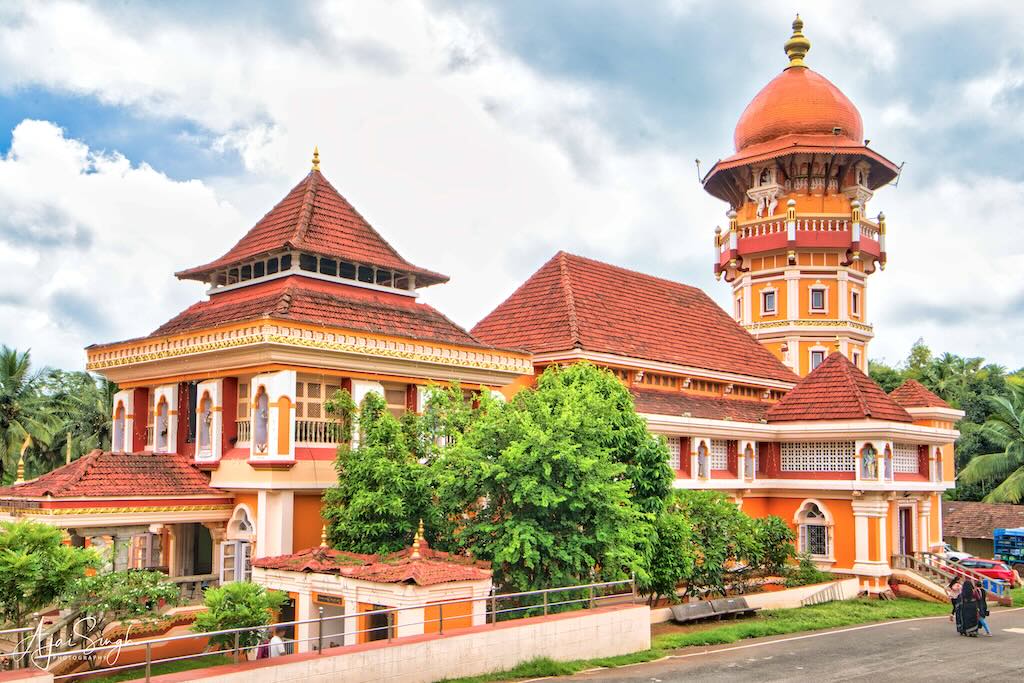
Śāntādurgā is the most popular form of the Durga revered in Goa, as well as in some parts of Karnataka. She is a form of the ancient Mother goddess known as Saterī who was a primordial deity. She is worshipped in almost all villages of Goa as an ant hill. This is also seen in some temples dedicated to Śāntādurgā. The assimilation of the folk deities into the Puranas was a gradual process. Thus, the folk deities like Sateri, Bhauka, and Mahalsa were Sanskritised.” [Mitragotri, 1992: ‘A Socio-Cultural History Of Goa From The Bhojas To The Vijayanagara’, 175]. It is interesting to note that the assimilation of ancient deities gathered momentum as the Portuguese rule took root and the Western culture, not necessarily the Christian religion, began to make headway. That seems to have triggered a defense mechanism in the native people to conserve their traditional faith, beliefs, and customs. Bramhanism provided an easy rallying point to counter the growing power of the Portuguese civil and religious authorities.
.
.
The word Saterī is derived from the Kannada word, ‘Sapta-teri’. ‘Sapta’ means seven and ‘teri’ means layers or waves. It is believed that anthills are made of seven layers. The tradition of anthill worship is also practiced in Karnataka and Andhra Pradesh where they are venerated as Renuka, Matangi, Ellamma, etc.
The second chapter of the Sanskrit Nāgavya Mahātmya, Śāntādurgā prādurbhāvaḥ, is a part of Sahyādrikhaṇḍa which is the chapter of Skandapurāna gives detail about this. Only the title of the chapter mentions the goddess Śāntādurgā and nowhere else is this epithet of the goddess mentioned. This section refers to a certain sage Śāntāmuni, a resident of Nagavya (modern Nagoa). The goddess appeared before Śāntāmuniand hence she’s known as Śāntādurgā. Durga is portrayed in her ferocious nature in many places, yet the adjective Śāntā (peaceful) is found in almost all Namavalis of Durga. In verses 16, 19, and 34 of Sahyādrikhanda, the goddess is called Śāntādevi (Śāntā -devi). Verse 18 of this section mentions the disappearance of the goddess into an ant hill. These ant hills symbolically represent Śāntādurgā as well as Saterī.
.
(Courtesy:https://www.behance.net/gallery/101055771/-Shree-Shantadurga-Vijayate-)
.
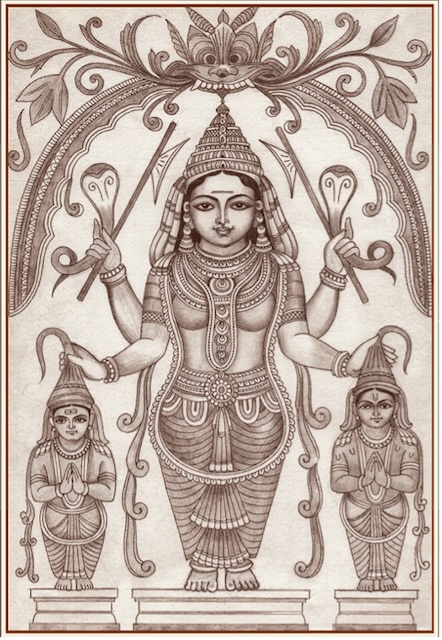
According to another lore, once there was a terrible war between Shiva and Vishnu due to which the entire world was distressed. Brahma then prayed and implored Shakti (the Divine Mother) to intervene and stop the war. She then intervened and held Shiva by one hand and Vishnu in the other hand and brought about reconciliation between them. This stopped the war and brought peace to the world. Such a murti of the devi is found in the inner sanctum of Śāntādurgā Temple of Kavale. The 17th century Marathi Koṅkaṇa Mahātmyafurnishes an exhaustive account of the conflict between the followers of Vaishnavism and Shaivism in Goa.
.

.
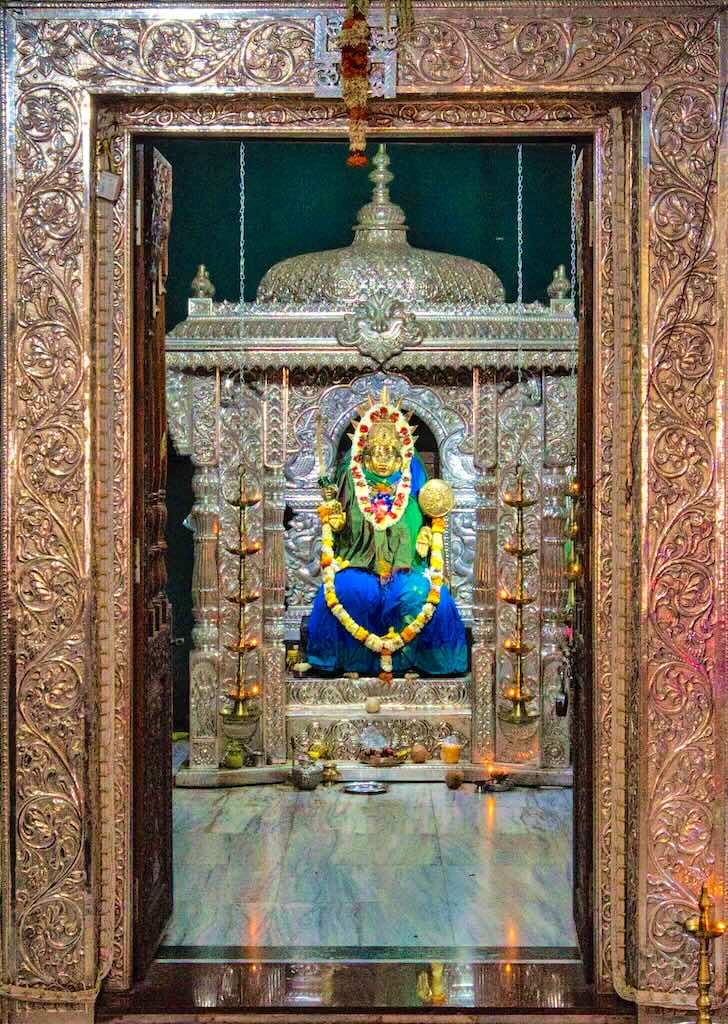
Shri Śāntādurgā Kunkalikarin is venerated at Fatorpa in the form of a vigilant (jagrut) Shakti Pith in Goa. She is a form of Goddess Durga or Mahamaya and is linked to Kali, Parvati, and the Mantrikas. The Goddess Durga is a warrior Goddess who is not linked or subordinate to any other male God. According to the Puranas, Goddess Durga combats the demons (Rakshasas) who threaten the stability of Mother Earth (Prithvi). She is associated with blood, sacrifice, and fertility…she is violent, dangerous, and potent but at the same time she is capable of intervening on behalf of her devotees. In Goa, the Goddess assumed a milder form of Śāntādurgā or a more peaceful form of Goddess Durga.
Though in few shrines dedicated to Śāntādurgā, an ant hill is found inside the sanctum in the place of a stone, the murti of the deity or a Kalasha is generally consecrated. Especially in Kavale temple, the metal murti of the deity which is four-handed, is depicted holding two male figures (Vishnu and Shiva) in her lower hands and snakes in the upper hands. Most of the Śāntādurgā temples have stone sculptures of Mahishasuramardini aspect of Shakti. Whereas some have stone or metal murti with four hands, sometimes seen holding any of the following: sword (Khaḍga), bowl of ambrosia (Pānapātra), a shield (Kheṭaka), trident (Triśūla), kettle drum (Ḍamaru), lotus (Padma), or snakes (Nāga). The deity is also portrayed with her hands in Abhaya Mudrā and varada. In rare cases, a Kalasha is worshipped as a symbol of the deity, like in Śāntādurgā Kumbharjuvekarin temple at Marcela, Goa.
.
Śāntādurgā Temples in Goa
.
- Shri Śāntādurgā Temple at Kandoli (Candolim) Goa.
- Shri Śāntādurgā Temple at Kavale
- Śāntādurgā Kunkalikarin at Fatorpa
- Śāntādurgā Fatarpekarin at Fatorpa
- Shri Śāntādurgā Khandparkarin at Khandepar
- Śāntādurgā Chamundeshwari Kudtari Mahamaya at Avedem, Quepem
- Śāntādurgā Kunkaliekarin at Kunkolie Ponda
- Śāntādurgā Kumbharjuvekarin at Marcela, Ponda
- Śāntādurgā Verlekarin at Marcela Ponda
- Śāntādurgā Talaulikarin at Marcela
- Śāntādurgā Mhapsekarin at Dhargal
- Śāntādurgā Sangodkarin at Sangolda
- Śāntādurgā at Veroda
- Śāntādurgā Shankhavaleshvari at Veling, Gothan
- Śāntādurgā Ballikarin at Balli
- Śāntādurgā Kalangutkarin Temple, Nanora, near Asnora
- Śāntādurgā Pilarnkarin Devasthan Narve Bicholim
- Shri Śāntādurgā Temple at Gaonkar Wada, Bicholim
- Shree Saterī Śāntādurgā Devasthan, Khandola Goa
- Shri Śāntādurgā Devasthan Vaghurme, Vaghurme-Vere, Ponda-Goa
- Śāntādurgā Temple at Mhapan, Vengurla
.
.
Owing to religious persecutions by the Portuguese in the 16th century (1583) Shri Śāntādurgā was shifted to the holy place at village Fatorpa, at the express command of the Goddess herself. Later, she became popular as Shree Shantadurga Kunkalikarin of Fatorpa.
The famous revolt of Cuncolim in the 16th century (15th July 1583) against the Portuguese oppression for the protection of ‘Swadharma and Swaraj’ took place as per the divine spirit and inspiration received from the Shri Śāntādurgā. As a result, the forcible conversion to Christianization was stopped. Hence, she has been considered as the savior of Hinduism in Goa.
.

.
This historical event of Cuncolim is similar to the spiritual event in Maratha history, which happened later in the 17th century, where Adimata Bhavani inspired and blessed Chhatrapati Shivaji Maharaj to form ‘Hindavi Swaraj’ in order to defend and save Hindu Religion, Vedic Culture, Civilisation, Mutt, and Temples from destruction by the Mughals.
Ponda is known as the land of temples; like Ponda, there is another holy land of temples in Goa known as Fatorpa. The village in South Goa falls in Quepem Taluka for geographical reasons but the part of Salcete for religious, art, cultural, and trade reasons. Here there are more than six big temples besides more than 20 small mathas and temples. These include the famous temples of Shree Shantadurga Kunkalikarin, Shree Shantadurga Fatarpekarin, Shree Shantadurga Kitalkarin, Shree Betal, Shree Laxmi, and close to the Shree Shantadurga Ballikarin at Balli.
I will be covering three Śāntādurgā Temples around Fatorpa in this blog. They are:
- Śāntādurgā Kunkalikarin Temple Fatorpa
- Śāntādurgā Fatarfekarin Temple Fatorpa
- Śāntādurgā Ballikarin at Balli
.
Śāntādurgā Kunkalikarin Temple Fatorpa
.
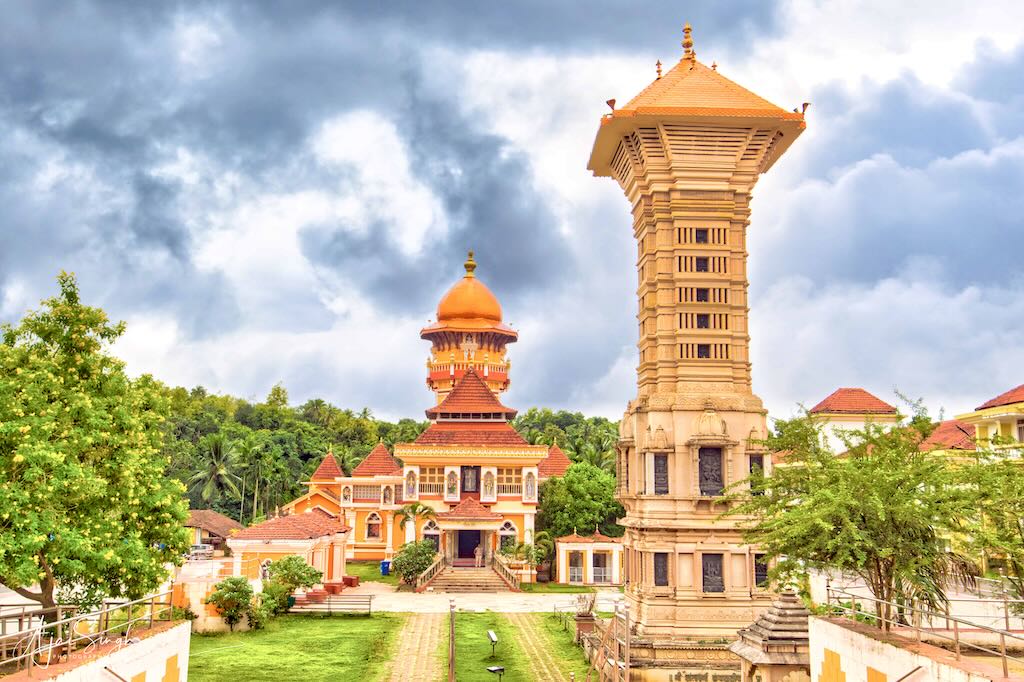
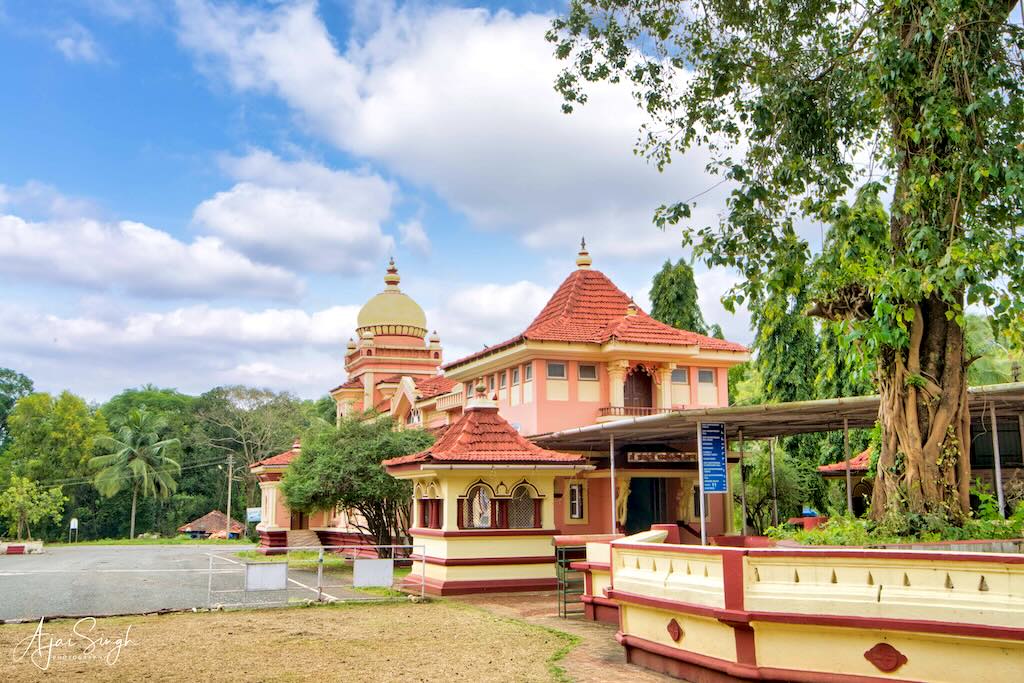
Śāntādurgā Temple complex in Fatorpa is one of the grandest holy places in Goa. Spread over many acres, the spectacular design and architecture of this edifice and its surroundings are worth admiring. The area hosts two main temples: Shantadurga of Cuncolim (also spelled as Kunkali) and Shantadurga of Fatorpa.
.
.
Cuncolim was often referred to as ‘ Punyabhumi ‘ meaning “a land of virtue” since ancient times. The term Cuncolim is derived from two words – Kunk is a Sanskrit term for KumKum that is also called Kesar or a crimson, red colour that is a sign of good fortune for married women and is an important symbol in the Hindu religion; and – Halli is derived from the Kannada word meaning village. This Kesar colour is also identified with the Kshatriya clans that live in the village. The Sanskrit word Kunk later became Kunku in Marathi and was later changed to Cuncolim.
Shri Śāntādurgā Kunkalikarin (of Kunkali or Cuncolim) was originally located at Cuncolim, the Gramdevi of Kukkolkars. In 1583, when Cuncolim was up in arms against Portuguese oppression, the colonial power retaliated by mercilessly killing 16 chieftains and demolishing temples. To save their deities Hindu devotees took the goddess and escaped to neighboring Fatorpa in Quepem taluka, not yet under Portuguese rule. Most notably among those rescued were the vigrahas of Shri Ramnath from his temple in Loutolim and that of Shri Shantadurga (Kunkolikarin) from the temple in Cuncolim to Fatorpa. Since then the temple has been situated at Fatorpa.
.
.
Itihāsa
.
The devasthan of the temple has twelve vangods, comprising twelve different communities. These twelve vangods are all-important for the opening of any socio-religious rituals in the village and temple. It is believed that the deity, the kulswamini of the twelve vangods, has two forms. In her calm avatar, she is maternal, loving, and kind; while her other form is called devi Durga, the fierce form, a destroyer of evil. Four forms of the idol can be seen on all four sides of the temple.
According to mythology, Cuncolim was ruled by a Nagvanshi who was a worshipper of Goddess Saterī. It is said that Shri Śāntādurgā was not the actual goddess of Cuncolim. When the village was reorganized and when Satpurush founded the barazan, all the twelve vangdis installed the image of Shri Śāntādurgā and started worshipping as their kuldevta.
.

.
In ancient times a number of Rishis and Saints came and settled down in Goa as the place was covered with a dense forest. In the sixth century, two saints from Goti Vanvas in Karnataka settled in Cuncolim. One of them was a man named Satvangri or Satpurush and his elder brother Kundeshwar. Satpurush was a Sardar in the court of a king in Andhra Pradesh. Satpurush Naik was very courageous and brave and therefore, the other Sardars in the Court were jealous of him. At the instigation of the other jealous Sardars, the King dismissed Satpurush. Satpurush left Andhra Pradesh with his wife and settled down at Gothi Banvas (Gati Vanvas) in Karnataka which was ruled by the Shilahara dynasty. In the 4th or 5th century, the Shilaharas overran Gomantak (Goa) and Satpurush left Karnataka with his wife and children and settled down in a place called Kumkumhalli (the ancient name of Cuncolim).
Satpurush had seven sons and one daughter from his two wives. The first wife had four sons and the second had three. They were Mhal, Shetkar, Naik, Mongro, Sombro, or Shet, Thombro, and Porobhu \ Probhu \ Prabhu.
.

.
One day when Satpurush was cleaning the place where he kept the Gods, Shri Śāntādurgā appeared to him in the dream and told him that the place was sanctified. He set up his four Gods, which he had got from Andhra with him, near the temple of Shri Śāntādurgā. Satpurush and his seven sons worked for the development of the village by getting permission from the local King and settled down in the village. However, Satpurush was unhappy with the development. He had another dream in which the Goddess told him that he and his seven sons would rule the village in the future. The deity instructed him to select five brave members who would support them.
Satpurush selected five more vangdis, who came from different parts of the Indian sub-continent, making a total of twelve. He gave all the twelve vangdis a place according to their courage and bravery. He divided the agricultural land into twelve Kattas and distributed them to the vangdis for their livelihood.
.

.
The local Nagvanshi Raja, Danga Mhar, became jealous of Satpurush but, it was difficult for him to fight a direct war against Satpurush and his twelve vangdis. Therefore, the Raia tried to establish good relations with Satpurush and told him that he wanted to marry his daughter. The intention of the Raja came to be known to Satpurush and the twelve vangdis attacked the bridegroom and beheaded him when he came to the mandap. They also attacked the other followers of the Raja whose body was wrapped in a dhotor or cotton dhoti and buried at a place called Dhotrabandh. Thereafter, they washed their weapons at Zoglabandh.
After some time, Satpurush married his daughter to the Sidhkali who was the eighth vangdi of Cuncolim. After the defeat of the local King, Satpurush looked after the village of Cuncolim with the help of his twelve vangdis and re-established the village administration.
.
.
A community of twelve vangdis (clans) was established. They are today called the gaonkars of the village. The village, temple, Church, and local festivals are dominated by the twelve charddo clans (warrior caste) even today. The Charddos of Cuncolim perceived themselves as being the warriors of Shri Śāntādurgā.
.
The Temple
.
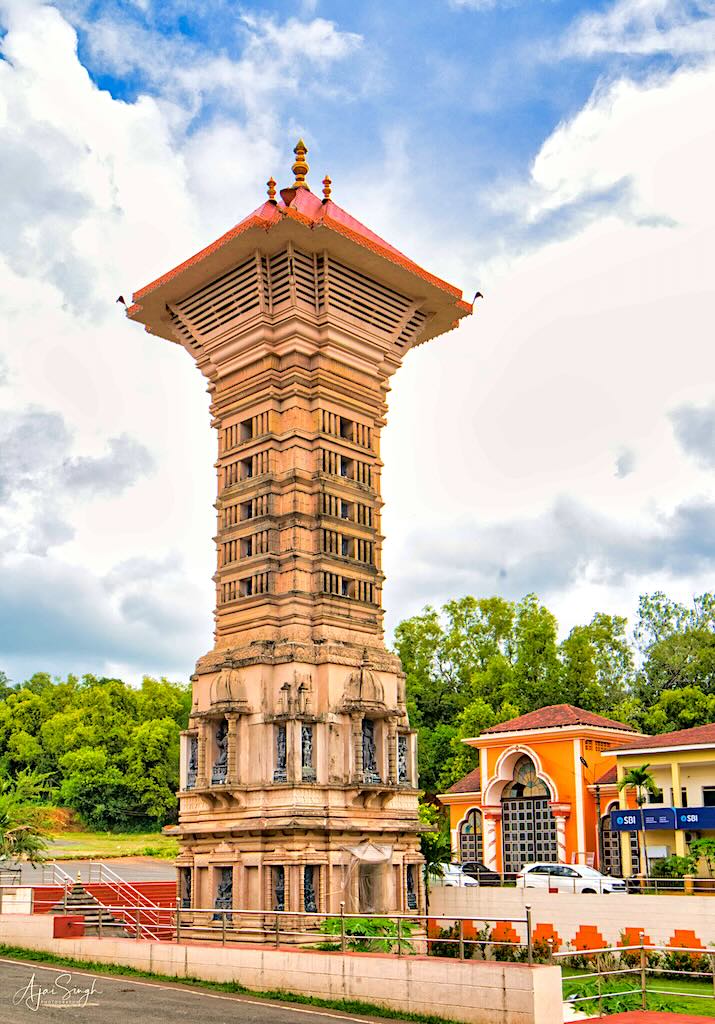
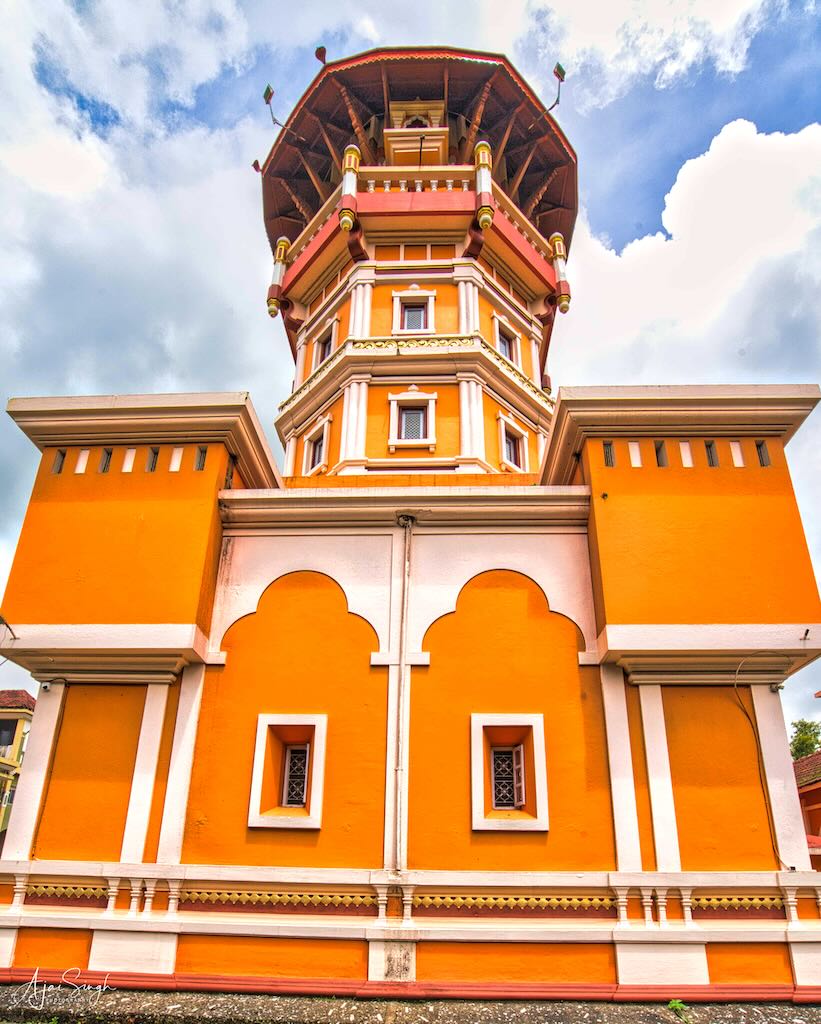
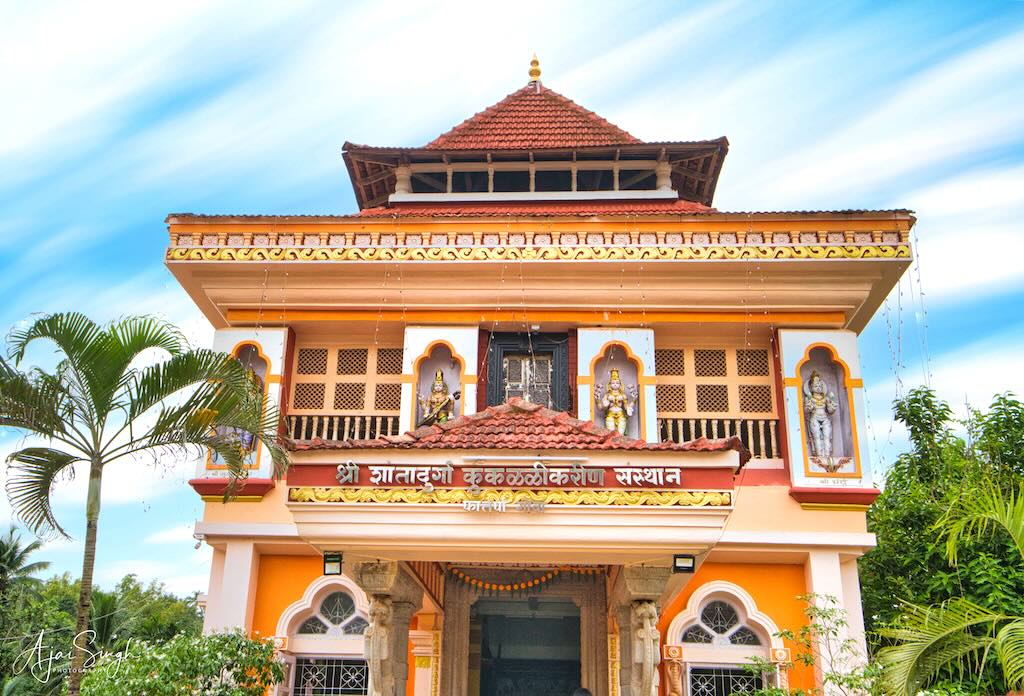
At the entrance of the temple of Shri Śāntādurgā Kunkalikarin, there is a large (praveshdwar) doorway called Mahadwar. The temple has a big gold-plated kalash that is built on the main dome, having ornamented designs.
.
.
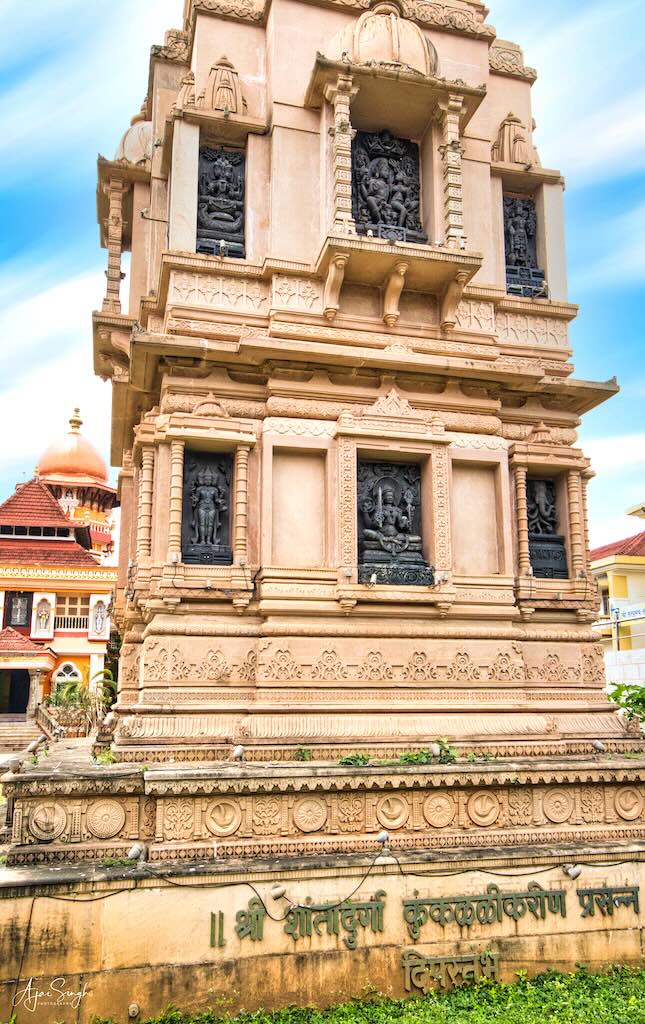
The main statues that are seen on the facade of the temple are Shri Bhishan Bhairavi, Shri Virbhadra, Shri Dakshinmurti, Shri Mahakal, Kalasanhhar Shri Mahakali, Shri Kartikey, Shri Kaliamardan, Gajesurvadh, Hiraanhakshyapudvadh, Shri Suryanarayana, Shri Saraswati, Shri Laximi, Shri Chandra, Shri Ketu, Shri Rahu, Shri Shanidev, Shri Shukr, Shri Brihaspati, Shri Buddh, Shri Mangal, Shri Dhavatari, Shri Ardhnarinateswar, Anandtandev, Shri Harihareshwar, Shri Rajrajeshwari, Shri Bhudevi, Shri Gajendrameksh, and Shri Sheetaladevi.
.

.
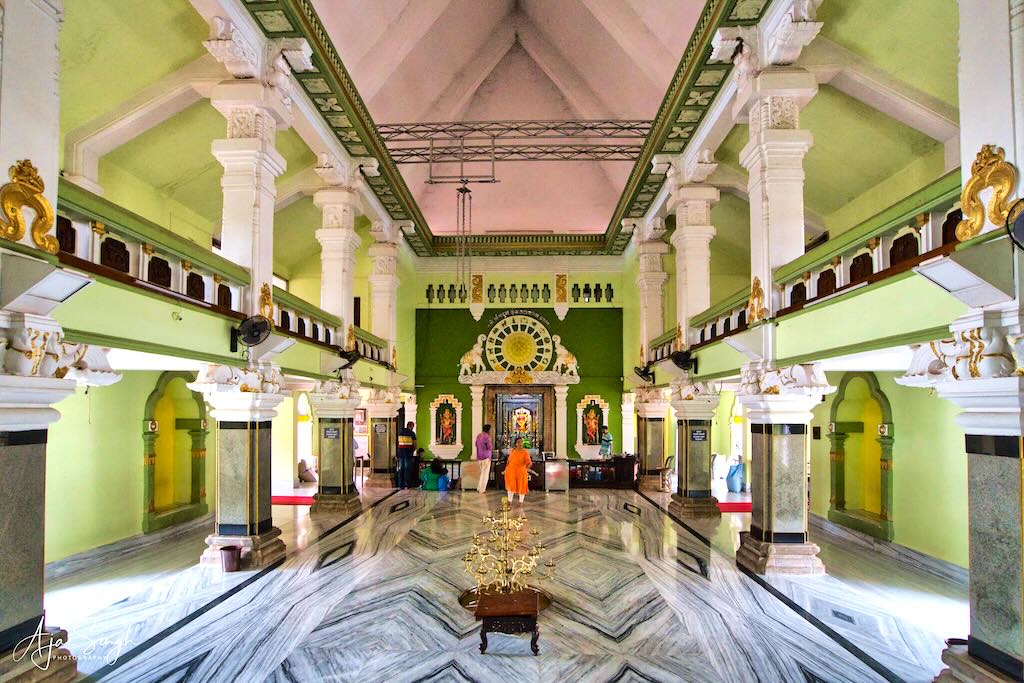
In the garbhagraha, there are two statues of Shri Śāntādurgā. One is in a sitting position where the Devi is standing in the silver makhara. On either side of the makhar, there are two lamps called nanddeeps. On the right-hand side of the Devi, there is a statue of Shree Khanderai. The second murti of the Devi is in a standing position. This is the Darshanamurti because the devotees can take darshan daily. This statue is made of panchadatu or five metals. She is standing on a patt. She holds a sword, trishul, Sudarshan chakra, and an arrow in her hand. Above the entrance of the garbhagraha, there is a Rashichakra or the zodiac sign. There is a buffalo under her feet and the lion is her vahana (vehicle).
.

.
In the big tiled hall that is separated from the garbhagraha by wooden railings, there are about 48 small wooden statues of the Samudramanthan, Maishasurvadha, etc.
The murtis of the navgrahas, kalbhairav, tandavnritya, kaliamardan, hirenyakashphu, and ugradevta are also seen in the temple complex.
.
.
Festival of Chatrostav or Sontrio
.
Though the temple of Shantadurga is now established in the nearby village of Fatorpa in Quepem taluka, devotees perform a ritualistic annual procession called Chatrostav, or the Umbrella Festival on the eve of Holi, the festival of colours. It is also known as the festival of Sontrio, which is reverentially referred to as ‘Mamai Saibinn’ by a sizable section of the local Catholic community. The festival of Sontrio is celebrated with much fervor in this South Goa village. The goddess returns home to Cuncolim, tracing the path that was taken by the fleeing Hindus carrying with them the deity to defend their faith from the onslaught of the Portuguese invasion.
.
.
The festival route is about 6-km-long tracing the route that the Hindus took 400 years ago while fleeing persecution by the Portuguese. It takes a couple of hours on foot over the hills from Fatorpa to its mulsthan, the original place of Kunkolikarin at Talebhat in Cuncolim. The goddess is placed in a solid silver palanquin and is led by 12 colourful silk umbrellas on tall poles of metal or carved wood, each representing the 12 Kshatriya vangods (clans) of the village. Along the way, as the procession stops at designated places, devotees, both Hindus, and Catholics, throw vermilion powder and rose petals, make offerings, and seek Devi’s blessings.
.
.
In Cuncolim, the site of the original temple has a church built over it. However, the locals have constructed a small temple right opposite. It is built on a small plot of land with an old and towering tree providing shade. The structure is an elegant and artful pure white dome, resembling a palanquin, with its front facade flanked by two warriors atop charging horses.
.

(Courtesy: https://timesofindia.indiatimes.com/travel/cuncolim/original-site-of-shantadurga-temple/ps51990185.cms)
.
Śāntādurgā Fatarfekarin Temple Fatorpa
.
.
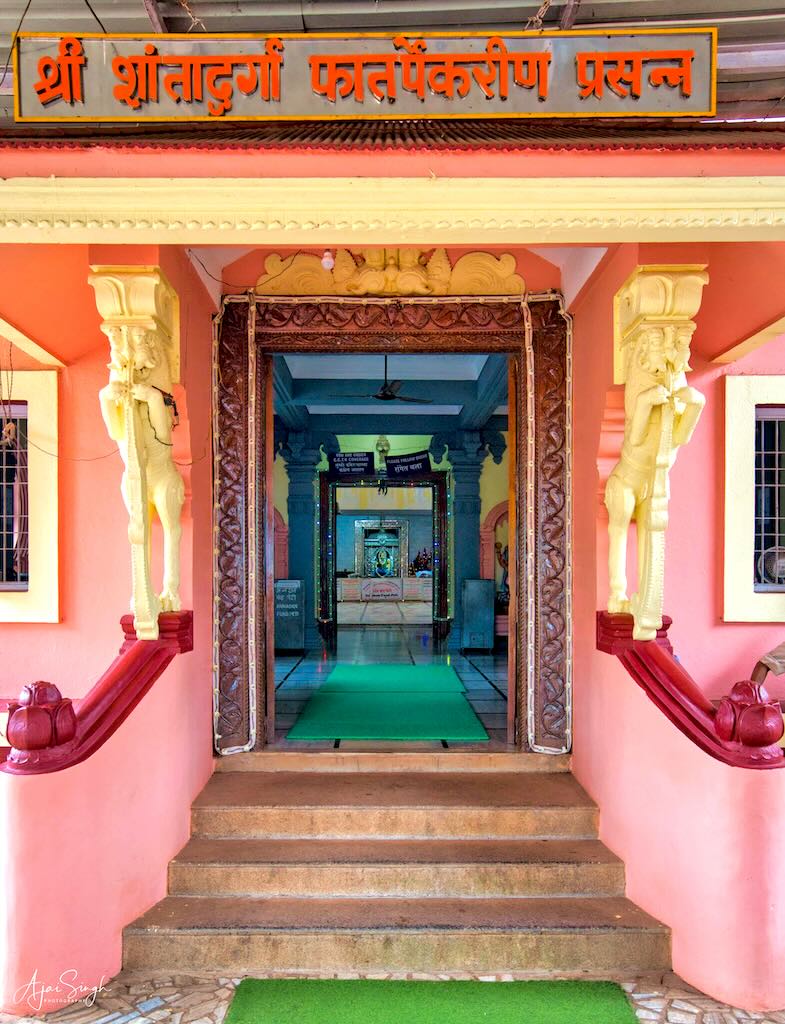
Temples in Goa have a shared history of moving from their original location leading to the usage of the term ‘migrant deity’. While persecution by the Portuguese has been the primary reason for most relocations, Shantadurga Fatarpekarin (of Fatorpa) suffered a similar fate during the reign of a Muslim ruler Bahmani Sultanate Allahuddin Hassan Gangu. He defeated the Kadambas in 1352 and took control of Goa for 14 years before he was again defeated by the Vijayanagar kings. The loot and arson of Hindu temples continued during his reign. During the Sultanate period, the Gomantak Brahmins ruled Goa when Turkic, Arab, and Afghans settled and used to harass the Hindu population by converting them or by breaking their religious places. they used to steal idols, Gold ornaments, and many things. The cruelty of the Gomantak Bahmins made the Naiks and Sawants, disciples of Shree Saptakoteshwar Narve, furious and they started to migrate to different places. Eventually, they took the vigraha, crossed the Zuari River, and settled in a village named Morpirla in the year 1365. Later they shifted from Morpirla to Fatorpa in the year 1500.
.
.
Fatorpa Village
.

.
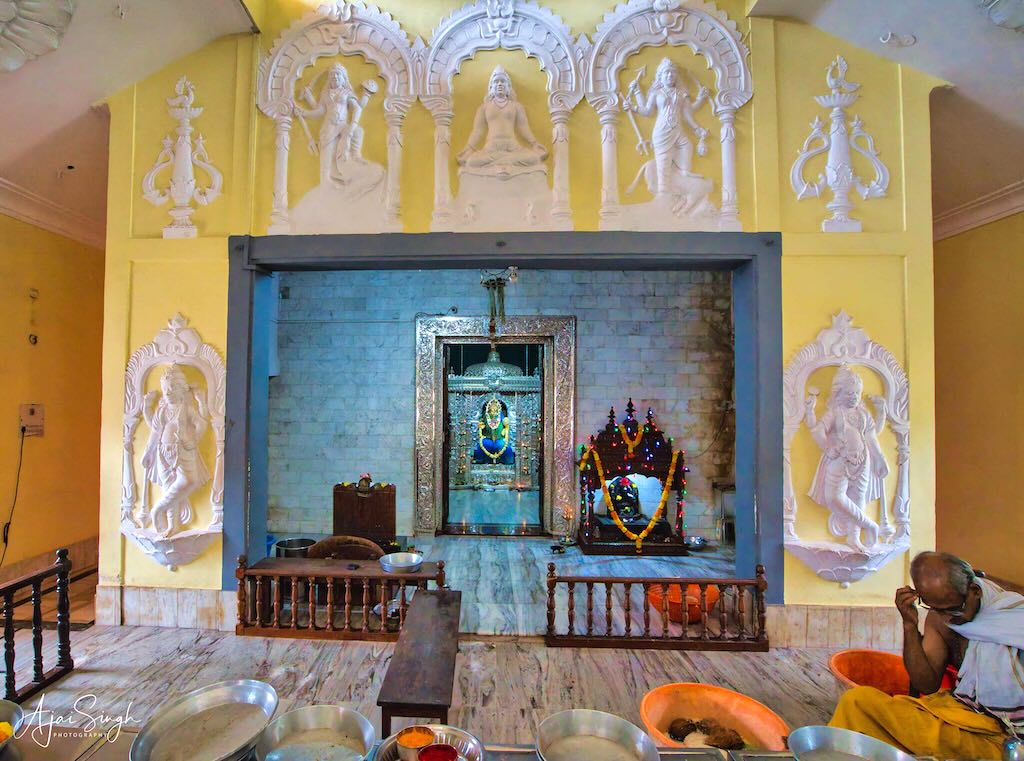
Fatorpa is a small village with all natural resources, habitat, and mountains and was considered to be a safe place to live. That is why our ancestors who were escaping from the persecution of the Muslims, and later the Portuguese, chose this place to settle down with their deities.
.
.
It is also said that the cave and a well of the Pandavas are hidden in the nearby mountains.
.

.
Kaul Prasad
.
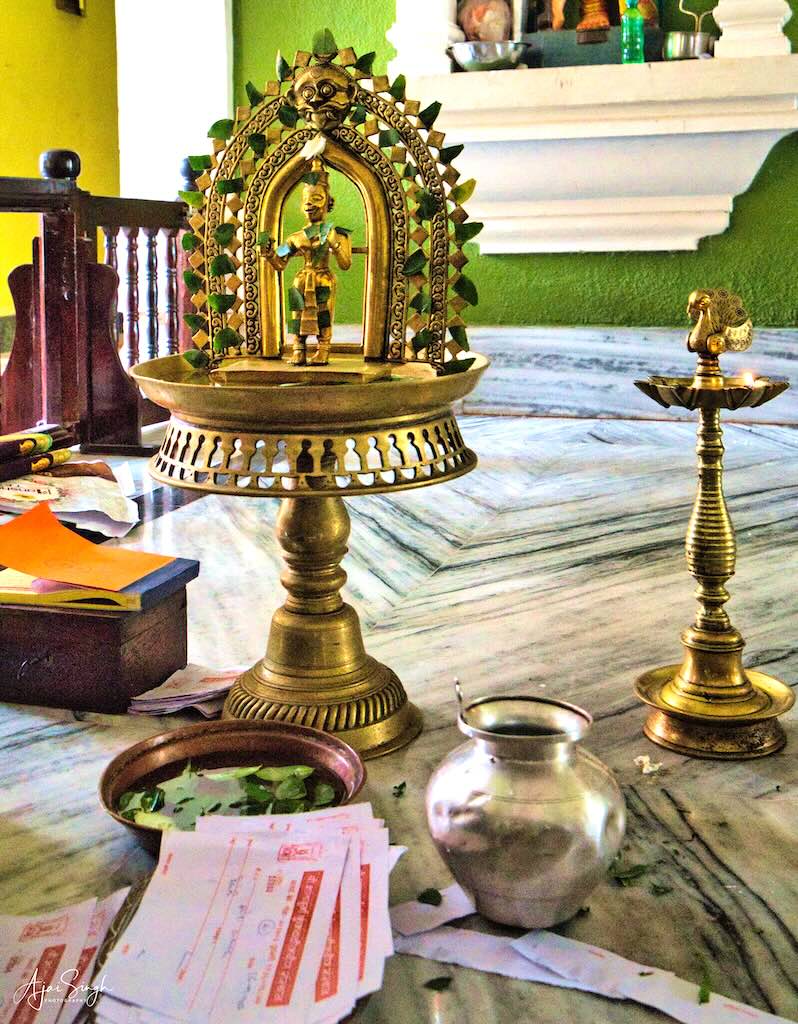
Kaul Prasad or simply traditionally known as Prasad is the traditional way, practiced from ancient times, of asking the deity about people’s problems and their solutions through the Pujari. Most of the people go home with a solution. Since this has been practiced for long, most people trust Kaul Prasad. In this, the Pujari uses small flowers of a plant called as ‘Tumbo’ (in the local language), which they stick to the wooden platform using water, and then questions or answers are asked to the deity. The deity replies by dropping the asked flower, which is interpreted by the Pujari. In the Shri Śāntādurgā Kunkalikarin temple, a brass murti was used for this purpose.
.
Amma Shri Śāntādurgā Ballikarin Temple
.
.
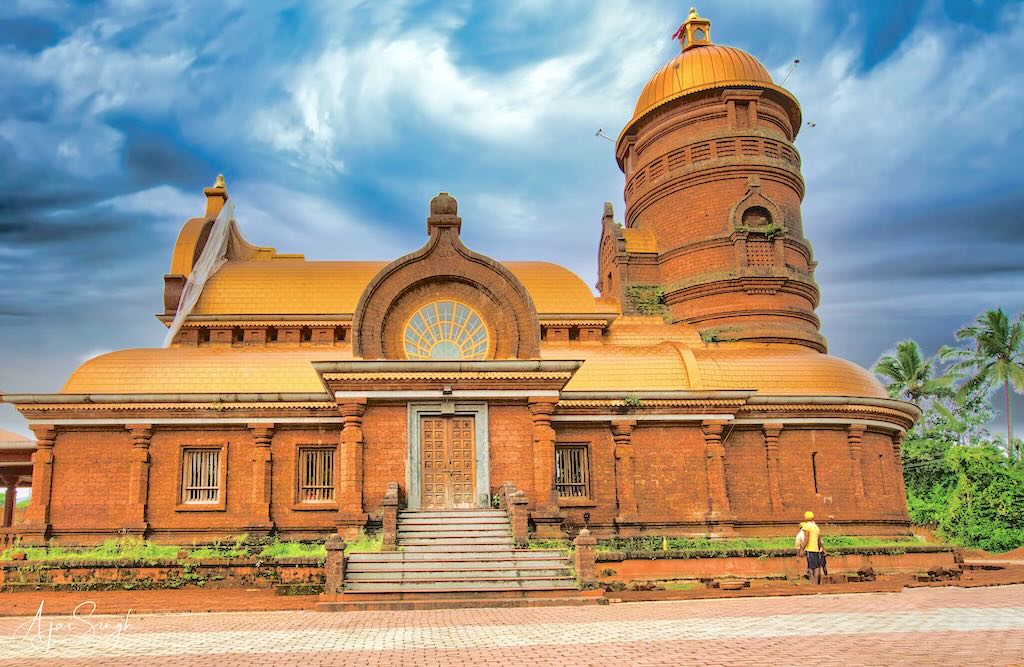
The Shri Śāntādurgā Ballikarin Prassanna Temple Balli is a Shakti temple located at Cavorem, Goa. There are 5 temples of 5 Devi’s in Goa. This is one of the sister’s temples in Balli village. The names of the five temples are Fatapekarin, Kitakarin, Ballikarin, kunalakarin, wadekarin. All these temples are near each other.
.
.
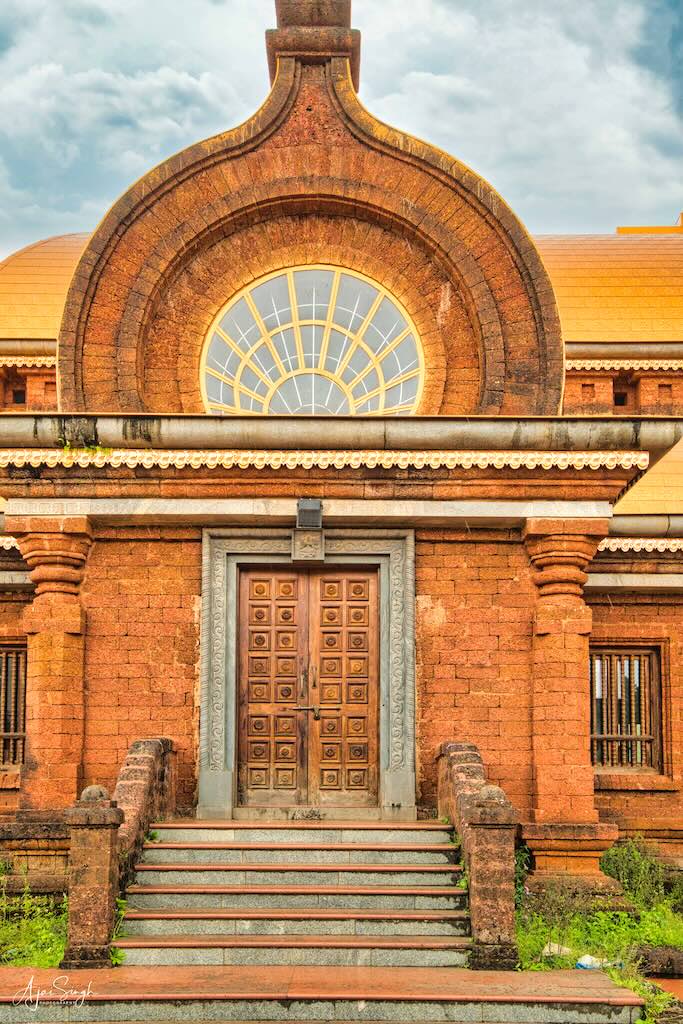
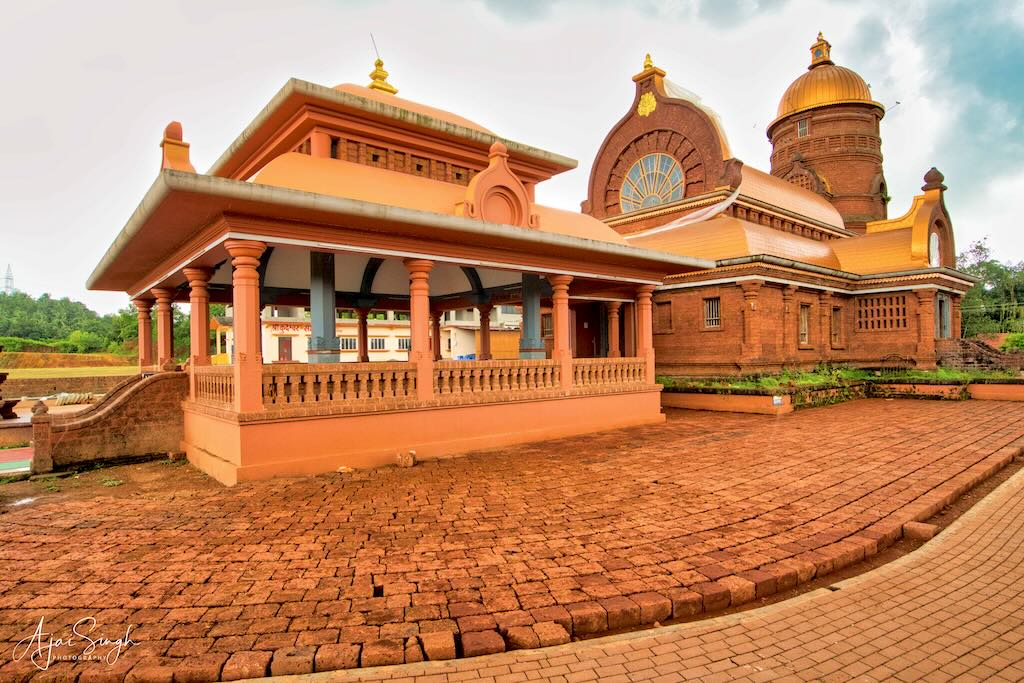
This is a beautiful temple rebuilt from an ancient one recently. The construction work was still ongoing during our visit. The surrounding mountains are exceptionally beautiful during the monsoon season when we visited. The uniqueness of this temple is its structural design. Instead of RCC, local chire (stone) has been used to form an arc for the roof. The stone has a copper cladding on top, giving it a lovely finish. The temple follows a Buddhist design, with features similar to a chaitya (prayer hall), horseshoe-shaped arches over the entrance, and a semi-circular shape of the roof.
.

.
There are two idols of Śāntādurgā and Saterī in Mahishasur Mardini swaroop made of black stone in the temple garbhagriha.
It has an annual ritual performed in honour of its patron deity, Shri Śāntādurgā Ballikarin. On the ninth day of the full moon (Navami) of Phalguna, on which ‘shidyotsav’ (festival of ladders) or the ‘gadostsav’ of ancient Balliyapur – as Balli was called in ancient times – it is celebrated.
.
.
Shri Saptakoteshwar Worship
.

.
The Itihāsa of Shri Saptakoteshwar
.
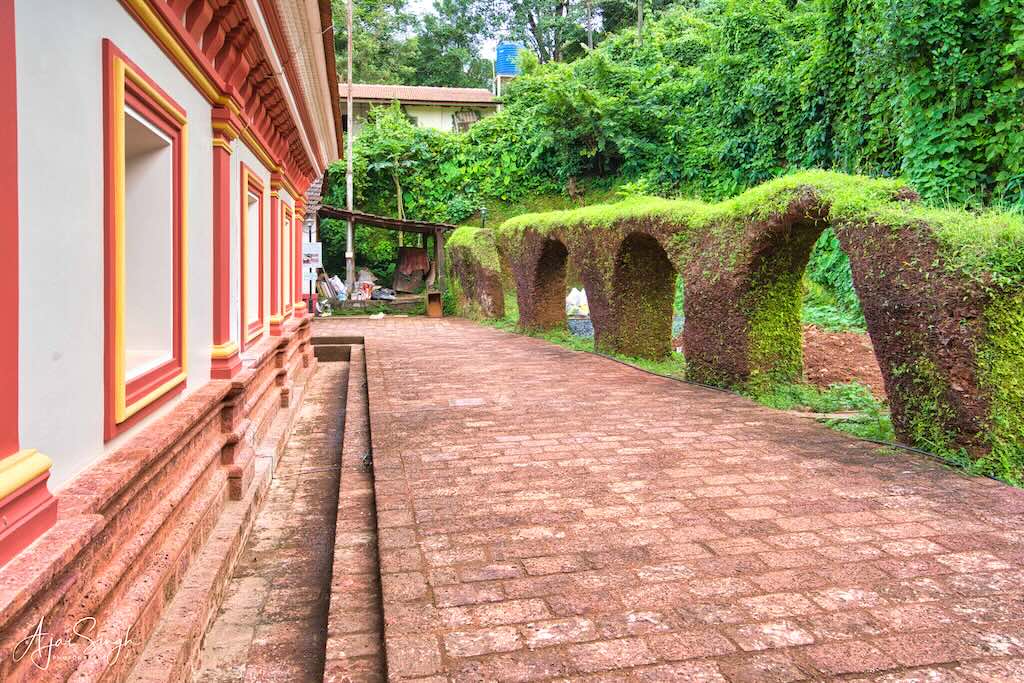
There is a story related to Shri Saptakoteshwar it goes as this: thousands of years ago the Saptharishis were doing penance to seek the appearance of Mahadev. It is said that they meditated on the bank of the river for around seven crore years. Mahadev was pleased by their devotion and appeared before them. After this, the Saptharishis took a bath in the holy water and performed puja. This further pleased Mahadev and he asked them what they desired from him. One of the rishis said, in order to get your glance we chanted very difficult mantras for seven crore years, to mark this event we wish you to stay here forever. Their wish was accepted and thus the temple dedicated to Shri Saptakoteshwar came into existence. As a mark of seven crore mahamantras, he came to be called Saptakoteshwar. As a lord of rishis, he is also called Saptanath (Sardesai, 1934).
.
.
The original Saptakoteshwar Temple was located in Narve on Divar Island and was built by Kadambas. In 1352, when the Kadamba kingdom was conquered by the Bahmani Sultan Allauddin Hasan Gangu, Goa came under the rule of the Sultan for a period of about 14 years. A number of temples were destroyed during this period and the Linga at the Saptakoteshwar Temple was dug up by the invading troops.
In 1367, the army of Vijayanagar King Harihararaya defeated the Bahmani Sultan in Goa and managed to restore most of the temples to their former glory including that of Saptakoteshwar. According to the records, the temple was reconstructed by Madhava Mantri, a Minister of the Vijayanagar Empire, by the end of the 14thcentury. However, after 200 years, the temple came under attack once again by the Portuguese colonialists.
.
The Kadambas
.
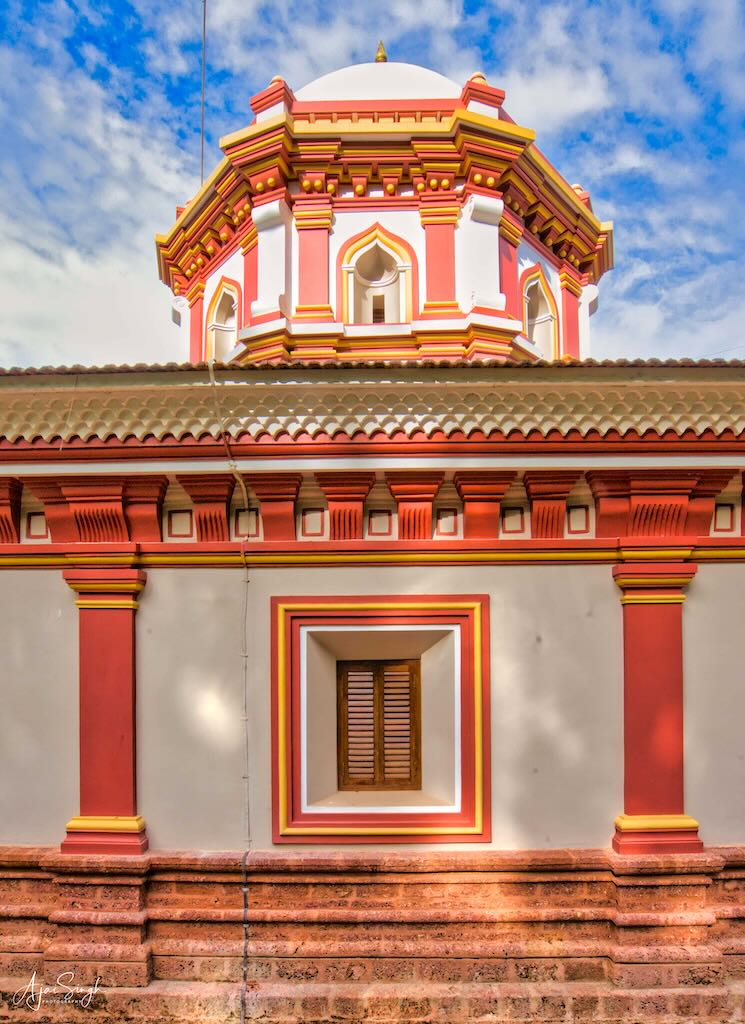
The period of the Kadamba dynasty (10th – 14th CE) was a golden period in the history of Goa. The Goa Kadambas were originally from Banavasi, Karnataka the ancient capital of the early Kadamba rulers. They had settled in the Halshi district in the area known as Palasige, which comprised the southern part of Belgaum district and specially Khanapur and Sampagaon talukas of Karnataka, situated on the south-eastern border of the Goa territory (Gune, 1979). There is only one remaining example of a Kadamba-era temple in Goa, which is dedicated to Mahadev at Tambdi Surla.
.
.
The Kadambas were an ancient ruling family of Karnataka, who had founded the first indigenous Kannadiga kingdom in Banavasi in the 4th century. That kingdom lasted for some 200 years, but eventually came under the Chalukyas of Badami, becoming their feudatories. It appears that the family may have remained in this position of vassalage to the Chalukyas of Badami and then to the Rashtrakutas. Then, in the late 10th century, the Kadambas supported the Chalukyas of Kalyan in their struggle against the Rashtrakutas. After the Rashtrakutas were defeated, it appears the Kalyani Chalukyas gave the Kadambas some measure of independence – one branch in Hangal and another in Goa.
The Kadambas of Goa enjoyed this period of independence for over 250 years, during which they issued a large series of gold coins. They eventually succumbed to an invasion from the Yadavas of Devagiri in the first half of the 13th century. Eventually, this territory fell to Alauddin Khilji and, after a brief period as part of the Delhi Sultanate, was absorbed into the Bahmani kingdom.
While Kadamba rulers were tolerant and supportive of both Buddhism and Jainism, later Kadamba rulers were more specifically devoted to Hinduism and, most particularly, the Shivite sects. Saptakoteshwar was adopted as the patron deity of the rulers at least from the time of Shivachitta (1147-81 CE).
.
Antiquity of Sri Saptakoteshwar Worship
.
Though the temple was built during the Kadamba period, the worship of Saptakoteshwar is very ancient and precedes the reign of the Kadambas. At Koti Teertha, a holy tank associated with Shri Saptakoteshwar temple at Dipavati island (now Diwadi/Divar), some bricks found have been dated to the 6th / 7th century CE.
.

.
Gomanchal kshetra mahatmya and Teerth Mahivarnan state that the Saptarishis (seven sages) consecrated the linga of Saptakoteshwar, while the text Chitpavanbrahmanotpatti associates sage Parashuram with the linga of Saptakoteshwar. It also mentions that the linga was made of metal.
.
The Temple in Literature
.
Sahyadri Khanda of the Skanda Purana, mentions the existence of Shri Saptakoteshwar temple in Deepwadi Shetra, which is Divar in Naroa area. The original temple was shifted from Tiswadi to Bhatgram, which is present-day Bicholim. In 16th century Portuguese literature, we find that this island was famous among Hindus and was known as Tirtha where Hindus flocked in large numbers. Andrea Corsali in his letter of January 6, 1515, written from Cochin to Juliao de Medici states as follows: “In the city of Goa and all over India there is an infinity of ancient buildings of the gentiles and in a small island near the city called Divari, the Portuguese, in order to build the city, have destroyed an ancient temple called Pagode, which was built with marvelous art and contained ancient figures wrought to the greatest perfection in a certain black stone, some of which remain standing ruined and shattered because these Portuguese care nothing about them. Should I have in hand any (figure) thus ruined, I shall send it to your Highness that your Highness may see how in ancient times sculpture was appreciated everywhere”.
.

.
Friar Antonio in his letter addressed to the King of Portugal on November 4, 1518, wrote, “Sir, there is a great temple in this island of Divar which has much of freestone and a large part of it is already destroyed. We pray your Majesty to make a gift of it to this Monastery”. Fr Fransisco Sousa says “was as much venerated by the Hindu Brahmins as the Holy Land is by us, on account of a temple of many indulgences and pilgrimages and even at present on a certain day of the year, the Hindus hopefully flock there to bathe themselves in the margin of the river facing the locality where the temple was formerly situated, so that they might not lose their plenary indulgence” (Gomes, 1978). Till today a great fair is held annually on Gokul Ashtami the eighth day of the full moon of the lunar month of Shravana, in honour of Shri Krishna when pilgrims bathe in this sacred water.
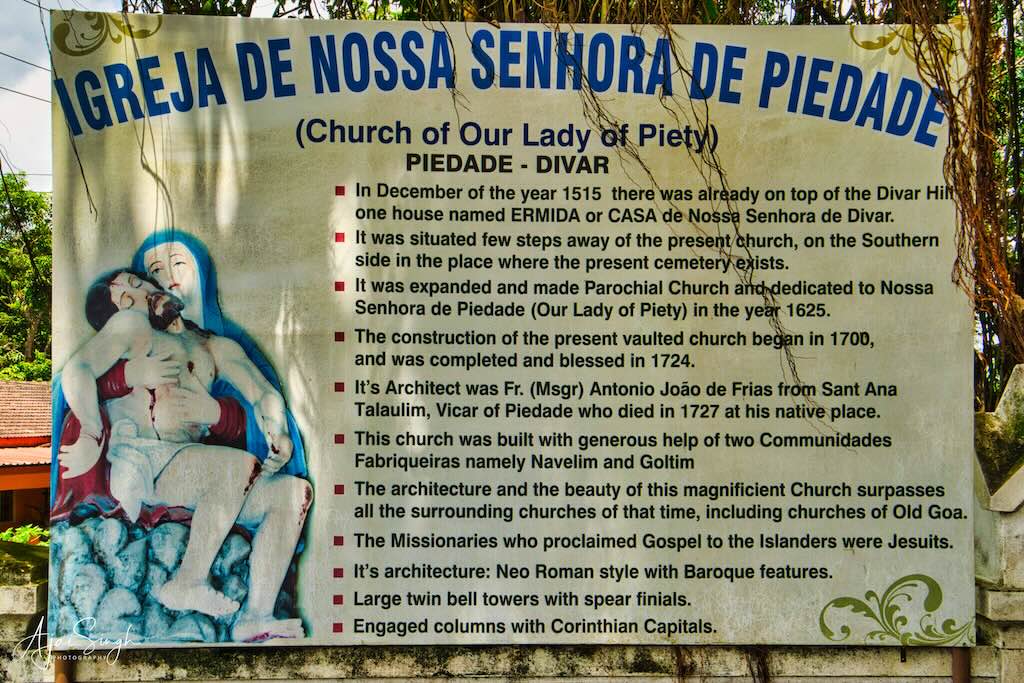
Although 16th century travelers and writers talk about the temple, it does corroborate the fact that there existed a grand temple. This is further proved by the temple material used in the Cemetery of Nossa Senhora da Piedade Church on the island, which is similar to the Mahadev temple at Tambi Surla.
.
.
Scholars like J.F Fleet, Father Henry Heras, and Gritli Mitterwallner were among the few to carry out the primary research on this temple in the early to mid-19th/20th century.
.
Archaeological Sources
.
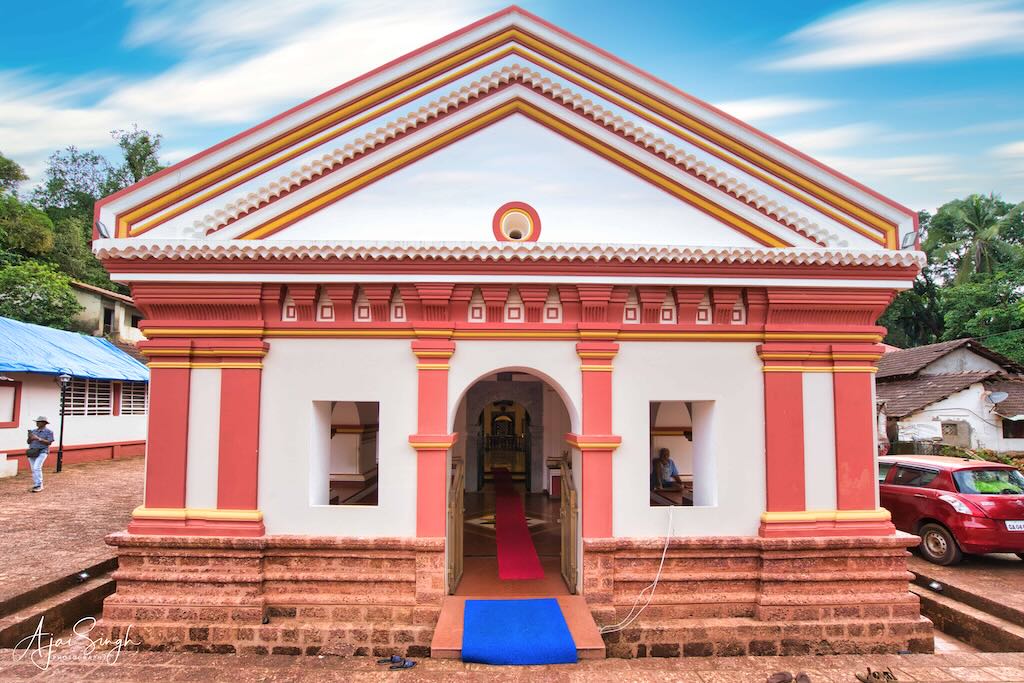
In the Degamve inscription of 1174 CE, which is in the Degamve Temple, written in Kaayastha and Kannada characters or script, in the Sanskrit language it is mentioned that Queen Kamalaadevi wife of King Shivchitta Permaadideva while having secured a required grant for the endowment (Agrahaar) to Brahmins released holy water at the feet of Shri Saptakoteshwaradeva. Nija-Radhya Sri saptakoteshwardevsripadsanidhyo is mentioned in the inscription (J.F Fleet, 1870). In the copper plate inscription of Jaikeshi III of the year 1187 CE of Kirihalasige village which is in Sanskrit language, Benares or Kaayastha characters, they have mentioned the king as ‘SriSaptakoteshwarlabdhvarprasad SrikadambveerJaikeshidev’.
.
.
In the copper plate inscription of 1247 CE of Shashtadev Ill in Sanskrit language and Nagari the character ‘SriSaptakoteshwarlabdhvarprasad‘ is mentioned (Fleet J.F. 1870). It is clear from this, that from the 12th century CE to mid-13th century CE until their downfall, Shri Saptakoteshwar was revered by the Kadamba rulers (Sardesai, 1934).
The mention of the deity is not just restricted to copper plates but can be seen on coins. The Bombay Branch of the Royal Asiatic Society has several Kadamba coins. On the gold coin of Jaikeshi III 1210 CE, he is called Nishk ‘SriSaptakoteshwarlabdhvarveerJaikeshidev’. One gold coin of Jayakesi II has an inscription saying “Sri Saptakotisa-Labda-vara-vira-jayakesideva-Malavaramari (Figure 2). Gold Coins of Sivachitta (1147-81 CE), and Soyideva (1217-36 CE) also mentions the name Saptakotisvara (Moraes, 1990). A mention of the name of Shri Saptakoteshwar on the coins, copper plates, and inscriptions points out that the Kadamba kings were staunch followers of Shri Saptakoteshwar. And that the Kadamba kings venerated the deity greatly.
.
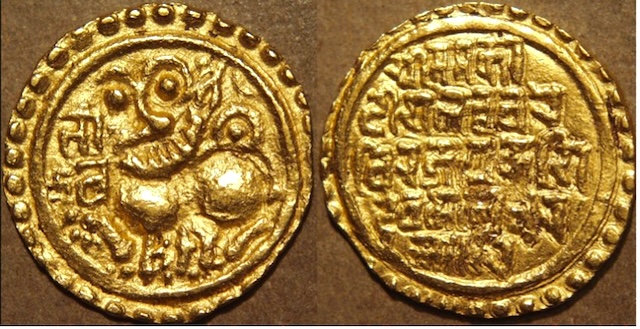
Jayakesin I (c. 1050-70) or II (c. 1119-47) Gold pagoda
Lion left, cyclic date at left /
5-line Nagari legend: Sri Sapta ko / tisa Labdhavara / Vira Jayakesi / deva Malavara / mari
.
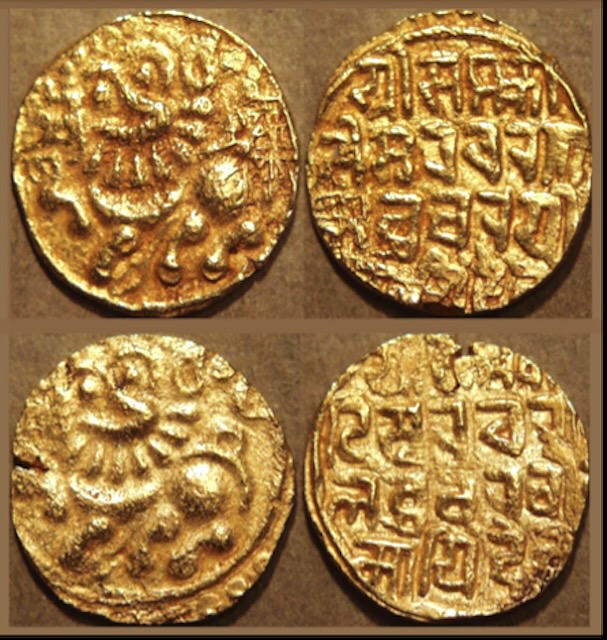
Soyideva (c. 1217-36)
Upper Coins: 4-line Nagari legend: Sri Sapta ko / tisvara Charana / Labdhavara So / yi deva
Lower Coin: 4-line Nagari legend: Sri Sapta ko / tisvara Charana / Labdhavara vira/ Ma(!)yi deva
.
Shri Saptakoteshwar Worship During the Portuguese Period
.
As part of the Portuguese onslaught against iconoclasm, the temple was razed to its foundations in 1540 by the Portuguese, and a chapel dedicated to Nossa Senhora De Candelaria was erected in its place using the stones of the destroyed temple. To hide the linga, it was put in a well shaft (the marks of the ropes used to draw water are still visible on the linga) until some Hindus managed to rescue it from further desecration. It was smuggled by one of the locals named Narayan Shenvi Suryarao and taken to a place across the river called Latambarsem in Bicholim where it remained for three years. In 1543, it was installed in a new temple in the erstwhile Hindole in Bicholim, which came to be known as Naroa (Narve). After the Marathas came to power in 1664, the temple was revamped in 1668 by Chhatrapati Shivaji Maharaj. The construction of the new site was carried out by Shri Shivaram Desai (president of the Sansthan) with Chhatrapati Shivaji Maharaj’s blessings and guidance.
Present day a revived temple shrine using a similar ancient Kadamba Nagar style has completed its construction and is open for the devotees to witness the architecture at Fatorpa Quepem.
.
The Three Important Shri Saptakoteshwar Shrines in Goa
.
- The shrine at Fatorpa was built by the Kshatriya families immediately after the destruction of Diwadi (Divar).
- The shrine at Narve was rebuilt by Shivaji Maharaj after the second destruction at Diwadi.
- The ancient shrine at Opa-Khandepar.
In this blog, I shall be writing about the original non-existent temple at Divar Island, and the two existing Shri Saptakoteshwar temples – firstly, the ‘migrated’ temple at Narve, Bicholim (which is regarded as the main temple presently), and secondly, the shrine at Fatorpa, at the site where the linga was first kept in a temple after the destruction of the Divar temple. This temple has been recently been rebuilt in stone, following the Kadamba style of architecture.
.
Shri Saptakoteshwar Temple Narve
.
.
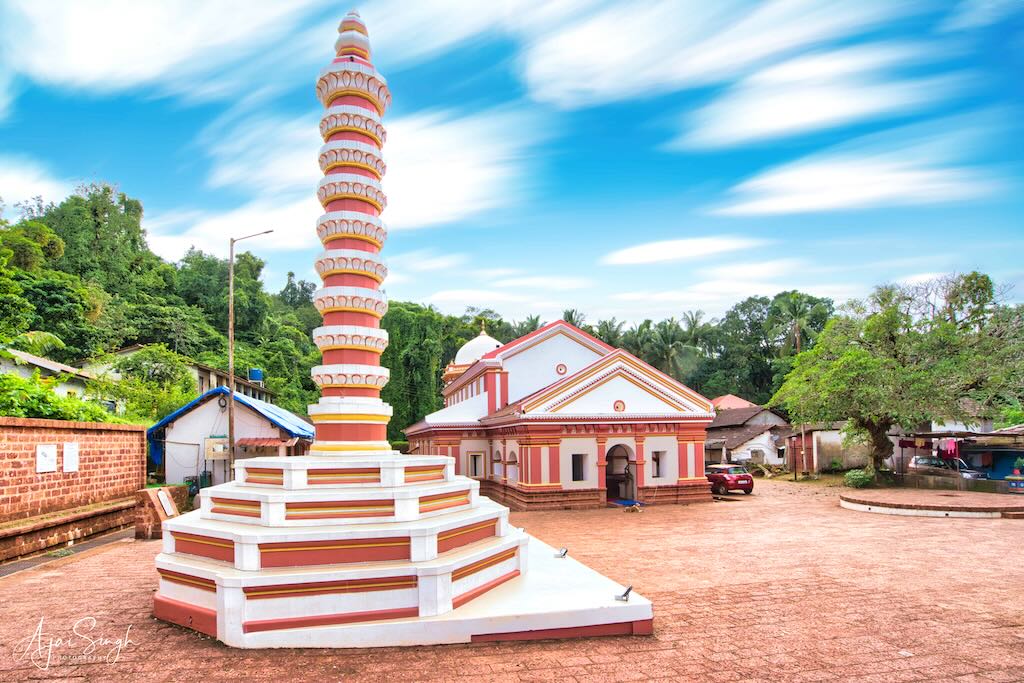
The Shri Saptakoteshwar temple at Narve in Goa is considered to be one of the six great sites of temples of Shiva in the Konkan area. Hence the temple is held in high reverence, as though the original temple was razed to the ground, the linga could be salvaged and consecrated in the ‘migrated’ temple at Narve.
.

.
The term ‘migrated temple’ is commonly used in Goa, since all temples were destroyed during the dark period under Portuguese rule when the onslaught against iconoclasm and the horrors of the Inquisition ensured that no temple escaped in their territories. It was to the credit of the pujaris and devotees who risked their lives to save the vigrahas by smuggling them out of Portuguese-controlled territories. Thus, most existing temples in Goa are those that ‘migrated.’
.


.
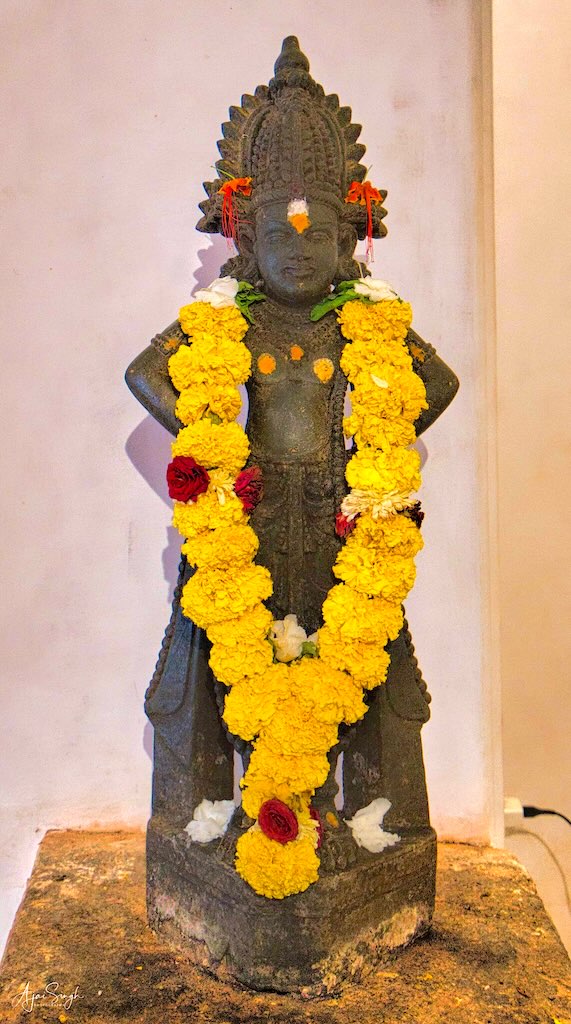
The Saptakoteshwar temple has a small entrance hall with bells. The main five-pillared hall is decorated with arches and is intricately painted with chandeliers glorifying the beauty of the ceiling while the sanctorum wall is made of plain wood. With its shallow kalash dome mounted on an octagonal drum-sloping tiled roof, European style Mandapa, or assembly hall, and tall lamp tower or Deepastamba, the temple is situated in an archaeologically important area.
.

.
The presence of ancient aggarshalas can be seen in the ruins of an arched crumbling structure behind the main temple. The surroundings of the temple have numerous Brahminical laterite and stone caves. In the vicinity of it also existed a Jain Math, the ruins of which are still visible.
.

.
The Maratha King Shivaji gave the order in 1668 for the Saptakoteshwar temple at Narve to be rebuilt and the linga installed in its proper place. The stone plaque mentioning this order still exists and can be seen above the temple entrance. Located amid Naroa’s iconic lush green fields, the temple is a Sanskrit Nagari inscription mentioning the commencement date of the construction of the temple by Shivaji Maharaj, dated 13 November 1668.
.

.
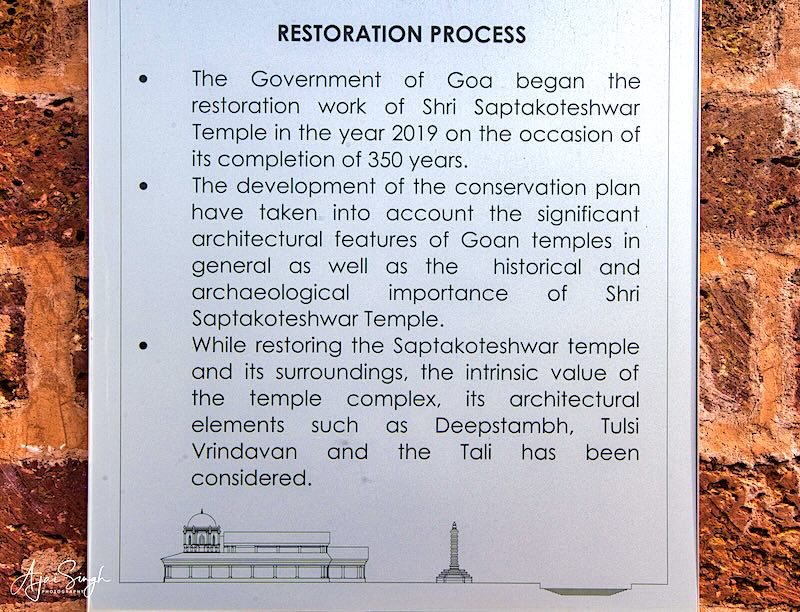
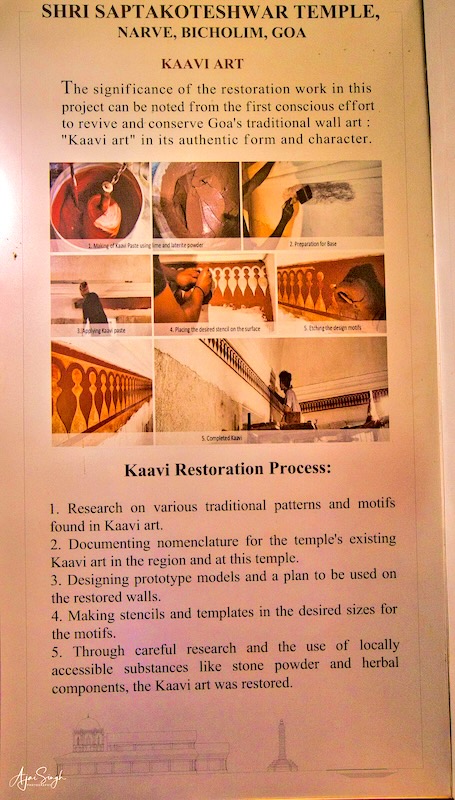
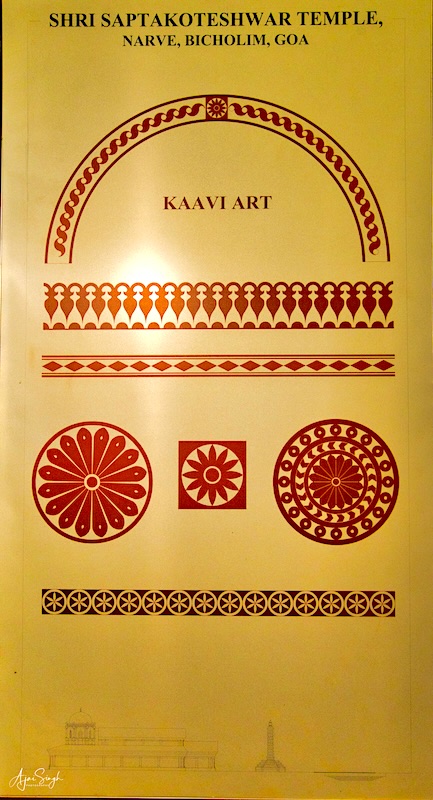
The temple has been recently renovated under the supervision of the Goa Archives and Archaeology Department. During the renovation, the ancient Goan ‘Kaavi’ art form of wall decoration was executed to revive the art form.
.

.
The original temple of Shri Saptakoteshwar was built using locally available laterite stone, as was the tradition for most ancient temples. Though the temple was destroyed, portions of it remained and one wall with steps leading to the roof has been incorporated into the structure of the new temple. This portion has been enclosed inside a glass panel to preserve the original legacy for posterity.
.

.
The most important festival celebrated at the temple, attended by thousands of devotees from Goa and other parts of India is Gokul Ashtami, which is considered to be the day on which Shiva appeared to grant the wishes of the seven holy sages.
.

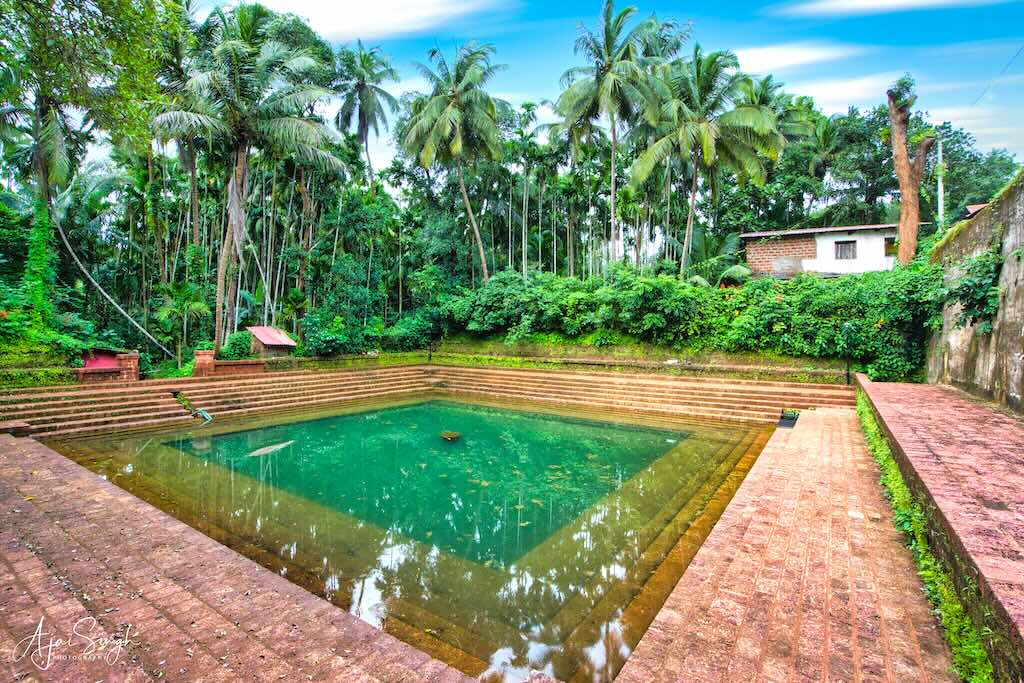
.
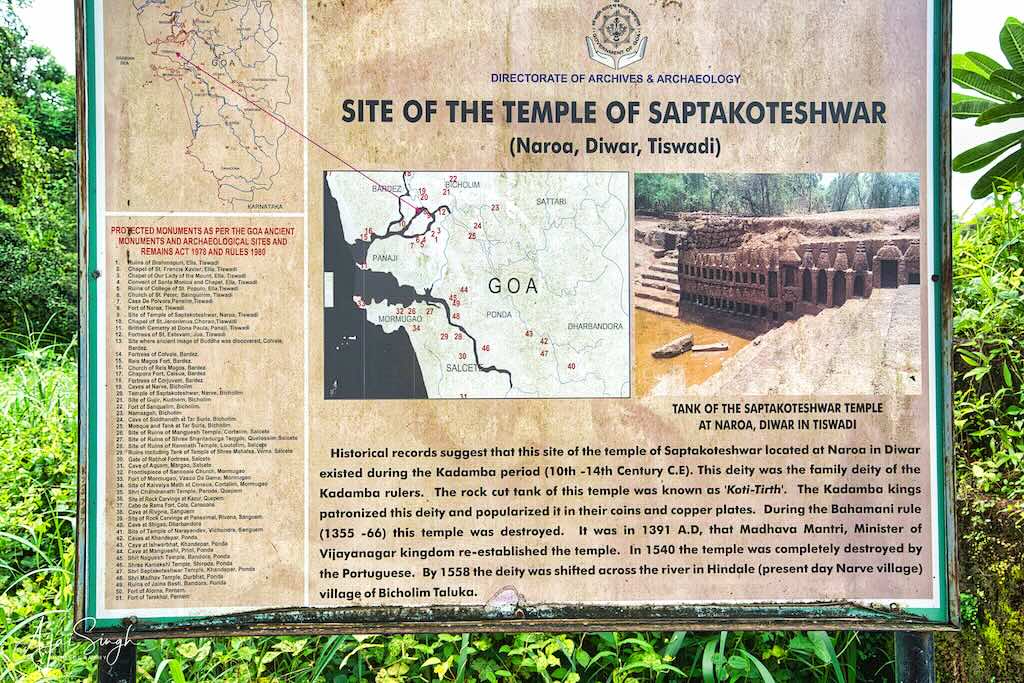
Sri Saptkoteswar Temple, Deepwadi (Divar), Tiswadi
.

.
This was the place where the original Shri Saptkoteshwar Temple was built by the Kadambas in the 12th century. The site was where the original linga was consecrated by the rishis in pre-historic times. The temple was attacked on a number of occasions, the first time by the Bahmani Sultanate. This has been described in the Itihāsa section above. was razed to the ground, and a church exists on the site today.
.
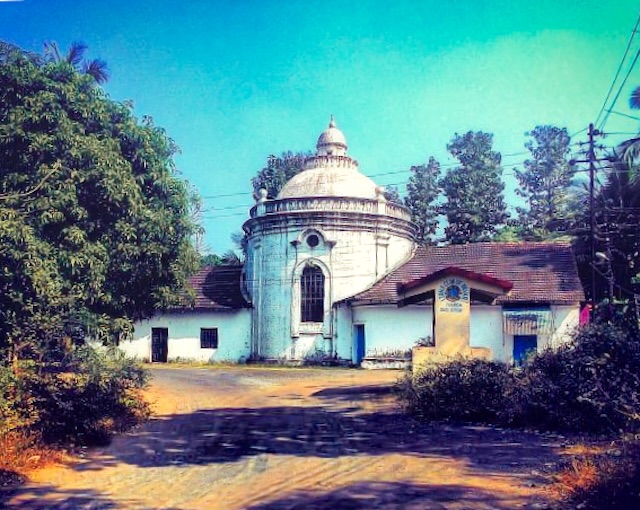
.
Divar Island
.
The people of this island are administratively separated by two Panchayats and are warmly hospitable and friendly, but they are also ferociously possessive about their land and culture; and they immediately bond together, irrespective of their communal identities in times of crisis, to celebrate and preserve the heritage and cultural aspects of their land. There are many separate villages – Piedade (Goltim-Navelim), Naroa, and Malar on this island; each with a wonderful heritage – tangible and intangible.
.
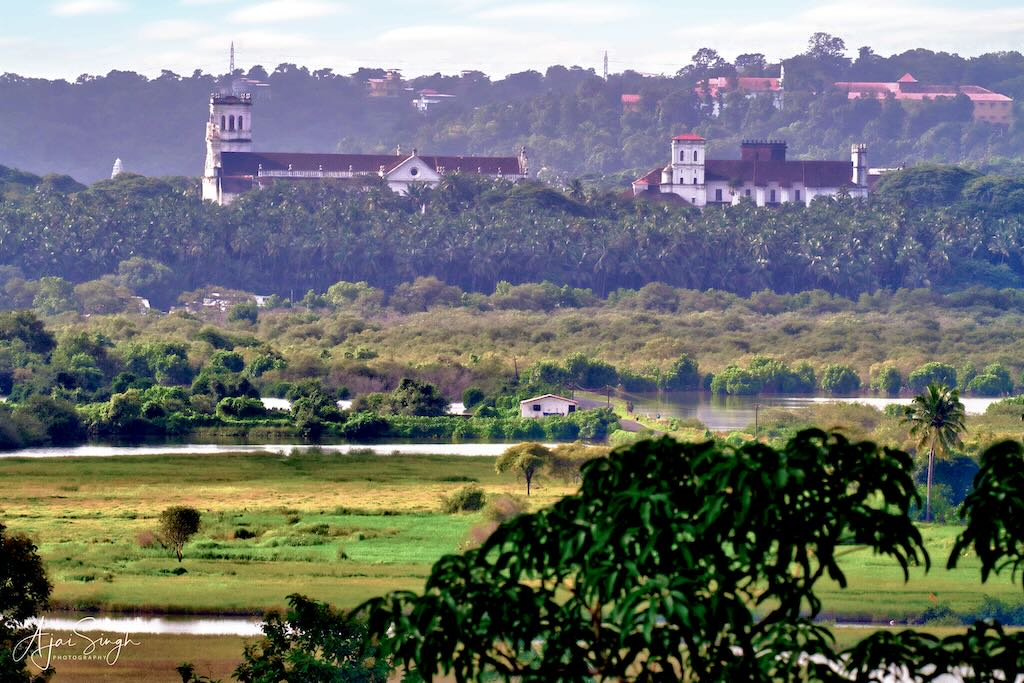
.
Divar is not on the bustling tourist routes as yet and one can still experience the old-world charm of the island – the only one that is not yet connected by a bridge with the rest of Goa and depends on ferries to take you across there. During my visit to Goa, I picked a homestay accommodation on the island to experience the ambiance while visiting the ancient sites, since this was one of the earliest places settled by the Portuguese. Not to mention that it was considered a tirth since prehistoric times because of the profusion of temples on the island. Naroa is a small village located on the easternmost tip of Divar. It claims to be a blessed village due to its location at the confluence of three branches of the Mandovi River, a place Hindus consider as a tirth (holy).
.

.
Once one drives through the Arch of the Viceroy (in Old Goa, the capital of the Portuguese empire) and crosses over in the drive-in ferry at the Old Goa ferry wharf, we reach this scenic mangrove-trees-fringed island, after a very short river trip over River Mandovi. The Arch of the Viceroys was the main gateway to the city of Old Goa and was built by Vasco da Gama’s great-grandson. On taking office, all Viceroys made their processional entrance with great ceremony through this archway where they were presented with the keys of the city.
The most impressive structure that one sees on this island when crossing the ferry, is the massive Church that stands atop the hillock right ahead of the route. This Church dedicated to Our Lady of Piety (Piedade), is the main hub of religious activity and is considered as the first ecclesiastical structure on this island. On the front walls of the church are portraits of Goan missionaries who went from Goa to Jaffna in Sri Lanka to spread Christianity. The church was built on the site of the demolished Shakti Ganesh Temple which existed here since ancient times.
.
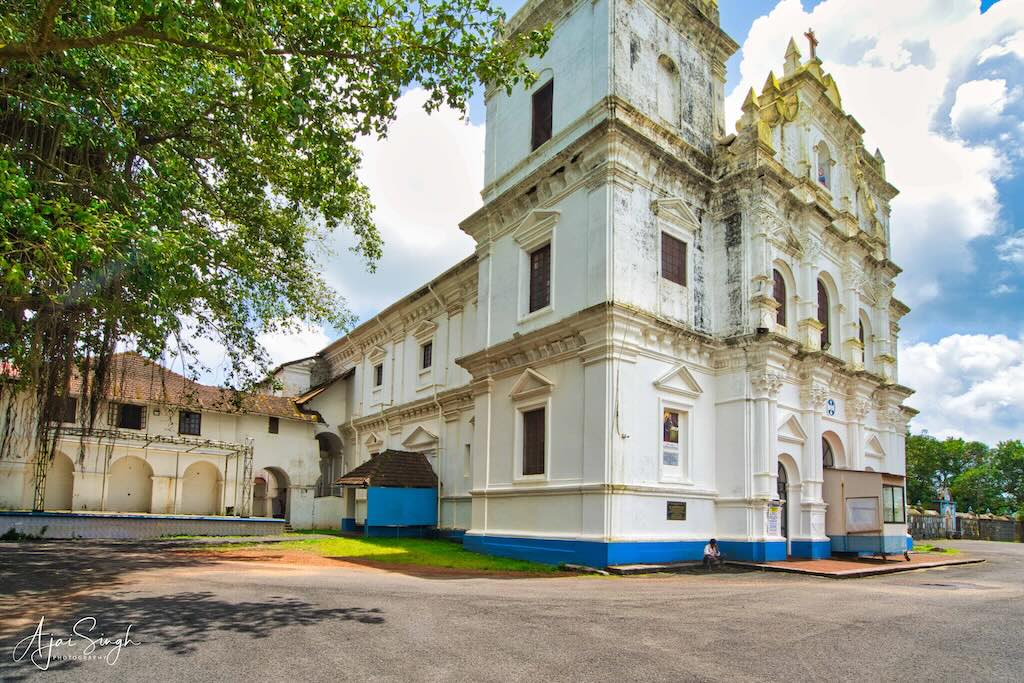
.
Adjacent to this Church is a cemetery, enclosed within a high wall. In this cemetery, there exists a small room, which is a part of the remnants of the original temple with a lotus flower symbol visible, predominantly seen in the Kadamba and Hindu temple architecture. This cemetery used to be the original Shakti Ganesh temple, one of the biggest and most impressive shrines in Goa before it was razed to the ground by the Portuguese. You can still see portions of the temple arch inside the cemetery, which was a part of the garbhgriha.
.
.
A small, artistic Ganesh Temple lies to the north, just about 100 meters away from this church. The land, on which this Temple stands today was built much later on land donated by a Christian gentleman from the Gomes Pereira Family – a landlord family from Divar island. Probably in remembrance of the demolished temple.
.
.
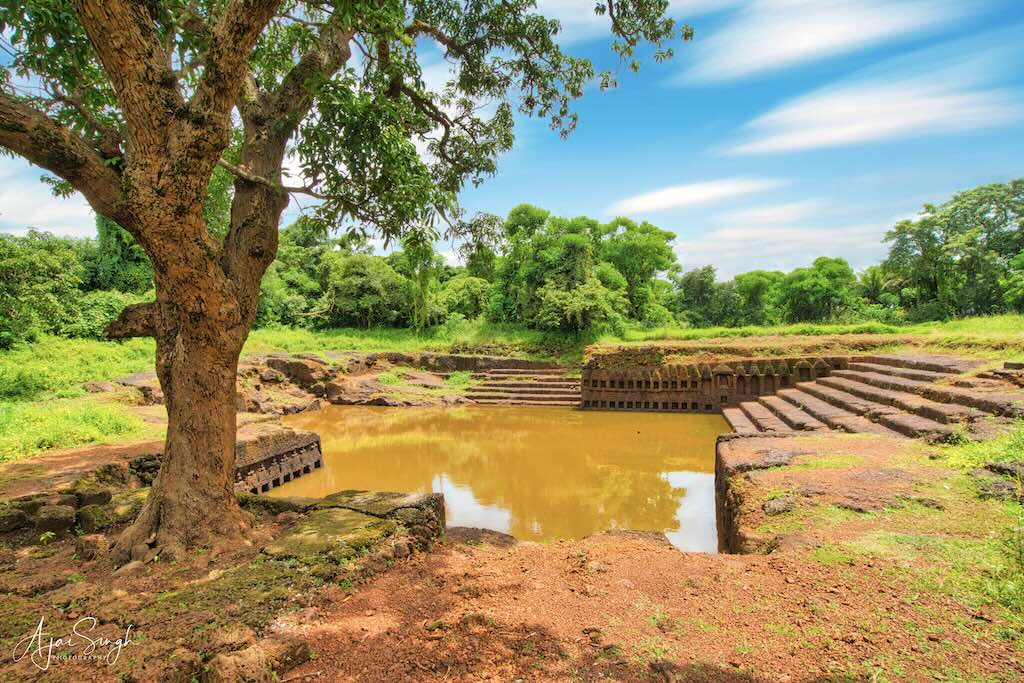
Apart from fragments of the Saptakoteshwar temple, beautiful remains of the lateritic pushkarni (temple tank) can be seen even today on Divar Island. This tank is carved in laterite rock with carved niches or devakoshtas and which is popularly known as Koti-tirth. The tank has steps on all four sides – the steps on the left are narrow and have partially collapsed. The niches with flat bases are carved around the tank where lamps would have been lit once. These 108 devakoshtas or niches of bigger size were used to place a murti which is evident from the flat surface base, with a depression at the centre. Its beauty speaks a lot about the grandeur of the temple that has existed at the site.
.
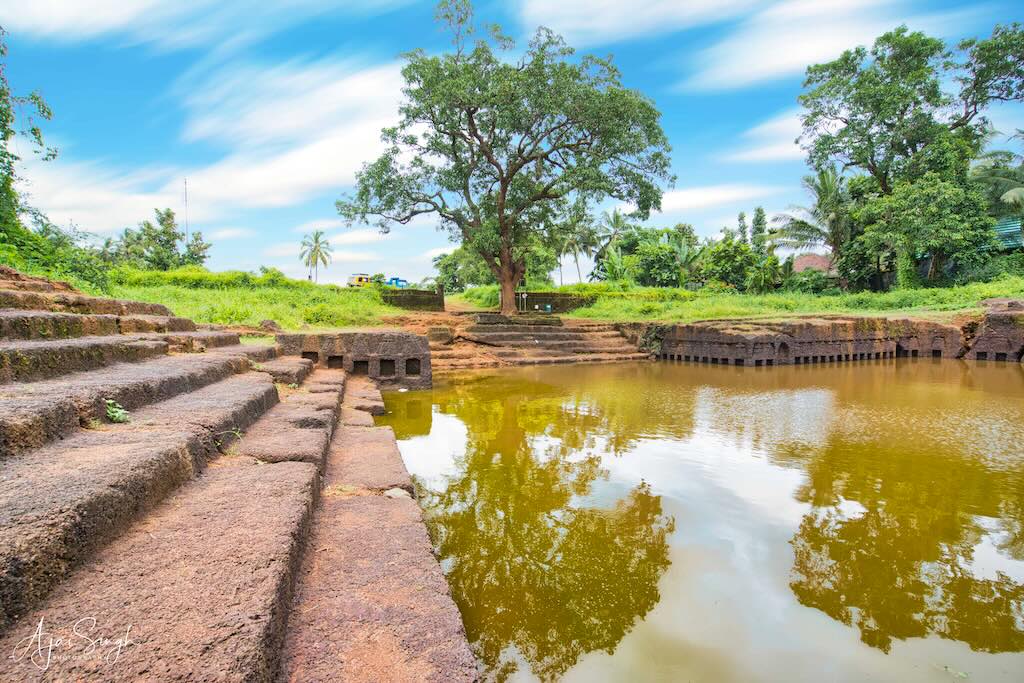

This tank beautifully carved in laterite rock with niches or devakoshtas at Koti Tirth. There were 108 niches originally

.
Shri Saptakoteshwar continues to be worshipped with great devotion and reverence. Presently the temple in Bicholim functions as the main temple. And other two temples that are Goandongrim, Cancona and Mor Pirla, Sanguem Goa are not very popular. Another ancient temple dedicated to Shri Spatakoteshwar is at Khandepar Ponda Goa, on the bank of the river Khandepar. Here Shri Saptakoteshwar is worshipped in the form of linga. The garbagriha of this temple consists of a rock-cut cave. The temple is built using laterite stones and the door jamb in schist stone.
.

(Courtesy:http://www.heritageuniversityofkerala.com/JournalPDF/Volume8.2/40.pdf)
.
From the site of the temple of Shri Saptakoteshwar Divar, fragments of the temple remains of basalt stone were recovered by Gritli Mitterwallner (1983), one is that of a fragment of the parapet. It is decorated with pilasters and miniature sikharas of slender dimensions. The remains are kept in the Archaeological Survey of India Museum, Goa.
.
Shri Saptakoteshwar Temple Fatorpa
.
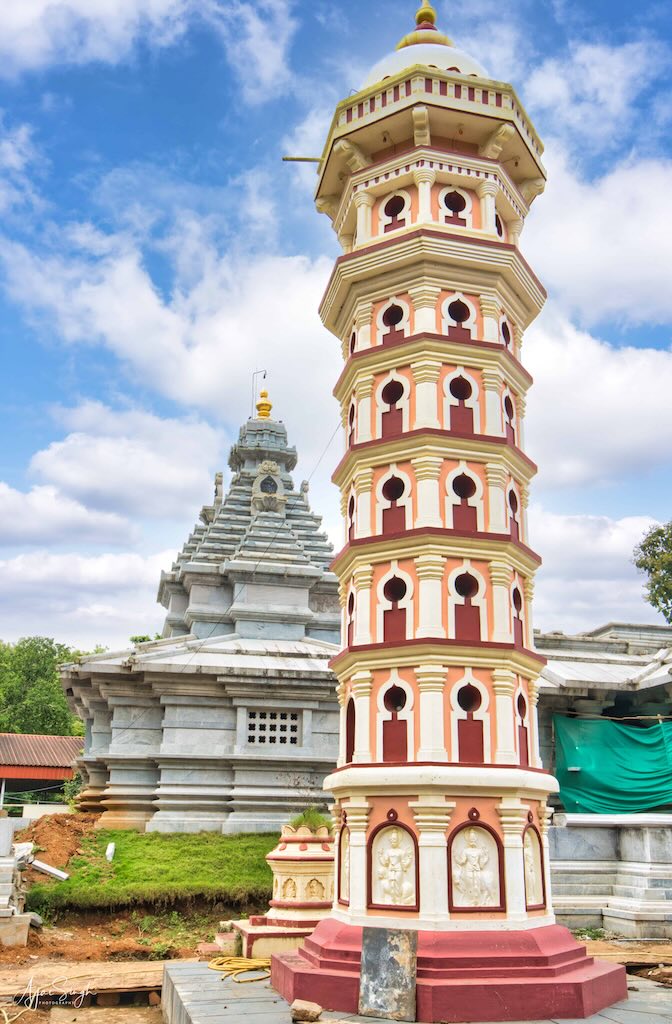
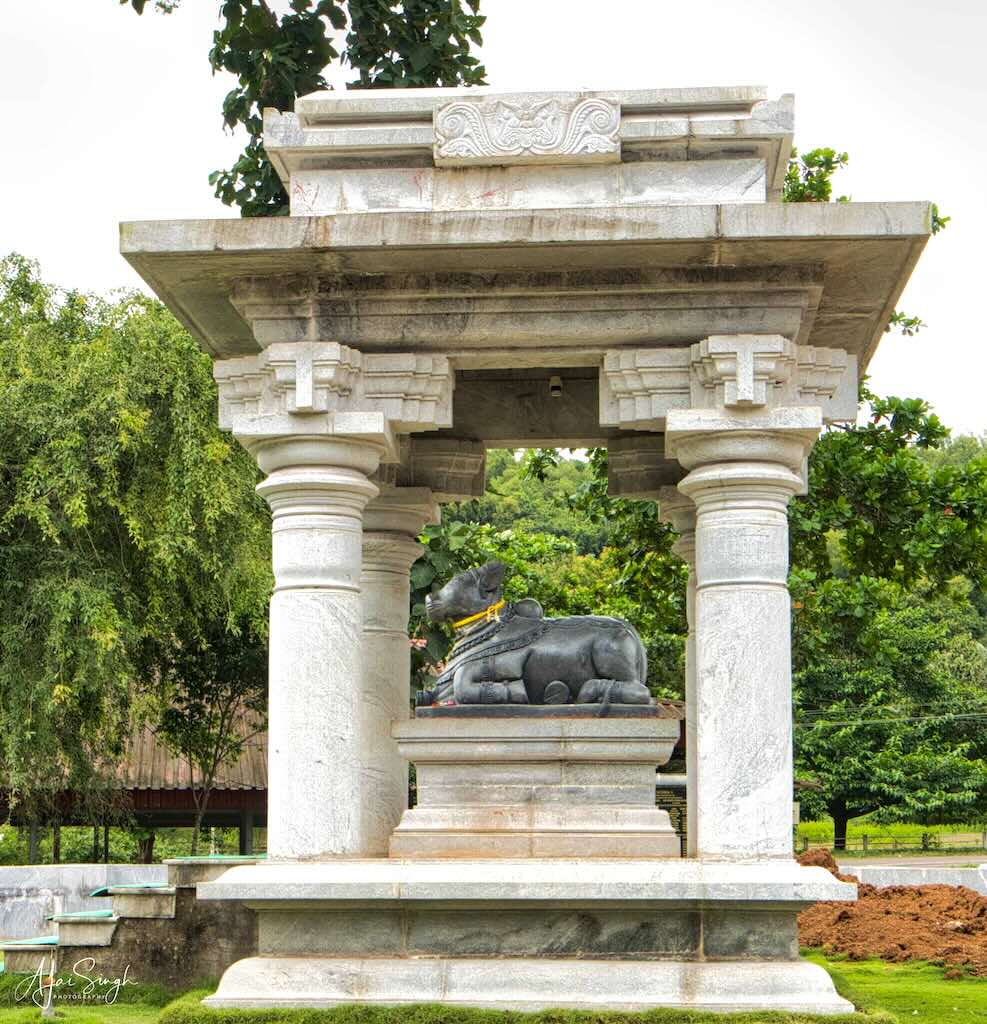
After the ancient Shri Saptakoteshwar Temple was destroyed by the Portuguese in 1640, a clan of families left the village taking with them the linga in search of a safe place after the destruction. They first migrated to Morpilla, and then finally settled in Fatorpa and built a temple housing the linga. This temple has been rebuilt on that site.
.
.
Reconstruction At Fatorpa
.
Architect KD Sadhle and his son Abhijit Sadhle, renowned temple architects and experts in archaeological restorations, historical styles, and ancient iconography oversaw the devotees and Mahajans of Shree Shantadurga Bumipurus Saptakotishwar Saunsthan to rebuild the temple of Saptakoteshwar in stone in the historical manner.
.

.
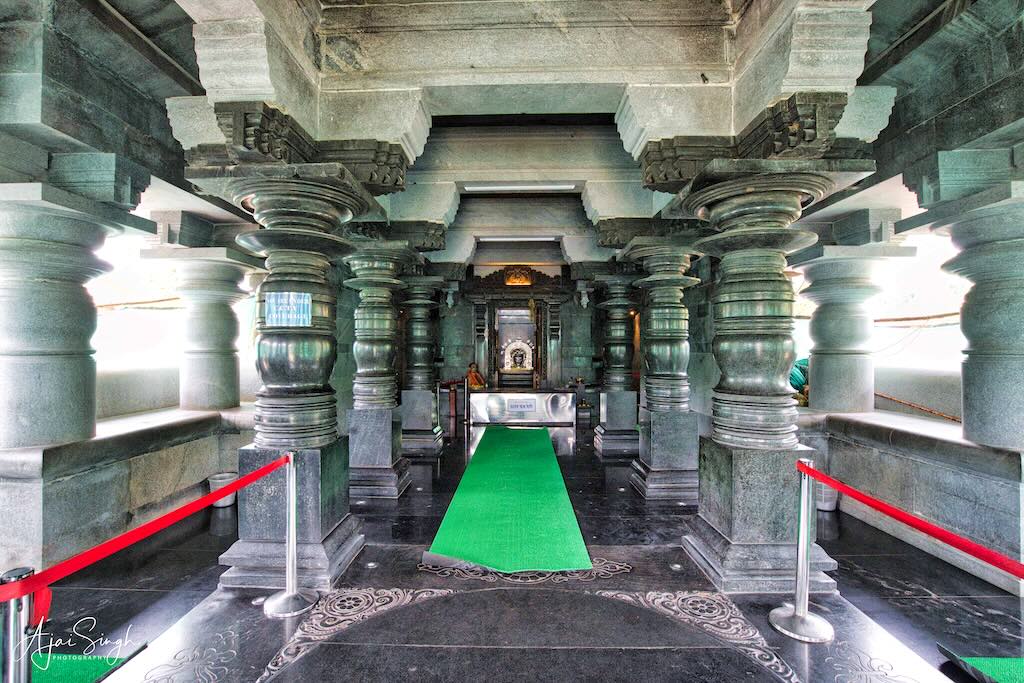
The temple is designed about the platform referred to as Upapeeth, allowing devotees to circumambulate the temple on the platform. The temple belongs to the sandhar tradition, keeping in mind local traditions, and having a pradakshinapatha. The temple consists of a Garbhagriha and Pradakshika preceded by Antaralaya mandap and Sabhamandap. The Sabhamandap is 21 feet x 21 feet and is developed with three entries through upamandapas in the East, North, and South directions.
.
.
The Grabhagriha and columns are constructed with black granite stone with a smooth polished surface, while the rest of the temple is of white granite stone. The stone pillars have been made in the polished lathe-turned Hoysala-style.
.

.
The pillars are designed with three typologies – Vishnukantha, Rudrakantha, and Indrakantha. The main supporting pillars are of Rudrakantha typology while the half pillars over the sukhasana (seat) belong to the Vishnukantha and Indrakantha type.
.

.
The Kadamba Nagar Shikara towers to a height of 50 feet and has a magnificent appearance. The main temple along with the temple of Bhargava and other ancillary deities has cost approximately Rs 5 to 6 crores.
.
.
Shri Hatkeshwara Temple Divar
.
Did you know that Divar was originally a place dominated by Brahmins and was a place of pilgrimage?
.
.
Yes, Divar Island (the ancient name was Dev-wadi or Divadi) was the home to some prominent temples since ancient times that attracted devotees from all over India. Shree Saptakoteshwar in Naroa, Shree Ganesh temple in Navelim, Shree Mahamaya temple in Goltim, and Shree Dwarkeshwar temple were some of the many temples located here. When the Portuguese invaded Goa, they converted most of the population and destroyed the temples. Building churches over the sites of a few prominent temples.
.
.
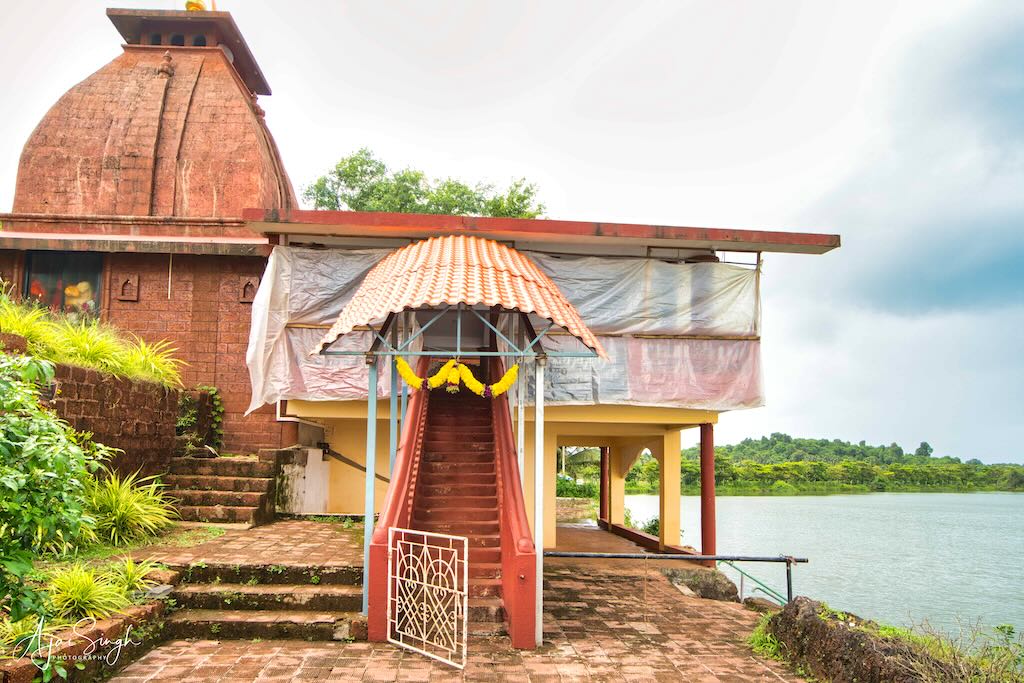
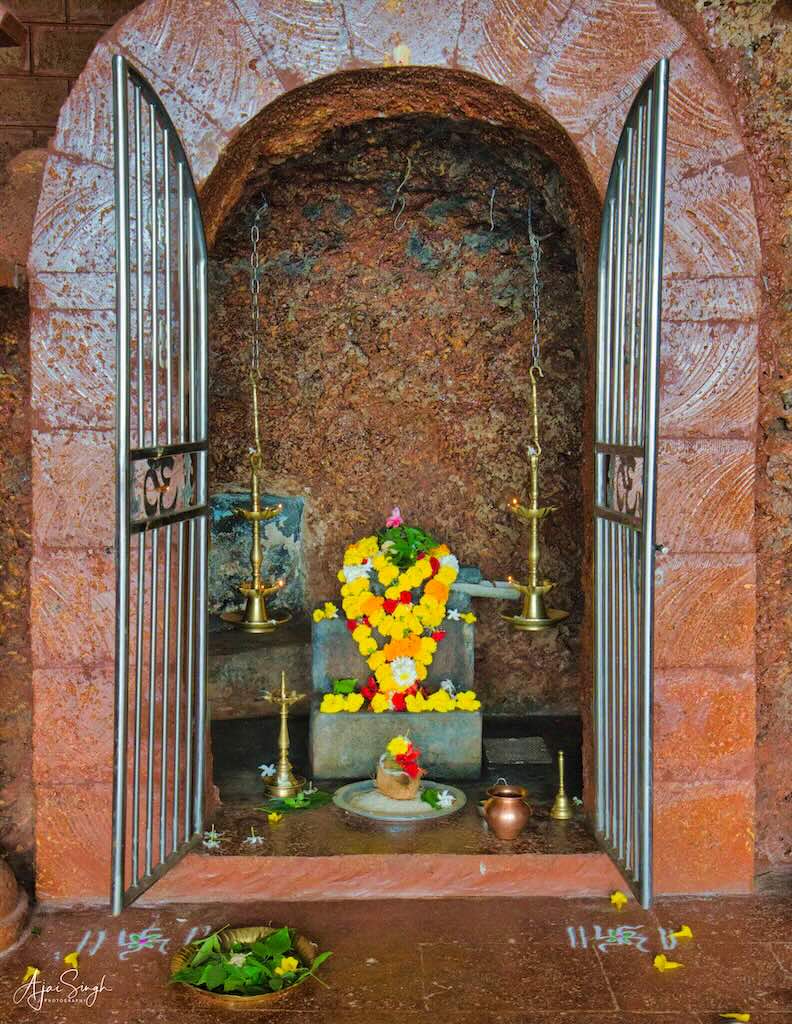
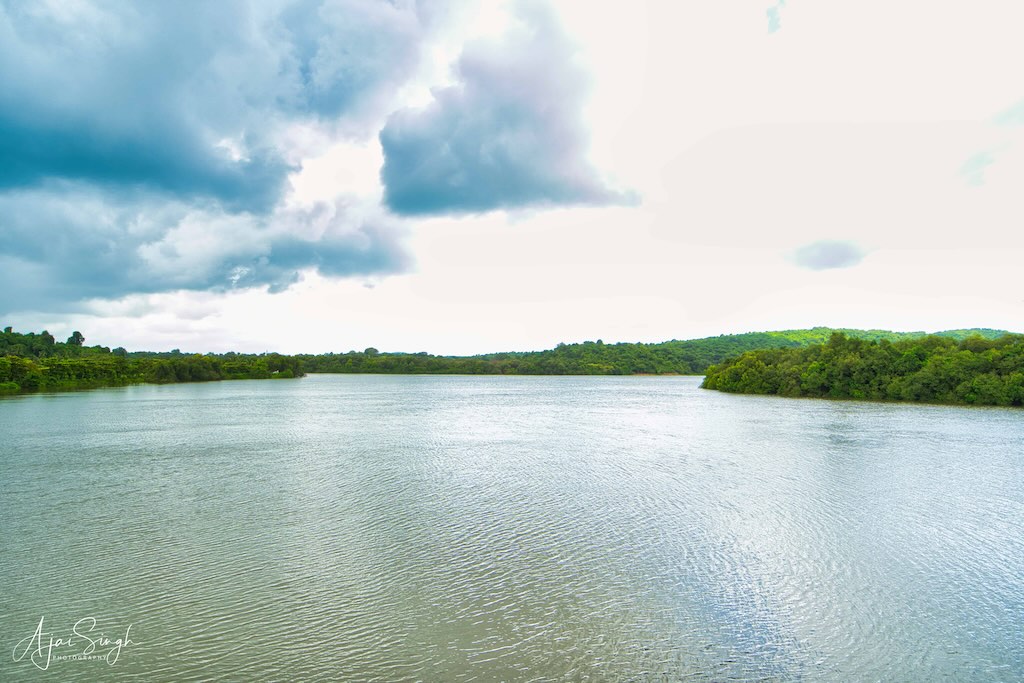
From the Porne Tirth if move ahead you reach another stretch of backwaters. It is a beautiful setting where you see no construction whatsoever except this small temple – Hatkeshwar Mahadev standing on the water’s edge.
.
.
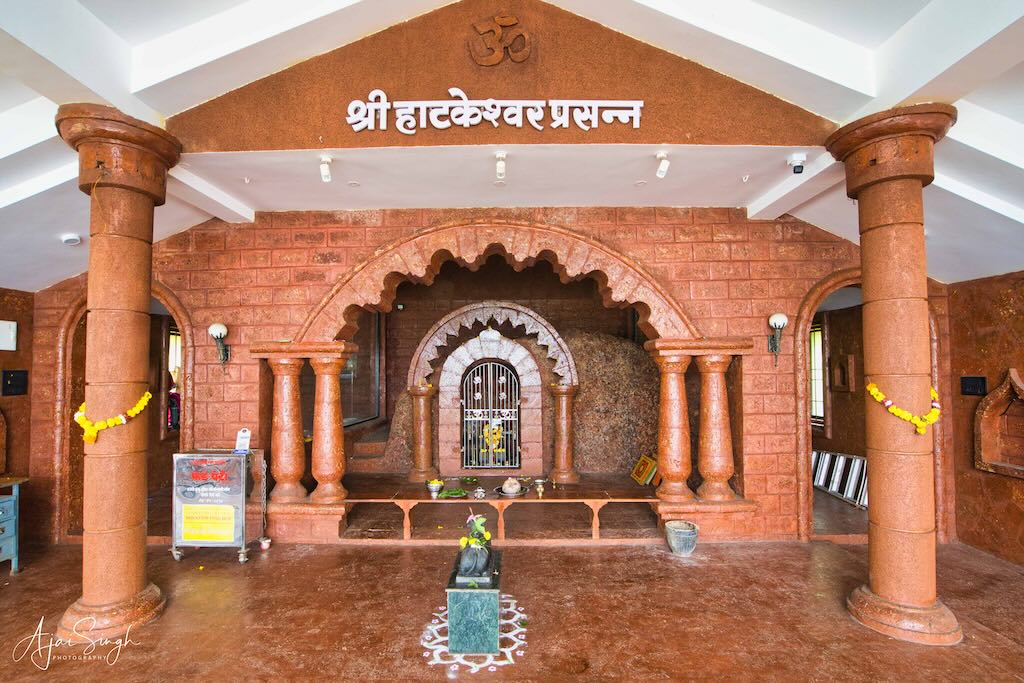
The Hatkeshwar Temple is dedicated to Lord Shiva. Positioned on the eastern edge of the island, it holds historical significance as the “Porne Tirth” or the “old sacred point.” This spot was revered for being the meeting point where five rivers meet at old Naroa – Zuari, Valvonti, Bicholim, Mhadei, and Khandepar. The place is known as the panchganga sangam.
The temple is on the first floor, I assume to make sure that it stays above the water level throughout the year. A small Shivalinga sits on a platform inside the temple and a Nandi outside. The view from the first floor is unbelievable – quiet backwaters surrounded by lush greenery, mangrove-lined rivers, and birds flying around with not a single human being in sight.
.
.
Opposite the temple is a cremation ground, where once a year a Jatra or a festival takes place. I was told this is also the place where Mundan or the first hair-shaving ceremony of children is performed.
.
Temples in Canacona
.
Deep in the forested village of Cotigao in Canacona taluka of south Goa, there’s a circular compilation of stones. It is a sacred place for villagers, where they gather to discuss important village events and also to conduct some rituals and ceremonies. However, these villagers are probably unaware that this site could be a burial ground dating back to thousands of years. Says research scholar Themistocles D’Silva “These are commonly known as stone circles. Evidence indicates that some were Neolithic burial sites or more likely solar and lunar observatories, places of ceremony, worship and healing, and social gathering.”
.

.
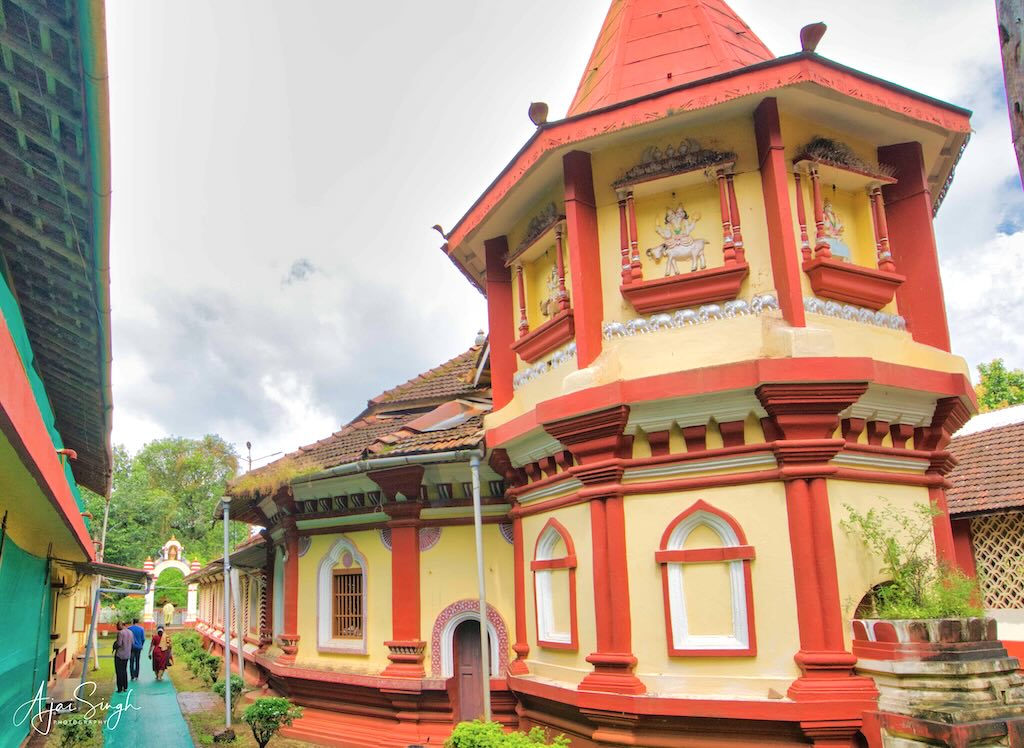
Canacona is Goa’s southernmost taluka, bordering Karnataka. Far from the maddening crowd, the place remains largely undiscovered due to its distance from the popular tourist circuits of Goa. Unlike the central and north talukas that witnessed intense proselytizing by the Portuguese, Canacona has managed to preserve a unique cultural balance. Being on the southern border, many people speak or understand Kannada, in addition to Konkani and Marathi. One will find a surprising number of temples and mathas hidden in the dense forested and hilly tracts of the taluka, where festivals are celebrated with a lot of fervor. Some in which locals of all faiths take part with equal zest.
.
.
I tried compiling a list of temples in this region – the list below is still incomplete!
- Mallikarjun Temple
- Shri Lakhanewhar, Agonda
- Shri Vinayaka Temple, Agonda
- Shri Keshav Damodar, Loliem
- Shri Venkatesh Temple, Loliem
- Nirakar Narsimha Temple, Loliem
- Shri Mahalaxmi Ravalnath, Lolien
- Shri Mahadev Gharvai Temple, Canacona
- Shri Kashipurusha temple, Shristal
- Shri Parshurama in Poinguinim
- Shri Betal, Poinguinim
- Shri Betal temple, Cola
- Siddhapurush Temple, Kuddi Cola Canacona
- Kali Mata Temple, Gaodongrem
- Yedkan Devi Temple, Khotigao
- Agondeshwar Temple, Agonda
- Kuldevtta Mahadev Nagdevta Gharurpurush Temple, Patnem-Colomb
- Siddheshwar Temple Canacona Barcem
- Sri Mallikarjun Temple Canacona Cotigao
- Shree Saptkoteshwer Devsthan Kudewada Canacona Gaodongrem
- Ghodya Paik Mahadev Devasthan Canacona Tiloi
- Shree Mallikarjun Temple Gaondongrim
- Saptakoteshwar Temple Morpirla
- Shree Laxmi Narayan Temple, Poinguinim
- Shree Nirakar Temple, Maxem
- Shree Bhumipurush temple, Gulem
- Shree Maruthi Temple, Chaudi
- Shri Navdurga Temple, Poinguinim
- Shri Ram Temple, Partagal Canacona
I visited only the major temples in Canacona, which are described below.
.
Mallikarjun Temple Canacona
.

.
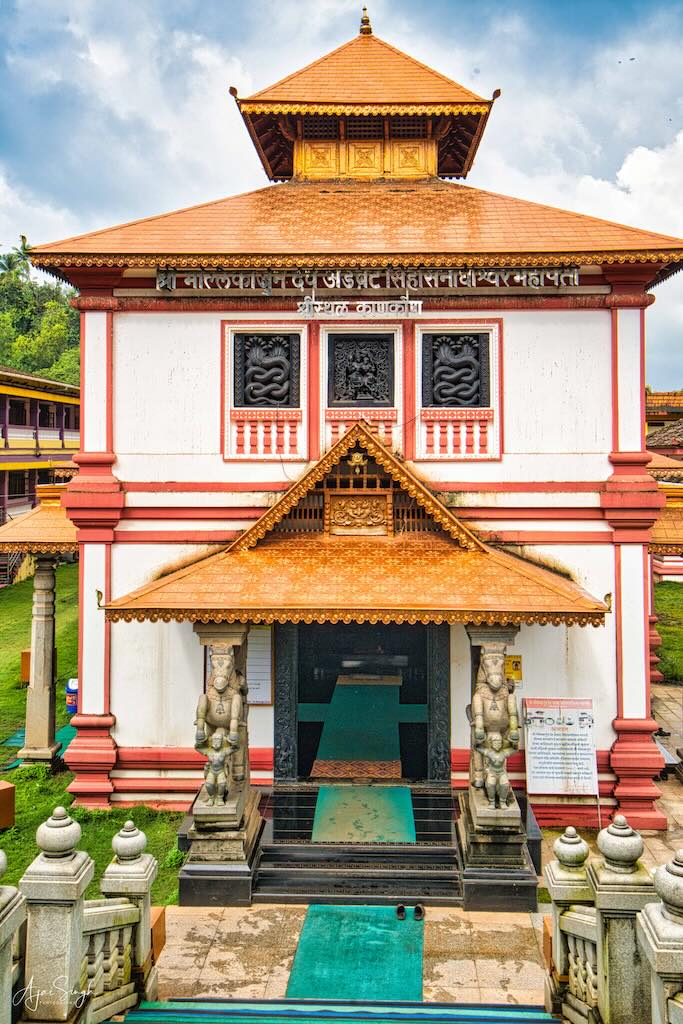
Shri Mallikarjun Temple is dedicated to Bhagwan Mallikarjun, an incarnation of Shiva, Gaondongrem, and is situated in Canacona Taluka in South Goa. This deity is mainly worshipped by Gavades, Kunbis, Velips, and the Marathas. The shrine is known to be one of the oldest in Goa and is situated amidst beautiful natural surroundings in a valley completely surrounded by the mountains of the Western Ghats. The temple was constructed during the middle of the 16th century, as per the writing on a plaque near the temple dome, by ancestors of the Kshatriya Samaj who descended from the royal Surve family from Prachitgad near Shringarpur of Ratnagiri district of Maharashtra. This Kankunkar clan was founded by Prince Kashi Purush and his band of brothers who founded the various Gharwais under Shristhal, Canacona. They were escaping from Mahmud Gawan’s (Prime Minister of the Bahmani Sultanate) wrath after his father switched loyalties from Bahamani to Vijayanagara. Since Goa’s Goud Saraswat Brahmins were known to work for Vijaynagara they chose to settle in Canacona.
.

.
The temple was refurbished in the year 1778. The main deity of the temple is referred to as Advat Sinhasanadheeshwara Mahapati by his devotees. His consort is referred to as Devati.
.
Itihāsa
.
Based on itihāsa, the location of the temple was the place where Shiva united with his consort Parvati after a long period of separation. Another source mentions that the demon Malla was fighting with one of the Pandava brothers, Arjuna. Shiva assumed the form of a hunter and killed Malla and saved Arjuna hence the name ‘Mallikarjun’. The temple is also known as Adavat Sinhasanadhishwar Mahapati Canacona among the locals.
.

.
Architecture
.
The Mallikarjuna Temple is renowned for its remarkable architecture, showcasing intricate wood and silver carvings that captivate visitors. According to historical accounts, the temple was constructed by the skilled Habu Brahmins belonging to the Dravidian dynasty. The craftsmanship exhibited in the temple’s design is a testament to their artistry and expertise.
.
.
The assembly hall, known as the mantapa, features six pillars adorned with some of the finest surviving artwork. These pillars serve as a visual delight, depicting scenes from ancient scriptures such as the Puranas and the Mahabharata. One of the wooden pillars in the mandapa holds a special significance as the oracle pillar, where devotees seek divine guidance and blessings.
.

.
As one approaches the inner sanctum, intricately carved silhouettes of doorkeepers, known as dwarapals, greet the visitors on either side of the entrance. These exquisite carvings add to the grandeur and spiritual ambiance of the temple, showcasing the artistic prowess of the craftsmen.
.


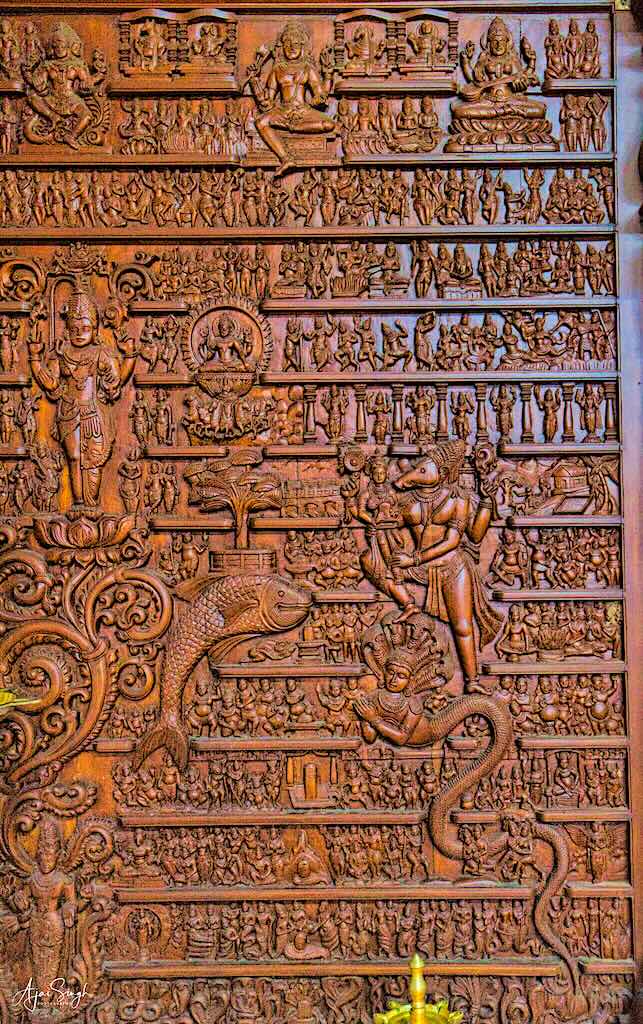
.
Symbolism is deeply embedded in the temple’s design and sculptures. There are about 14 Mallikarjuna shrines spread across Goa. Across these shrines scattered throughout Goa, a striking similarity can be observed in the lingas. These wooden murtis, known as Nirakar or “formless” by the local population, are adorned with metallic masks and accompanied by Trishul, symbolizing Shiva’s power and transcendence.
.

.
The linga in the temple was uncovered by a member of the Kunbi community while clearing the forest and it is a cylindrical shaped uncut stone covered with a metallic mask.
.
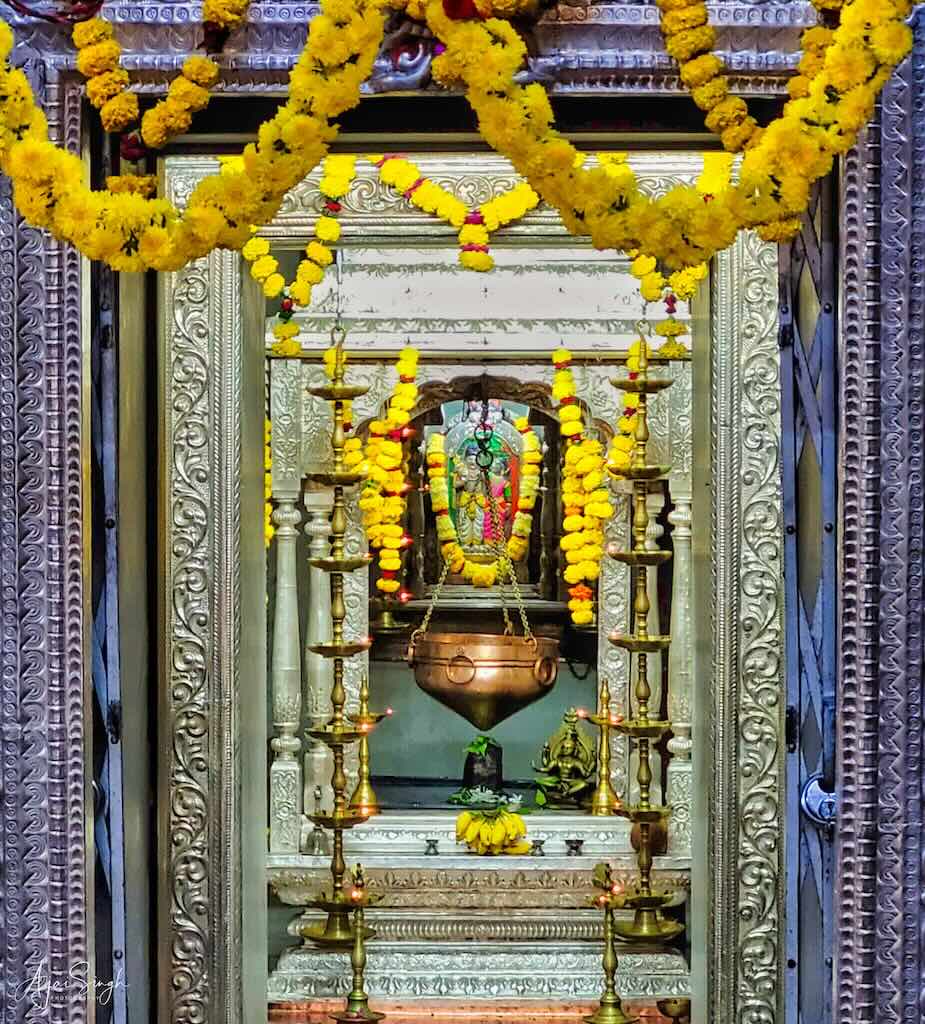
.
These murtis are believed to be remnants of the era when the Natha Sampradaya held prominence in the Western Deccan region. Additionally, the lingas housed within the shrines are believed to be Swayambhu lingas, self-manifested representations of Shiva and not man-made.
.

.
One of the shrines in the temple complex depicts the Nirakar (formless) form of Shiva, with walls bare in the garbhgriha, without any murti. One of the carved wooden pillars of the original temple has been displayed in a separate enclosure in the temple complex. According to the records, two ancient shrines of Mallikarjun existed in Bardez at Assgao and Pomburpa which were demolished by the Portuguese.
.

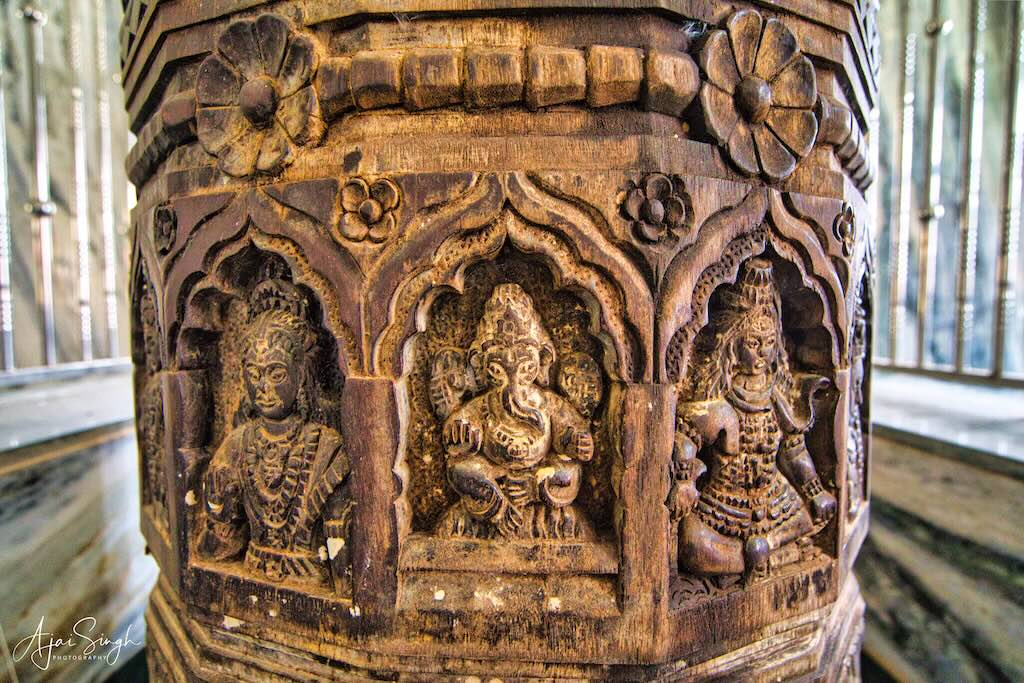
.
The temple has around 60 deities and it celebrates a number of festivals with the annual jatra being the most unusual amongst most of the festivals in Goa. The temple also celebrates the festivals of Rathasaptami and Shigmotsav which attract a number of devotees.
.

.
The Mallikarjuna Temple stands as a testament to the architectural brilliance and deep symbolism prevalent in ancient Indian temple architecture, offering visitors a glimpse into the rich cultural heritage of the region.
.
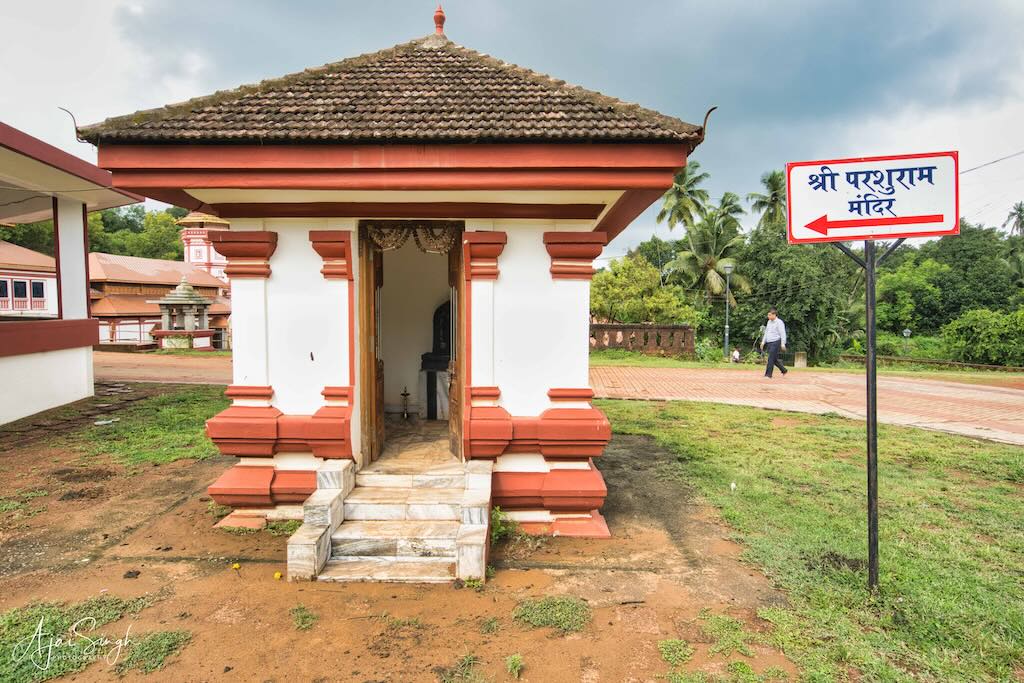

.
Festivals
.
Shisharani: This typical ritual alternates every year with the Veeramel celebration held at the time of the traditional Shigmo festival. The word Shisharani is supposed to mean a cooking place on top of a human head. This ritual involves cooking rice in an earthenware kept on the head of three men who sleep on the ground with their heads touching each other and fire is lit between the heads to cook the rice. The heads are covered with wet cloth and layers of the trunk of a plantain.
.

.
Jatra: The annual festival (Jatra) held at the temple is unique among the temple festivals of Goa. Early morning on the day of the festival, the murti of the deity is taken out in a procession that travels for almost 2–3 hours to reach the nearby Rajbag beach. A number of rituals including a special bath for the deity are held at the beach, after which the deity is brought back to the temple. Hundreds of devotees have a holy bath at the same time in the sea.
Veeramel: This celebration is held once every two years at the time of the traditional Shigmo festival. During this celebration which occurs close to midnight, selected local youth who are called Gade, rush from house to house with swords in their hands followed by people with drums and other musical instruments.
.
.
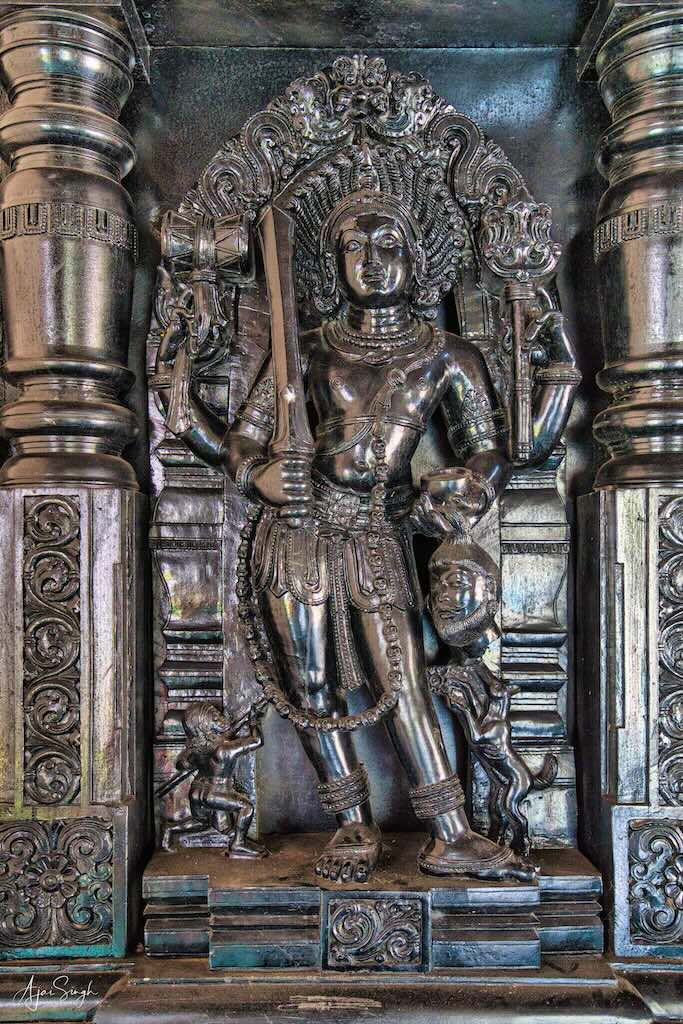
Avatar Purush: These are actually smaller deities called Avatar Purush located at three nearby places: Asali, Khalvade, and Bhatpal where they are worshipped. But once a year, they are taken in a magnificent procession at night to the main temple at Sristhal. Besides these, the temple celebrates a number of common Goan festivals like Rathasaptami Rathasaptami and Shigmo.
.
Parshuram Temple Poinguinim
.
.
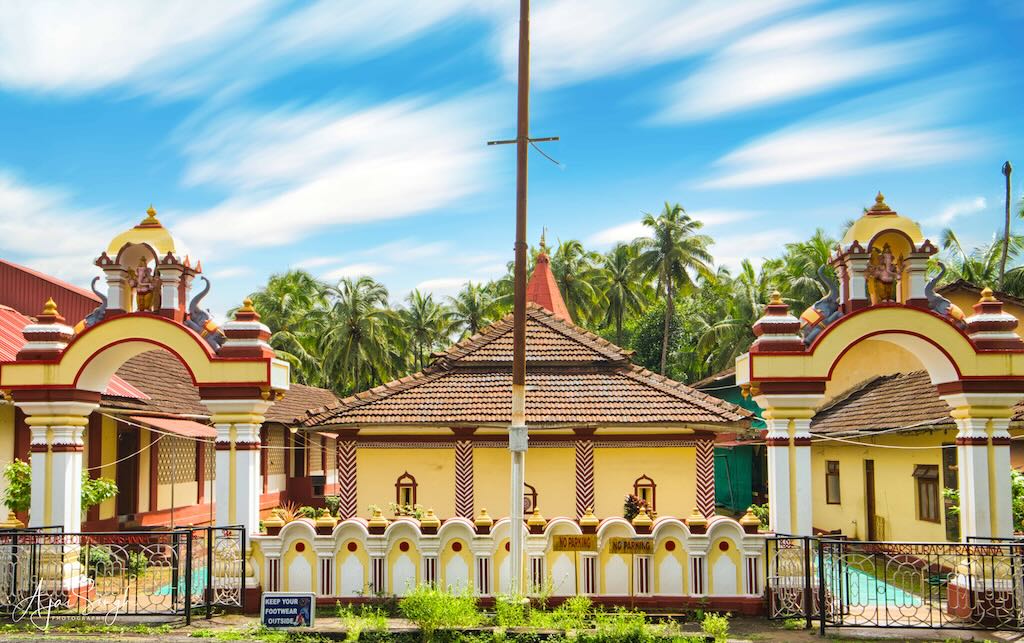
In a blissfully quiet and green corner of Poinguinim in Canacona taluka, sits Goa’s only temple dedicated to Lord Parshurama. The temple awakens curiosity because Parshurama, who is the 6th incarnation of Vishnu, is rarely worshipped in this avatar. There are only a handful of temples across the country dedicated to Parshurama, two of which are, not surprisingly, located in Kerala. Not surprising, because it is Parshurama who is credited with causing the creation of the country’s strip of the West Coast (Parshurama Srishti). He is believed to have made the sea retreat by either throwing his axe or by shooting an arrow, according to different versions, to mark the land he wanted to claim.
.
.
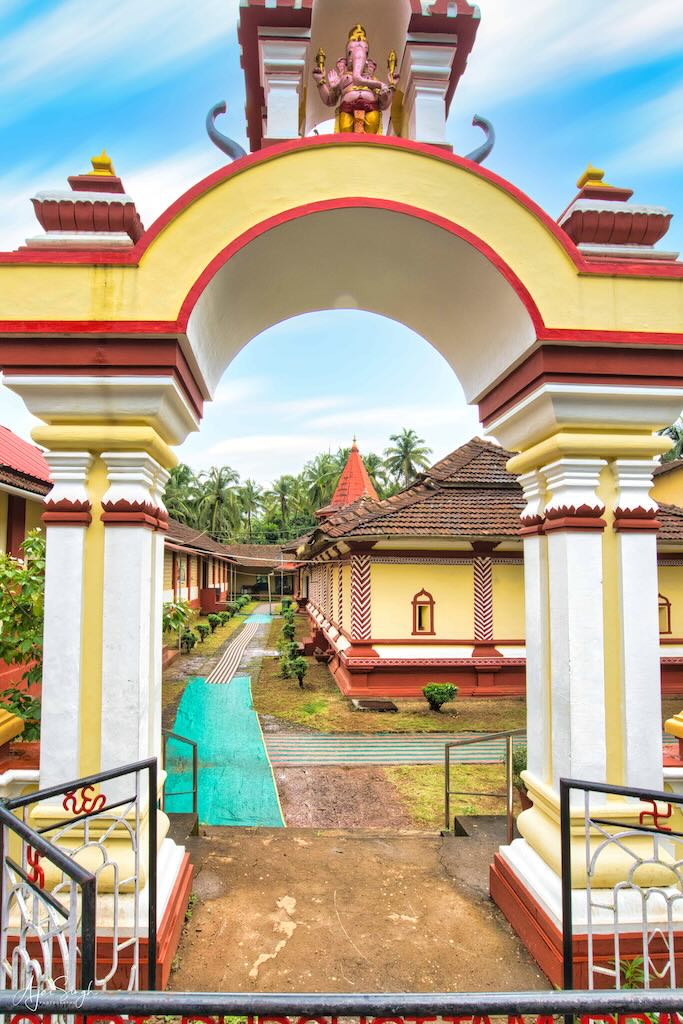
The Parashuram temple at Poinguinim is located amidst forest groves in serene surroundings. The mantapa has traditional carved wooden pillars and the Shikara is of a traditional pyramid shape. There is also an iconic representation of Kshetrapala in the courtyard.
The other shrines of Parshuram are at Pethe Parashuram near Chiplunand Payyanur, and Thiruvallom in Kerala. During 1300-1400 CE, the rise of the Nath sampradaya appeared to have coincided with that of Parshuram, and the shrines at Poinguinim and Chiplun were set up as independent shrines to Parshurama.
.
Itihāsa
.

.
In our itihāsa, the story of Parshurama is a popular one, though with different regional versions. According to one version, Parashurama, the axe-wielding avatar of Vishnu is the son of Sage Jamadagni and Renuka. Jamadagni is killed by despotic Kshatriyas because he refuses to part with Kamadhenu, his wish-fulfilling divine cow. In revenge, Parashurama traverses the earth twenty-one times and wipes out all the Kshatriyas.
.

.
Parshurama, struck by remorse tried to expiate his sins by performing yagnyas during which he gifted away all his lands to the Brahmins, with no land left even to build a hermitage for himself. Varuna, God of the Seas, came to his aid and offered him to gain from the sea as much land he could cover in one throw of his axe. Parashurama stood at Pethe Parashuram (near Chiplun, Maharashtra) and threw his axe as far as Kanyakumari. The sea retreated and the coastal tracts of Konkan, Kanara, and Kerala were thus generated.
.

.
Parashurama populated his new lands with Brahmins as well as new plants such as the coconut, the banana, and jackfruit which now thrive throughout the region.
This folklore correlates with the geological lowering of the sea level, which resulted in the emergence of the coastal strip which is now referred to as Konkan and Malabar.
.
Parshuram – A Historical Figure
.
Itihāsa mentions that Parshuram shot an arrow in the Arabian Sea from the peak of the Sahyadri. This arrow hit Baannaavali (Benaulim) and made the sea recede, thus reclaiming the land of Goa.
.

.
An ancient temple of Kaatyaani Baaneshwar also existed in Baannaavali till the 16th century. VS Dhume points out a temple of Parshuram on Saalher (Sahyadri hill). Two rock-hewn footprints in the pose of a man standing to shoot an arrow are seen near it. Today the ancient temple of Parshuram dates to 2550-2350 BCE, as determined by historian Dr. Pusalkar corresponds to the period of the Sahyadri Khand, opines VS Dhume.
.
.
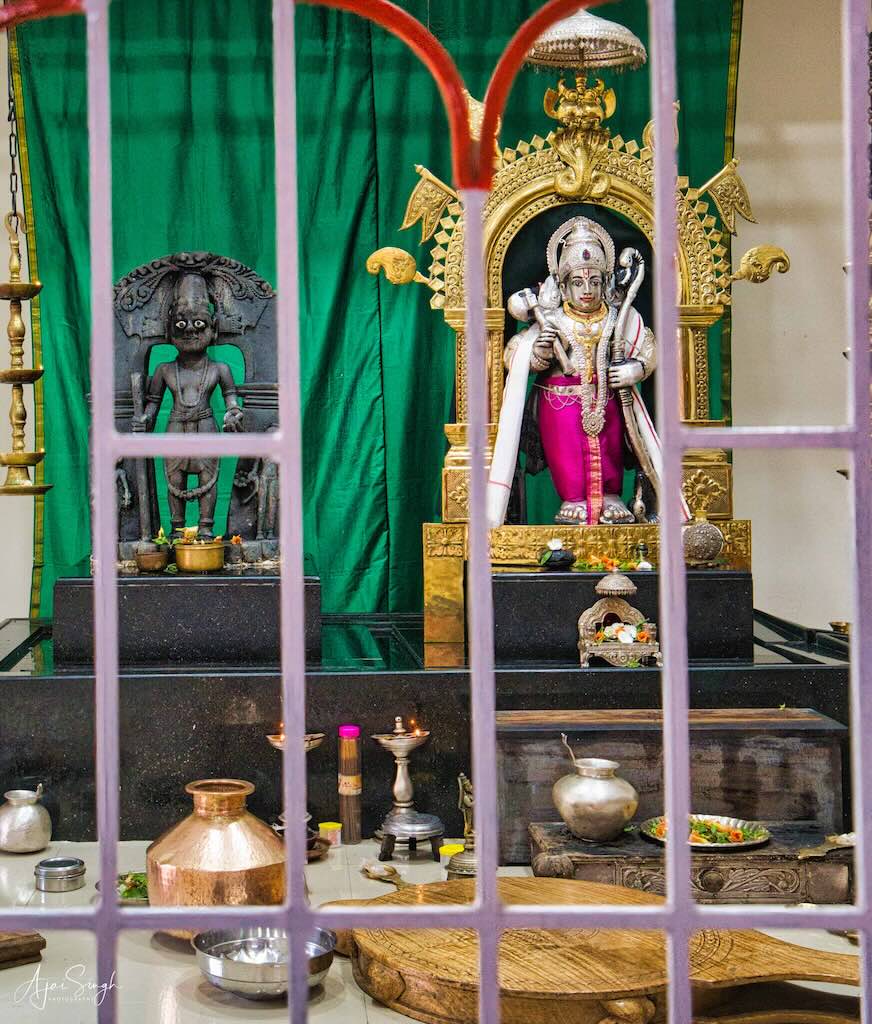
The Sahyadri Khand states that Parshuram along with 10 sages from Trihotra (Bihar) settled in Gomaanchal (Goa). They were Bhaardwaaj, Koushik, Vatsa, Koudimy, Kashyap, Vasisht, Jamadagni, Vishwaamitr, Gautam and Atri. They settled in eight villages – Mathhgraam (Madgaon), Vrney (Verna), Kudtari, Shankhaavali (Sancoale), Raaichuri (Raai), Lotli, Naagve and Baannaavali.
.
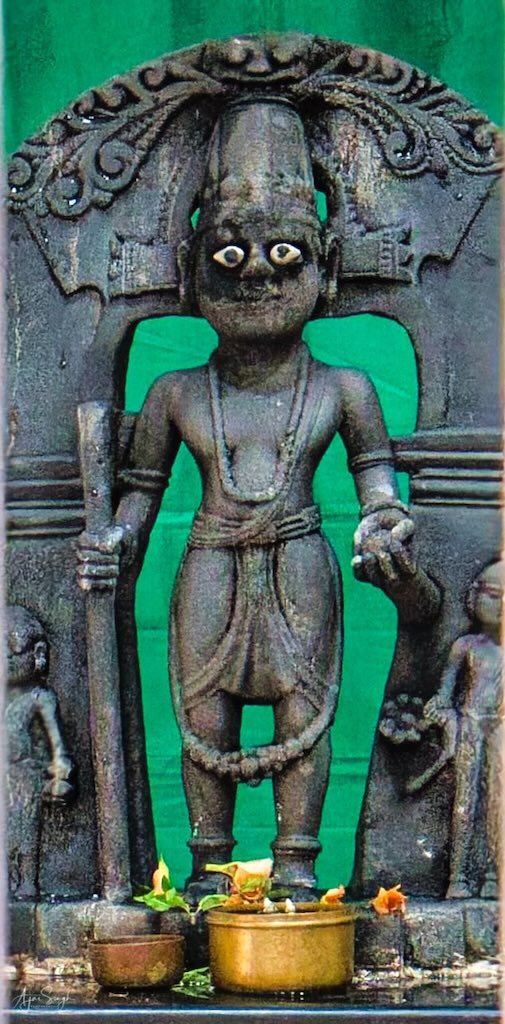
.
The families of these sages settled in 66 villages called Saasashti (Salcette). This is evident from the line “Shat-Shadteshu Graameshu Kulaani Sthaapitaani” of the Sahyadri Khand. Ten families settled in Chudamani (ancient Chorao); 8 more in Dipvati (Diwar) and 12 families in central Goa. This formed the ancient Tiswadi (Tis meaning 30). In total 96 families were established. From this, it is inferred that the Goan surname ‘Shennai’ is a corruption of ‘Shaannavi’ meaning 96.
.
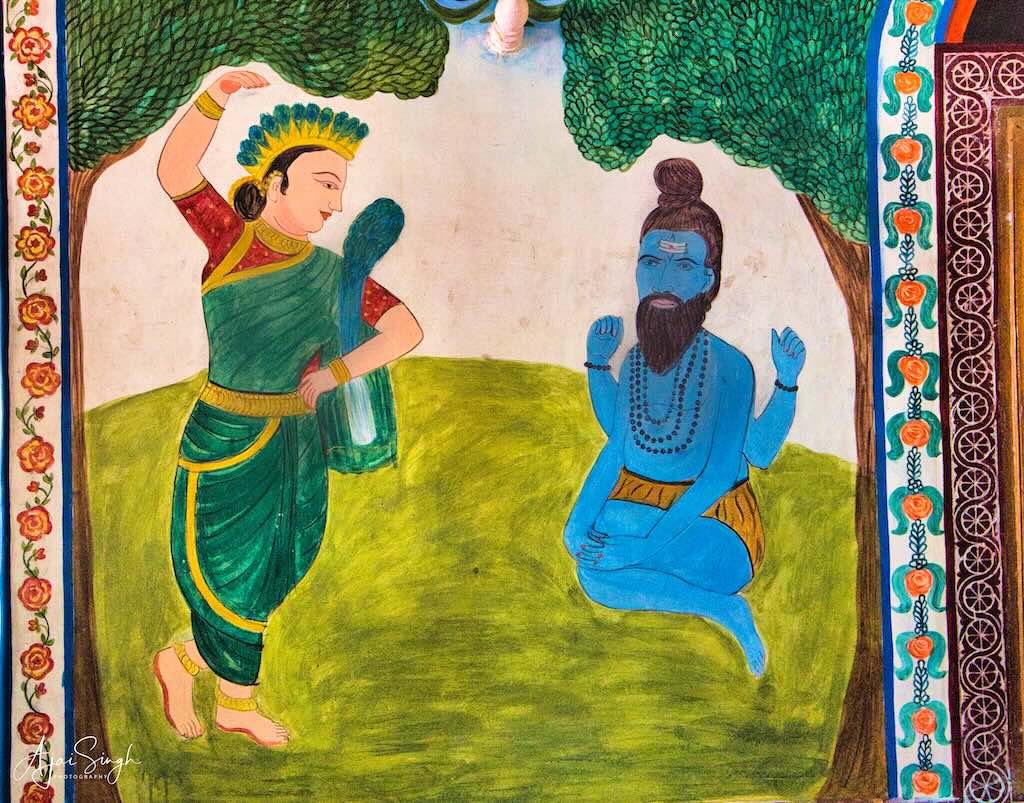
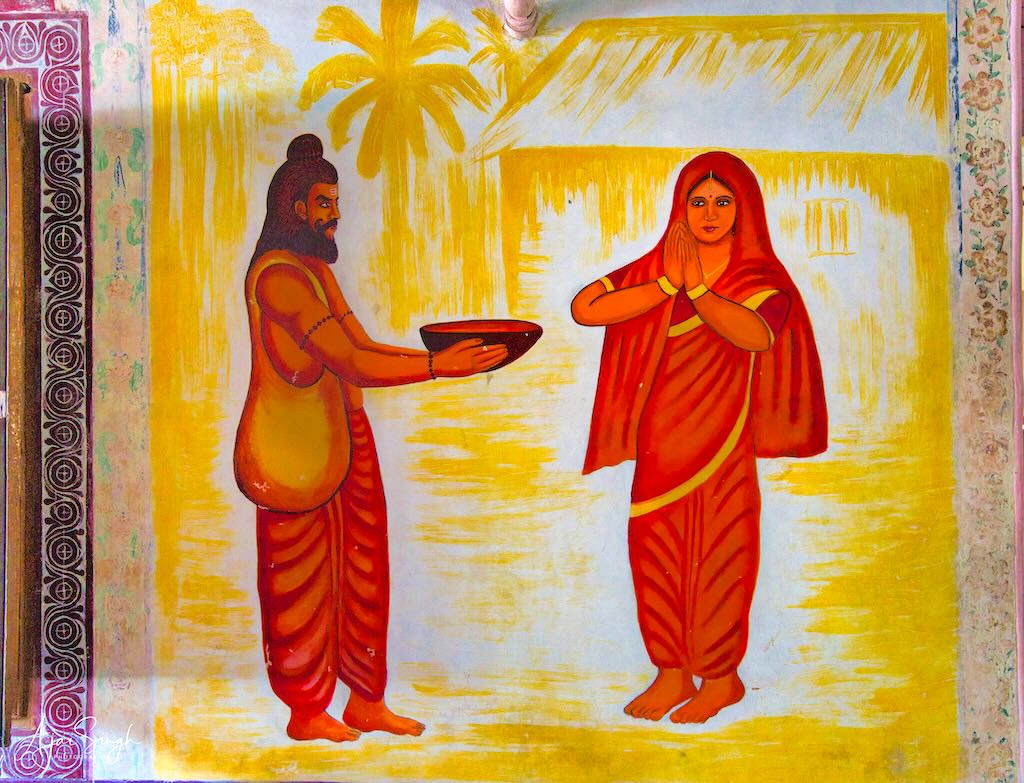
Episodes from the epics adorn the walls of the mandapa
.
The Sahyadri Khand also mentions a Yadny (fire ritual) performed by Parshuram in Goa. It is said that the vestige of this Yadny is the ‘Bhasmaacho Dongor’, a small hillock facing the sea in Arambol. Pernem. Arambol is a corruption of Harmall, which appears to have derived from ‘Hari Mall‘ (Shri Vishnu’s land). The soil on this hillock resembles ash. Surprisingly, a natural rock formation in the shape of a ‘Yadney Kund‘ (provision made to light fire) is seen at its peak. One can also see an ancient laterite shrine nearby.
From this, it appears very likely that Parshuram was a historic figure, which led a group of people to help them to settle in Goa by reclaiming the land.
Temples of many ‘Vir’ or ‘Purush’, reclaimed flooded lands by bunds are found in Goa, showing that the art of land reclamation was also known to the aboriginal inhabitants of Goa.
.
Architecture
.
The temple architecture is traditional for this region – carved wooden columns which in the mandapa, and the shikhara of classic pyramid shape.
.

.
However, the temple is unique in its layout. In a roughly rectangular layout, Parashurama and Purushottam (another Vishnu avatar) are placed on either end in two separate sanctum sanctorums that face each other. Nishikant Tengse, the priest whose family has served for generations at the temple, says that it is actually two temples constructed during two different periods, which eventually combined to look like a single structure.
.

.
“The Shree Purushottam temple existed first, with a tulsi vrundavan in front of it. It faces the east like all Hindu temples do. The vrundavan had a stone chakra dedicated to Parashurama in it. The Parashurama temple was constructed around this and as the chakra faced the west, the temple also faces west,” says Tengse.
.
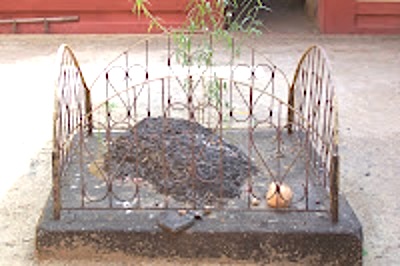
.
Festivals
.
The festivals of Das Navami Mahotsav and the Parshuram Devalayi Jatra are celebrated with great fervour.
.
Nagdo Betal Loliem
.
Every village in Goa has a place with a tale to tell.
The Vetals (or Betal) of Goa – Vetal is represented by a striking form that is unique in Hindu iconography. On seeing the fierce visage of the murti towering over me, the American televangelist Pat Robertson came to my mind, and with it a chuckle at his rant that we Hindus are worshippers of the devil!
.

.
A mere 50 or so out of the hundreds of ancient Vetal sites in Goa survived the iconoclasm by the Portuguese. Every site in the Bardez and Tiswadi talukas was destroyed. The village of Taleigao was a major center of Vetal worship, but I doubt you will find a single current resident of the area with any memory of this past.
Priol, Moolgaon, Chopdem, Khandepar, Amona, Sanvordem, Netravali, Naveli-Sakhali, Keri, and Poinguinim, among others, are where Vetal sites exist. The village of Mauxi, famous for the prehistoric petroglyphs, also has an exquisitely sculpted Vetal in a nearby grove.
.

.
Betal is a gramdevata or village deity in the western coastal Konkan, Goa, and North Karnataka. Considering the number of shrines across Goa, one assumes that the cult of Betal was widespread in ancient times. Betal sculptures found in Goa date back to the Shilahara-Kadamba period from 700 CE. According to D.D. Kosambi, Betals were worshipped by non-Aryan, Austric Gauda tribes who were the first settlers of Goa and were engaged in agricultural activities from pre-historic times. Later the deity was embraced by the Nath Panthis between the 10th & 13th CE and eventually, they were absorbed into the Hindu pantheon and became part of the temple (as Parivar devata or Panchayatan) but his popularity as a village deity did not decrease.
.
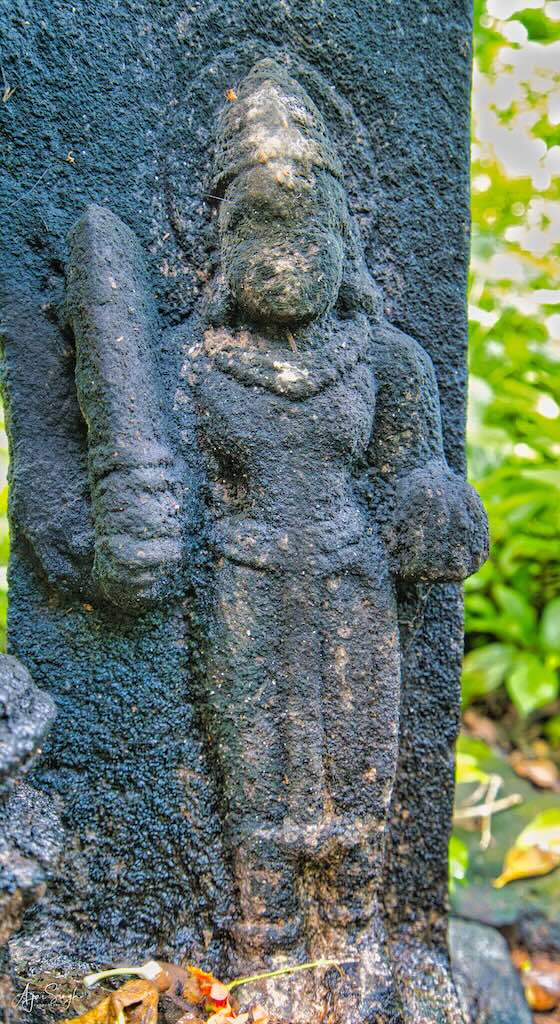
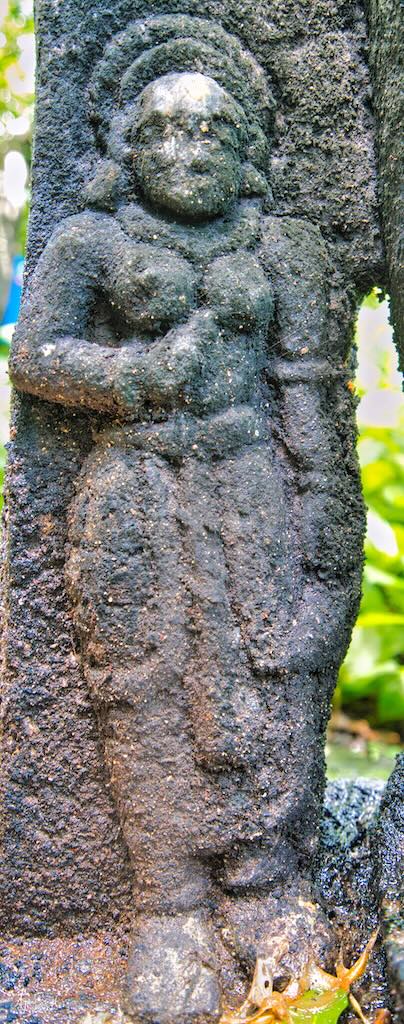
The attendants of Nagdo Betal
.
There are three types of Betals – Agio-Betal, Jwala-Betal and Pralay-Betal.
According to tradition, Vetal should not have a roof over his head and for this reason, there are no temples to Vetal with classical architectural traditions. The tribes believed that a roof over Vetal would bring grave misfortune to the misguided devotees. This was the period when they had learned cultivation and started the slash-burn method of farming.
.
.
Loliem is a small village in south Goa‘s Canacona Taluka. On entering the village an arched gateway on the left of the road marks the path to the Vetal shrine. It runs through a house and then beyond into the jungle where in a small clearing the sculpture stands. It’s a very beautiful setting in the post-monsoon green lushness of the surrounding foliage. But the sudden emergence of the ominous figure towering over you tends to give a bit of a shock to the first-time visitor.
.
.
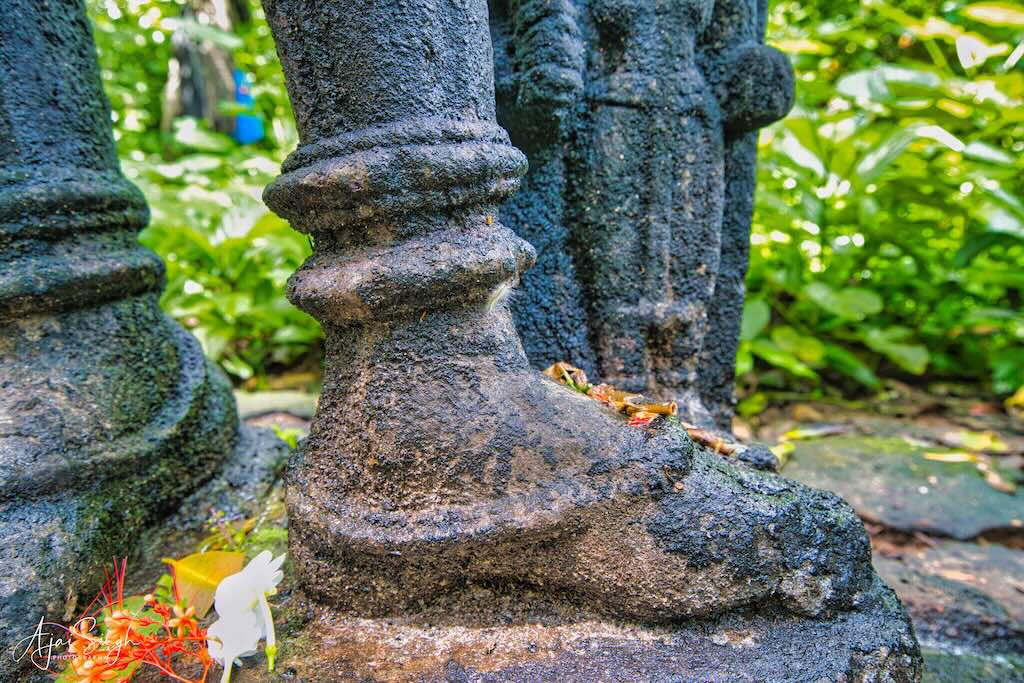
Measuring two meters in height, the Betal of Loliem is the tallest freestanding Betal murti in Goa. Vetal, or Betal, is known locally as the Nagdo Betal (Nagdo meaning “unclad”). It’s a Goan deity that seems to be specific only to this region. There are other Vetal statues in the region, but mostly housed inside temples. What makes Betal of Loliem a commanding figure among other icons, is his tribhanga posture (the other murtis stand in the sambhanga stance) and has a circle of nimbus or prabhavali around his head, a rare feature in Betal iconography.
.
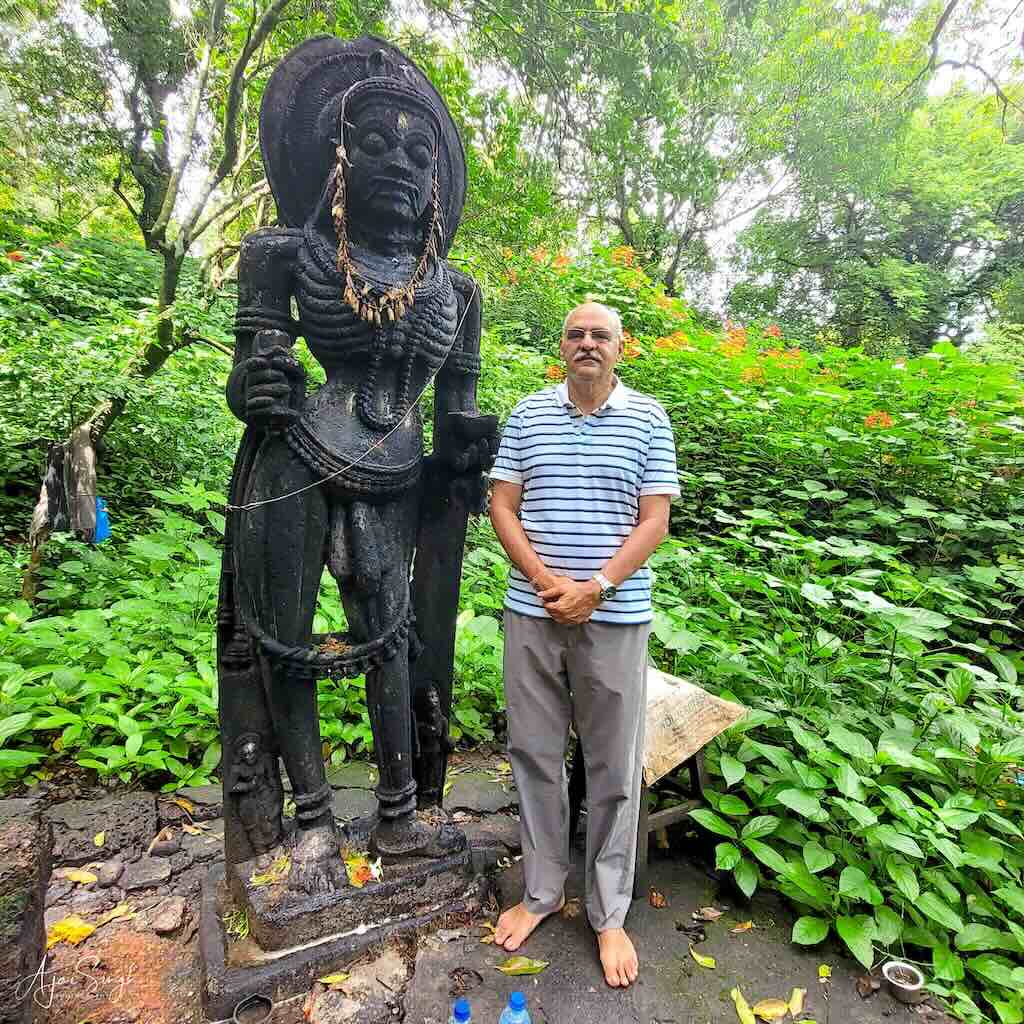
.
Local lore suggests that Betal was tricked into staying in the village of Canacona. Once a Betal arrived in the region after conquering twelve territories and was about to conquer the thirteenth region, by killing all the inhabitants who would confront him. But a shrewd community chieftain, by the name Nagizan, requested Betal to reside in the village as its guardian. Betal agreed on the condition that he be given a two-legged animal, a four-legged animal, a ten-legged animal as well as a fetus as an offering. Nagizan agreed and offered him a fowl, buffalo, crab, and a tender areca nut sprout. The wisdom of Nagizan thus forced Betal to stay on in the village as the protector.
.
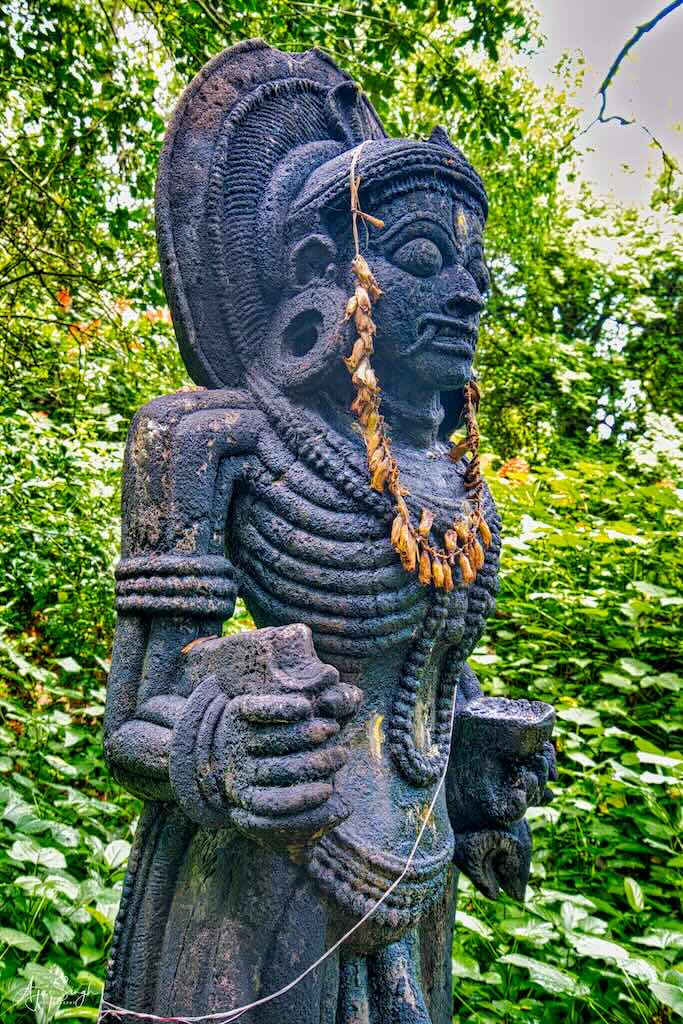
.
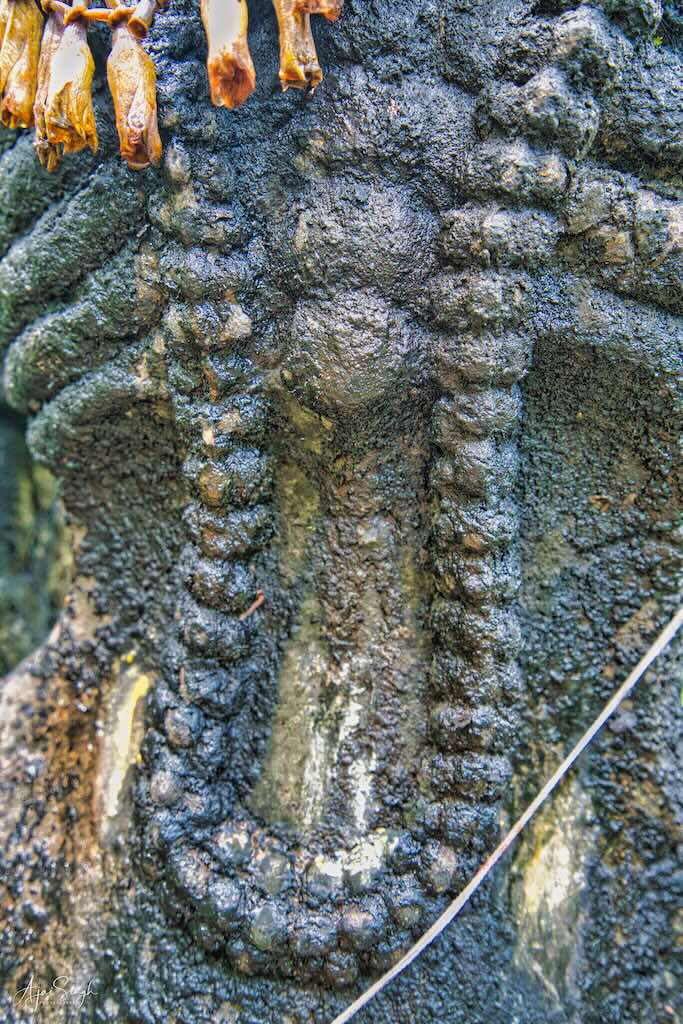
The iconographic depictions of Betal show him as a warrior, holding a dagger or sword in his right hand – which is broken in this sculpture – and a bowl (akshaya patra) in his left. A scorpion dangles around the waist girdle made of bells, and serpents entwine as armlets. He is also wearing a rundamala (garland of human skulls). His gaping mouth reveals sharp fangs, suggestive of his carnivorous nature and his unblinking and bulging eyes make his gaze ominous. Betal’s large circular earlobes dangling over his shoulders and skeletal body frame showing a pronounced rib cage reveal that he leads a mendicant’s life. The usual offerings to the Betal consist of liquor, meat, and a cigar. He is also offered leather sandals and a stick as he walks around the village as a night watchman.
.
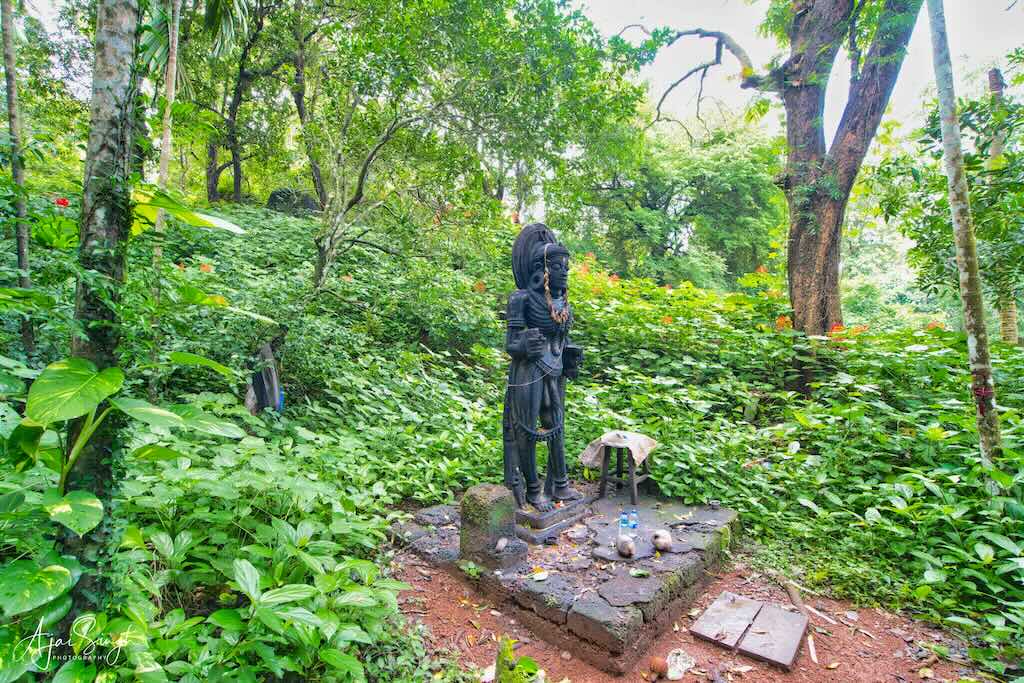
.
Though no regular worship is offered to Vetal, the local devotees through the gurav make occasional sacrifices. Interestingly, the gurav belongs to the Gomantak Maratha Samaj and hails from the neighboring Poinguinim village. The sacrifice is in the form of Soro-Ront (alcohol and bread). It is interesting to note that no animal sacrifice is offered. Another important feature is that all the Gaud Saraswat Brahmans of Loliem village do not take the prasad of Betal. This might be due to the fact that the Betal are deities to whom alcohol sacrifice is made, which was considered untouchable for the Gaud Saraswat and Karhade Brahmans.
.
Shri Aryadurga Devi Loliem
.
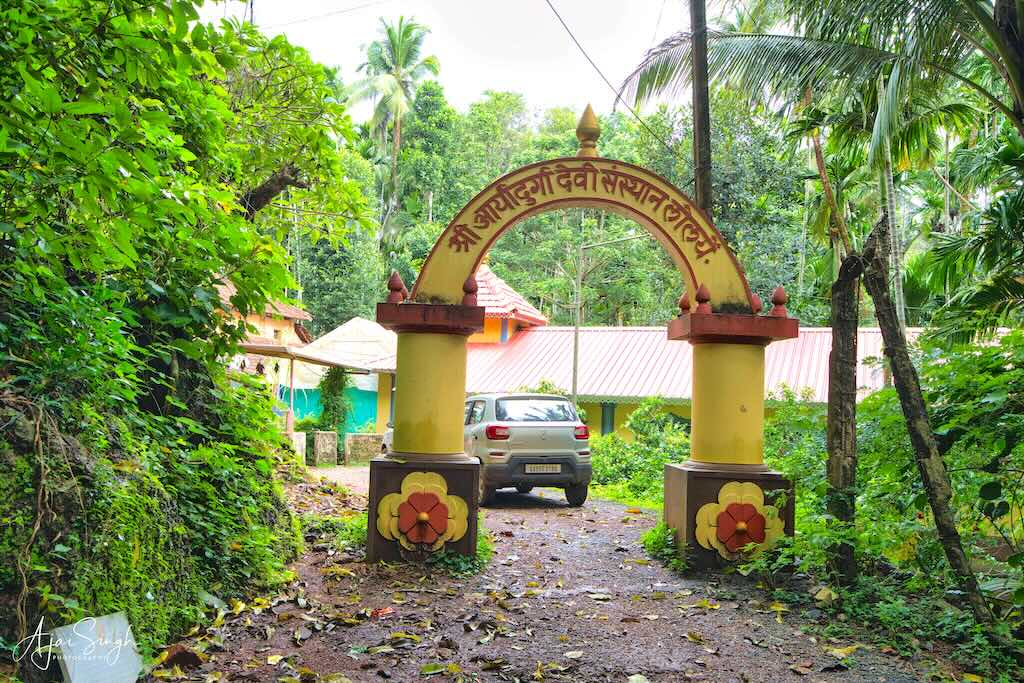
.
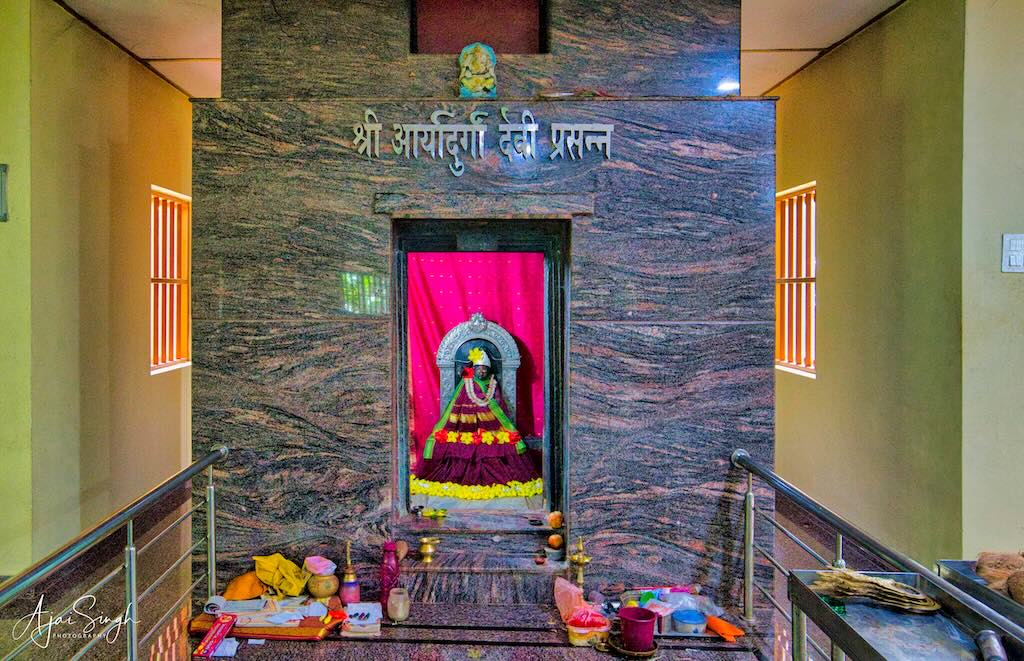
The fierce form of Devi (goddess) is Durga. In Loliem, the goddess is consecrated as Aryadurga and regarded as the kuladevata (clan deity) of the Prabhu Desai and Prabhu Gaonkar families. The original temple of this deity is situated at Ankola in North Kanara. However, the present temple, situated in the Dingar ward, was constructed by the local people to avoid the long journey to worship the deity at Ankola. It is also reported that prior to the construction of this temple, the devotees used to worship Aryadurga at Anjidiv island till the time that the temple was destroyed. The Aryadurga idol is that of a two-armed Mahishasurmardini which shows the influence of Vijayanagara. The roof slab depicts the late Kadamba architectural style.
.
.
Morjai Temple Morjim
.
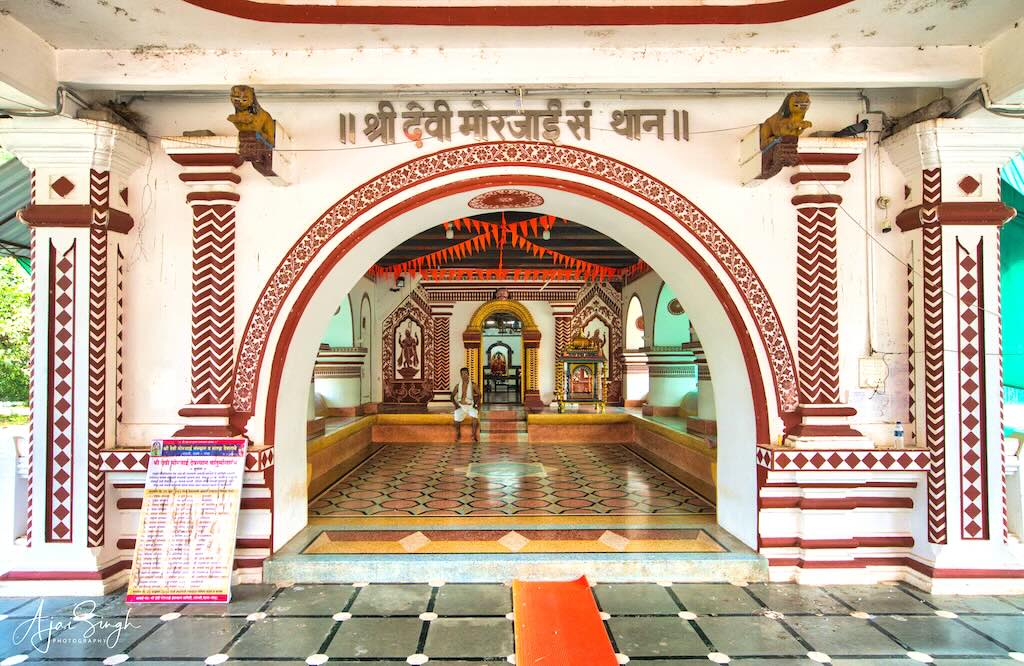
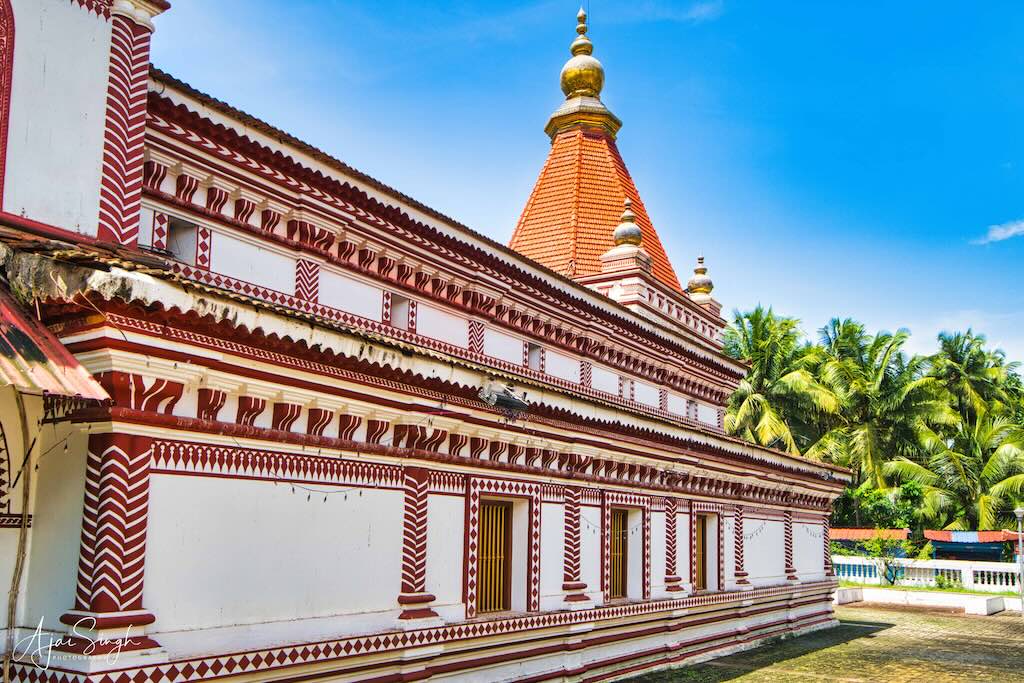
The home of Goddess Morjai is part of the cluster of Goan temples distinguished by their unique kaavi (sgraffito) embellishments. Located in the beautiful eponymous village of Morjim in the Pernem taluka of north Goa, this seat of worship is ancient although the main structure seen today was first rebuilt 80-100 years ago. The temple is situated amidst natural surroundings and is a unique blend of grandeur and simplicity – elegant designs and grand structure. Shri Morjai is known as one of the seven sisters who came and resided in different parts of Goa along with their brother, Shri Khetoba.
.
.
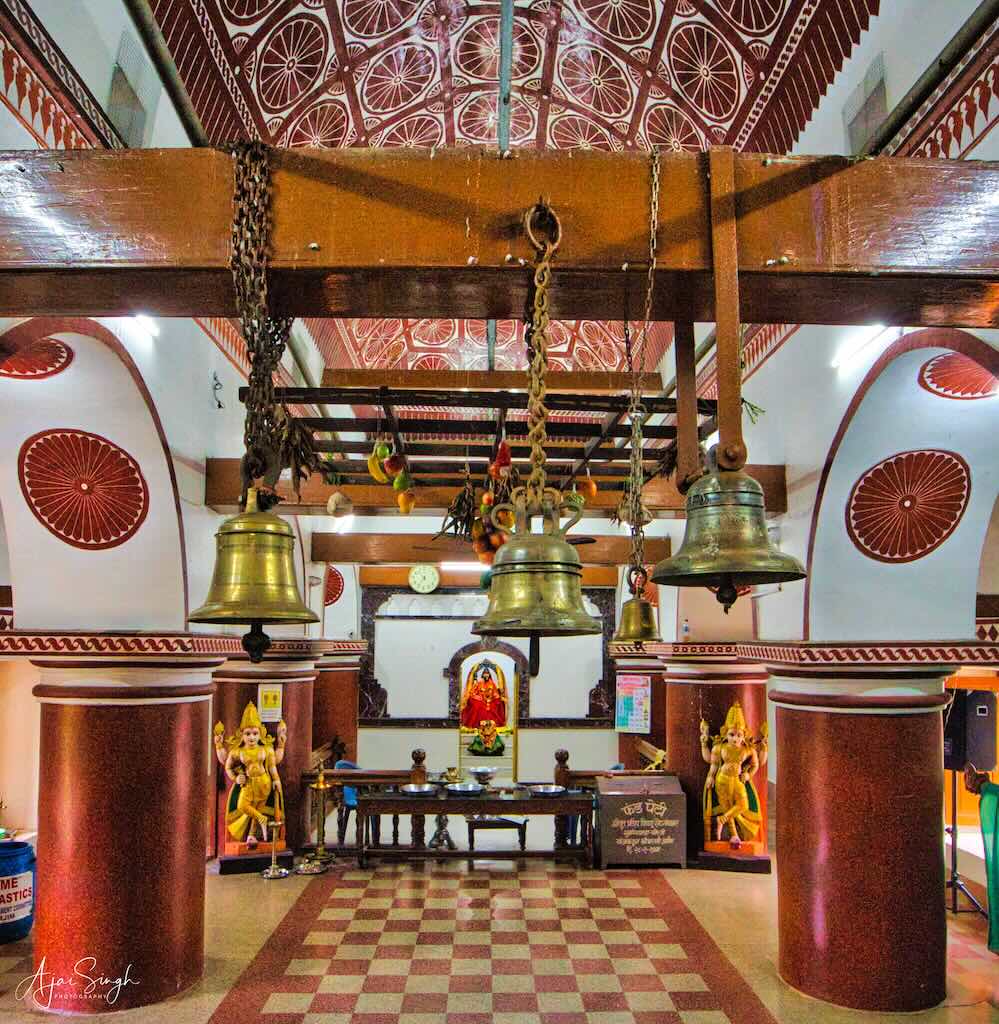
The Morjai temple possesses an elegant look as the temple walls are elaborately decorated with rare and extinct ‘Kaavi’ art friezes. The original Mukhmandap and its window grills also have various geometric and floral patterns which are depicted with ‘Kaavi’ art. The exterior Sabhamandap dates to 1936 AD and has rectangular columns supporting a balcony above.
.

.
Itihāsa
.
Goa has more temples per capita than most other parts of India, contrary to its popular perception. Apart from the Goud Saraswat Temples which are essentially the Kul Devata temples of the Goud Saraswat Brahmin families of Goa, there are many other temple trails. This temple takes us on the Lairai Temple Trail which is at the heart of Seven Sisters and a Brother story of Goa. These are seven ancient Devi temples of Goa, mostly north of the Mandovi River.
.

.
Story of the Seven Sisters and a Brother
.
Once upon a time seven sisters and a brother came to the land of Goa riding an elephant. We only know that they came down the ghats, probably via Chorla ghat, but no one knows exactly where they came from.
Eight siblings reached Mayem village via Bicholim. The elephant that they came on can be seen at Vydanar near Mayem village, very close to the temple of Maya-Kelbai or Kelambika. It is carved in laterite stone on top of a hillock.
.
.
Kelbai, the eldest sister sent the brother to fetch fire to cook food. He takes a long time, so Kelbai sends Lairai, the other sister to look for him. She finds her brother Khetoba playing with the children. In anger, she kicks the brother with her foot and he obviously feels hurt and refuses to return with her. He then goes to Vainguinim village. When Kelbai finds out, she feels responsible for the brother leaving. So, she decides to go to Mulgaon to do penance. She vows to walk with fire on her head with five hundred followers called Dhonds.
.

.
Now Lairai also feels hurt and she decides to go to a pious place. She chooses to stay at Shirgaon. As penance, she decides to walk on fire with seven hundred Dhonds.
Morjai decides to walk into the water on the shore. Her Murti was later discovered by fishermen and installed at the Morjim village.
Ajidipa decides to go to an island called Anjidipa close to Karwar.
Shitalai decides to leave the earth and enter Pataal or the netherworld.
.
.
The seven sisters are now located in seven different places:
- Lairai in Shirgaon
- Kelbai in Mulgaon
- Mahamayi in Mayem
- Mirabai or Mirabalis in Mapusa
- Morjai in Morjim
- Ajidipa at Anjidipa Island near Karwar – no temple remains there as were destroyed.
- Shitlai went to Pataal or the netherworld so she had no temple.
.

.
This is where they continue to live and are worshipped.
The Devi at Morjai is in the form of Mahishasurmardini.
.
Kaavi Art
.
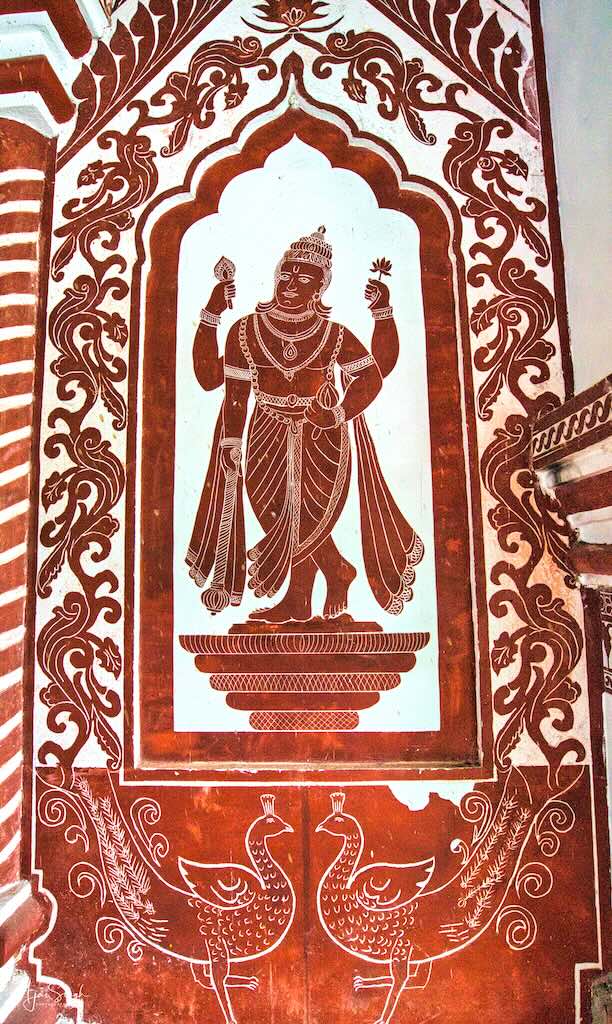
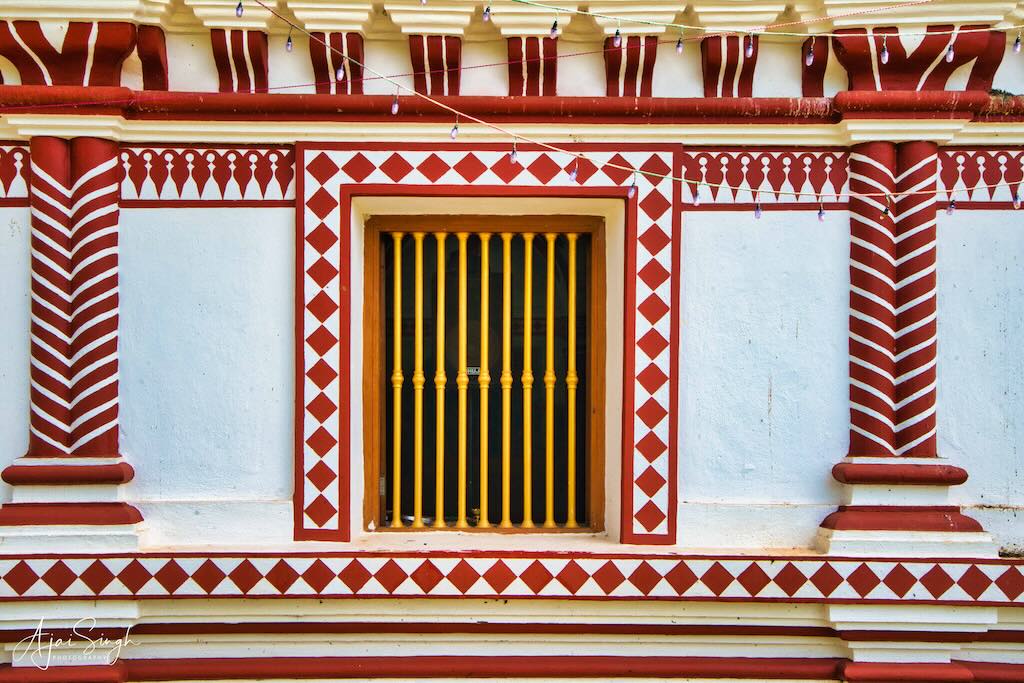
Kaavi art is a form of painting used to decorate the temples in Goa, coastal Karnataka, and parts of Konkan. Kaavi art is one of the oldest and most sacred art forms of Goa. It is a monochromatic style of painting where the only colour used is the Indian red oxide pigment against a brilliantly white-washed background. Lines of the drawing are drawn by etching while the paint is still wet.
.

.
Traditionally, the limestone mixture used to whitewash the walls used to be painstakingly prepared by pounding sea shells into a fine powder. This powder was mixed with washed fine sand from river beds and natural jaggery. The slurry was then allowed to ferment for two weeks. It was then whisked well to form a buttery smooth paste that would glide easily and evenly on temple walls. The red pigment came from the laterite stone. The friezes of suspended heart-shaped pipal leaves usually serve as frame borders.
.


Columns decorated with Kaavi art
.
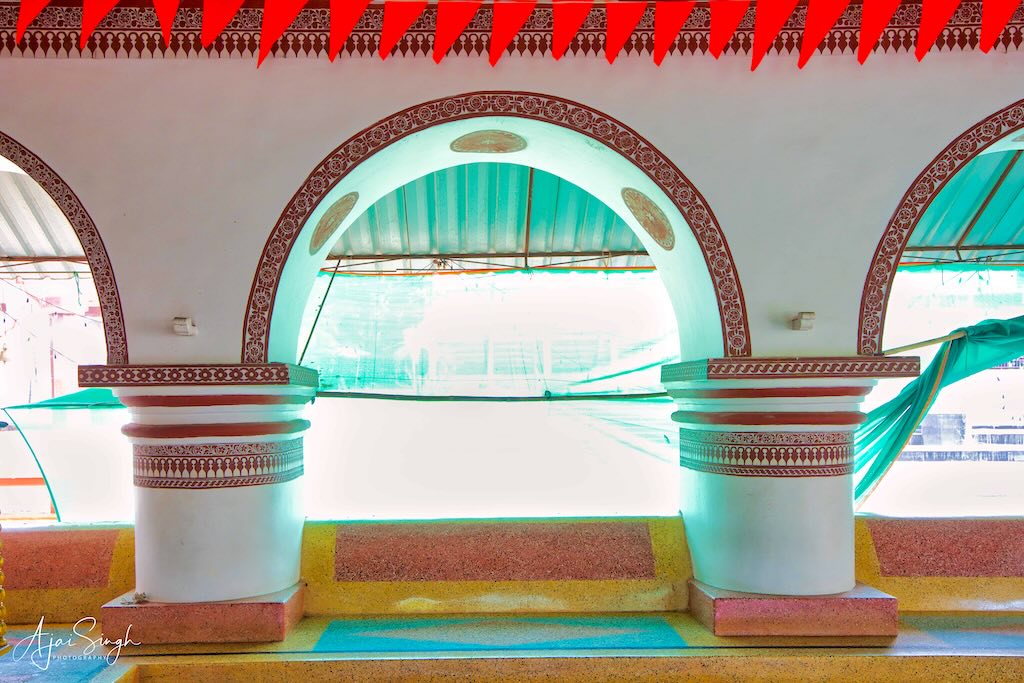
Unfortunately, not many examples of old Kaavi art survive intact in Goa. The few old Kaavi art murals that still survive are often damaged by water. However, some temples like the Morjai temple of Morjim, Goa have some excellent contemporary examples of Kaavi art.
.
.
Morjim is famous for backpackers and tourists on its beaches, but not many know of the serene temple of Morjai which is famous for its Kaavi art. Morjai temple stands apart with its stunning white exterior highlighted with exceptional Kaavi work. The temple always Kaavi art murals decorating it, but a few years ago, the murals were repainted in the old style by artists specially brought in from Karnataka.
.
.
Festivals
.
.
The main festival celebrated at this temple is Kalas Utsav which is observed once every three, five, seven, or nine years and lasts for nearly a month. It begins with the Phalgun Shudda Panchami and is celebrated with a lot of fanfare and festivities.
The other festivals celebrated are the Gudi Padwa, Dussehra, jatra, and ghodemodni. The annual Jatra takes place on Shravan Krishna Trayodashi.
.

.
I visited the temple during Ganesh Chaturthi celebrations. Goan celebration of this festival is unique to the region. It is an exclusive family affair and is celebrated in every home. The matoli, a bamboo checkered frame is hung above the Ganesh murti, decked with seasonal fruits like coconuts, aambaade, mango leaves, bananas, and flowers. This is unlike the public celebration of the festival in Maharashtra and other places.
.

.
Morjai Temple had the unique distinction of being listed by TIME magazine as one of the World’s Greatest Places 2021.


.
Shri Mahalasa Narayani Devalaya Verna
.
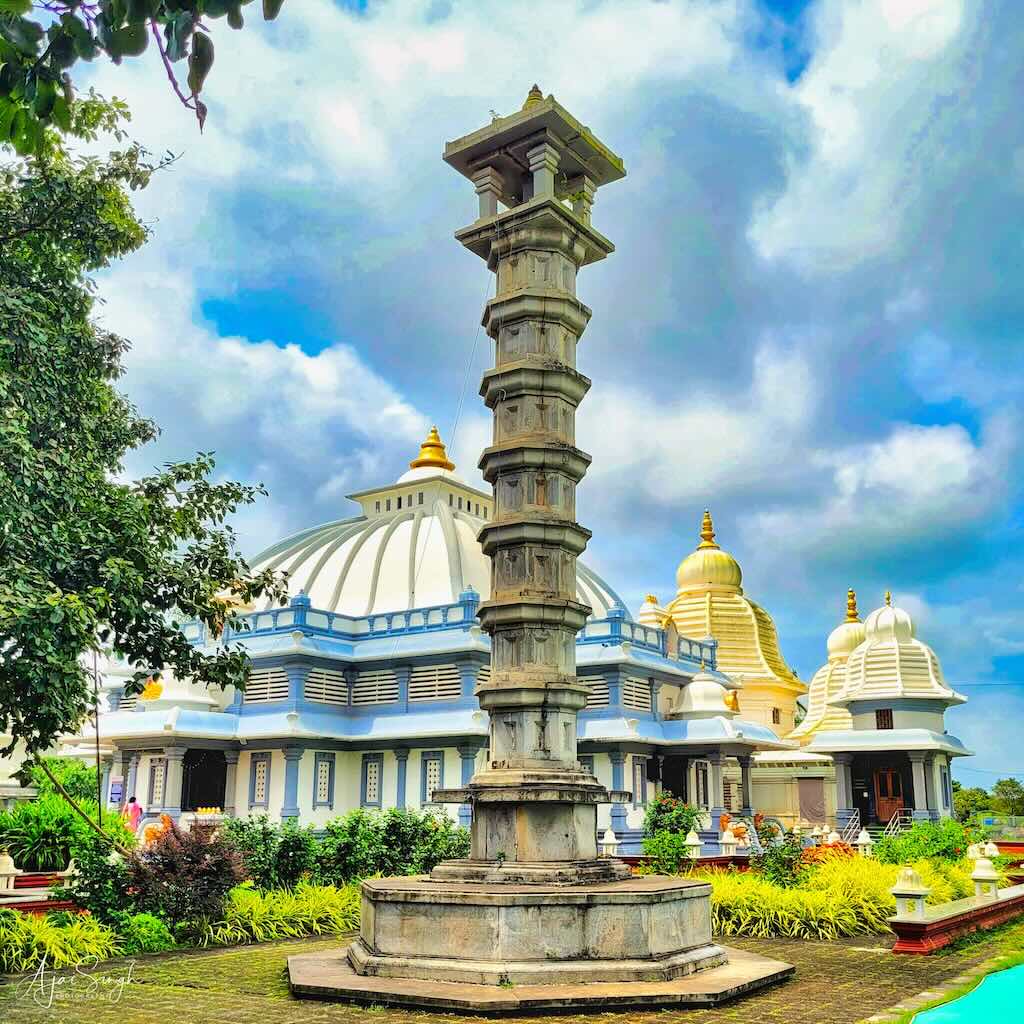
If any place can rightly claim to be the first place where Shri Mahalasa Narayani came to Goa, then it is Varenyapur, now known as Verna, in the southern part of the scenic coastal state of Goa. For centuries, there existed a temple dedicated to the Goddess, the female form of Lord Vishnu also known as Mohini, until it was razed to the ground by the Portuguese invaders in the year 1567 CE. She is probably the oldest presiding deity of Gomantak. The worship of this deity prevailed from ancient times among the Saraswat Brahmins, even before their settling down in Gomantak.
.
.
The temple of Shri Mahalasa had been on the plateau of Verna village in Salcette taluka from ancient times, long before the advent of Portuguese rule. Its reference is found in Skanda Purana. It is the largest of all Puranas and is believed to have been written between the 7th and 9th century CE. In this Purana, there are two adhyayas (chapters) entitled Varunapur Mahatmya and the legend of Shri Mahalasa of Varyenapur (now Verna) is narrated in these two adhyayas.
.
.
The Shri Mahalasa Narayani Temple is one of the primary temples of Goa. At present the popular temple of the Devi is at Mardol in Ponda where she ‘migrated’ when the temple at the original site at Verna was destroyed by the Portuguese in 1567. The Shri Mahalsa Temple at Mardol is covered in detail in my earlier blog on the Temples of Goa.
Despite the devastation caused by the Portuguese, the devotion towards Goddess Mahalasa remained alive in the hearts of devotees. During the Portuguese period, many attempts were made to construct a structure on the site of the demolished temple. However, these were never successful as hindrances forced all such attempts to be abandoned. The site remained empty and subsequently, efforts were made to revive and reconstruct the temple. With the support and dedication of the devotees, the Shree Mahalasa Narayani Temple emerged once again, becoming a symbol of resilience and faith.
.


Ruins of wells of the original temple in the complex
.
Mahalasa is the Kuldevi (family goddess) of some 96 Khatriyas (Dessai’s) and many Konkani Saraswat Brahmins, Karhade Brahmins, Daivajna Brahmins, (Arya Vaishyas-also known as Shetti), Bhandaris, and many families of different caste/communities.
Other temples of Shri Mahalasa are located in Paithan, Nevasa, Karwar, Kumta, Kasargod, and Harikhandige.
.
Itihāsa
.
The Devi is supposed to have come to Gomantak initially in the form of Vayu or Air. She was looking to find a place for herself, eventually settling down in Veranyapura. However, the people informed her that there was a scarcity of water there. The Devi then used her toe to dig a pond, from where fresh water oozed out. The place came to be known as Nupur Tirtha. Nupur is the toe ring worn by the Devi.
.

.
Once the Devi started living here, a temple came up for her. Another large tank was built with laterite stones to meet the needs of the temple and the devotees. It is likely that the two tanks were linked through an underground spring. This temple complex became the center of the social life of Veranyapuram, which was also a big trading center.
.
Sagar Manthan
.
Mahalasa Narayani is associated with Sagar Manthan or the Churning of Ocean story. Vishnu took the Mohini avatar to serve the Amrit churned out of the ocean. As we know, an Asura by the name of Swarbhanu sat in the line of Devas to receive the elixir and was cut into two parts by the Chakra of Vishnu in Mohini’s form for this deception. Mohini chased Rahu who ran, and she killed him on a hill called Mahalasa. It is this Avatar of Vishnu that is immortalized here as Mahalasa Narayani.
.
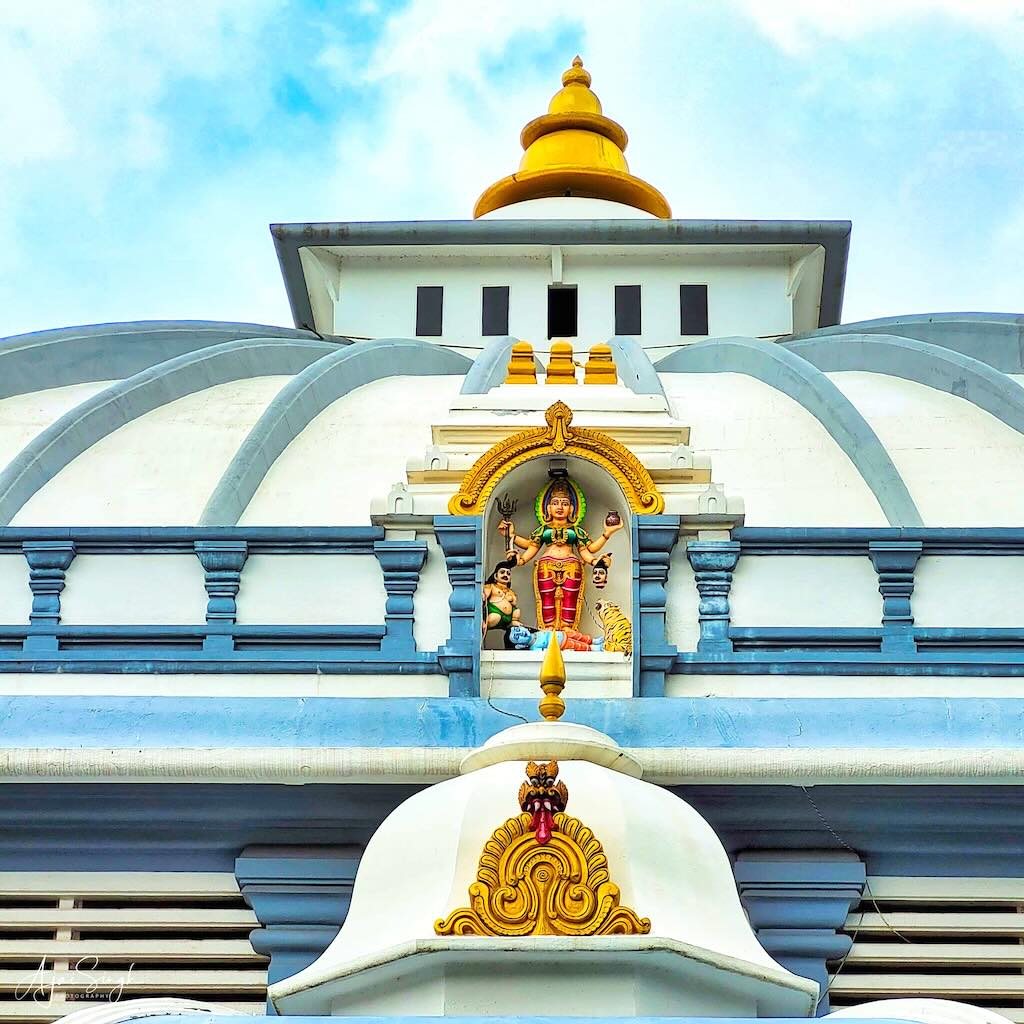
.
Local folklore also says that she is Mahalasa – the wife of Malhari Martand or Khandoba, a form of Shiva that is worshipped in western India. Indeed, there is a Malhari temple close by, which may have been a part of the original temple complex. This story is not disconnected from the first story. It is said that Shiva was enchanted by Mohini and he decided to take the earthly form of Khandoba to marry Mahalasa.
.
The Temple
.
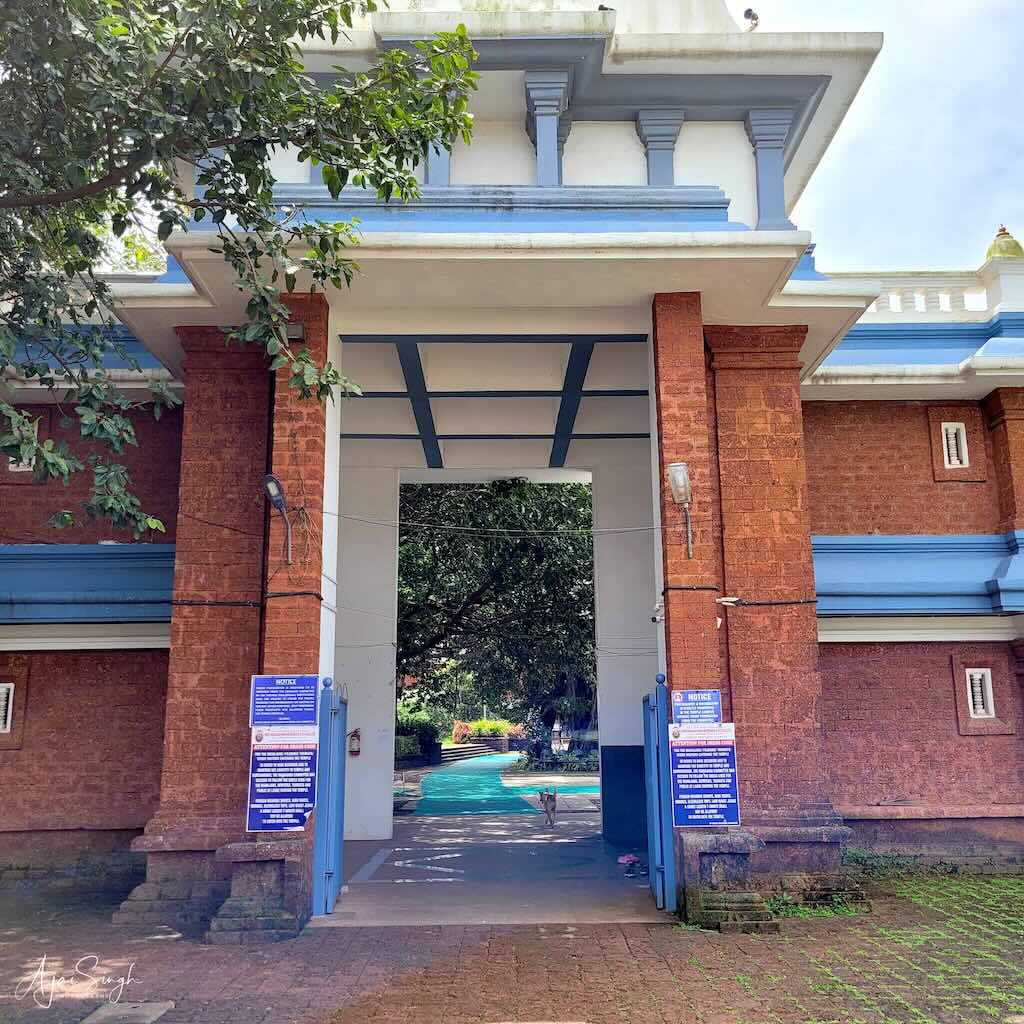
.
The Shri Mahalasa Narayani Temple showcases magnificent architecture that blends traditional Goan style with unique elements of divine aesthetics. The temple structure exhibits intricate carvings, vibrant colors, and ornate decorations, creating a visually captivating experience for visitors.
.
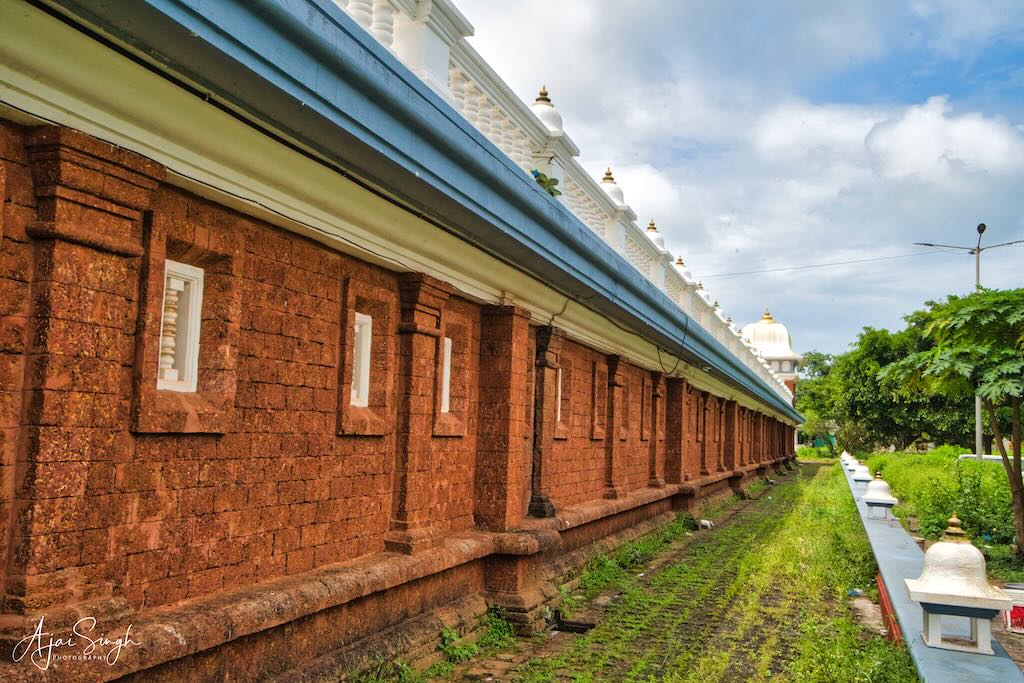
.
Entering the gate of the temple, one is struck with the massive scale of the complex within. In typical Goan style, everything is gleaming in brightly painted colours. The architecture of the new temple is unique and some of the domes are Buddhist-style inverted bell-shaped.
.
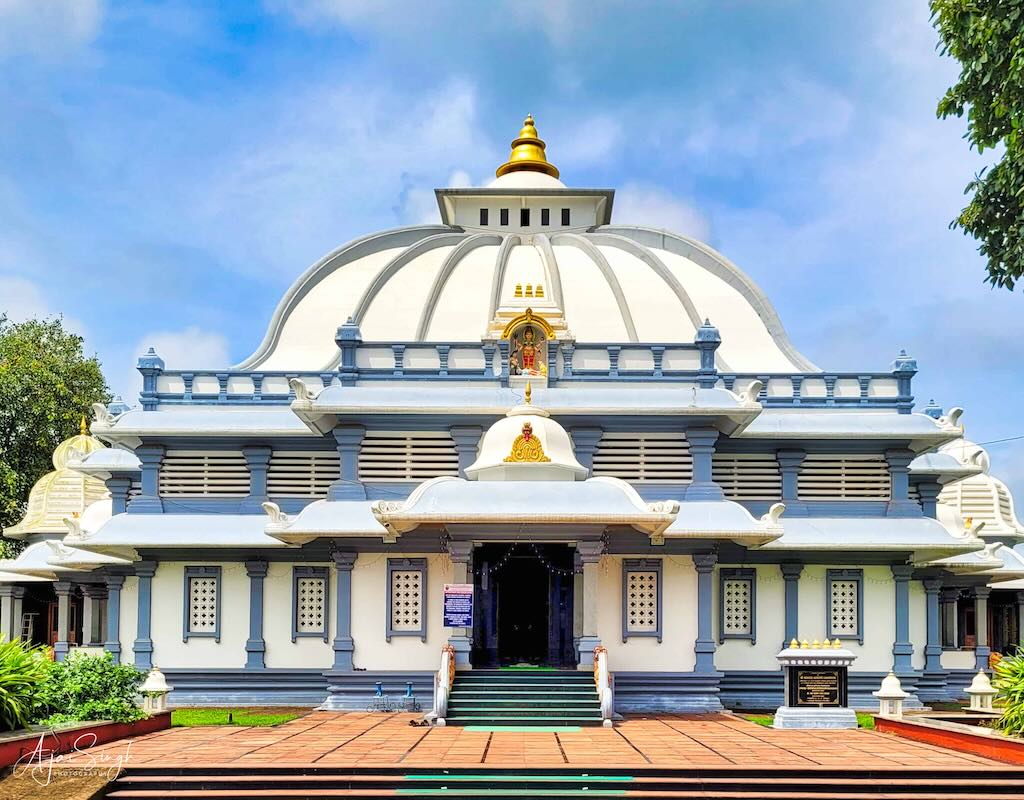
.
The main temple has a huge mandapa with a rectangular curvilinear dome. The polished granite floor inside reflects the hollow dome like a mirror so that when you walk on it, it almost feels like you are hanging in the air. The credit goes to the authorities for keeping it sparkling clean.
.

.
The original tank of the temple still survives and can be seen, though the temple was completely razed to the ground. The new temple and ancient pushkarni stand facing each other. A circular well is located at one corner of the tank. This is made of laterite stone and belongs to the original temple and it is still in good condition.
.
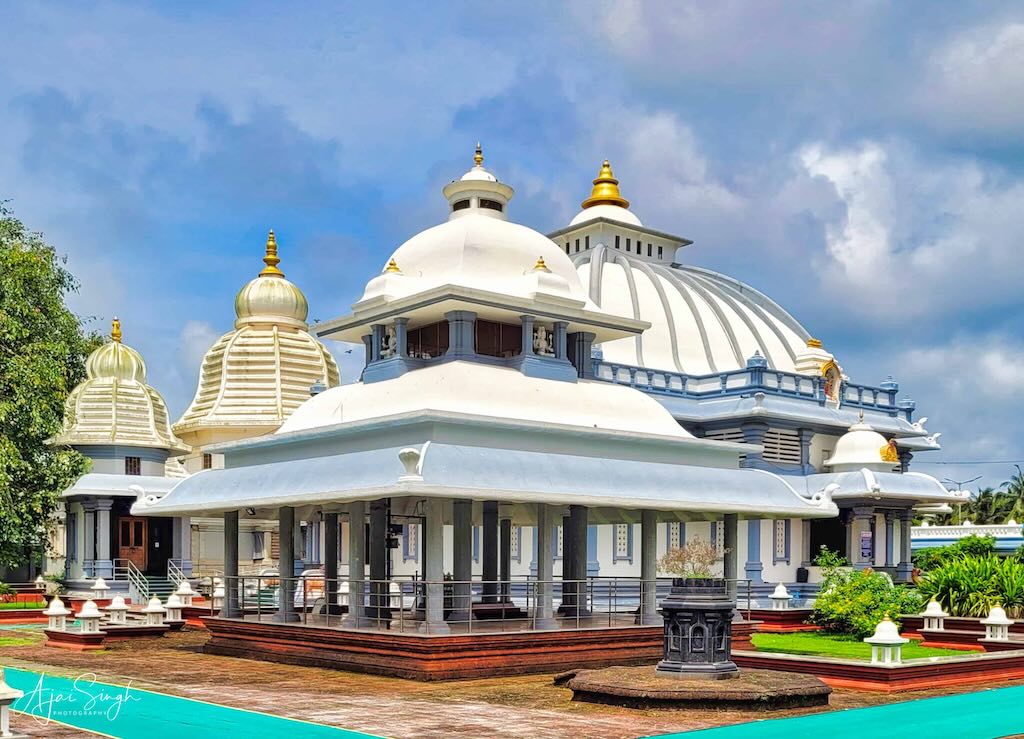
.
On one side of the temple is a school for children and on another side is the Kalyanmandapa or the hall for weddings. Well-maintained lawns surround the temple as well as the tank.
.
The Murti of Mahalasa Narayani
.
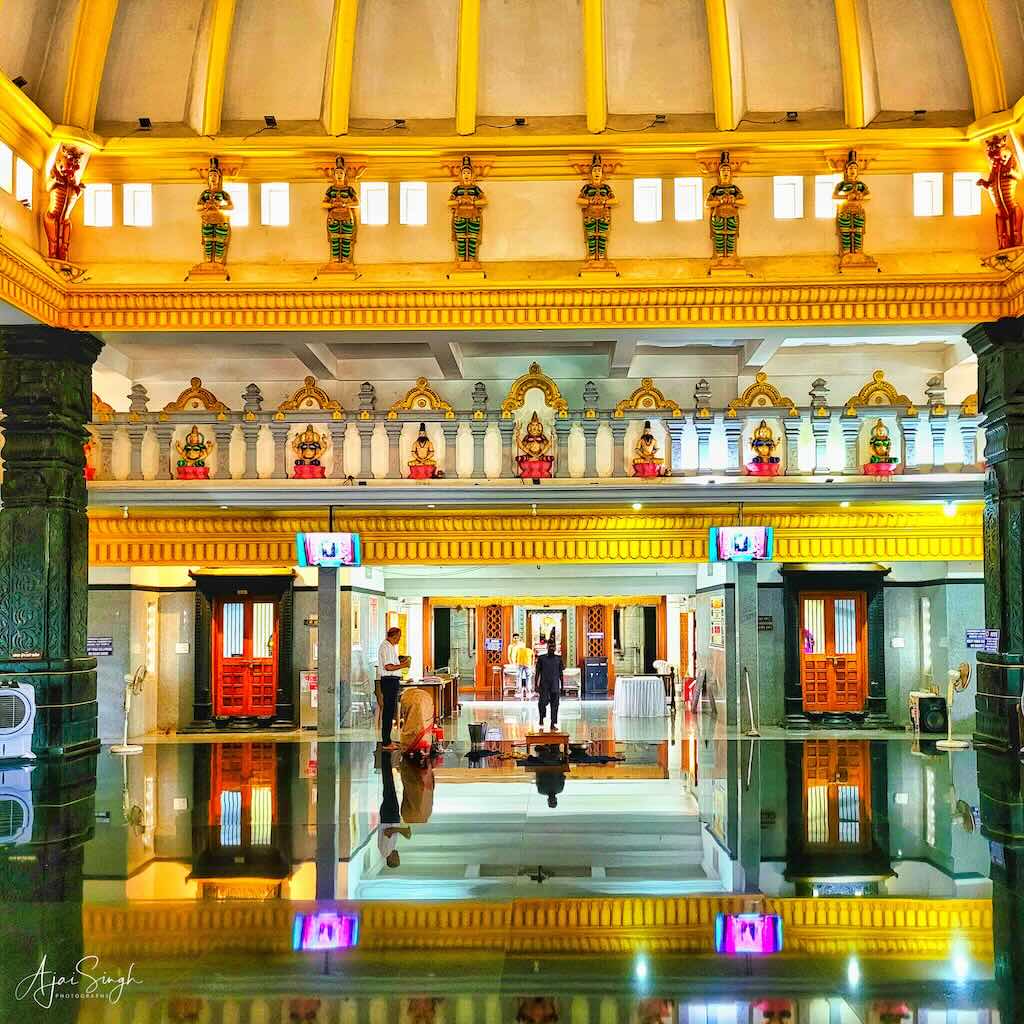
.
The murti of Devi is in black stone. She has four arms holding a Trident or Trishul, a Sword, an Asura head, and a bowl. She also wears the Yagnopavit or the sacred thread. This is unusual as the thread is primarily worn by males. She stands on top of an Asura that she has killed.
On the side of the main deity are two other finely carved murtis. On the left is Ardhanarishwara – the combined form of Shiva and Parvati. On the right is Hari Hara – the combined form of Shiva and Vishnu.
.
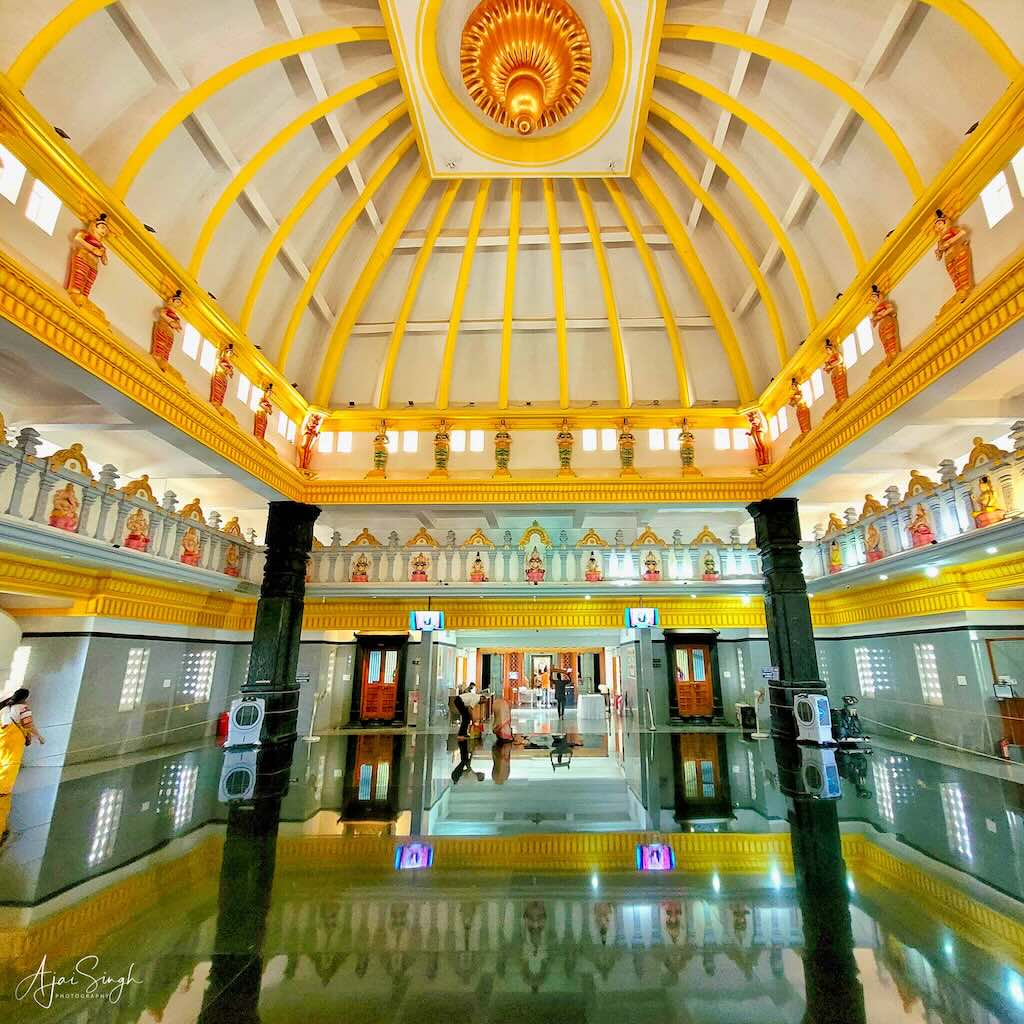
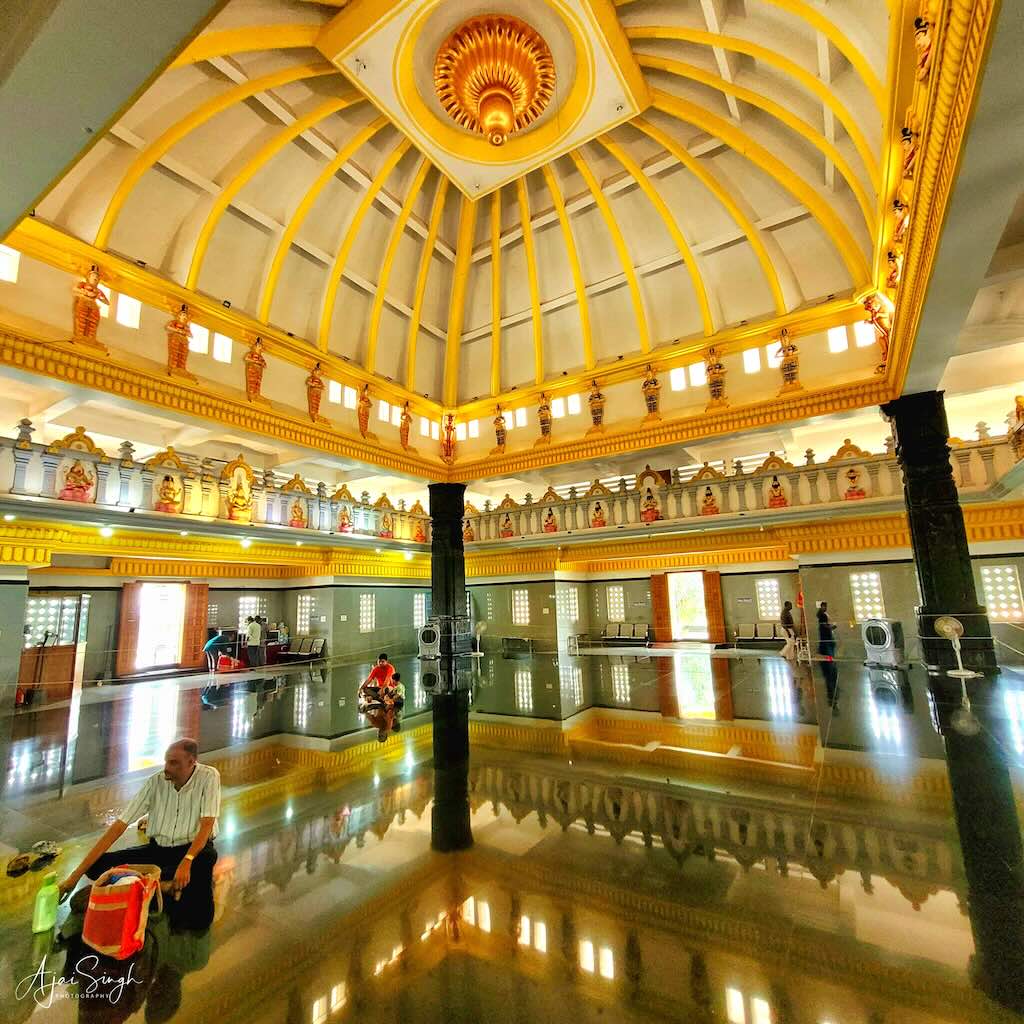
The mandapa interiors leave devotees dumbstruck at their magnificence
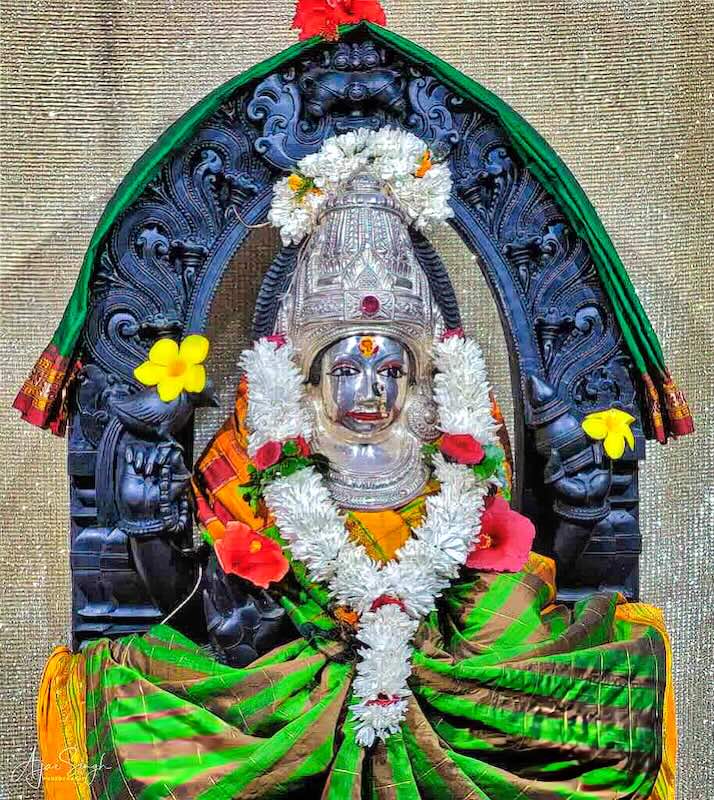

Smaller shrines dedicated to Shardamba and Adi Shankaracharya
.
On the left of Devi is a smaller temple dedicated to Sharadamba and on the right to Adi Shankaracharya. Every temple entrance has a lovely sculpted Chandrashila (a lotus-shaped stepping stone before the doorframe), like ancient temples used to have.
.


Beautifully carved Chandrashilas before the doorsteps
.
Chausat (64) Yogini Temple
.
On the right of the main temple structure is a temple dedicated to Swarnakarshan Bhairav. This literally means the Bhairav who can attract gold. On the right is a unique temple dedicated to the Chausat (64) Yoginis. I have visited the 64 Yogini temple in Hirapur, Odisha but I never knew there was one in Goa. This temple is of course a miniature version of the bigger temples but it follows their design.
.
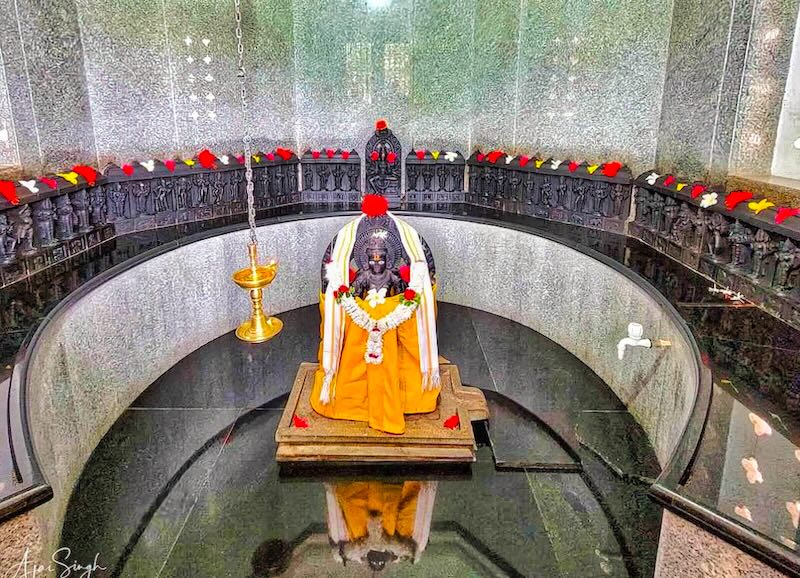
.
There are 64 yoginis in a circle. All 64 names are written on the panel outside the temple. In the center is Samhar Bhairav – the Bhairav responsible for destruction. The difference of this yogini is that the whole cluster of 64 yoginis is enclosed within a small temple that is covered on top. Most 64 Yogini temples are open to the sky.
.

To protect your personal data, your connection to YouTube has been blocked.
Click on Load video to unblock YouTube.
By loading the video you accept the privacy policy of YouTube.
More information about YouTube’s privacy policy can be found here Google – Privacy & Terms.
.
A question that arises is whether there has been a 64 Yogini temple in Goa since ancient times. And why was this temple chosen for the 64 yoginis?
.
Festivals
.
Navaratri is obviously the biggest festival celebrated in any Devi temple. Besides this, the temple celebrates Ram Navami with the Utsav Murtis of Sri Ram, and a Jhoola is organized for the occasion.
.


Beautiful murtis adorn the temple precincts
.
The annual festival of Mahalasa is organized from Shashthi to Ashtami or the 6th to 8th of the Krishna Paksha of Chaitra month. This would fall just after the Chaitra Navaratri.
.
Nupur Tirtha and Hanuman Temple
.
Nupur Tirtha, the one that is believed to have been dug by the Devi is located a few hundred meters away from the main temple. It is a small square pond that is linked to an underground spring. A small temple stands at its corner with a Shivalinga inside it.
Next to the Tirtha, in fact, closer to the road is a newly built Hanuman Temple. The architecture is similar to the main Mahalasa temple. On the right of Hanuman is a temple dedicated to Parashuram and on the left to Kaal Bhairav.
After the visit to this temple and seeing the pre-historic parts of the original temple where Gods and Goddesses had tread upon this earth, it felt like having made a connection with the itihāsa of Gomantak. An itihāsa that is mentioned in the Puranas and a part of history that is now being slowly reclaimed.
.
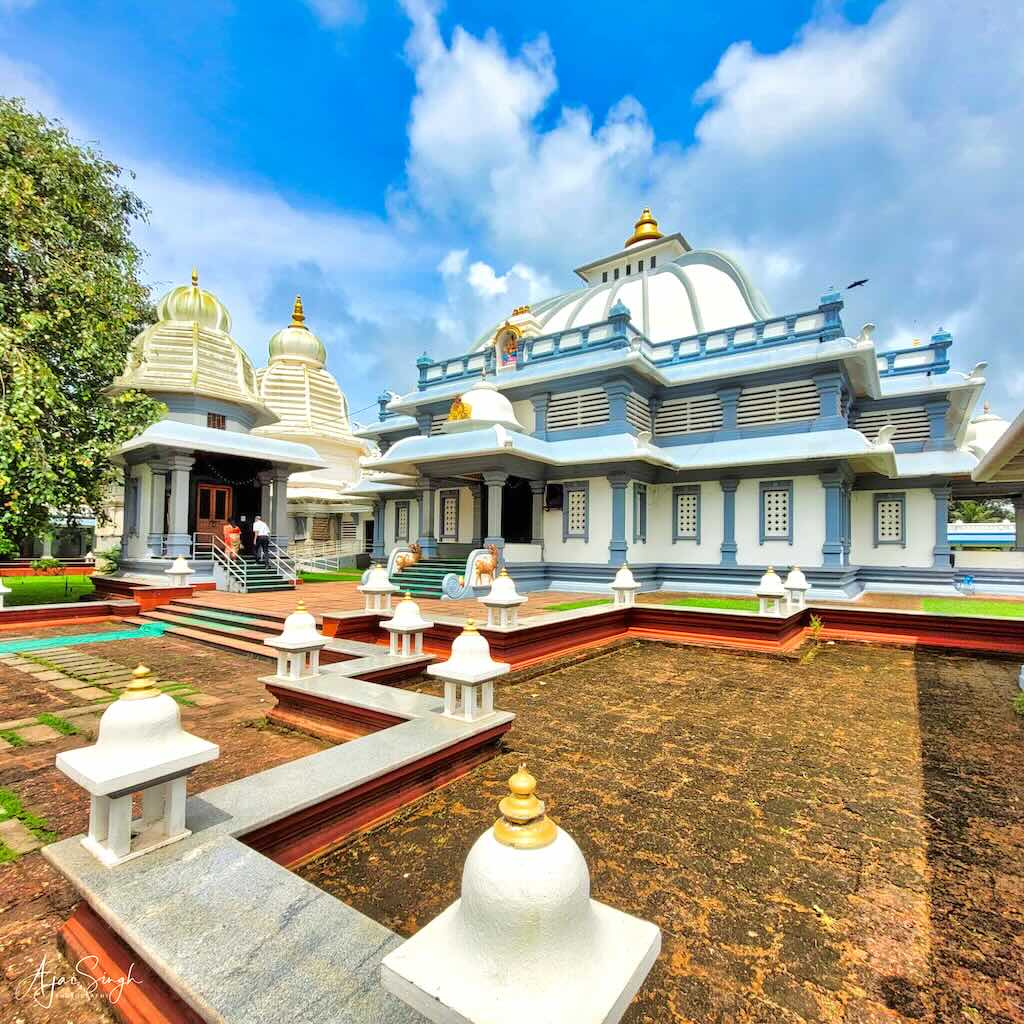
.
Memorandum of Understanding with Government
.
In an expression of its intent to involve trusts and management committees of ancient temples in the conservation and development of historic sites, the State Archives and Archaeology Department has entered into a memorandum of understanding (MoU) with the Mahalasa Narayani temple trust, Verna in 2022. The first-of-its-kind agreement concerning ancient or rebuilt temples will facilitate hassle-free development of the government-owned site by the temple trust with the least financial implications for the government. An excellent initiative by the government.
.
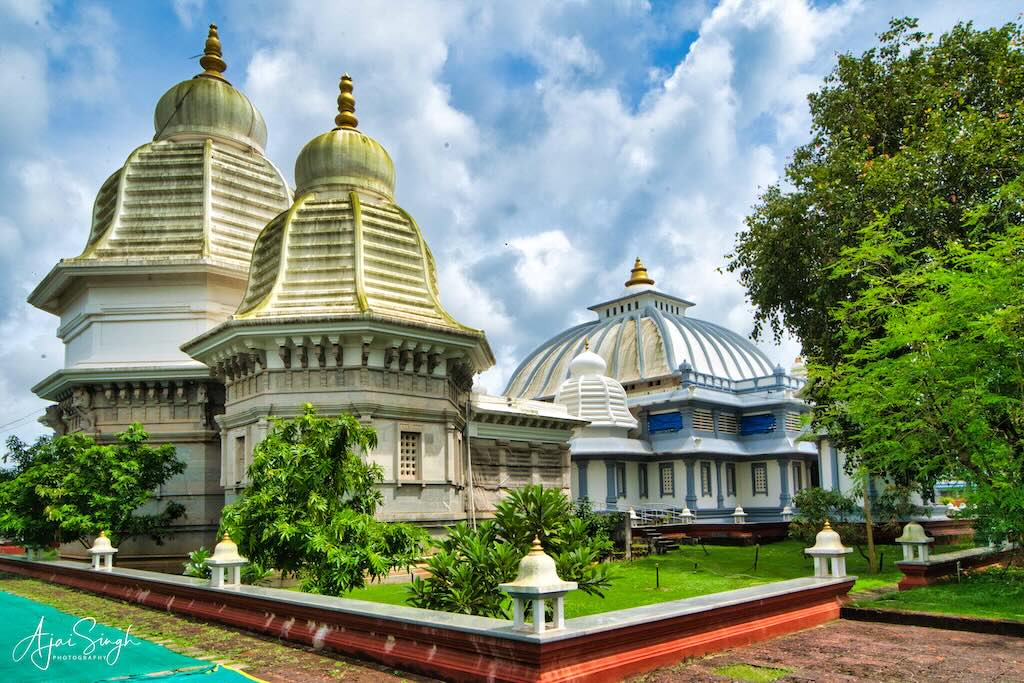
.
Chieftain’s Martyrs Memorial Cuncolim
.
Our last visit was to a temple of a different kind, though equally revered. The temple honors the memory of the martyrs of the freedom movement.
.

.
The Chieftain’s Martyrs Day is an important milestone in Goa’s history. On July 15, 1583, village heads of Cuncolim in South Goa revolted against Portuguese rule by killing five Jesuit priests, who had visited the village for forcible conversion to Christianity, and 14 local converted people.
Tiswadi was completely Christianized by January 1563. Cuncolim was a border village, inhabited by a majority Hindu population. It was prosperous compared to neighboring areas due to its fertile land. In keeping with the traditional fairs and religious festivities, the economy of Cuncolim depended upon its temple and religious celebrations. Due to this, there was an angry reaction from the locals towards the attempts of the Jesuits who sought to establish Christianity in Cuncolim and its satellite villages. When the Jesuits approached the village with the objective of erecting a cross and selecting ground for building a church, it was the last straw.
.

.
The local Portuguese garrison retaliated by executing 15 village chieftains who participated in the revolt. One, however, luckily managed to escape and lived to tell the tale of the brutalities. The 16 chieftains had been invited by the Portuguese to the Assolna fortress unarmed for peace talks and were attacked once the heavy doors closed behind them.
After killing 15 chieftains, the Portuguese razed the temples in Cuncolim and the traditional system of land sharing and scrapped the institution of Gram Samstha.
.

.
The villagers later constructed a memorial to honour the chieftains as true martyrs of Cuncolim. The 1583 revolt was the first revolt against colonial powers not only in Goa but in the entire country. A new memorial has recently been constructed to honor the freedom fighters. Since the place where they had been killed has a church constructed over it, the memorial has been constructed on an adjacent plot of land.
.
Spice Farm
.
Spice Farms are a popular tourist attraction in Goa, giving visitors an insight into the varied flora and fauna of the region. They also provide important lessons on maintaining the delicate ecosystem using traditional practices, which have been mostly lost in mechanized farming.
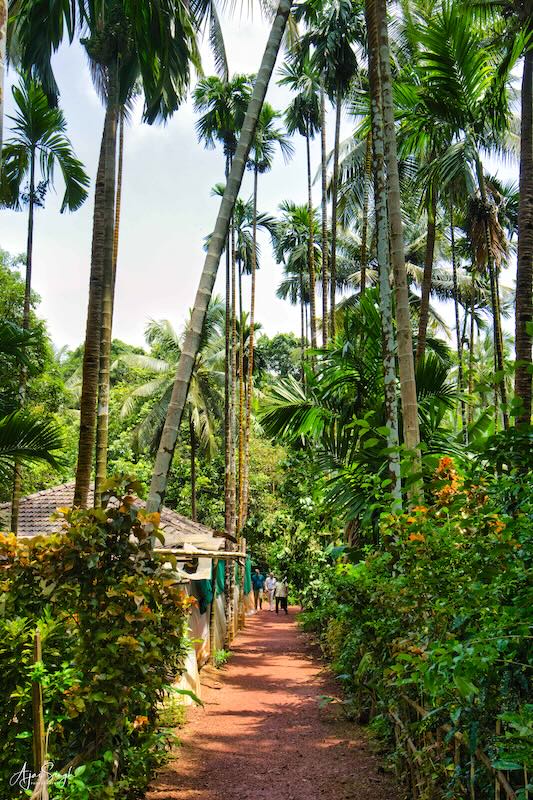
The Sahakari Spice Farm is situated amidst lush green surroundings at Curti. The taluka of Ponda in which it is located is extremely popular amongst tourists for its rich cultural heritage and magnificently designed places of worship. This Spice farm adds to the variety of tourist destinations that Ponda boasts of.
Occupying an area of 130 acres, 60 acres of which is exclusively devoted to the cultivation of Spices, Fruits, Medicinal trees, and Herbs. This Organic Spice Farm is reputed for the various types of Spices grown in a systematic and scientific manner since 1979/80.
Since then the farm has been developed using new scientific techniques in conjunction with the age-old concepts of mixed crop farming. New and scientific techniques like the use of sprinklers for irrigation are used in the farm to recreate the climatic conditions prevailing in the rainy season. These scientific methods coupled with older water harvesting methods help in water conservation to a large extent.
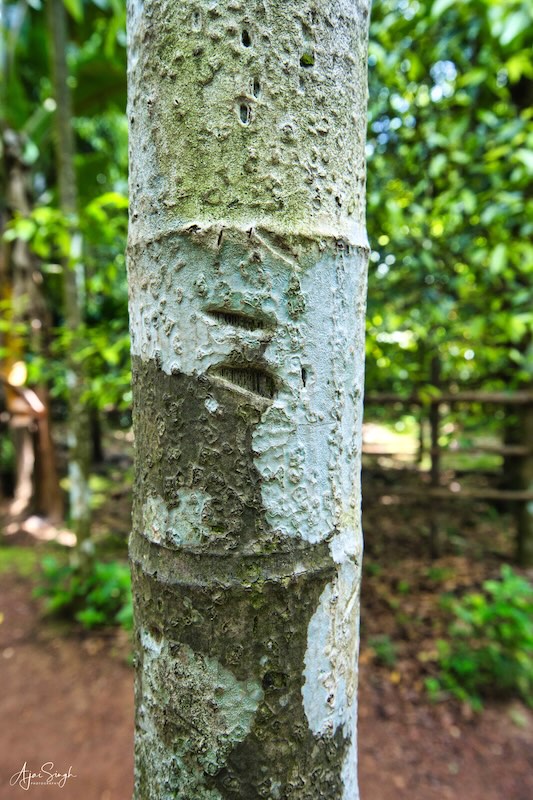
The sloppy terrains of the plantation are covered with Cashew nut trees and some land has been covered with thick vegetation by planting economically profitable fruit-bearing trees/plants, spices, and medicinal herbs. This process of planting more trees helps prevent the erosion of land as well as generating green foliage used in preparing compost. The farm which was earlier providing employment opportunities of 2120 man-days and an annual turnover of Rs. 3,50,000/- is now providing 6000 man-days of employment and has a turnover of Rs. 56,00,000/- only in the farm sector.
The farm is used to dissipate knowledge about different spices and their medicinal values to visitors. Foreigners have been lured to India since time in search of spices and trading in different varieties of spices.
.
Restaurant
The mesmerizing view of the open restaurant helps you relish a large variety of traditional food and unwind naturally!
.
Conclusion
.
This was not my first visit to Goa for visiting temples, and historic sites which played an important part in the region’s past. A past not only limited to the period of colonial rule, which is mostly the case for popular literature. We forget that the Portuguese landed in Goa in the early 16th century, while the history of Goa goes back to prehistoric times. However, for an outsider to discover the places through books or local guides is not feasible and I was lucky to be part of the group which had Shefali Vaidya Ji, a renowned public speaker, historian and columnist from Goa, taking us to the shrines and enlightening us with unknown facts hidden in their shrouded past. That she also belongs to a former militant freedom fighter’s family added to the interesting anecdotes she narrated. A visit to her ancestral home was the icing on the cake. This has helped piece together the thread of history I have compiled in this blog.
.

.
My Goa visit had another highlight – a meeting with the knowledgeable Pradhan Achrak of the Shri Navdurga Temple, Madkai, Shri Makarand Ghaisas. I have covered in detail my visit to this ancient temple in my earlier blog on the temples of Goa. I was fortunate that during this visit too I got the opportunity to meet him and learn about the history of Goan temples in general, and his temple in particular, and the system of administration which the Portuguese instituted which continues even today. Hopefully, those details will get covered in a later blog post.
After seeing the preponderance of temples through my blogs, I am sure that the general misconception of tourists that Goa has only beaches and churches to be seen, will be corrected. There is no other region in India where there exist so many beautiful and well-maintained temples, despite the best efforts of the Portuguese to erase Hinduism and any of its signs from the regions under their control. The strength and resilience of our ancient civilisation not only survived but has thrived in this region.
.

The sky is the limit. I’m just following where life takes me. It’s been an incredible journey.
Christina Aguilera
.
References
.
- https://en.wikipedia.org/wiki/Shantadurga
- https://en.wikipedia.org/wiki/Saptakoteshwar_Temple
- https://en.wikipedia.org/wiki/Mallikarjuna_Temple,_Goa
- https://coinindia.com/galleries-kadambas-goa.html
- http://www.heritageuniversityofkerala.com/JournalPDF/Volume8.2/40.pdf
- https://www.firstpost.com/india/there-were-no-hindus-in-goa-before-portuguese-landed-church-thinker-953727.html
- Flight of the Deities: Hindu Resistance in Portuguese Goa by Paul Axelrod and Michelle A. Fuerch
- Pictorial Encounter: Iconoclasm and Syncretism on India’s Western Coast by Alexander Henn
- Goa: Hindu temples and deities by Rui Gomes Pereira
- https://www.goaholidayguide.com/history/
- https://theprint.in/opinion/heres-history-of-portuguese-violence-in-goa-shefali-vaidyas-rebuttal-to-theprint-column/1398584/
- https://www.academia.edu/8754597/_Hindu_Temples_of_Seventeenth_and_Eighteenth_Century_Goa_The_Maintenance_of_a_Sacred_Integrity_and_the_Process_of_East_West_Cross_Fertilization_Portuguese_Study_Review_vol_9_nos_1_and_2_2001
- https://www.navhindtimes.in/2022/11/20/magazines/panorama/ancient-temples-and-deities/
- https://shantadurgakunkalikarin.org/mahajansold1.htm
- https://timesofindia.indiatimes.com/travel/cuncolim/original-site-of-shantadurga-temple/ps51990185.cms
- https://www.shantadurgafatarpekarin.com/history/
- https://timesofindia.indiatimes.com/travel/destinations/shantadurga-temple/articleshow/52411678.cms
- https://indiapl.com/goa/shree-shantadurga-ballikarin-temple-1247369
- http://timesofindia.indiatimes.com/articleshow/98726357.cms?from=mdr&utm_source=contentofinterest&utm_medium=text&utm_campaign=cppst
- https://www.tourmyindia.com/states/goa/saptakoteshwar-temple-goa.html
- https://www.facebook.com/lostgoantemples/posts/pfbid0mcCaPdJzzsNYZDLW1tizzgt8dZ6jpd8nnwiNHTeaH6f8cW5A6y1oUvh5L98auB9nl
- http://timesofindia.indiatimes.com/articleshow/63657258.cms?utm_source=contentofinterest&utm_medium=text&utm_campaign=cppst
- https://www.opindia.com/2023/02/pm-modi-congratulates-goa-govt-renovation-shree-saptakoteshwar-temple/
- https://itsgoa.com/saptakoteshwar-temple-lord-shiva
- http://timesofindia.indiatimes.com/articleshow/45366109.cms?utm_source=contentofinterest&utm_medium=text&utm_campaign=cppst
- http://www.shantadurgafatarpekarin.com/saptakotishwar-temple/
- https://www.gomantaktimes.com/ampstories/web-stories/saptakoteshwar-parikrama-showcasing-goas-unexplored-history
- https://www.inditales.com/divar-heritage-nature-trail-river-island-goa/
- https://lifestyle.livemint.com/how-to-lounge/books/a-photo-book-chronicles-goa-s-hidden-heritage-111641902451901.html
- https://atmanirvana.com/mallikarjuna-temple-canacona-goa/
- https://archive.ph/20130203075912/http://flightofgods.sulekha.com/blog/post/2009/04/the-flight-of-gods-21-mallikarjun-temple-gaondongrem.htm#selection-1151.0-1151.140
- https://www.goaholidayhomes.com/information/parashuram-temple-at-poinguinim.html
- https://theflightofgods.wordpress.com/tag/parashuram-temple/
- https://www.hvk.org/2007/0107/29.html
- https://timesofindia.indiatimes.com/city/goa/the-axe-wielding-god-of-poinguinim/articleshow/61614313.cms
- https://www.thegoavilla.com/goa/distanation/south-goa-canacona-parashuram-temple.html
- https://twitter.com/YugaantarGoa/status/1552849343677272064
- https://blog.parrikar.com/2013/01/19/the-vetals-of-goa-loliem/
- https://www.facebook.com/105647301280507/posts/the-loliem-nagdo-vetalvetal-is-a-tribal-deity-which-was-absorbed-into-the-hindu-/138517204660183/
- https://www.reddit.com/r/ArtefactPorn/comments/gv5n60/nagdo_betal_or_loliem_vetal_17th_century_black/?rdt=35904
- https://kevinstandagephotography.wordpress.com/2015/04/06/loliem-vetal-goa/
- https://docplayer.net/90451569-Loliem-a-case-study-of-a-culturally-resourceful-village.html
- https://www.inditales.com/lairai-devi-seven-sisters-of-goa/
- https://oneindiaonepeople.com/goas-hidden-treasure-trove-of-temples/
- https://www.goaholidayhomes.com/information/shri-morjai-temple.html
- https://sahakarispicefarm.com/about-us/
.

.
Note: All photographs displayed above (except those sourced and acknowledged) are my exclusive property and copyright; their use is prohibited without explicit consent, in writing.
.


6 Responses
Wonderful to always read your posts Ajai Ji:)
! I didn’t even know we had such beautiful Durga Ma places in Goa….
and that there was a form of Ma called Sāntādurgā, who is the most popular form of the Durga revered in Goa and Karnataka.
Thank you, Sarika. Goa has been misrepresented in what it offers in terms of our heritage/history and culture. It is much more than just beaches and churches, and its history goes back many millennia before the Portuguese came to Bharat!
I extremely pleased….. Goa Temples that I have not hear before except one or two Temples.
Very neat and clean photography of rare place in structure. MATAJI bless you for Happy and Peaceful life with your family. JAY MATAJI……. BHAVSUKH SHILU.
Thanks
Such a wonderful exploration of Goa’s temples! Your post beautifully uncovers the lesser-known treasures beyond the beaches, offering a fresh perspective on the state’s rich cultural heritage. The depth of your research and vivid descriptions make it an enlightening read. Keep sharing these hidden gems
Thanks for the comment. You can explore the other blogs too for our heritage and culture since ancient times.