

Continuing the description of my visit to the Hoysala temples in my initial blog, this is a follow-up post on the Chennakeshava Temple, Belur.
.

.
“Every beauty which is seen here by persons of perception resembles more than anything else that celestial source from which we all are come.”
Michelangelo
.

.
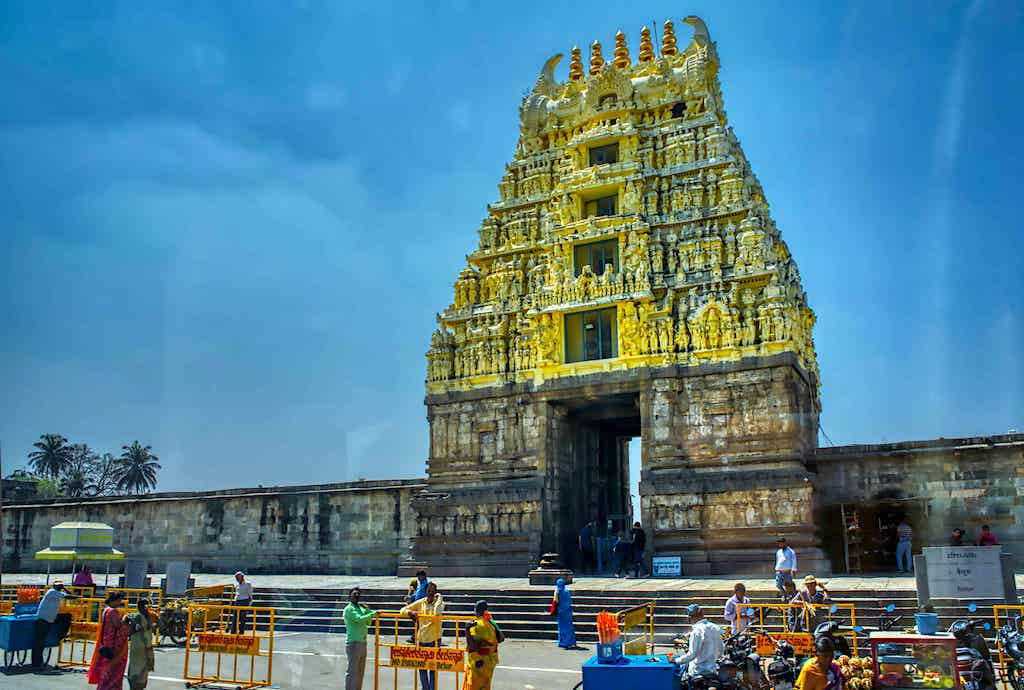
The Chennakeshava Temple, also referred to as Keshava, or Vijayanarayana Temple of Belur, is a 12th-century temple in Karnataka, India. It was commissioned by King Vishnuvardhana in 1117 CE (after a major military victory in 1116 CE over the Cholas in the great battle of Talakkad), on the banks of the Yagachi River in Belur, also called Velapura.
.
.
The city was so revered by the Hoysalas that it is referred to as “earthly Vaikuntha” (Vishnu’s abode) and “Dakshina Varanasi” (southern holy city) in later inscriptions. Belur was the first capital city of the Hoysalas.
The Hoysalas were great patrons of art. Without a doubt, the most remarkable achievement of this era lies in the field of architecture. The vibrant temple tradition that was flourishing in south India in those times sustained guilds of architects, sculptors and other artisans who worked as a unit. Temples were constructed by professional and specialized guilds. These guilds travelled from one kingdom to another and that is why knowledge of architecture and sculpture was easily transferred from one dynasty to another. The major innovation during the Hoysala era was the exquisite embellishing of the temple exteriors by extremely fine sculptures. The Hoysalas developed a new architectural tradition combining the elements of North Indian Nagara and South Indian Karnata style architecture, which art critic Adam Hardy called the Karnata Dravida tradition. The building material used in the Chennakesava temple is chloritic schist, more commonly known as soapstone. It is soft when quarried and allows artists to carve minute details. Over time the material hardens with exposure to the atmosphere.
.
.
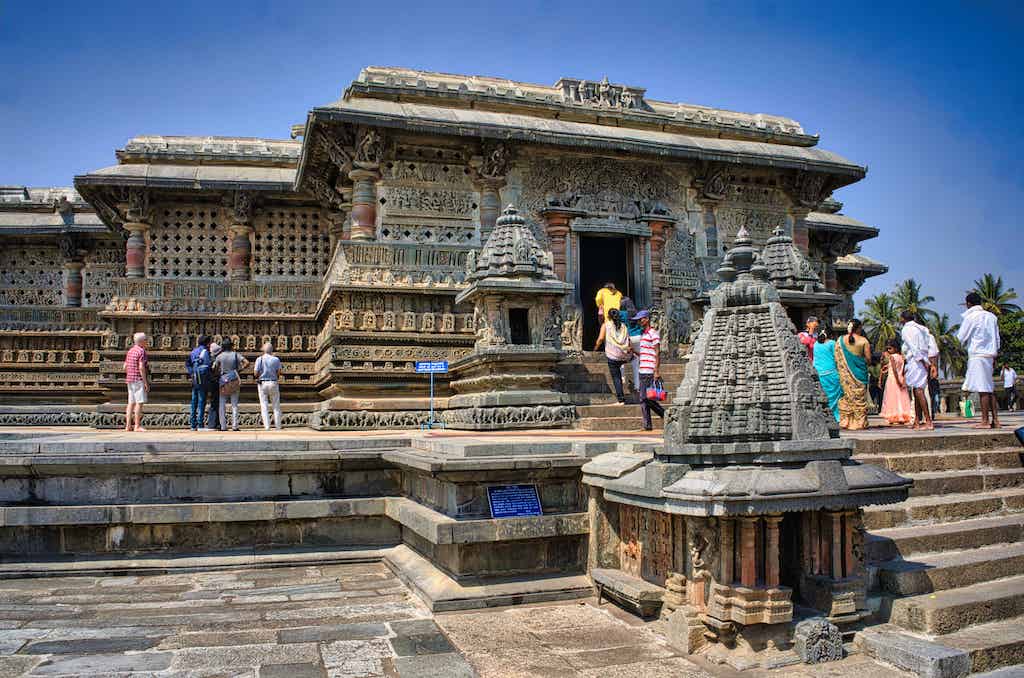
Chennakesava, or “handsome Kesav“, is one of the forms of Vishnu Bhagwan. The temple has been an active Hindu temple since its founding. It is reverentially described in medieval Hindu texts and remains an important pilgrimage site in Vaishnavism. Though it is a Vaishnava temple, it reverentially includes many themes from Shaivism and Shaktism, as well as images of a Jina from Jainism and the Buddha from Buddhism. The Chennakeshava temple is a testimony to the artistic, cultural and theological perspectives in 12th century South India and the Hoysala Empire rule, which was tolerant towards all beliefs.
.
.
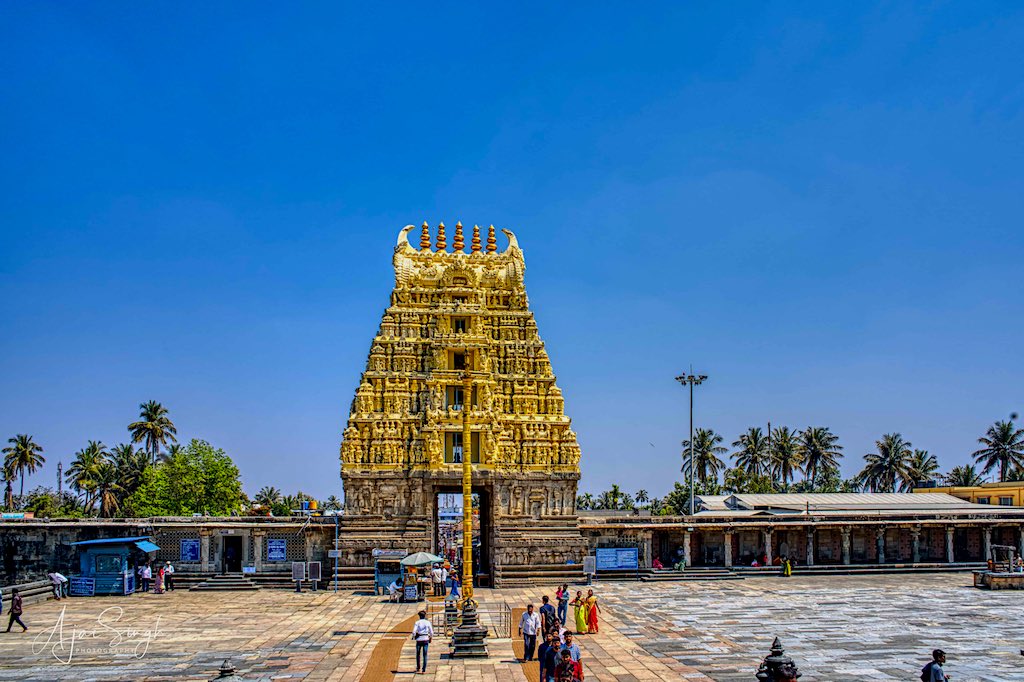
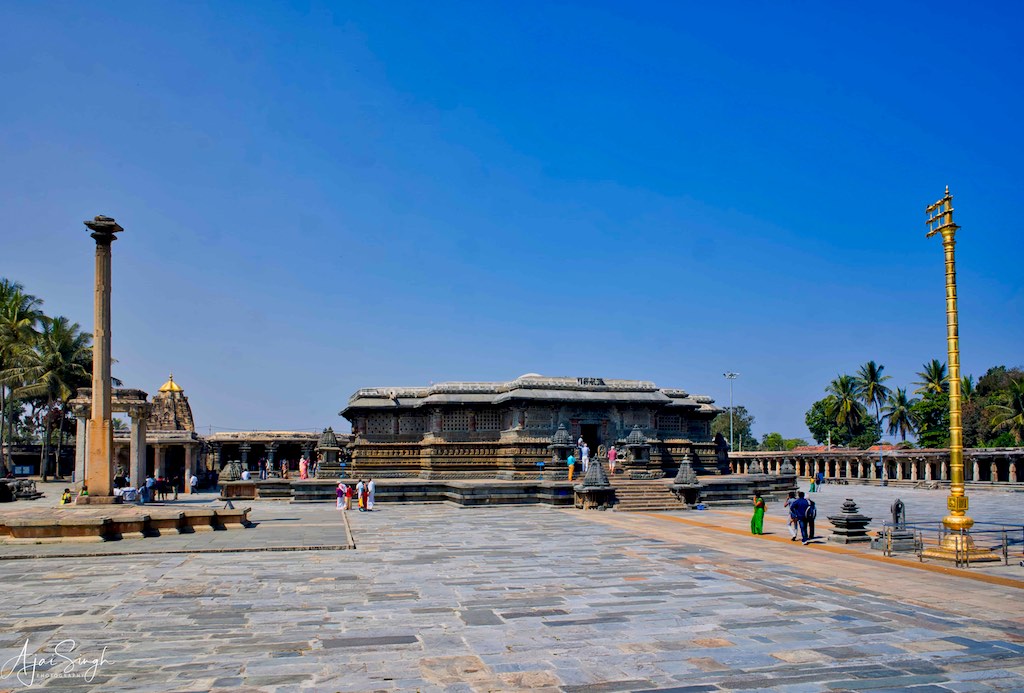
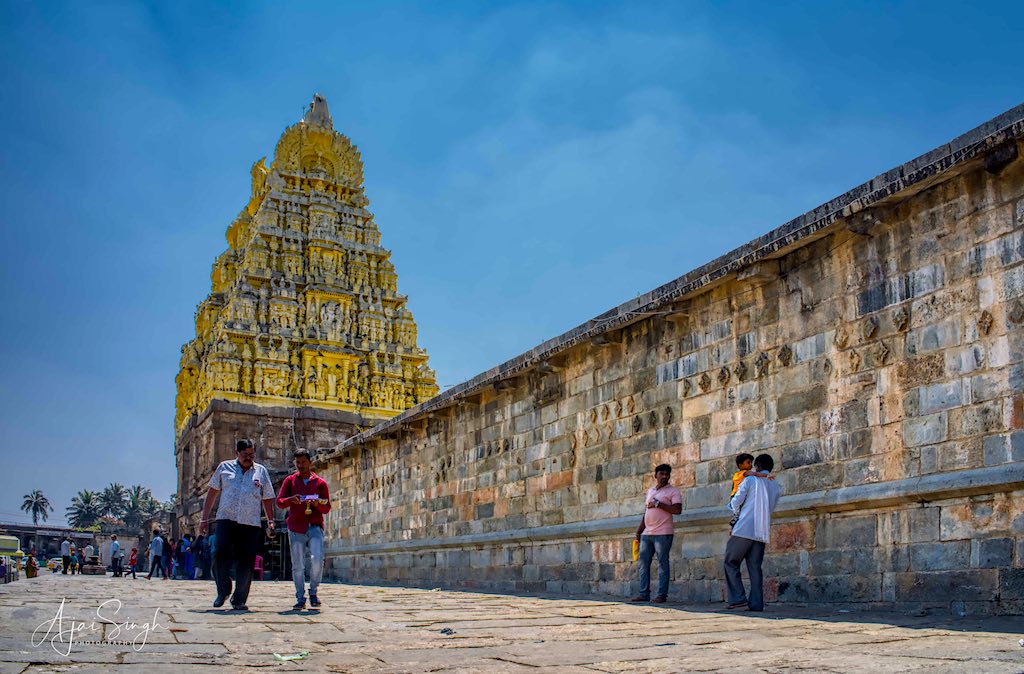
The temple complex consists of a 443.5 feet by 396 feet courtyard with several temples and minor shrines inside a walled compound. The entrance to the compound is from the east through a seven-storey Gopuram. The bottom part of the Gopuram is made of hard stone while the top is made of brick and mortar. It is richly decorated with figures of Gods and Goddesses. There are two structures on the topmost corners in the shape of cow’s horns, hence the name Go-puram and between the two horns are five golden kalashas or pots.
.
.
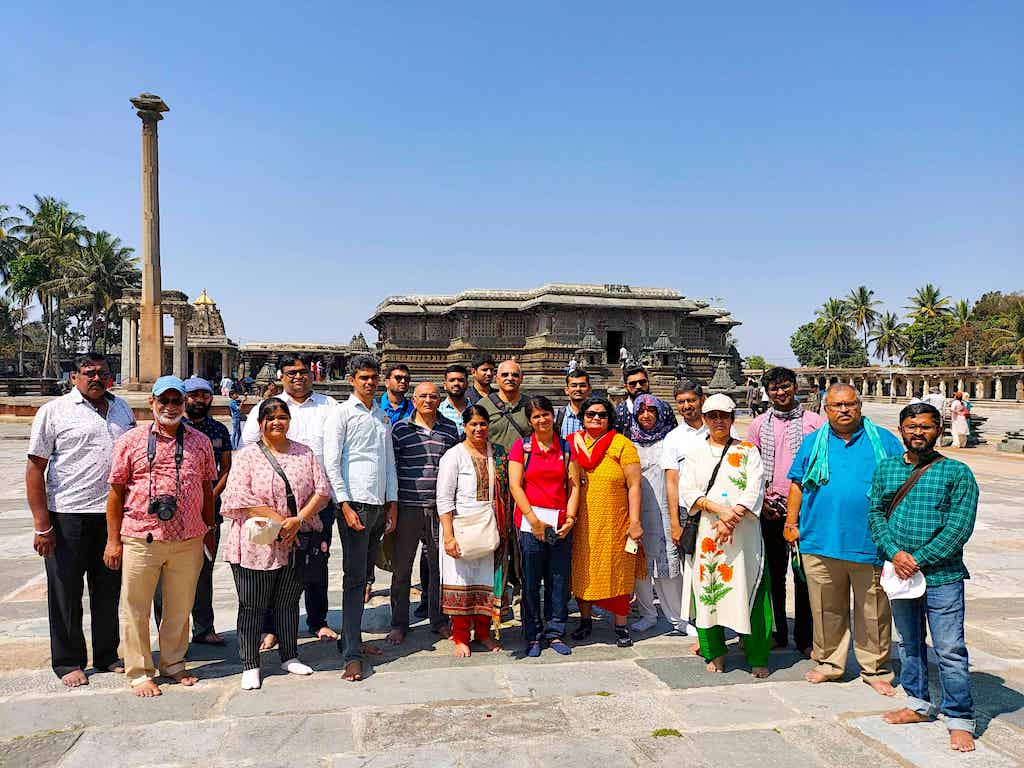
The temple complex was built at the centre of the old walled town and took over three generations – 103 years – to finish. It has been repeatedly damaged and plundered during wars, repeatedly rebuilt and repaired over its history. The Hoysala Empire and its capital was invaded, plundered and destroyed in the early 14th century by Malik Kafur, a commander of the Delhi Sultanate ruler Alauddin Khalji. Belur and Halebidu again became the target of plunder and destruction in 1326 CE by another Delhi Sultanate army.
.

.
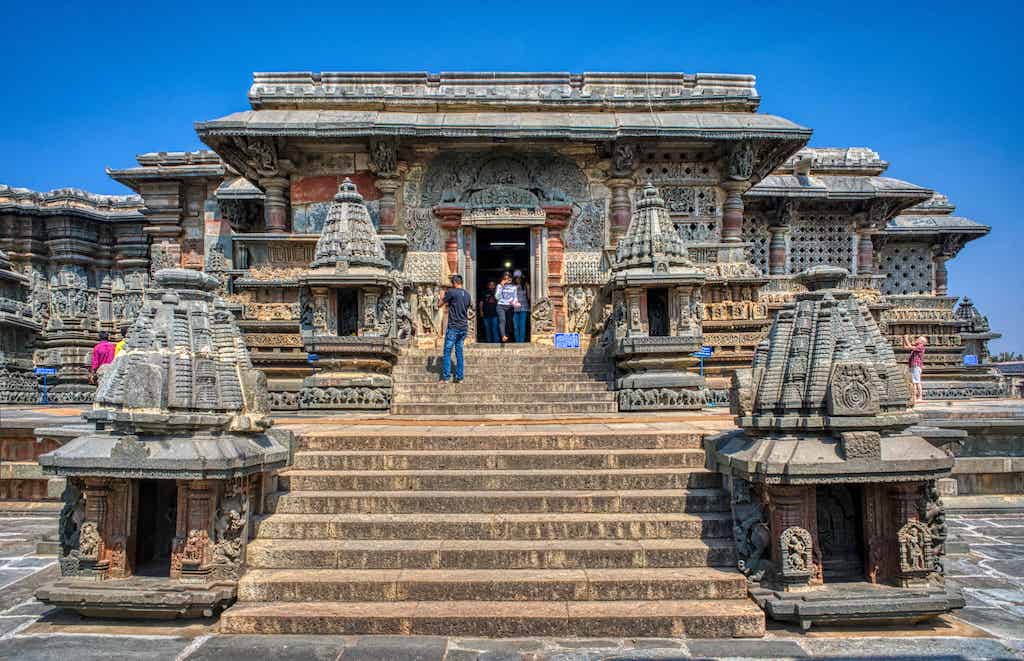
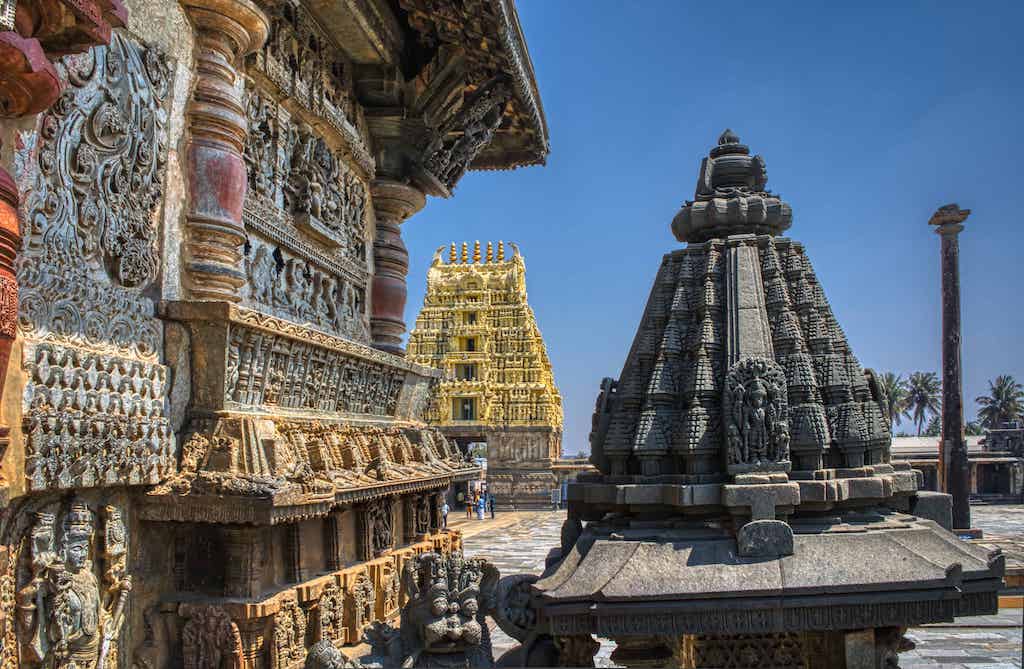
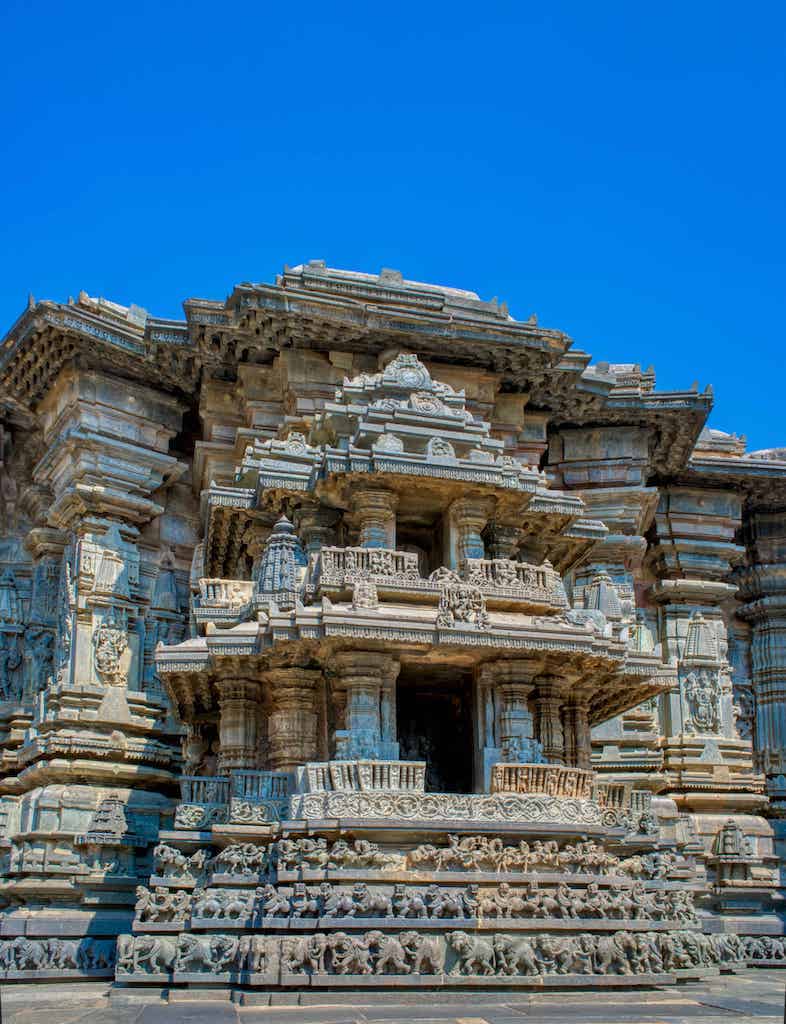
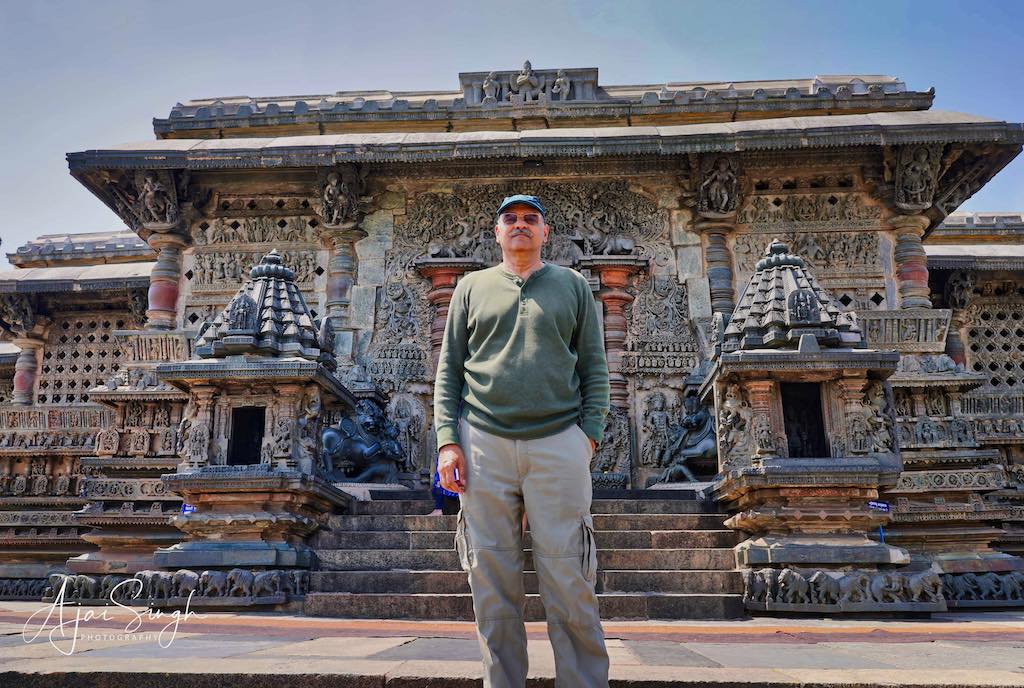
The temple is built on two levels. The first flight of steps is to the jagati, from where the next flight brings one to the level of the mandapa. The stairs from the courtyard are flanked on either side by miniature shrines. These shrines are supposed to be a scaled replica of the main shrine and are complete with dwarapalas with attached yalis (mythical creature with a lion head), and have beautifully carved murtis inside. The original missing shikhara of the temple is supposed to have been similar to those over these miniature temples.
.
.
The main temple had a shikara (superstructure tower) but it is now missing and the temple looks flat. The original vimana or shikhara (tower), suggest the inscriptions, was made of brick and mortar supported by woodwork that was plated with gold gilded copper sheets. It had to be dismantled during the early 19th century in order to save the damaged inner sanctum.
.
.
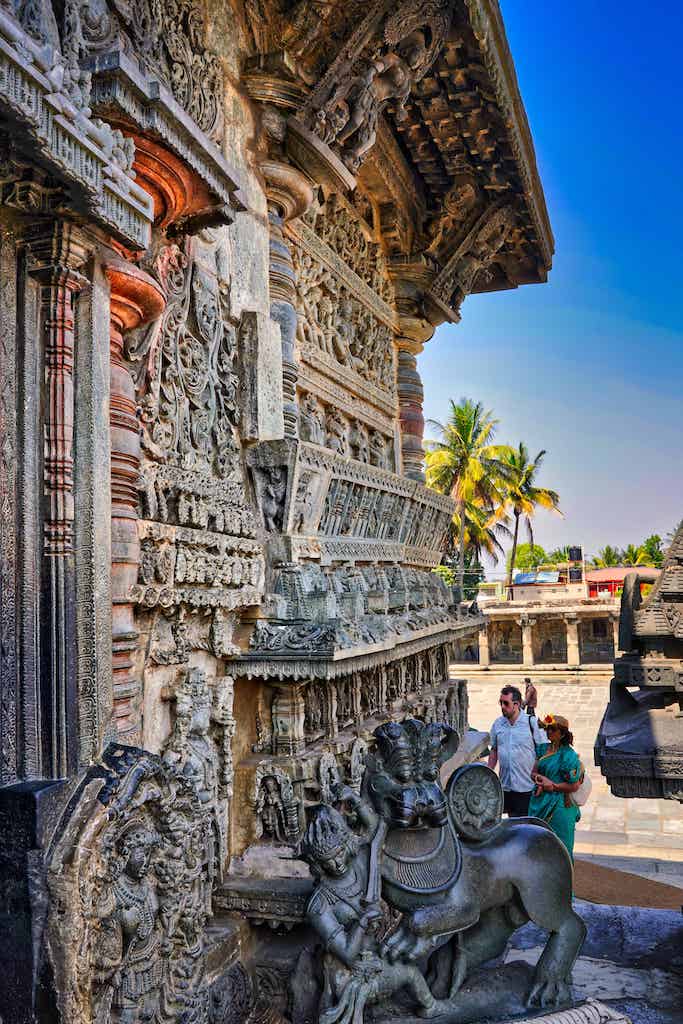
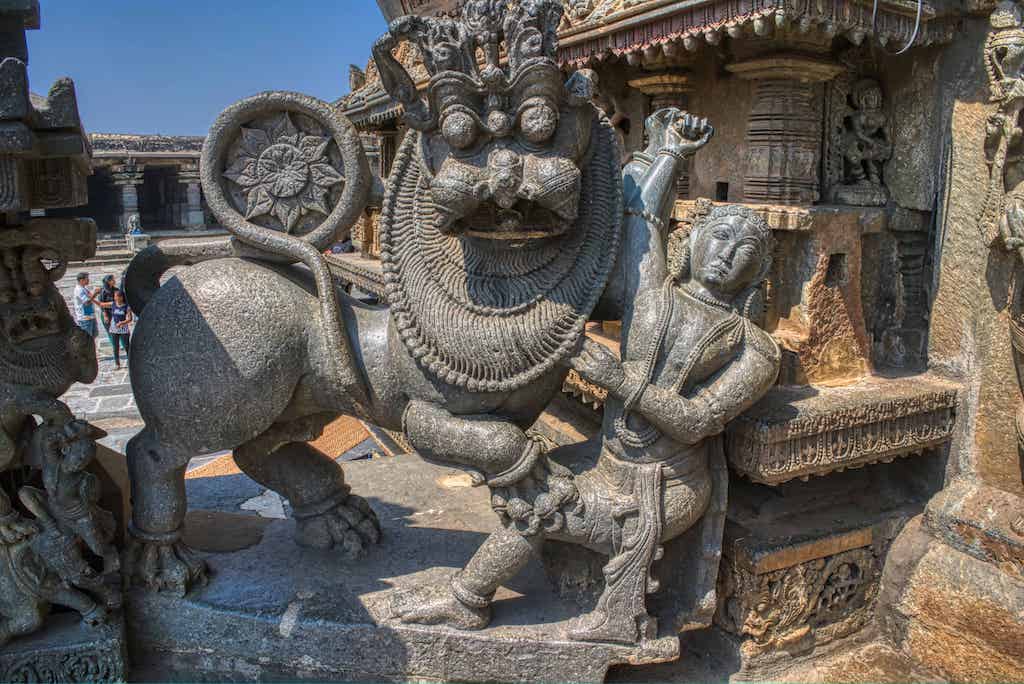
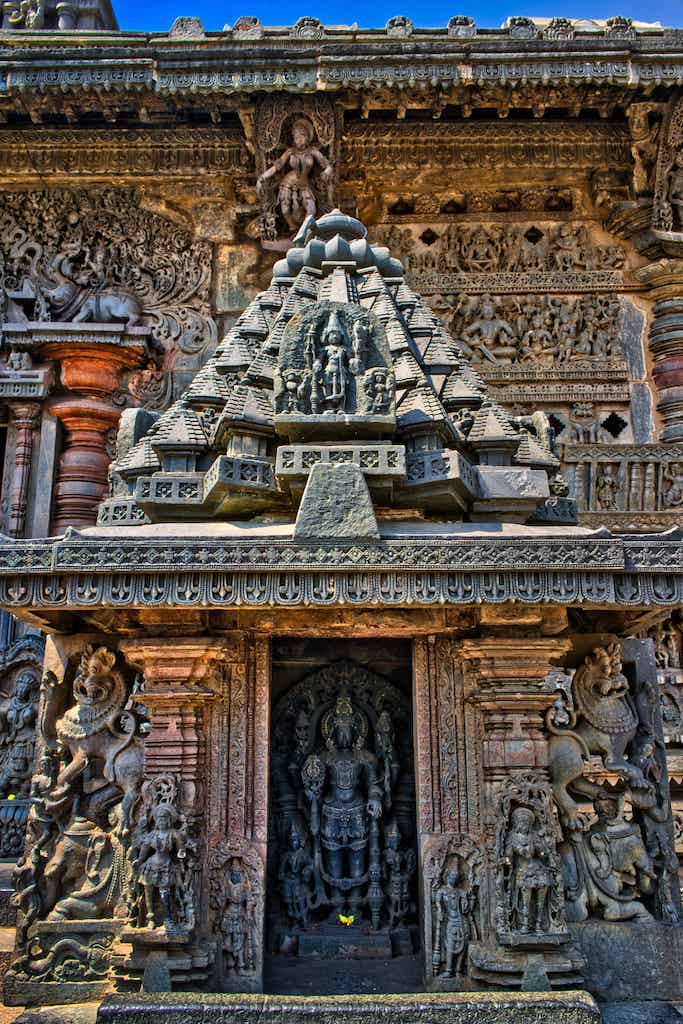
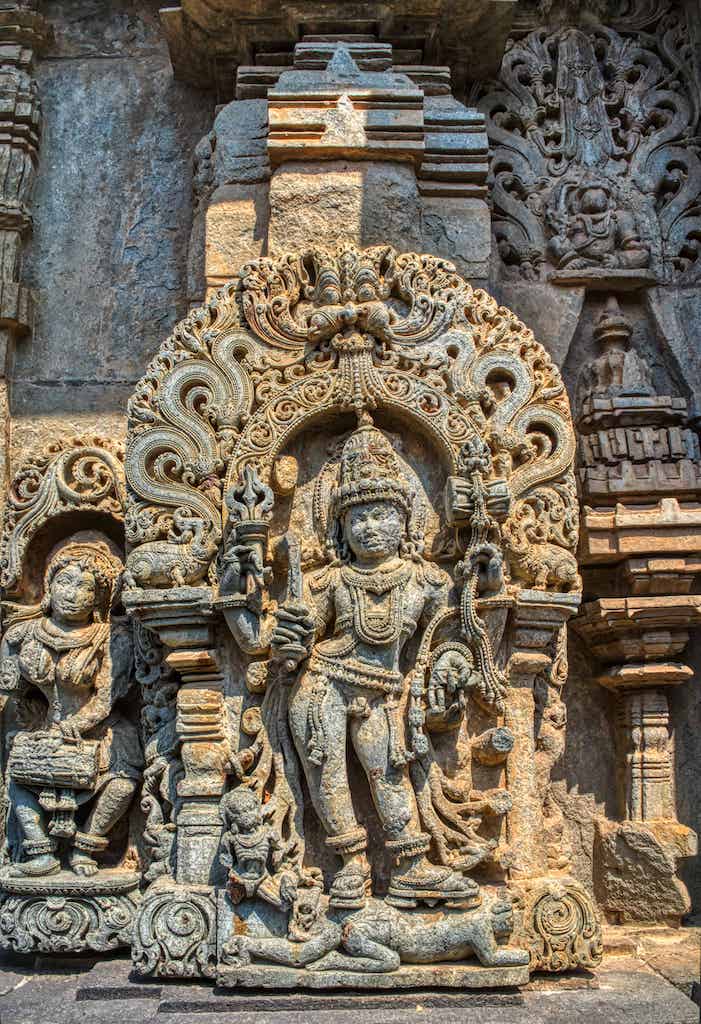
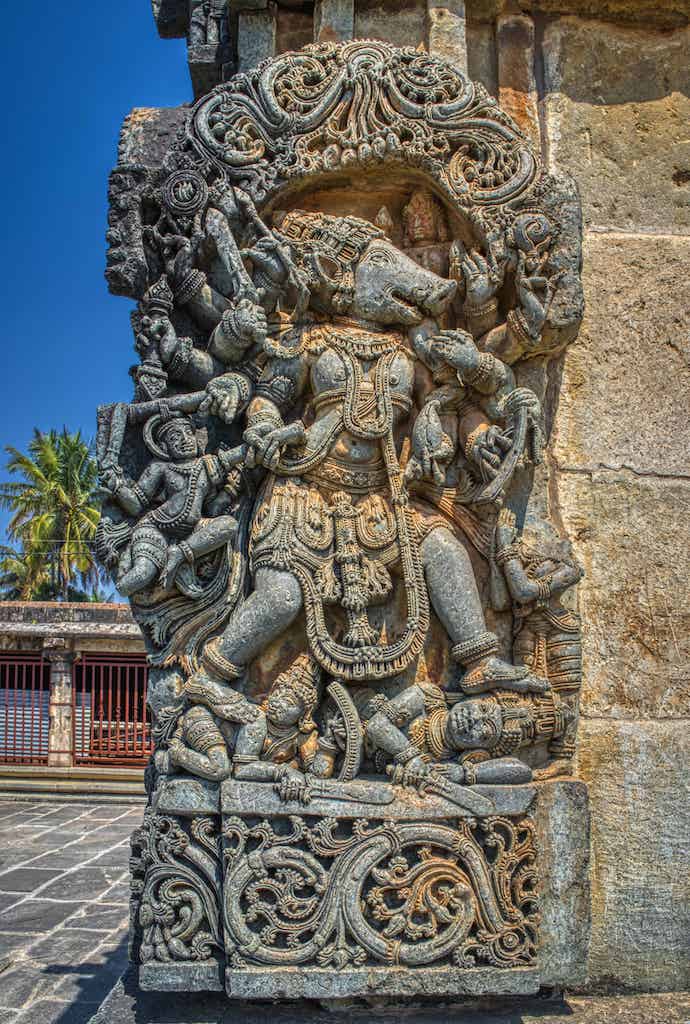
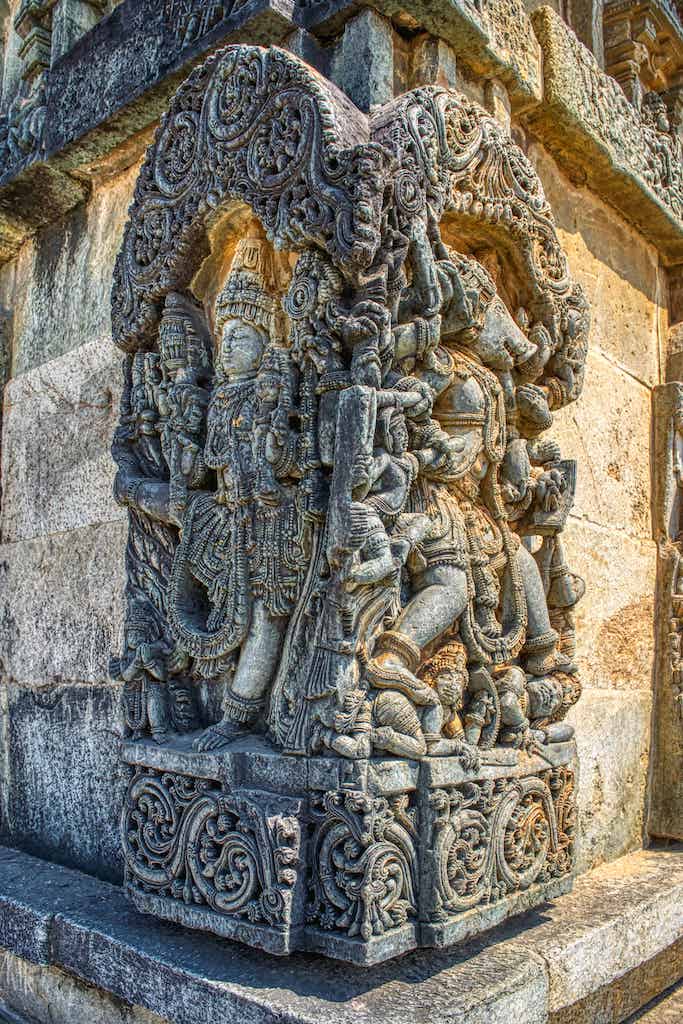
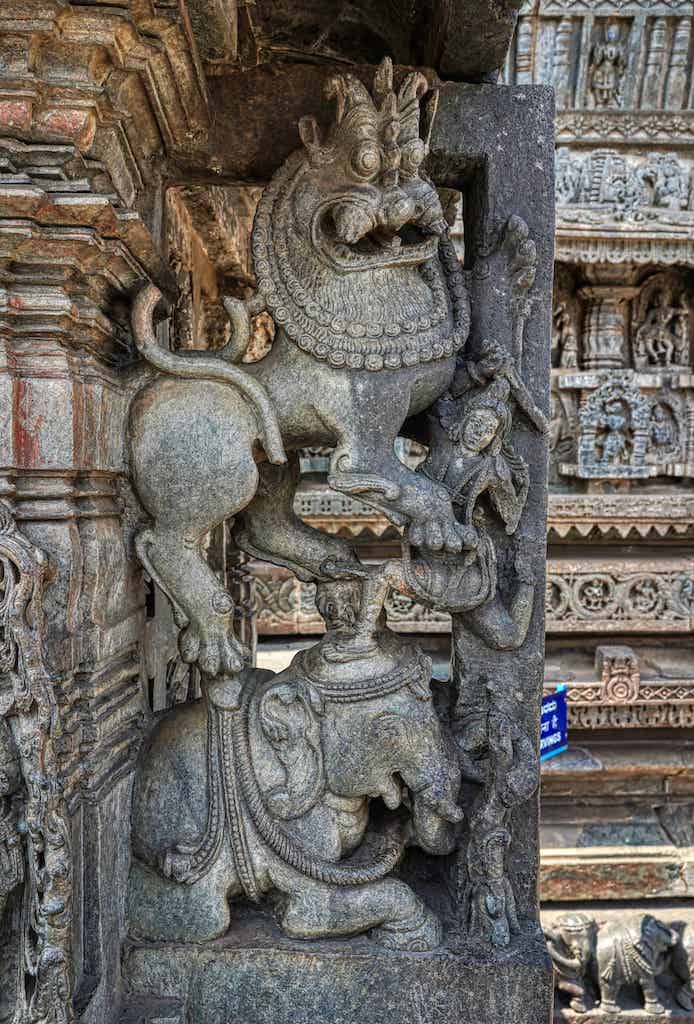
The temple has three entrances and their doorways have decorated sculptures of dvarapalaka (doorkeepers) on either side. On both sides of the entrance are two large sculptures of Sala killing the tiger, the state emblem of the Hoysalas. Kannada folklore tells a tale of a young man, Sala, who saved his Jain guru, Sudatta, by striking dead a lion or tiger he encountered near the temple of the goddess Vasantika at Angadi, now called Sosevuru. The word “strike” literally translates to “hoy” in Old Kannada, hence the name “Hoy-sala“. This legend first appeared in the Belur inscription of Vishnuvardhana (1117 CE). The legend may have come into existence or gained popularity after King Vishnuvardhana’s victory over the Cholas at Talakadu as the Hoysala emblem depicts the fight between the mythical warrior Sala and a tiger, the tiger being the emblem of the Cholas.
.
.
The legend is that a small local chieftain Sala slew a tiger and went on to establish the Hoysala dynasty. Though no trace survives to tell us about the heroic Sala who defeated the tiger, there are enough historical and archaeological records to support the fact that Sala did live in this hamlet which today is away from the tourist circuit. This is Angadi or Sosevur, the place where Sala slew the tiger. It is in the temple of a Goddess Vasanthika here that Sala killed the tiger while he was with his preceptor, a Jain ascetic called Yogendra Sudatta.
.
.
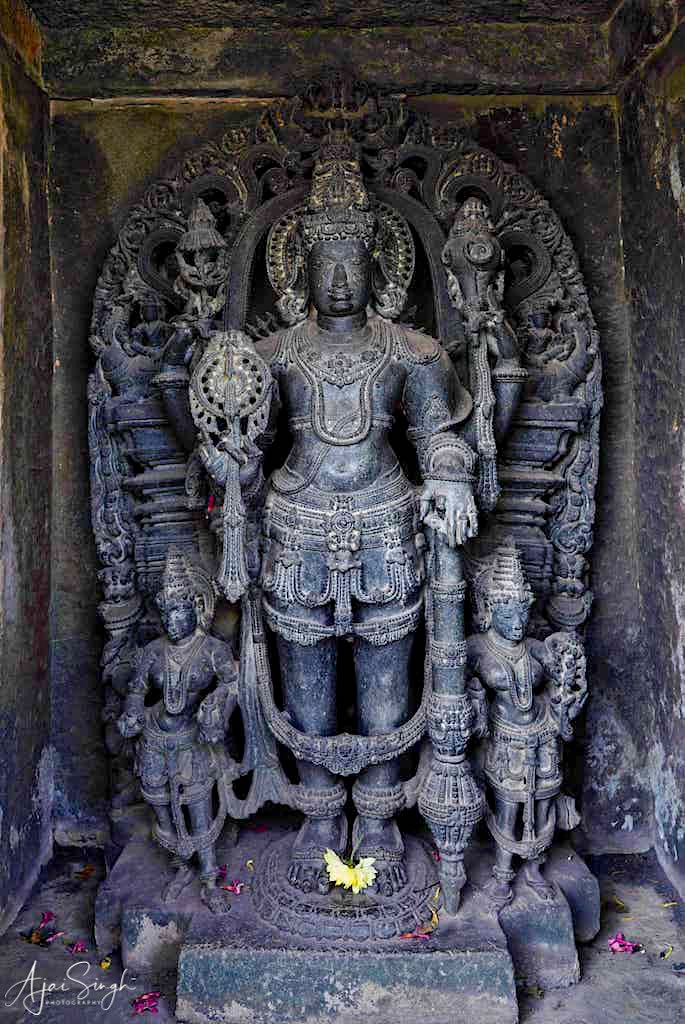
There are two small shrines on each side of the emblem dedicated to Lord Vishnu.
.
.
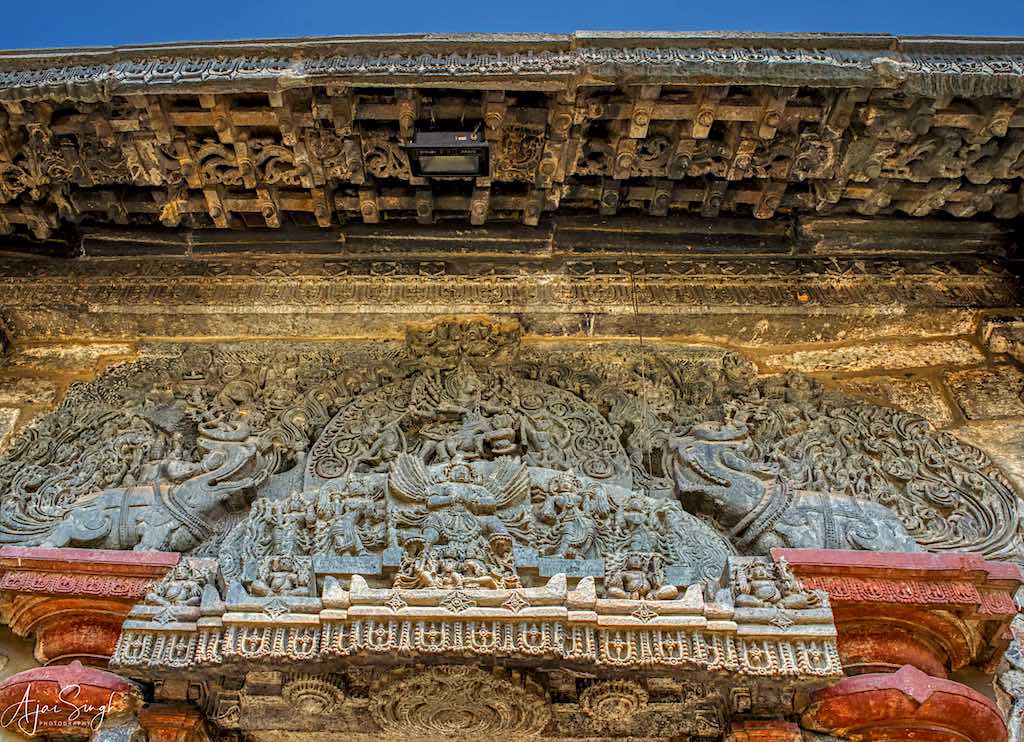
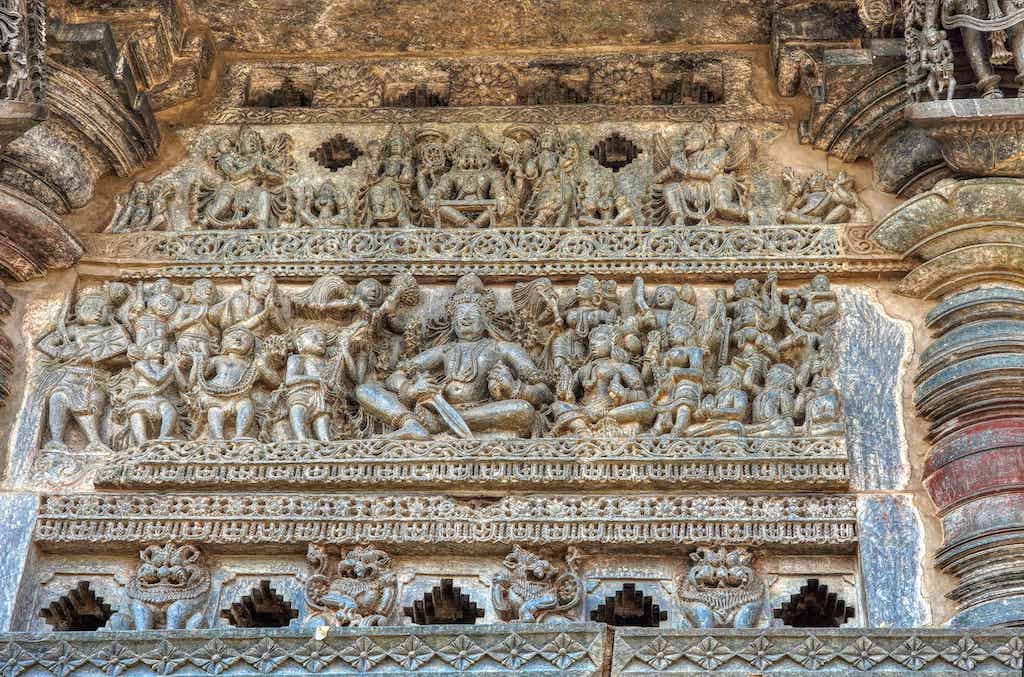
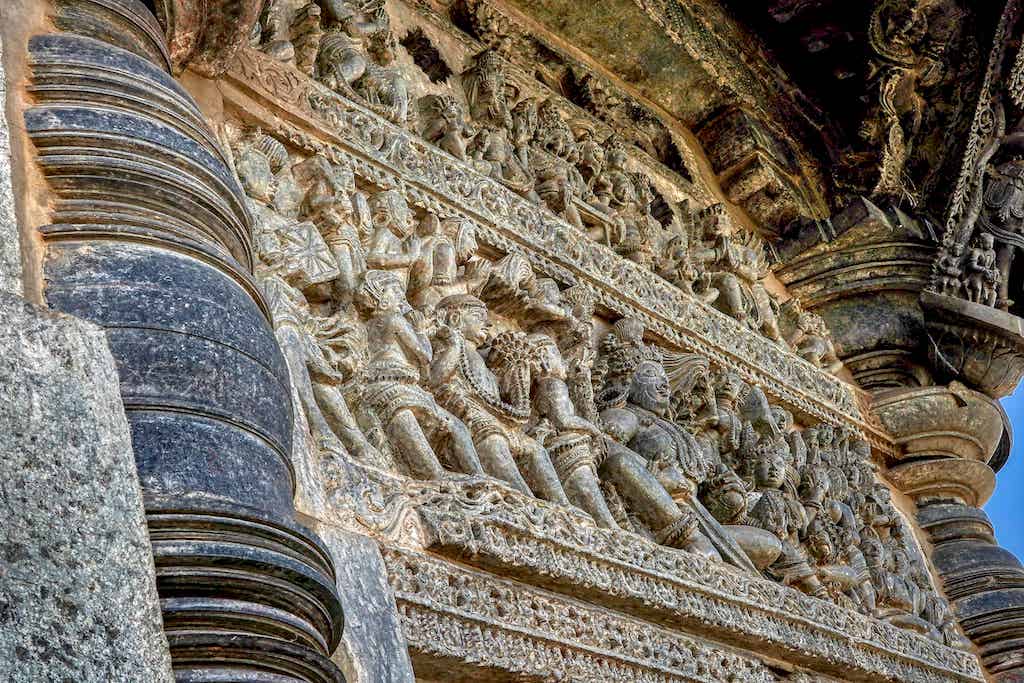
The entrance on the east is decorated with Makara Torana. The overhead panel on the main door depicts the ten avatars or forms of Lord Vishnu. On the walls on each side of the east gate are carvings of court scenes of King Vishnuvardhan on the left and his grandson Veer Ballala, on the right.
.
.
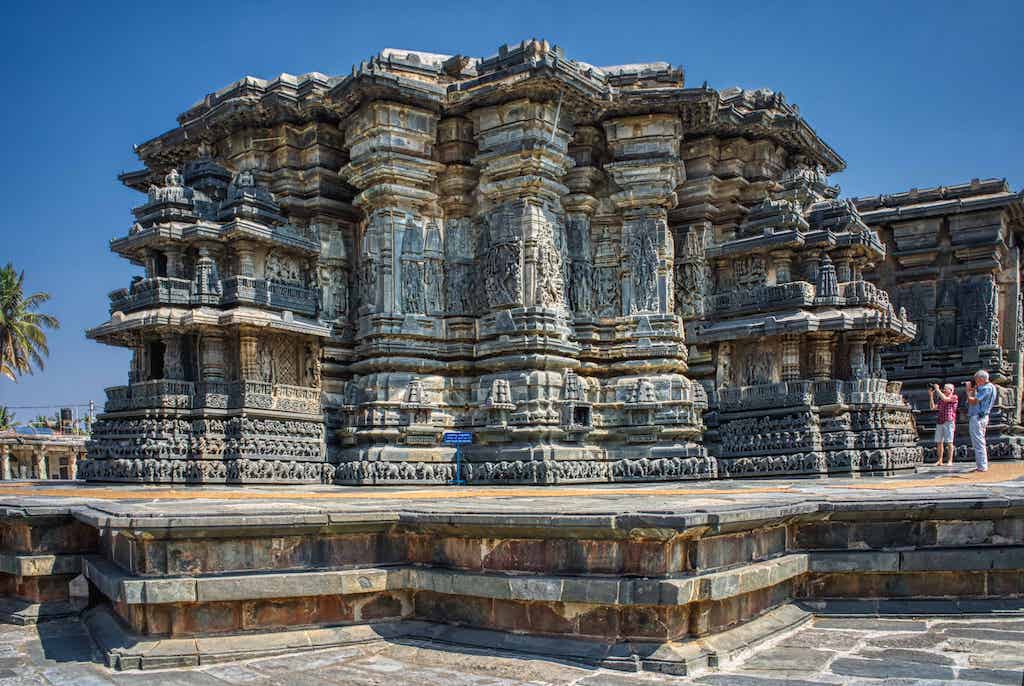
The temple is an ekakuta (with one shrine) and the garbha griha houses a murti of Krishna (Chenna means beautiful, and Kesava is another name of Vishnu). It stands on a wide platform (jagati) designed to be a parikrama (circumambulatory) path around the sanctum, typical of Hoysala shrines. The jagati follows the star-shaped outline of the shrine.
.
.
The temple and platform were initially without walls and the platform surrounded an open mantapa, following the contour of the temple. A visitor would have been able to see the ornate pillars of the open mantapa from the platform.
.
.
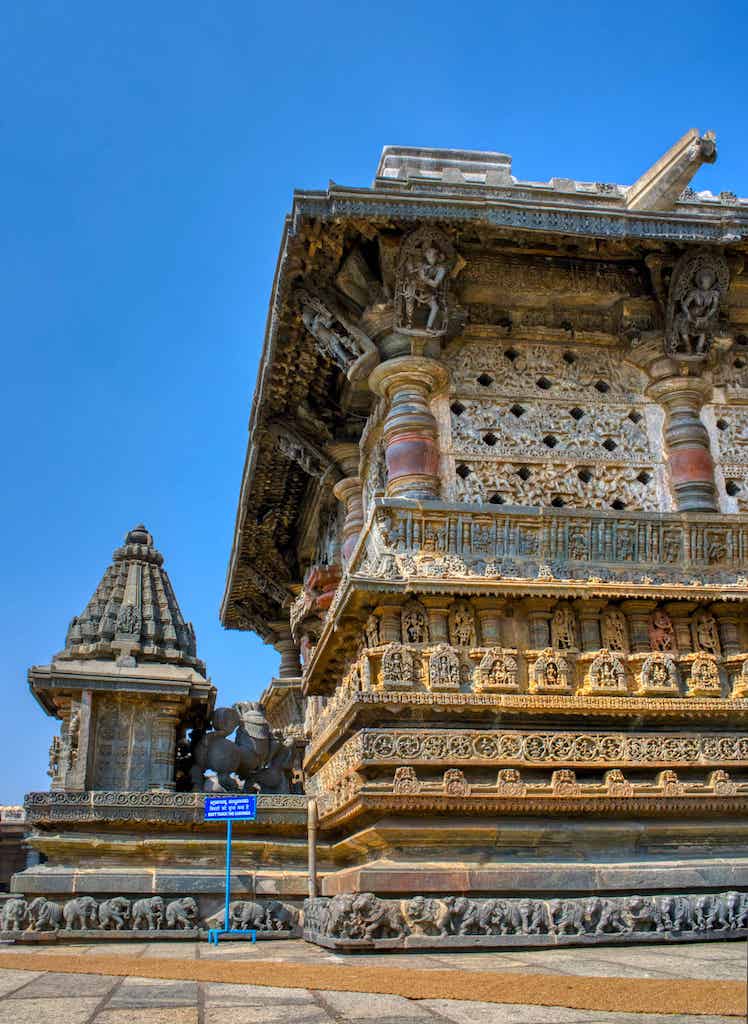
Later walls and stone screens were added, creating an enclosed vestibule and mantapa, providing security but also darkening the interiors, making it difficult to appreciate the artwork inside.
.
.
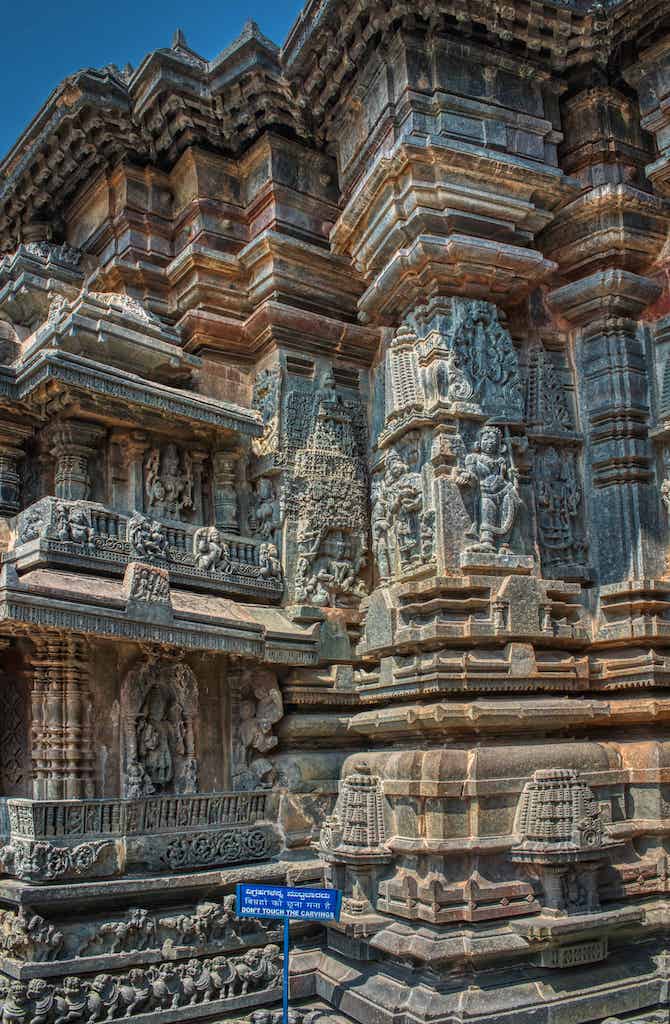
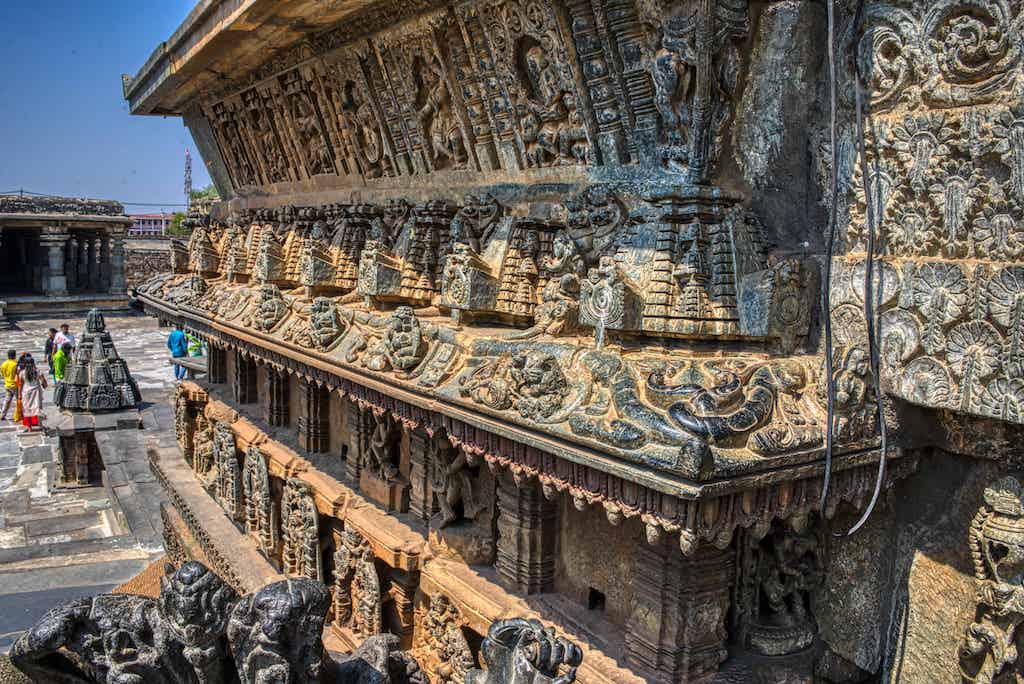
The richly sculptured exterior of the temple includes sculptures and iconography and horizontal friezes covering the entire external walls. The temple is remarkable for its architecture, sculptures, reliefs, friezes as well its iconography, inscriptions and history. The temple artwork depicts scenes of secular life in the 12th century, dancers and musicians, as well as a pictorial narration of texts such as the Ramayana, the Mahabharata and the Puranas through numerous friezes. There are supposed to be nearly 4000 carvings in the temple.
.
.
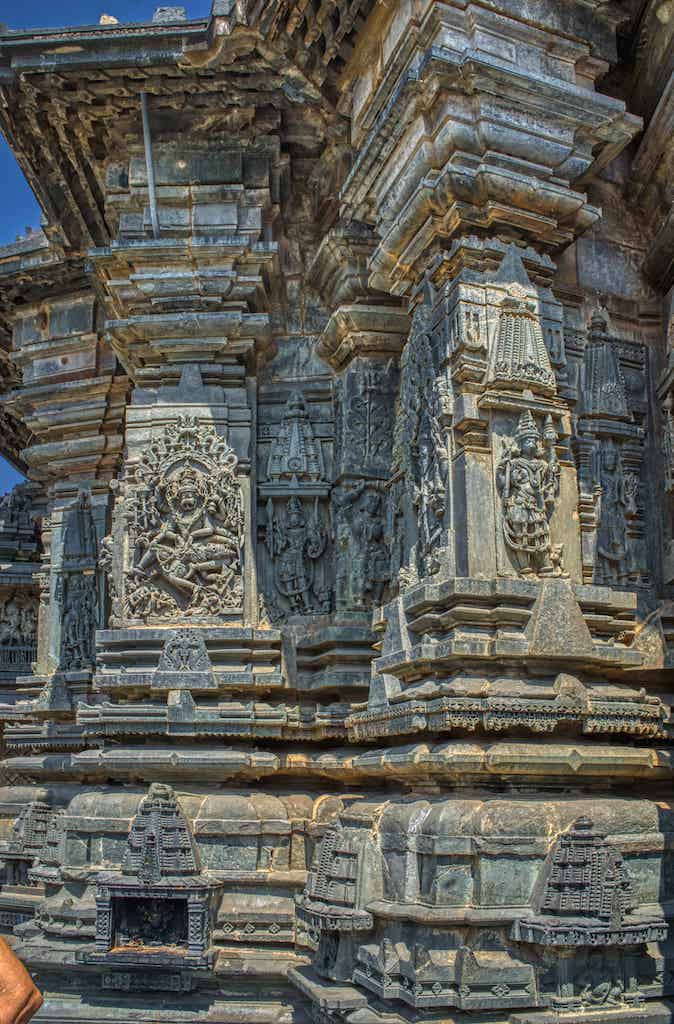
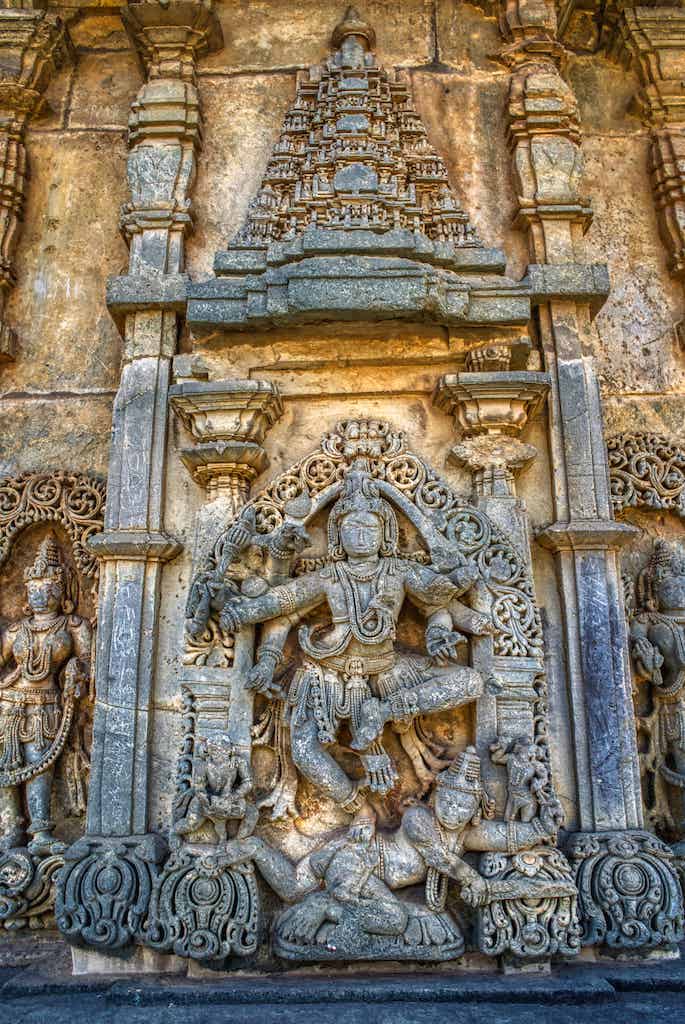
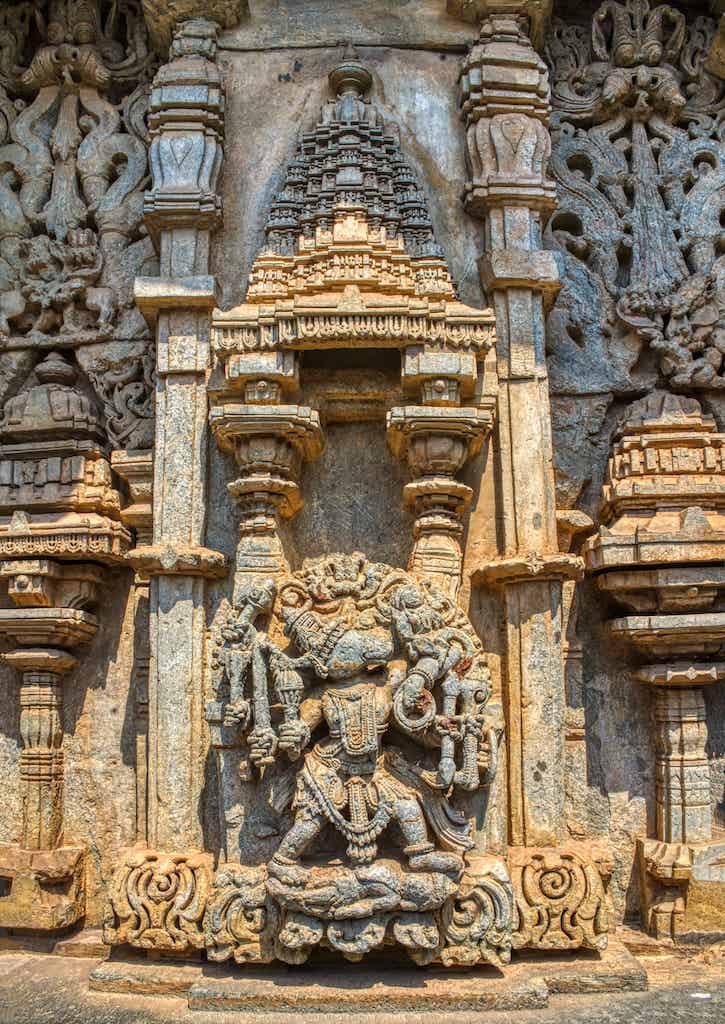
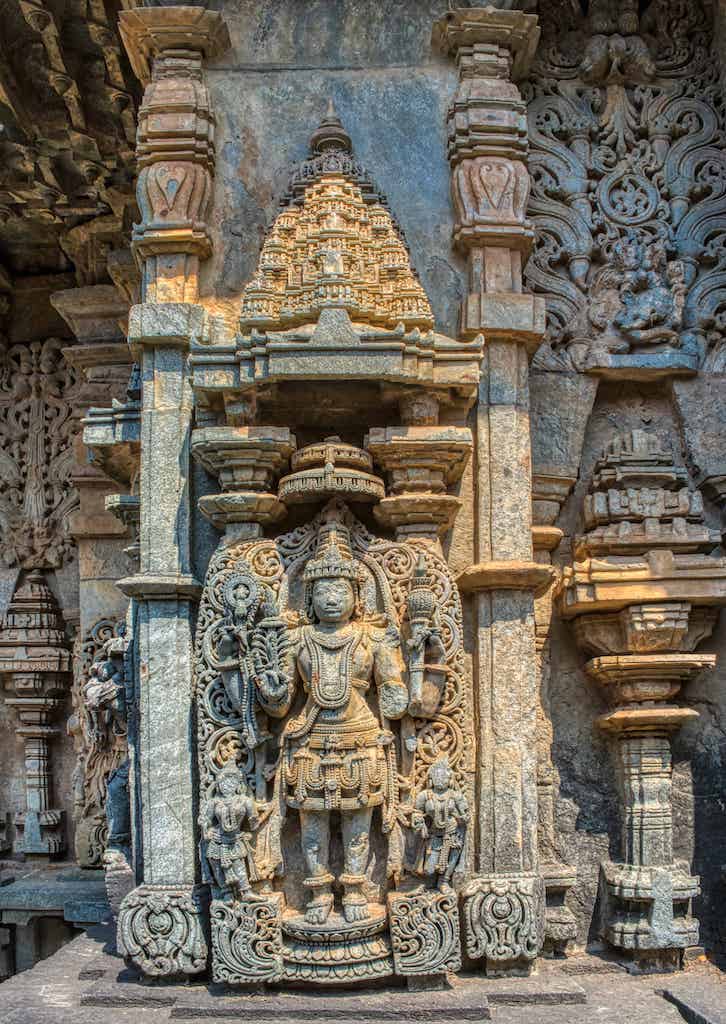
The external walls feature 80 large reliefs around the temple.
.
.
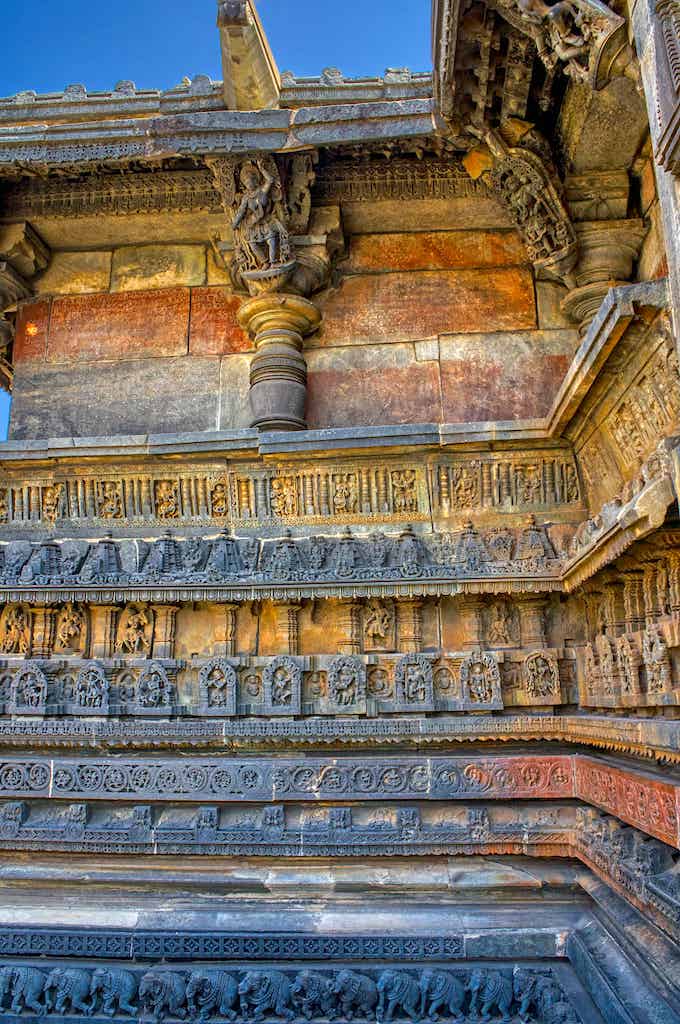
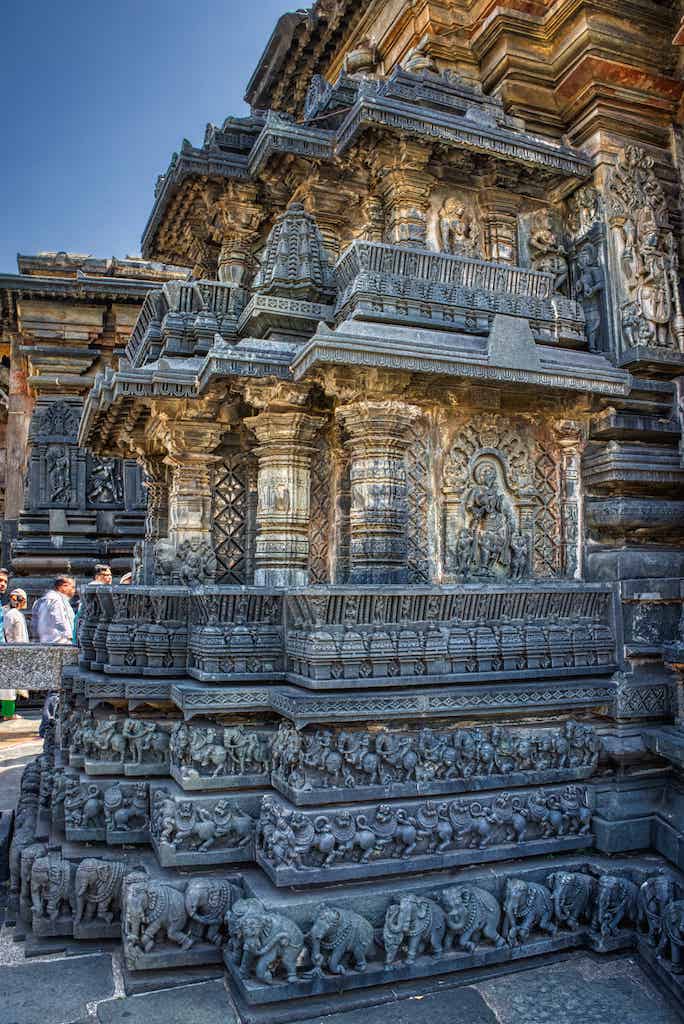
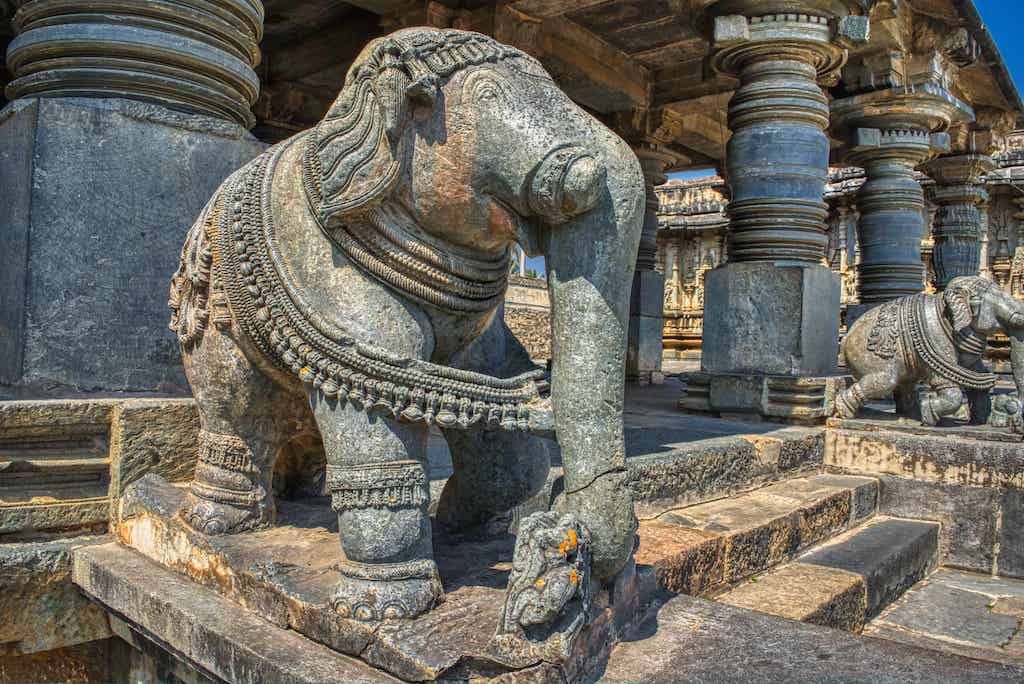
The artwork can be seen during the parikrama and comprises of horizontal bands of sculptures from the bottom. The lowermost band consists of about 650 elephants, each with a unique expression; they represent stability and strength symbolically supporting the entire structure above.
.
.
Above this is an empty layer, followed by cornice work with a periodic yali (lion face) which symbolizes courage. Above it is another band of scroll and then the cornice band, except at the back of the temple where a row of horsemen in various riding positions are depicted, symbolising speed.
.
.
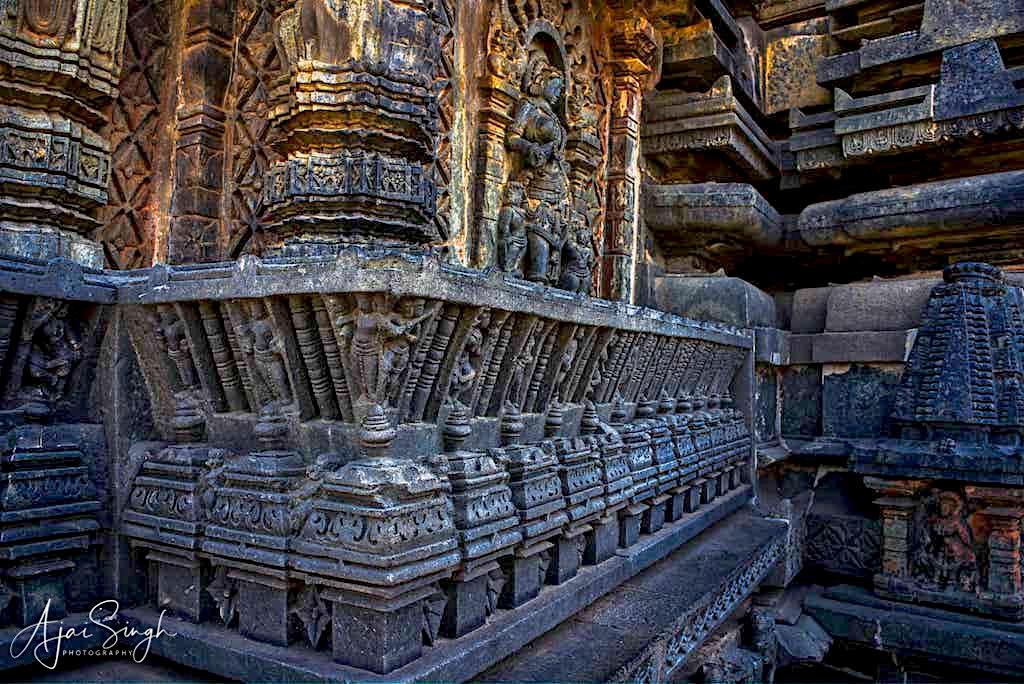
The fifth carved band is of small figurines, mostly females with various expressions facing the viewer, while periodically the band includes Yakshas who face towards the inside of the temple. This layer also has numerous dancers and musicians, as well as professionals with their tools. The band above has pilasters between some of which are carved secular figures mostly females and couples.
.

.
A nature and creepers band wraps the temple above the pilaster band, with scenes of the Ramayana epic included in this band. Above this layer are scenes from common life depicting kama, artha and dharma. Included here are couples in courtship and eroticism, followed by couples with children, economic and festive activities.
.
.
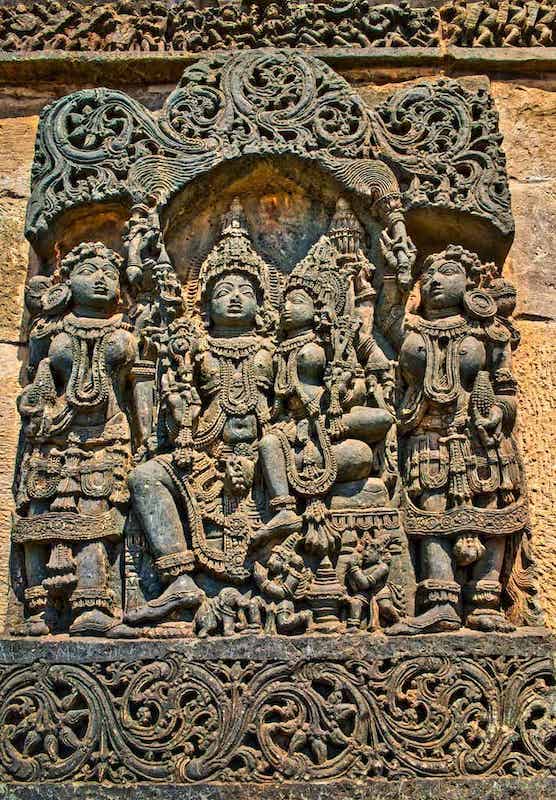
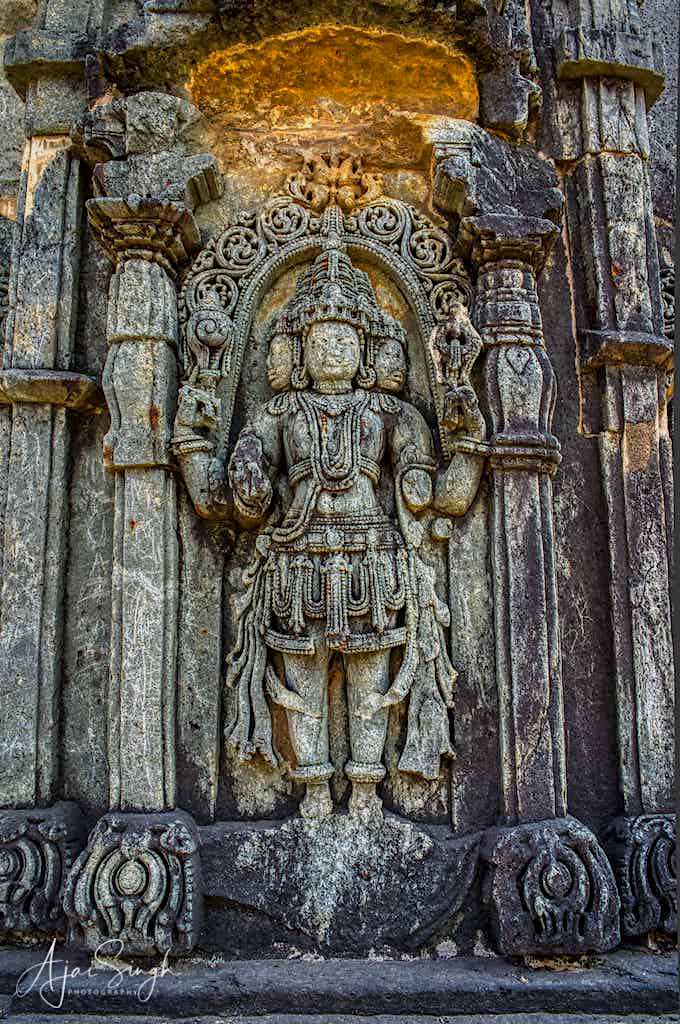
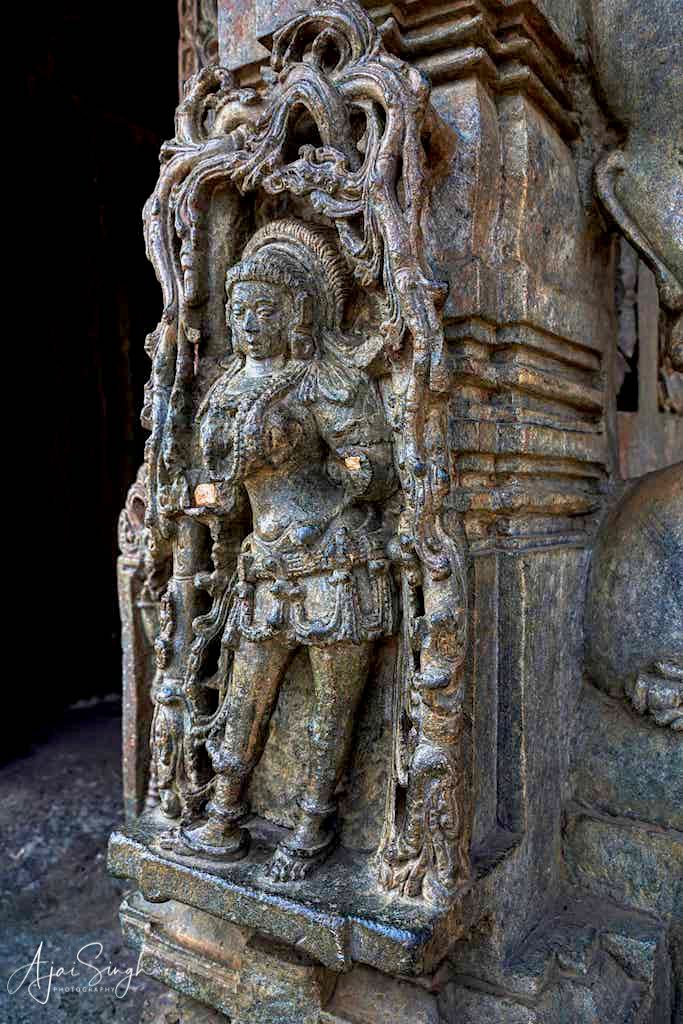
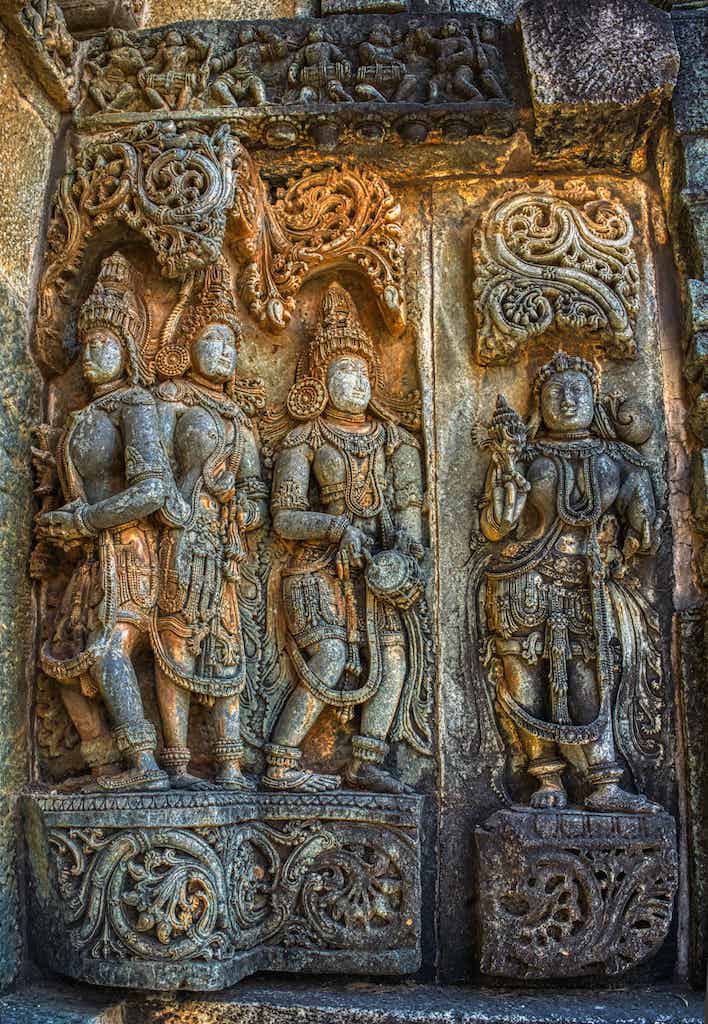
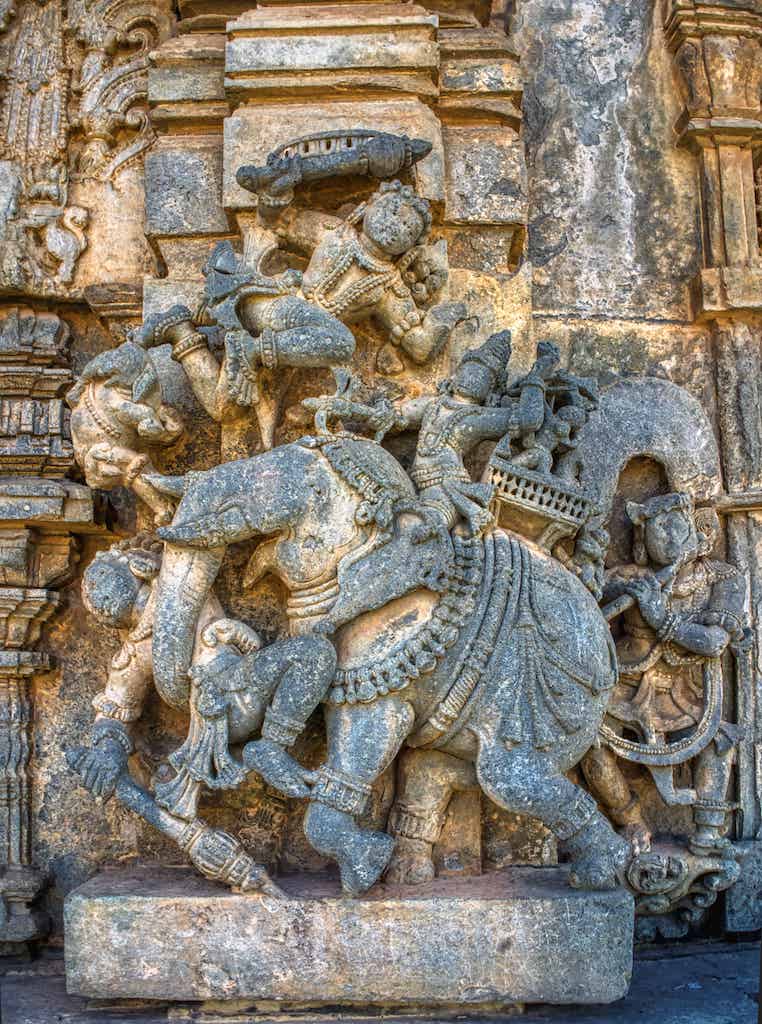
Above these bands is a later construction that added 10 jalandharas (perforated stone screens) to the north side and 10 to the south side of the temple. Artists engraved Puranic scenes in ten of these later additions, and the other ten have geometric floral designs.
.
.
The later artists engraved Purana scenes in ten of these later additions, and the other ten have geometric floral designs.
.
.
A large number of sculptures are in the form of miniature temples, sculpted along the external walls showing various scenes from the Puranas.
.
.
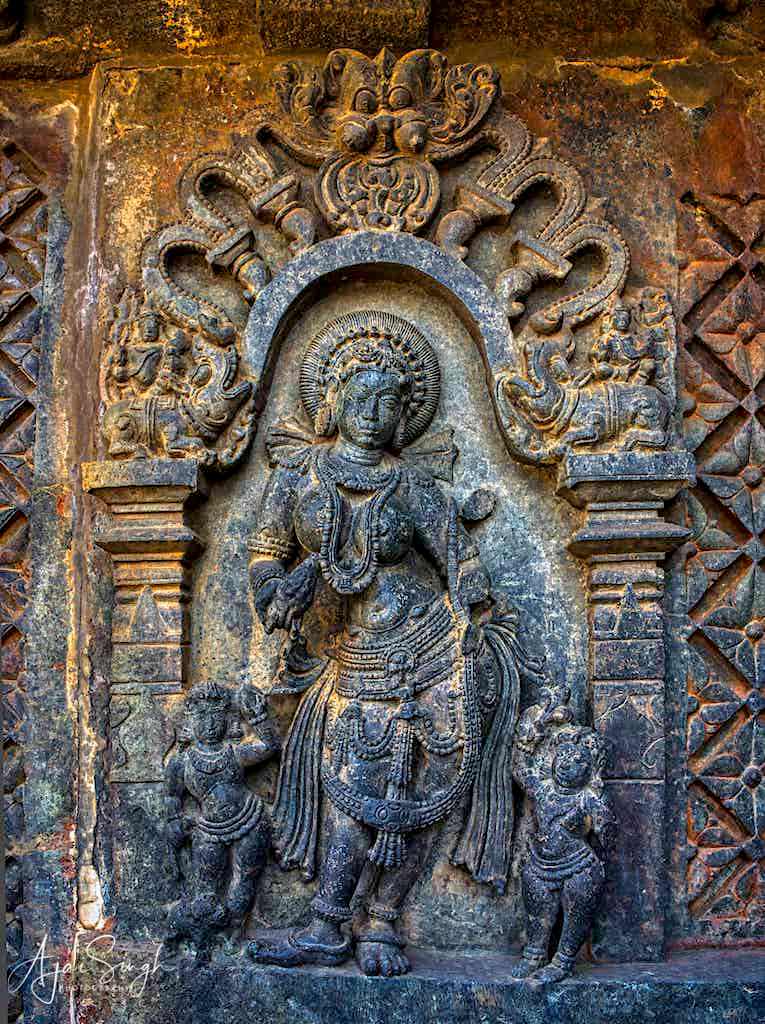
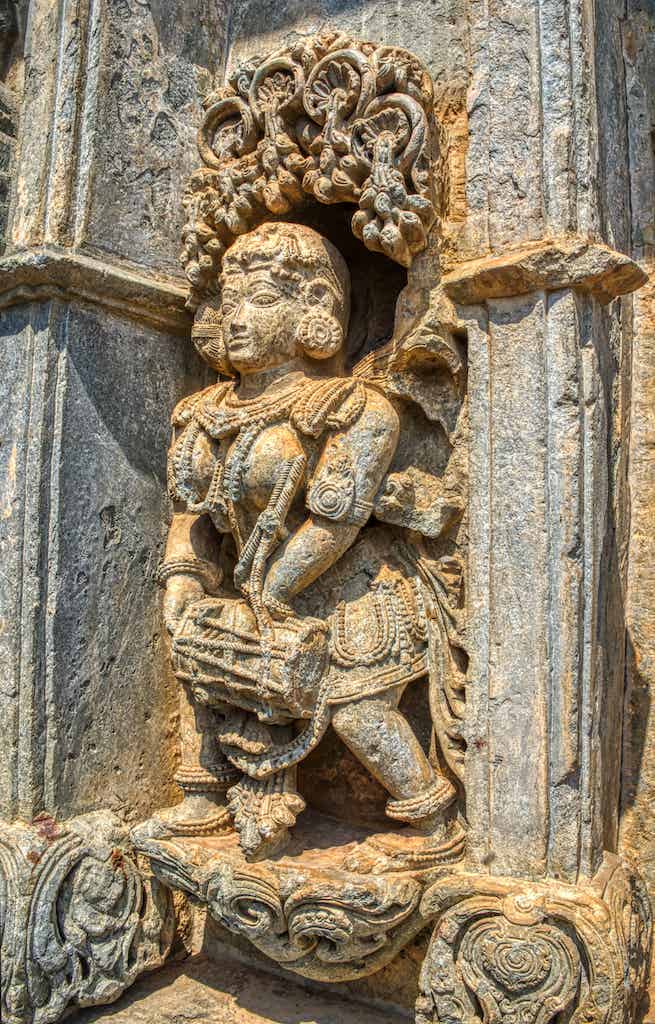
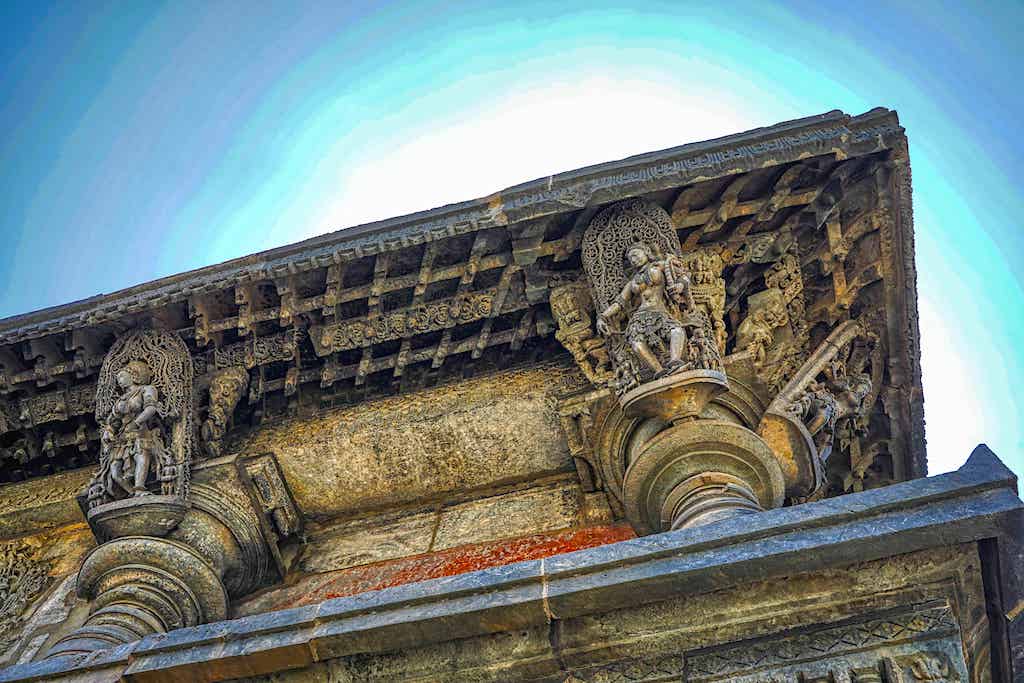
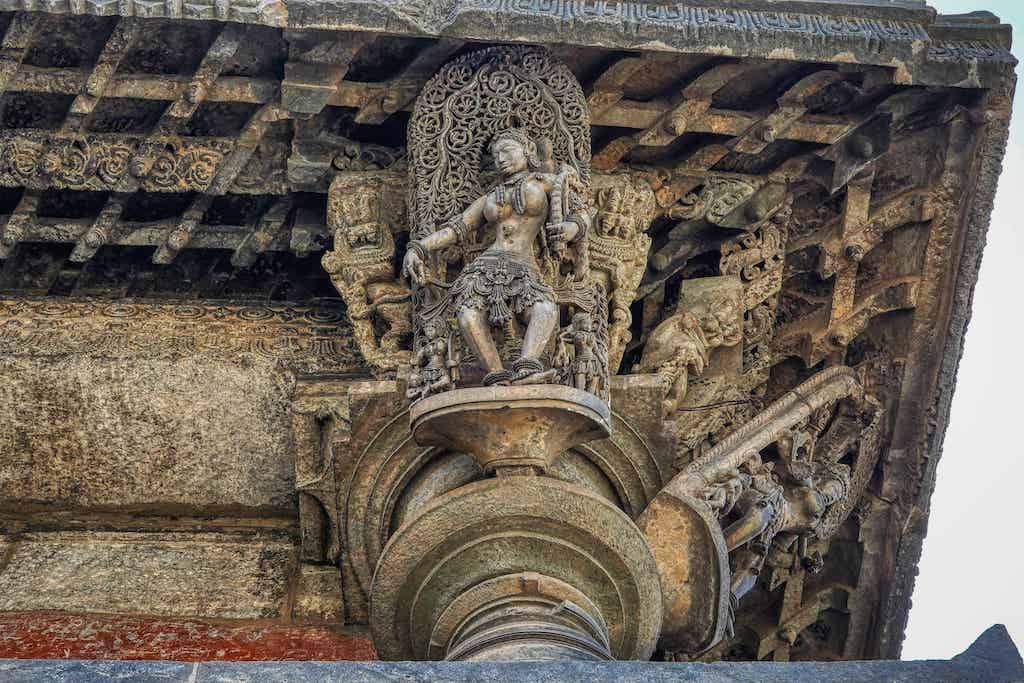
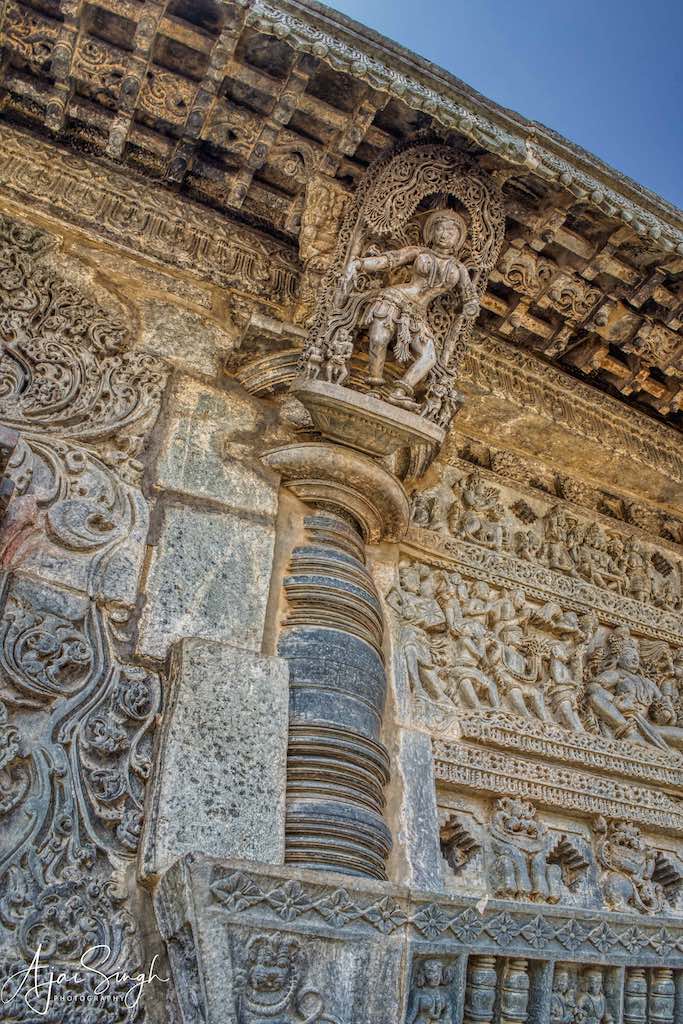
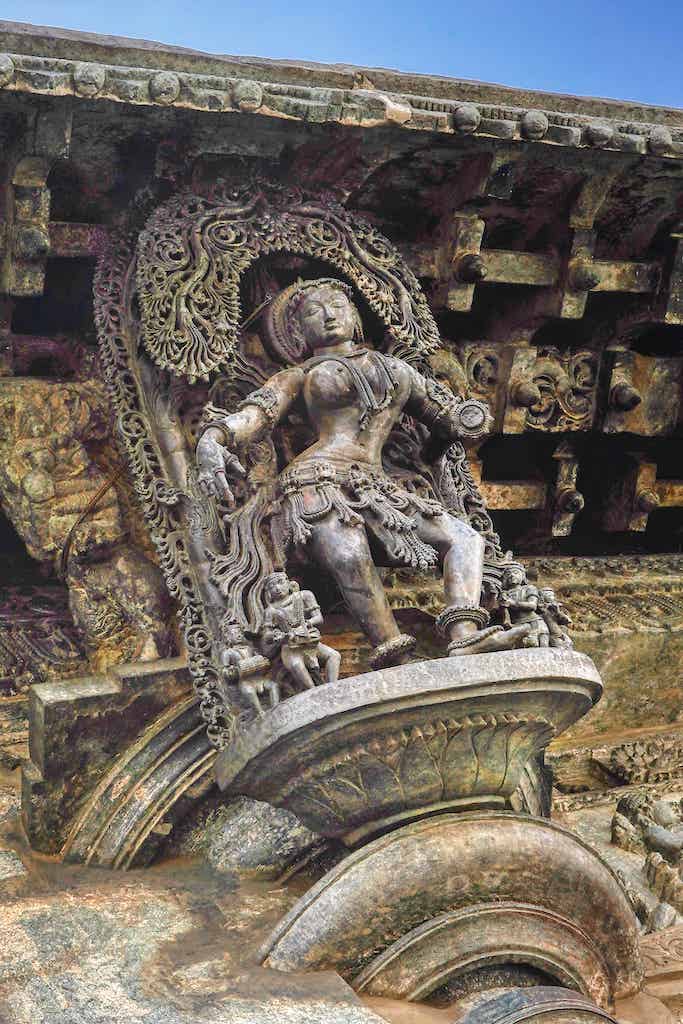
Above the perforated screens, on capitals of the supporting pillars, are madanika (Salabhanjika) figures. There were originally 40 madanika, of which 38 have survived in damaged or good form.
.
.
Two of these are Durga, three huntresses (with a bow), others are dancers in Natya Shastra abhinaya mudra (acting posture), musicians, women dressing or doing makeup, a woman with a pet parrot, men making music.
.
.
A majority of these madanika figures are also carved into miniatures in the sixth band of the outer wall around the pradakshina patha.
.
.
These bracketed figurines were inspired by Queen Shantala Devi and epitomise the ideal feminine form. They are one of the best creations of the Hoysala artists, being finely proportioned, exceedingly ornamented and depicted in exceptional detail. For example, one madanika figure is shown with a fruit tree canopy, where a small fly is shown sitting on the fruit and nearby a lizard is preparing to pounce on the fly.
.

.
In another, an eagle is shown attacking a sarabha, which in turn is attacking a lion, which in turn is pouncing on an elephant, which itself is seizing a snake, which in turn is shown in the act of swallowing a rat – a sight that includes a pondering sage.
.
.
The walls of the Navranga mandapa (central hall) depicts the social fabric – the Jivatma, whereas the walls of the garbha griha depicts the spiritual life with tales from the Puranas – the Paramatma. With the addition of the perforated screens, it is difficult to appreciate the artwork inside the Navaranga in the darkness. The artwork starts right from the three entrances to the hall. The hall has carved pillars with a large domed ceiling in the centre. The mandapa has 60 “bays” (compartments).
.

.
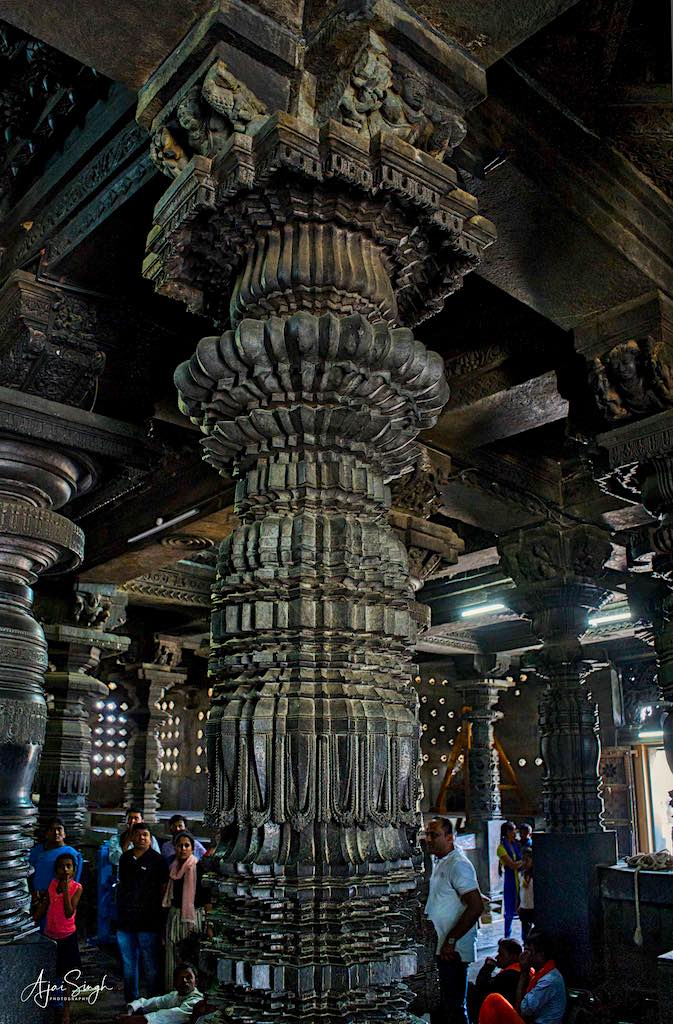
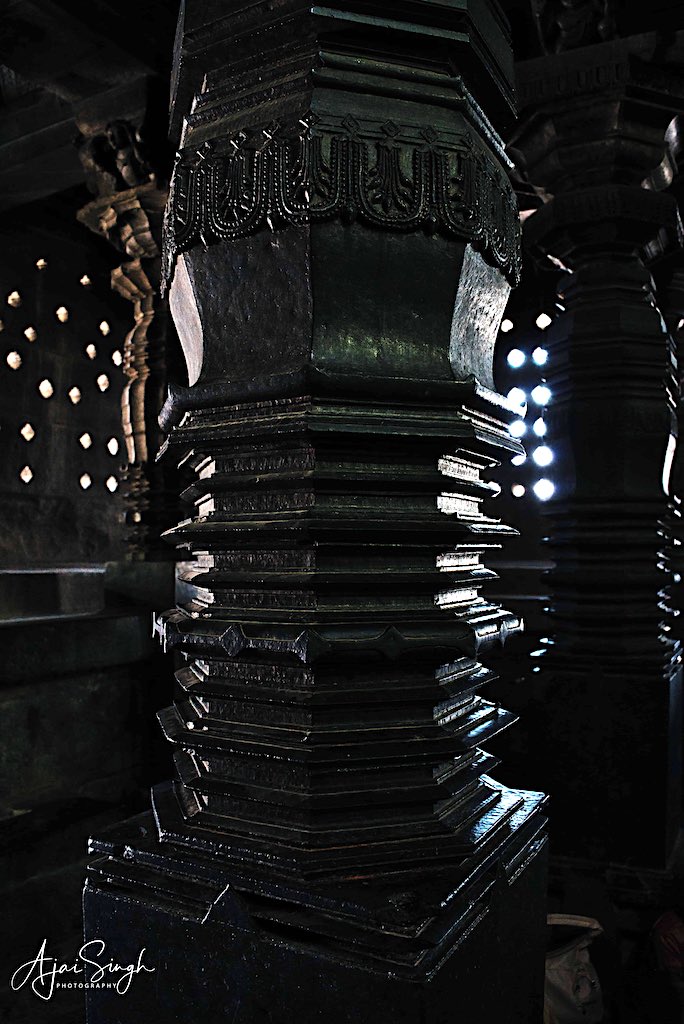
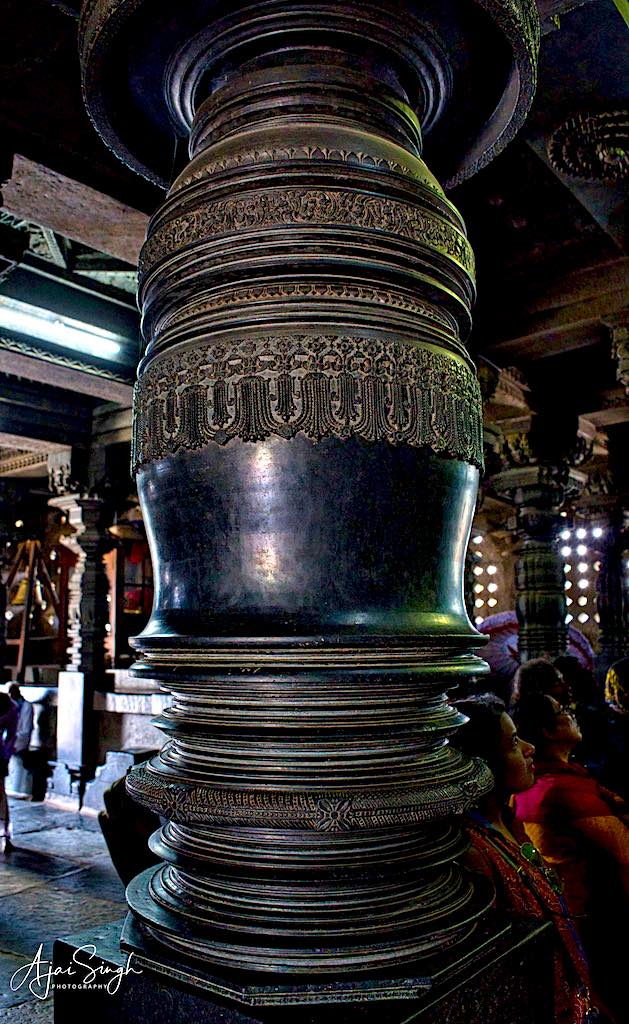
The central hall (navaranga) in the Kesava temple at Belur is the largest of any Hoysala temple and is of triratha diamond-shaped layout. The navaranga hall has forty-eight pillars. All except the central four are carved in a unique way – the central four are later additions built to support the roof.
.
.
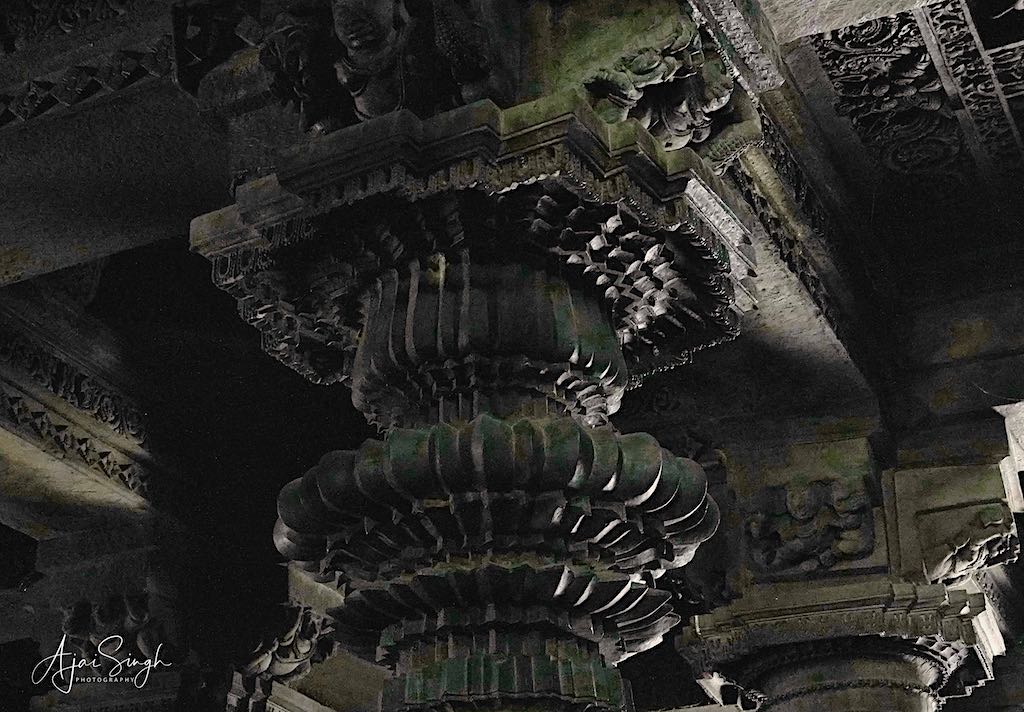
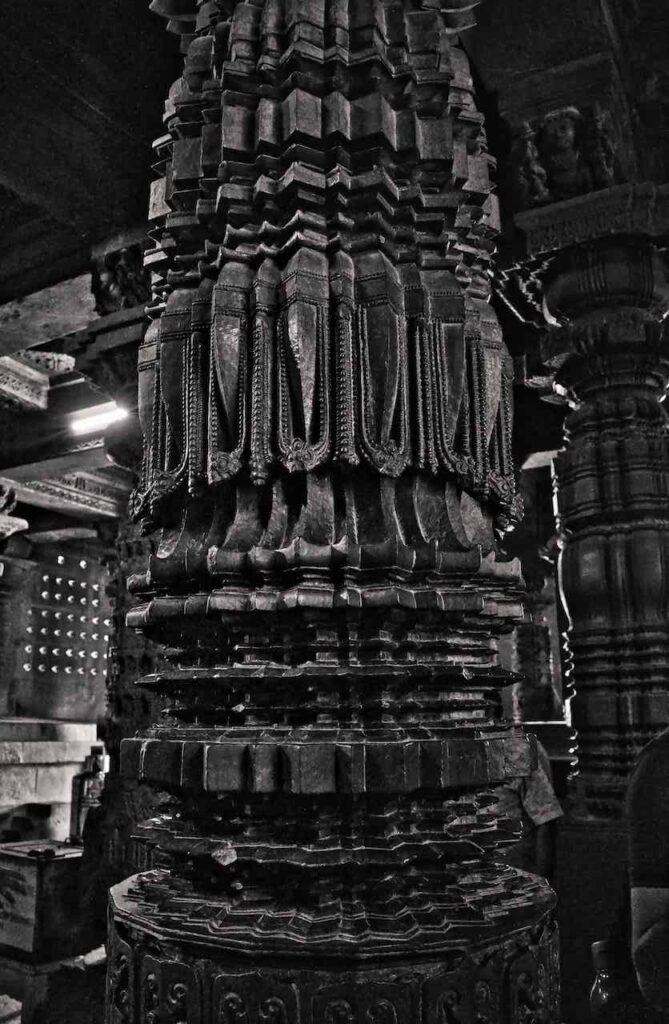
The four central pillars are notable for having been hand carved while the others were lathe-turned.
.
.
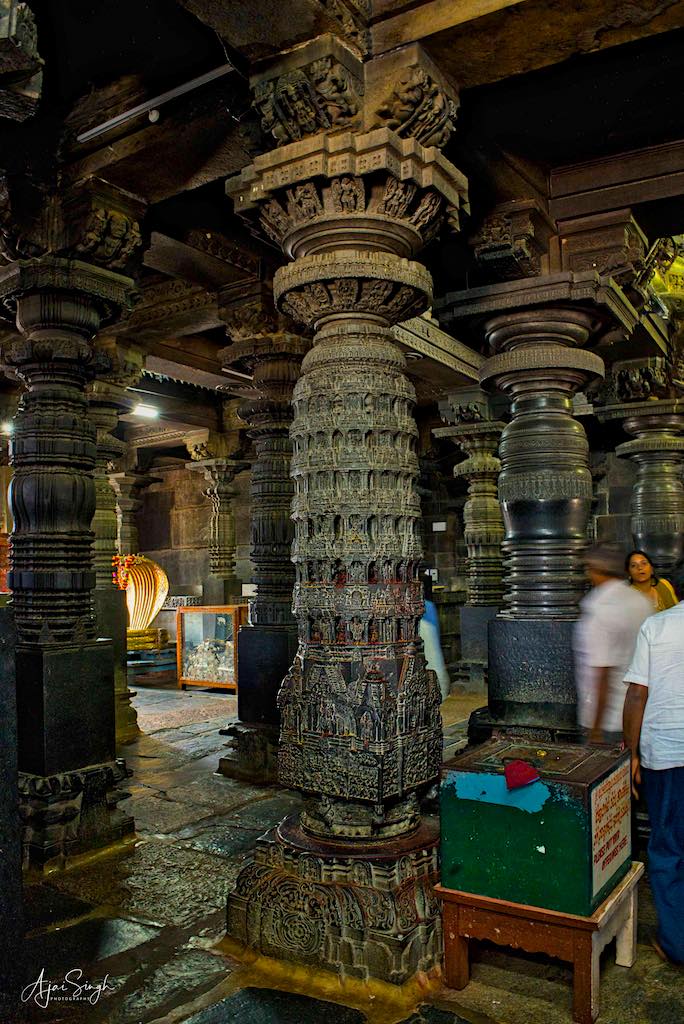
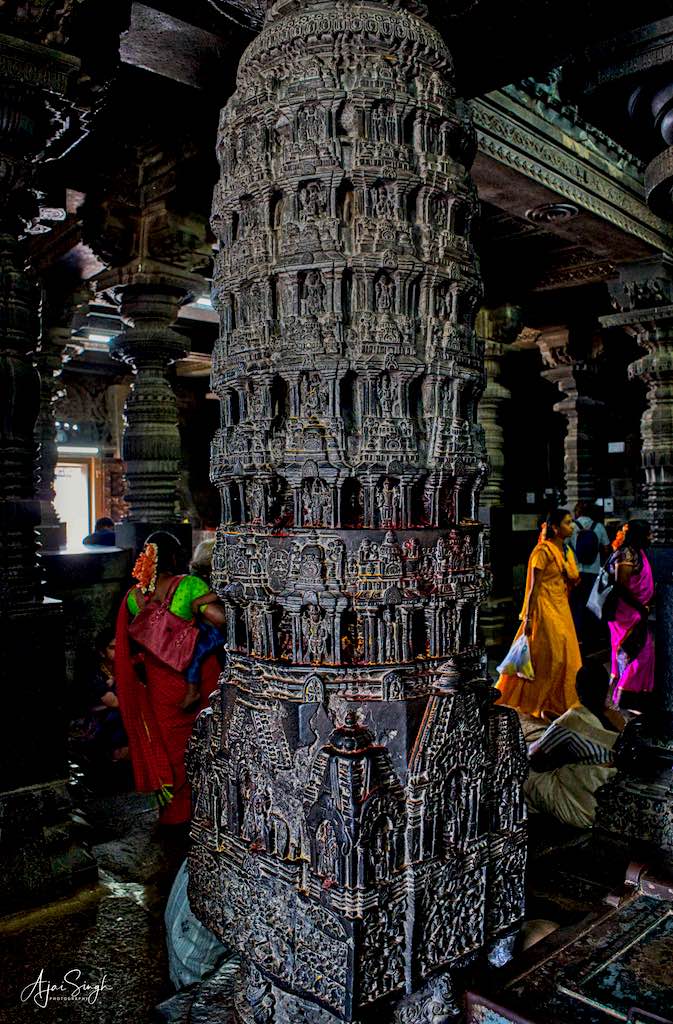
Two pillars in the hall are particularly notable. One is the Narasimha pillar, which is one of the major attractions of the temple. This pillar was designed to rotate because of how it was supported, but it has now been fixed to prevent damage. The circular portion of the pillar is divided into six horizontal layers, each of which has several miniature shrines carved into it. Above these layers, the pillar narrows down, ending up with two disc-like constructions, and then it evolves into a wide disc. Perched on top of the wide disc is an inverse conical construction with a polygonal slab on the top. Above this is the capital of the pillar. The entire pillar is covered with fine filigree work. The pillar has reliefs depicting episodes such as the Samudra Manthana and Ravanaughara. A number of deities are carved inside and around the miniature shrines.
.
.
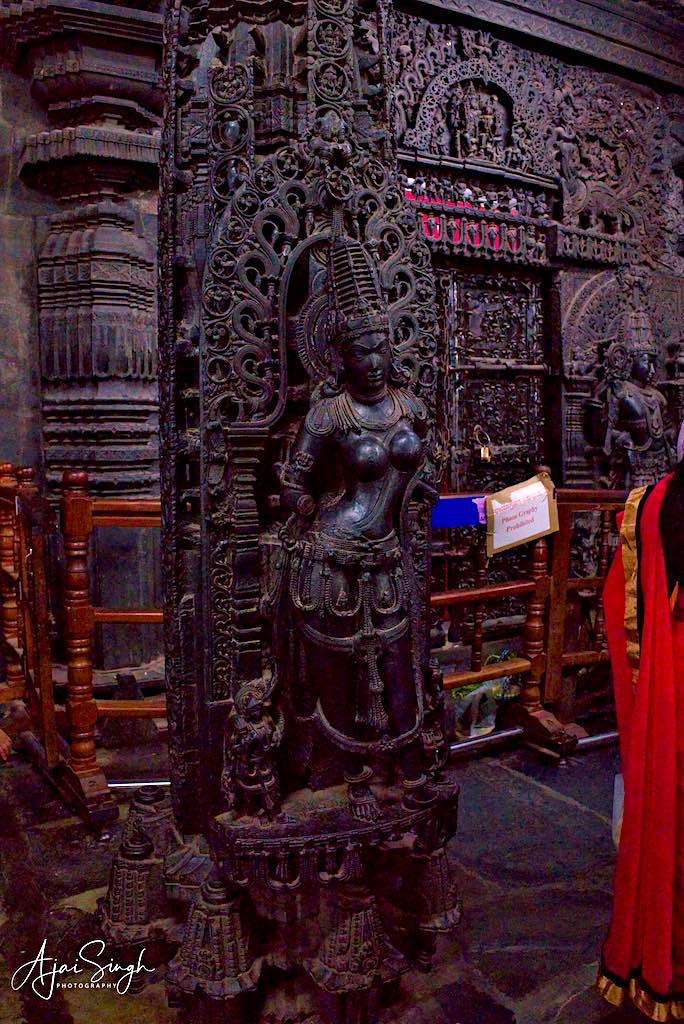
The other notable pillar is the Mohini pillar. The Mohini pillar is a sixteen-fluted star-shaped pillar with a large enchanting figure of Mohini, the female avatar of Vishnu, flanked by a Chauri bearer and a garuda (Vishnu’s vahana). The stunningly beautiful and intricately carved sculpture is one of the finest specimens of Hoysala pillar craftsmanship. It is made of black stone (locally known as Krishna Shile), unlike most other reliefs which are made of soapstone. Mohini is adorned in a variety of jewellery, an udiyana (waistband) and wears a yajnopavita (sacred thread, indicative of being a master of the Vedas and having undergone the Upanayana ceremony). Her second toe is longer than the big toe, an attribute much sought after in a woman in India.
.
.
The pillar has eight bands of carvings, including those of Brahma, Vishnu, Shiva, the Dashavatars (ten avatars of Vishnu), the eight direction deities, and mythical animals with the body of a lion but the face of other animals.
.
.
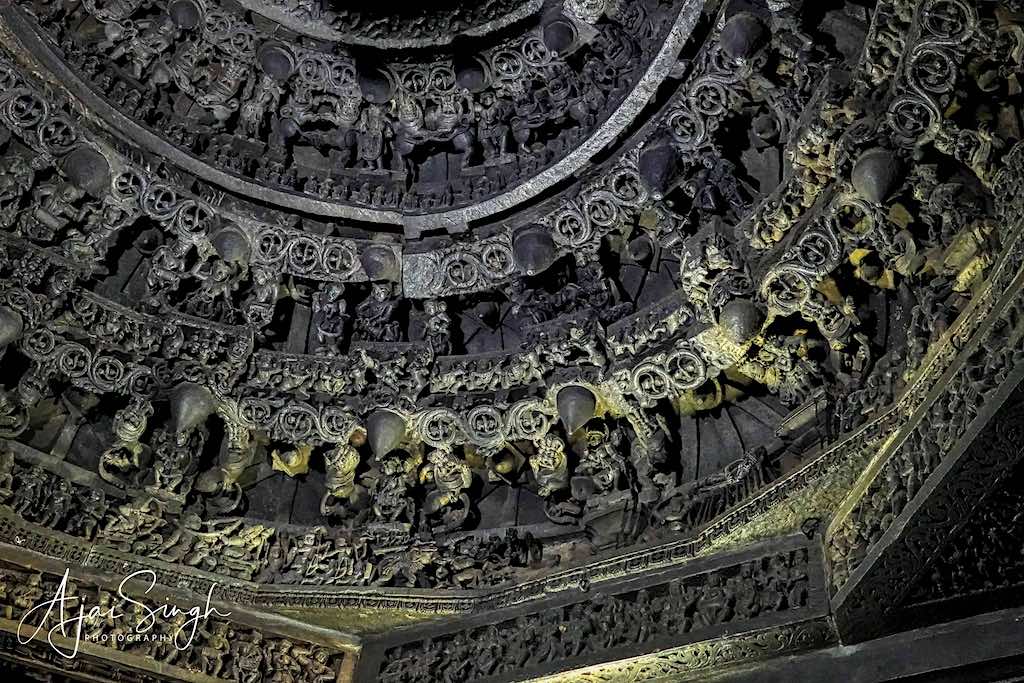
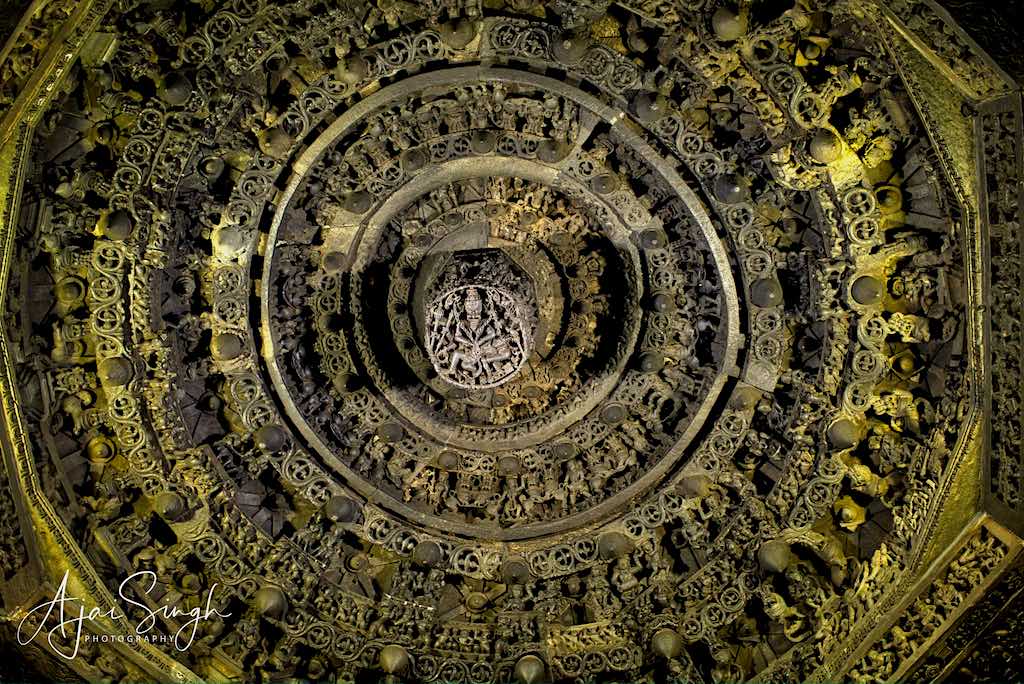
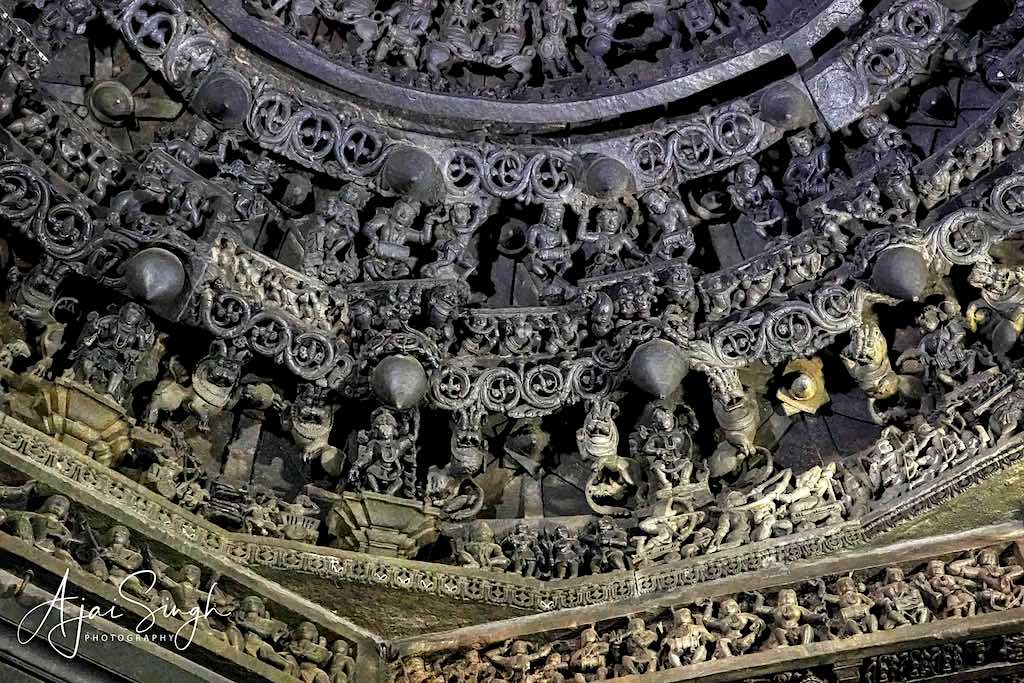
In the centre of the hall is a large open square, above which is a domed ceiling about 10 feet in diameter and 6 feet deep. The central ceiling of the mandapa is an exceptional beauty carved on stone. The ceiling is in the shape of an inverted lotus between two concentric circles. The design follows Hindu texts and is a modified utksipta style with images placed in concentric rings.
.
.
The central part of the circle is in the shape of an inverted Shiva Linga, with Ugra Narasimha carved on the base and lotus flower in the middle, symbolic of Brahma. This carving of Ugra Narasimha has multiple hands with claws, tearing apart the Asura King Hiranyakashyapa and is carved with profound details.
.
.
The Trinities are represented in a single stone through symbols, also called as Trimurti Sangama Bhubaneshwari. At the bottom of the dome is a series of friezes with the Ramayana story.
.
.
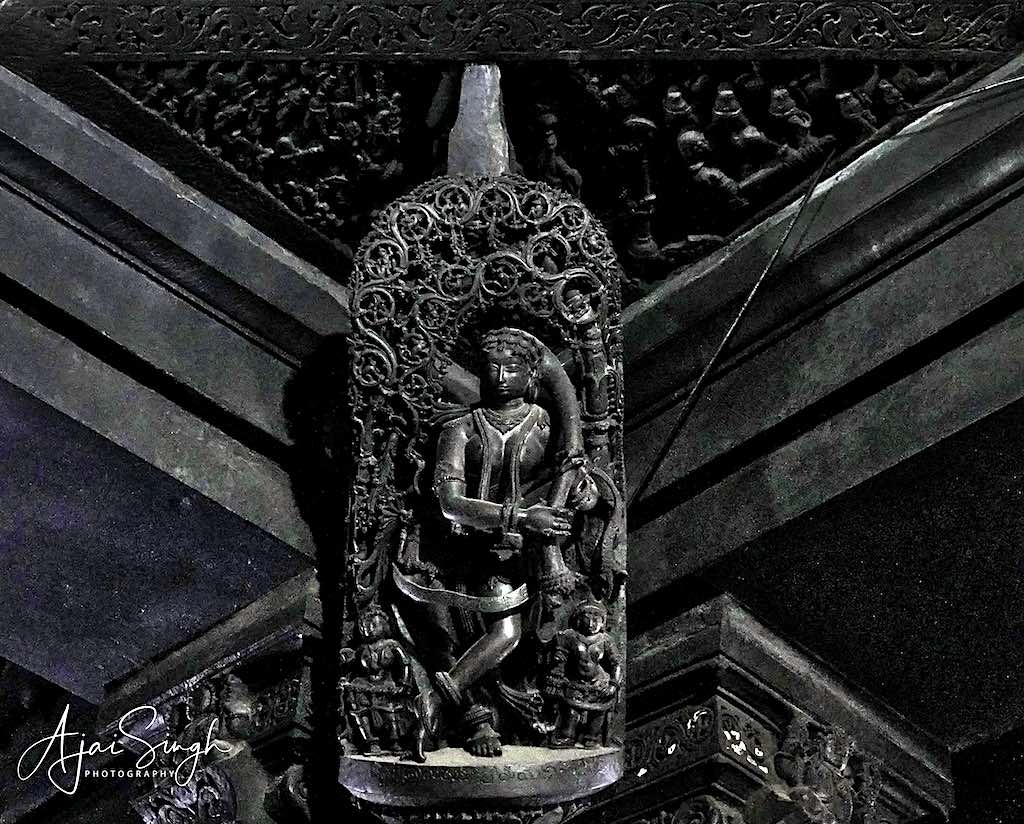
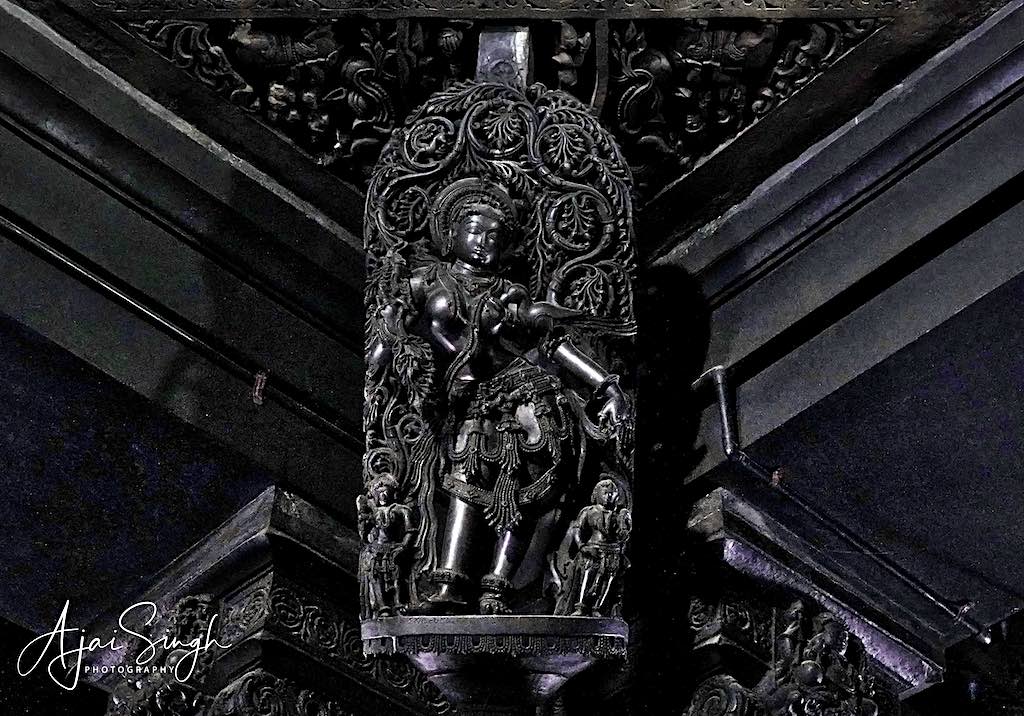
On top of the four central pillars are madanikas (Salabhanjika). One of these are of Queen Shantala Devi, herself a renowned dancer, and the others are regular dancers, each having different expressions.
.
.
One is dressing her hair, the other in a Natya posture, and the fourth has a parrot seated on her hand.
.
.
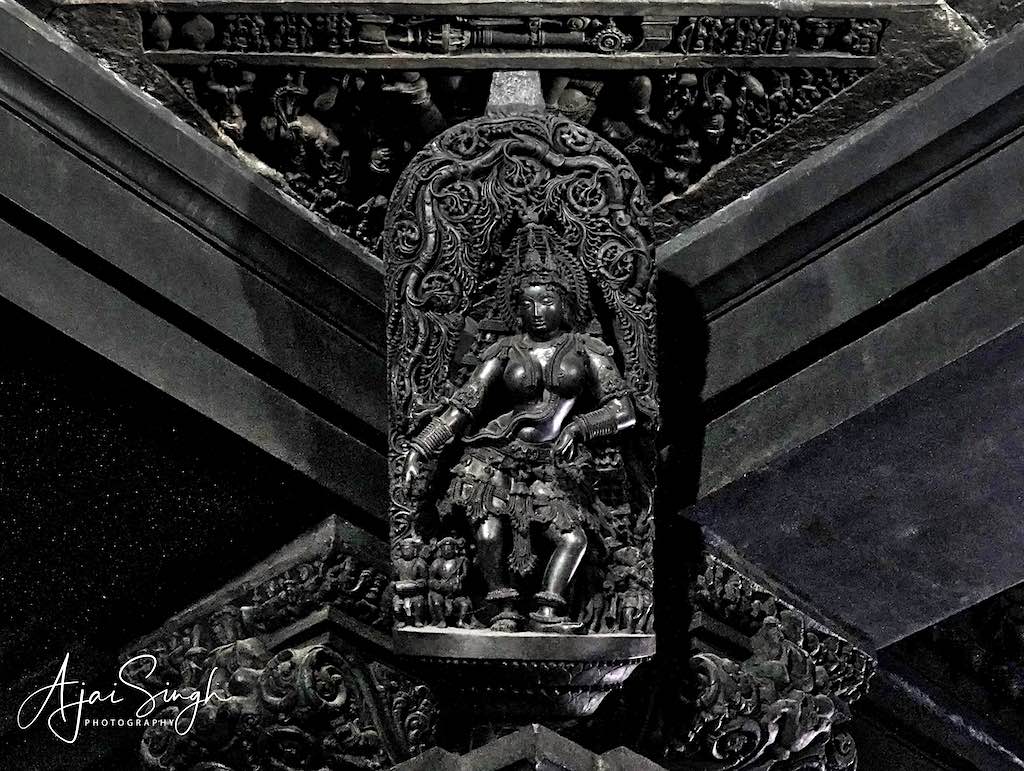
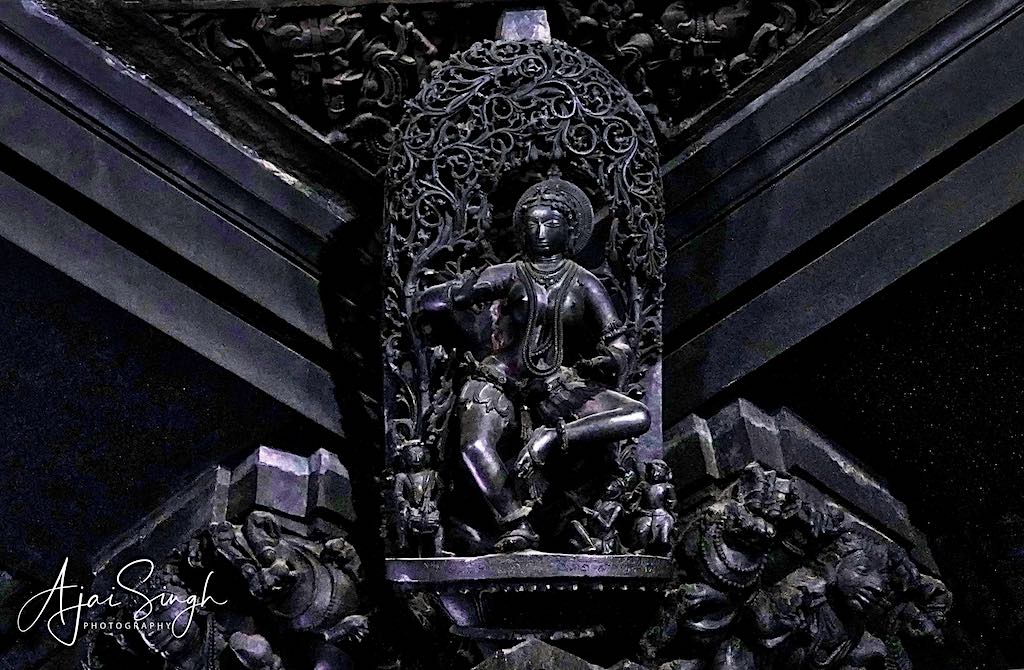
The figures of the Gandharva dancer and Queen Shantaladevi (Darpan Sundari) are noteworthy as their accessories are movable.
.
.
The tiny ring on the headdress of the Queen, on the southwest pillar and the bracelet on the arm of the dancer, on the northwest pillar can be rotated.
.
.
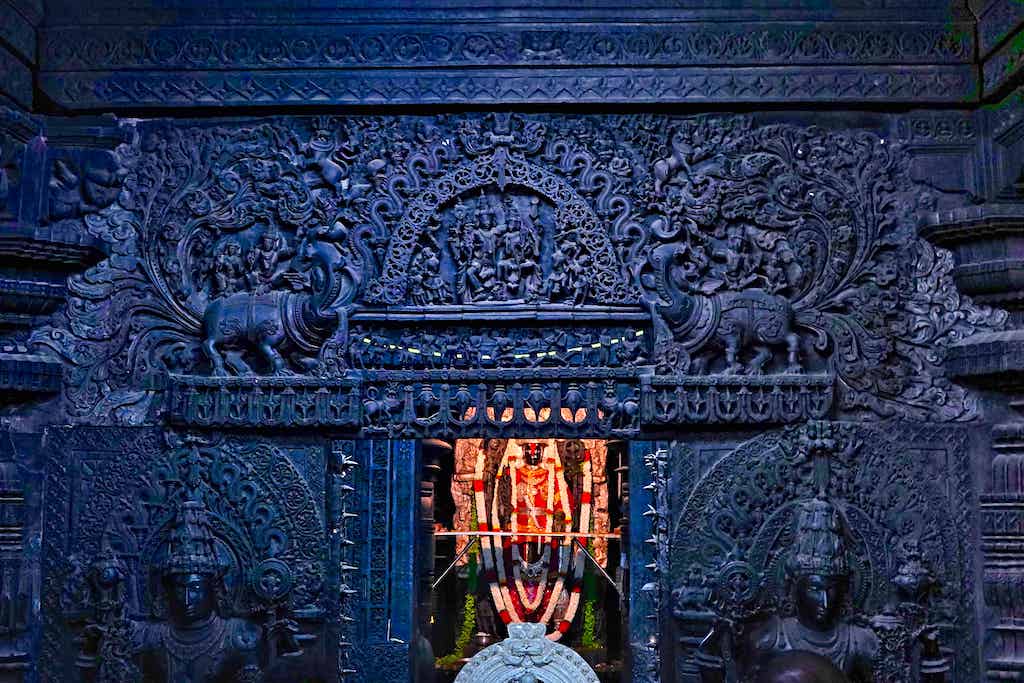
The mandapa leads to the garbha griha past the pillars and a doorway. The door is flanked by two minutely carved dwarapalas, Jaya and Vijaya. The entrance to the garbh griha is intricately decorated with Makara Torana and filigree work on the panel above the doorway, with the figure of Vishnu and Lakshmi in the centre within the prabhavali (arch). On both sides are Varuna and Varuni seated on Makaras (crocodile-like animal, the vahana of Varuna). From the mouth of makaras extends the Makara Torana which encompasses the prabhavali. The Torana is adorned with the cyclical carvings of the Dashavataras (ten avatars of Vishnu) – Matsya, Kurma, Varaha, Narasimha, Vamana, Parasurama, Rama, Krishna, Buddha and Kalki. At the centre of the Torana is a Kirthimukha (demon face). Two lions are carved on either side of the Torana. Below Vishnu and Lakshmi is a band which has 12 three-dimensional figurines of dancers and musicians playing 12th century instruments. These figurines depict the state of joyfulness (bhakti) while serving the lord. Pancha Padmas (five lotus flowers) are carved below the musicians. These Pancha Padmas symbolise the Pancha Bhoothas. Two lions flank the Pancha Padmas on either side.
.
.
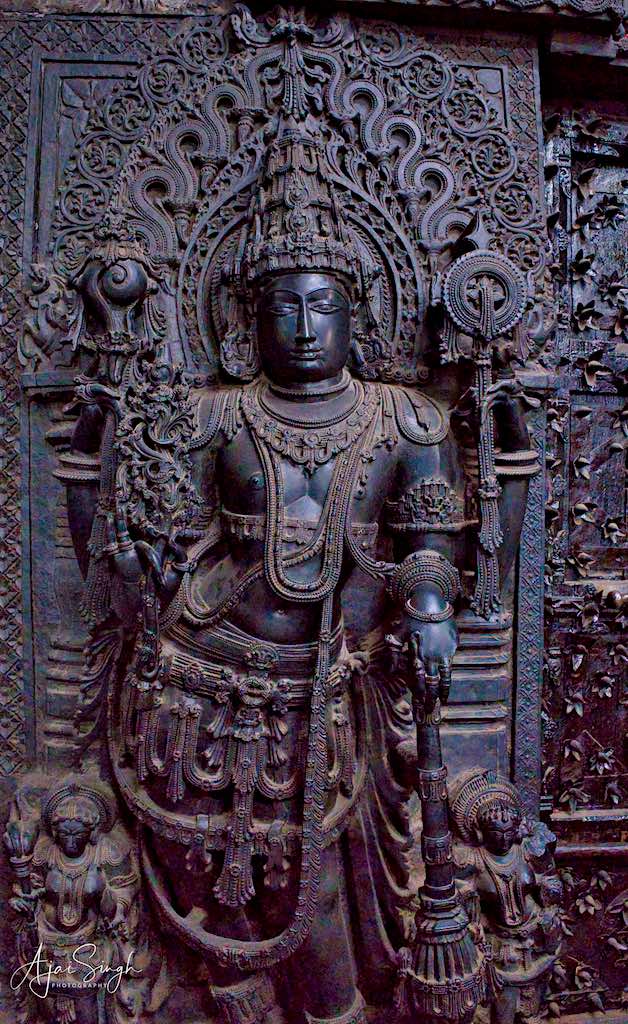
Inside the square garbha griha is the image of Keshava, or as inscriptions call it “Vijayanarayana”. It stands on a 3 feet high pedestal, is about 6 feet high with a halo. It has four hands, with chakra and shankha in the upper hands and a gada and lotus in his lower hands. The halo has cyclical carving of the ten avatars of Vishnu – Matsya, Kurma, Varaha, Narasimha, Vamana, Parasurama, Rama, Krishna, Buddha and Kalki. Keshava is flanked by idols of his consorts- Sridevi and Bhudevi. The temple is an active house of worship and the murti is elaborately decorated in fine silks and flowers.
.
.
Stambhs (Pillars)
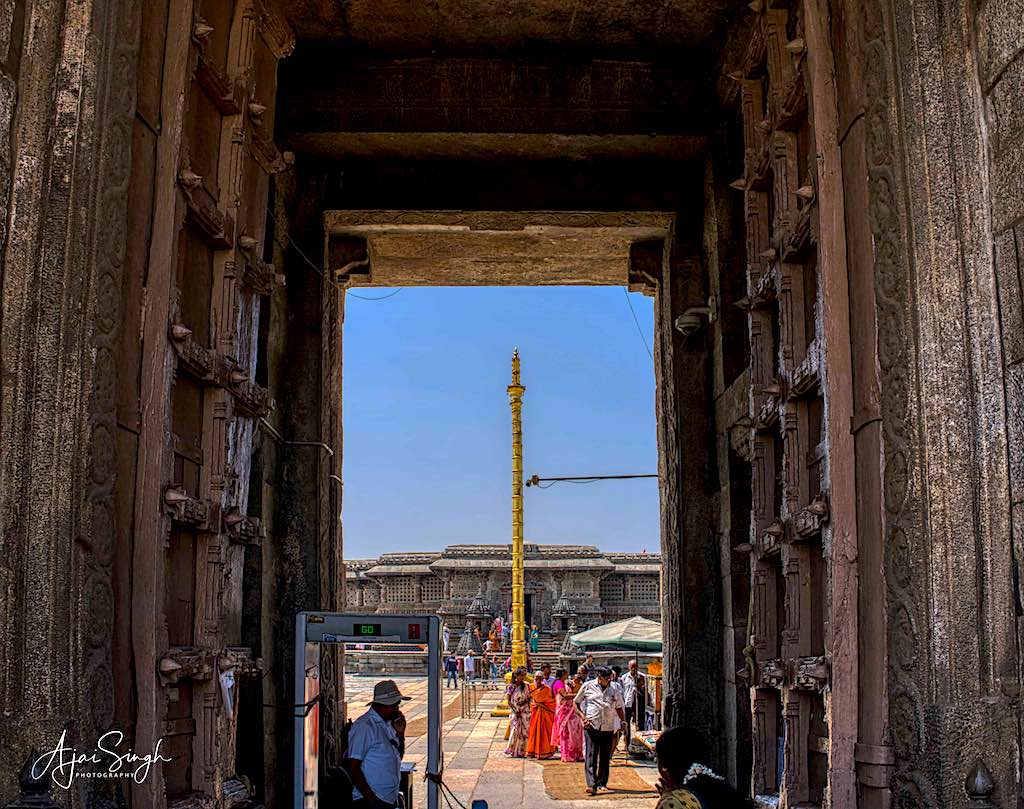
Two main sthambha (pillars) are found in the temple complex. In front of the east gate the pillar facing the main temple, the Garuda (eagle) sthambha was erected in the Vijayanagar period, also known as the Dhwajastambha.
.
.
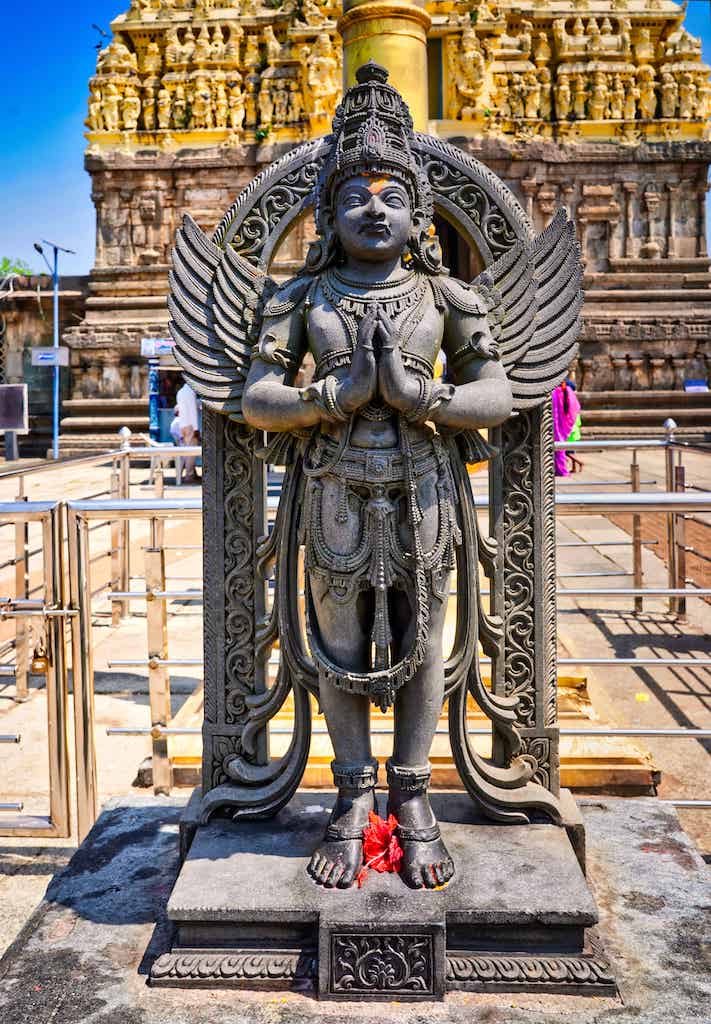
In front of it is a beautifully carved sculpture of Garuda, the Vahana (vehicle) of Vishnu, facing the main shrine. The sculpture of Garuda stands on a separate platform with folded hands in the Anjali Mudra,saluting the lord. Garuda is depicted with the wings of an eagle and torso of a man and he’s well ornated. A yajnopavitha (sacred thread) runs across his left shoulder. Snakes form his armlets, bracelets and earrings.
Garuda, also known as Kageshvara (King of birds), Suparna (He who has golden feathers), Suvarnakaya (golden bodied) and Nagantaka (devourer of serpents) is the son of Kashyapa and Vinata. He is the Vahanaof Vishnu and the statue of Garuda can be seen in all temples dedicated to Vishnu.
.
.
.On the left side of the gopuram towards the south is a huge free-standing 42 foot-high pillar carved out of a single stone called the Deepastambha. Erected on a star-shaped platform, the pillar has no foundation and stands by its own weight, known as a gravity tower. It has a lamp at the top and dates from the Hoysala period.
.
Kappe Chennigaraya Temple
At the southern end of the main temple is the Kappe Chennigaraya temple, consecrated by the queen of Vishnuvardhan, Shantala Devi in the same year as the main temple. Besides the main shrine of Chennigaraya (the local popular name of Chennakeshava, Vishnu), there is a sub-shrine housing the image of Venugopal. The temple is called Kappe Chennigaraya – Kappe means a frog in Kannada. The legend how the temple was named Kappe involves Jakanachari, the renowned architect and sculptor of the Hoysala era. He hailed from the village of Kridapura in present-day Tumkur district of Karnataka. Because of martial discord, he left his wife Manjari and moved to the Hoysala capital and worked as master sculptor under King Vishnuvardana. Unknown to Jakanachari, his son Dakanachari, himself a talented sculptor, came to Belur and started working for him. While Jakanachari was carving the statue of Chennakeshava for the Chennigaraya temple, his son discovered a flaw, i.e. a frog was inside the belly of the sculpture. Jakanachari felt humiliated when this was pointed out to him and challenged Dakanachari to prove the flaw. He vowed to cut off his right hand if the flaw was proved.
Dankanachari was proved correct and the frog jumped out when a hole was made in the sculpture. Jakanachari kept his word and cut off his right hand. During this time he also learned that the challenger was his son. Legend has it that Vishnu restored his right hand once he built a temple dedicated to Vishnu in his village, which became known as Kaidala. In Kannada, Kai means hand. Both Jakanachari and Dakanachari collaborated to carve a new Chennakeshava murti, which was consecerated by the Pattada rani (principal queen) Shantala Devi herself. However, Kappe remained a part of the name even after the new murti was installed in the temple.
This temple is similar to the main Chennaksheva temple, thought built on a reduced scale and decoration. However, the Kappe temple is a dvikuta (having two shrines) temple. It has the life-sized murtis of Chennakeshava (on the west) and Venugopala (on the south), both being forms of Vishnu.
.
Saumyanaki Temple
.
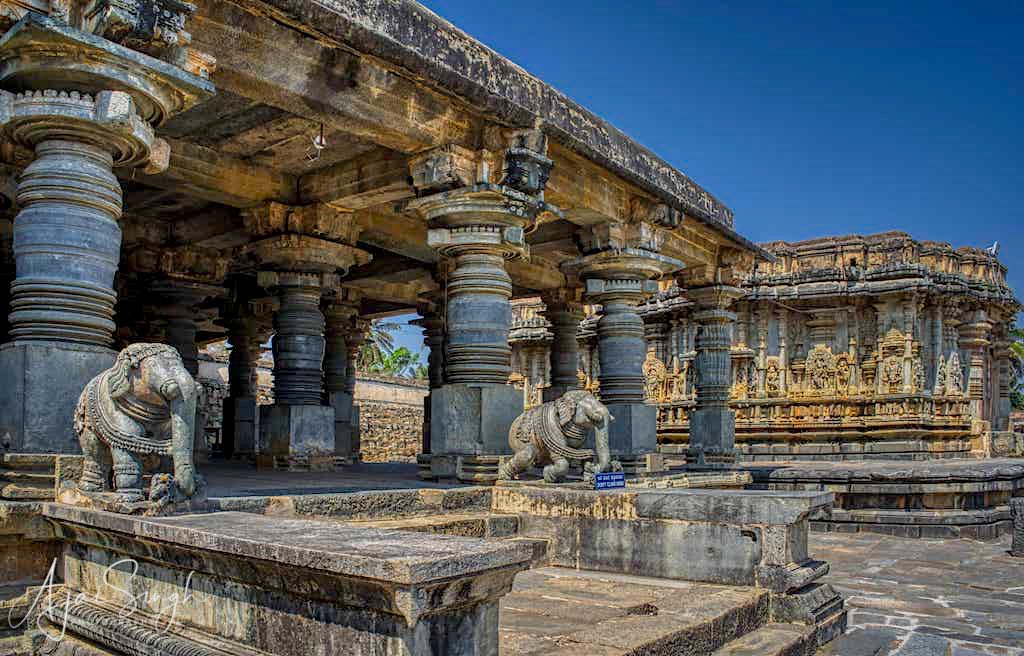
This is an important temple dedicated to Goddess Sridevi towards the southwest of Keshava Temple. It has a Garbhagriha, Sukanasi and a Mandapa. The temple is adorned with a vimana or shikhara which is said to resemble the original vimana of the Keshava temple that has been brought down. The outer wall is adorned with sculptures.
.
.
Ranganayaki (Andal) Temple
The Andal temple, also called Ranganayaki shrine, is to the northwest of the Kesava temple has been built in memory of the poet-saint Alwar. She is believed to be an incarnation of Mahalakshmi and is the only female among the 12 Vaishanavite Alvar saints of South India.
.
.
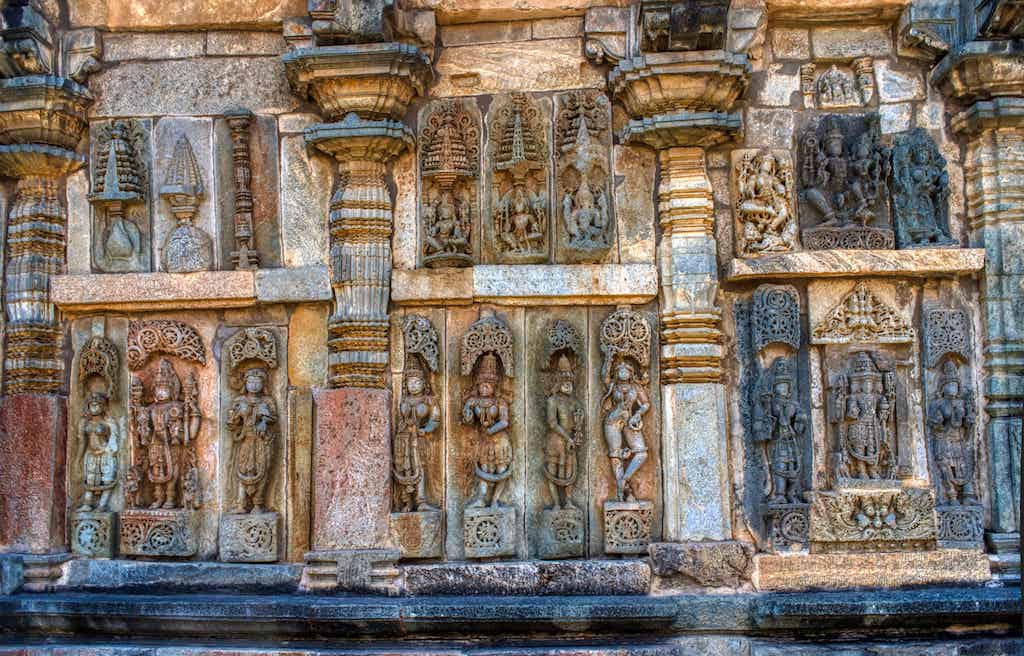
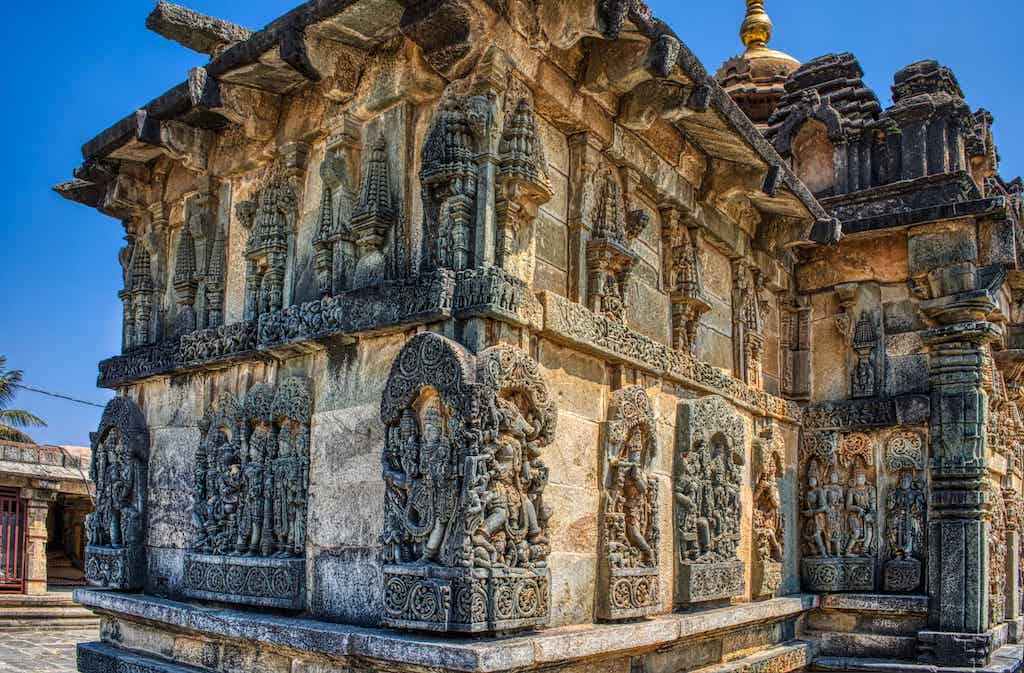
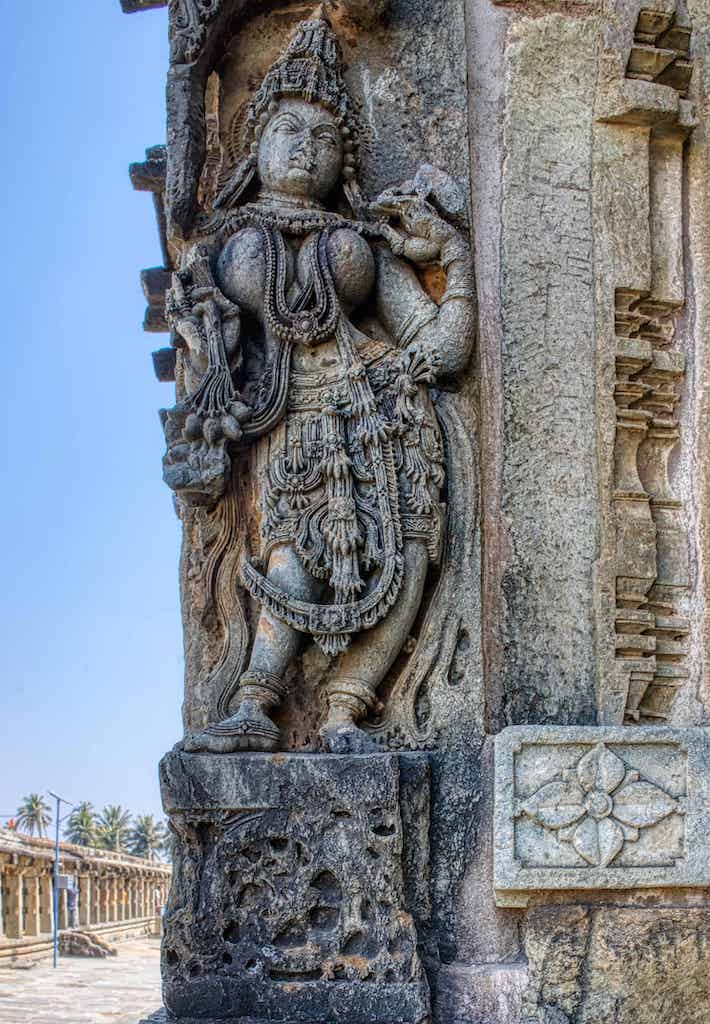
Its outer wall is decorated with artwork such as elephants and nature. It also displays 31 large images of deities from the Vaishnavism, Shaivism and Shaktism traditions of Hinduism. It also has intricately carved Venugopala, Mohini and Lakshmi, as well as friezes showing legends in the Puranas.
.
.
Viranarayan Temple
The same compound houses another temple named Viranarayan to the west of Chennakesava. It is an ekakuta, Vaishnava temple. It is a small but complete temple with a navaranga (nine square hall) and a garbha griha (sanctum) with 59 large reliefs on the outer walls. These reliefs are dedicated to Vishnu, Shiva, Brahma, Bhairava (angry Shiva), Lakshmi, Parvati, Saraswati and others. Some panels depict the Bhima story from the Mahabharata. The temple is also dated to the 12th century.
Near the Viranarayana temple is a mandapa where annual procession ratha and temple vehicles have traditionally been stored. It is called vahana mandapa. The complex also has a kalyana-mandapa in the southeast corner for ceremonies. This was added later in the 17th century.
.
Vasudev Tirtha
A stepped pond called Vasudev Tirtha was constructed to the northwest of Chennakesava by Veer Ballala II. It is a consistent feature of any temple in which devotees perform an ablation before entering the mandapa.
.

.
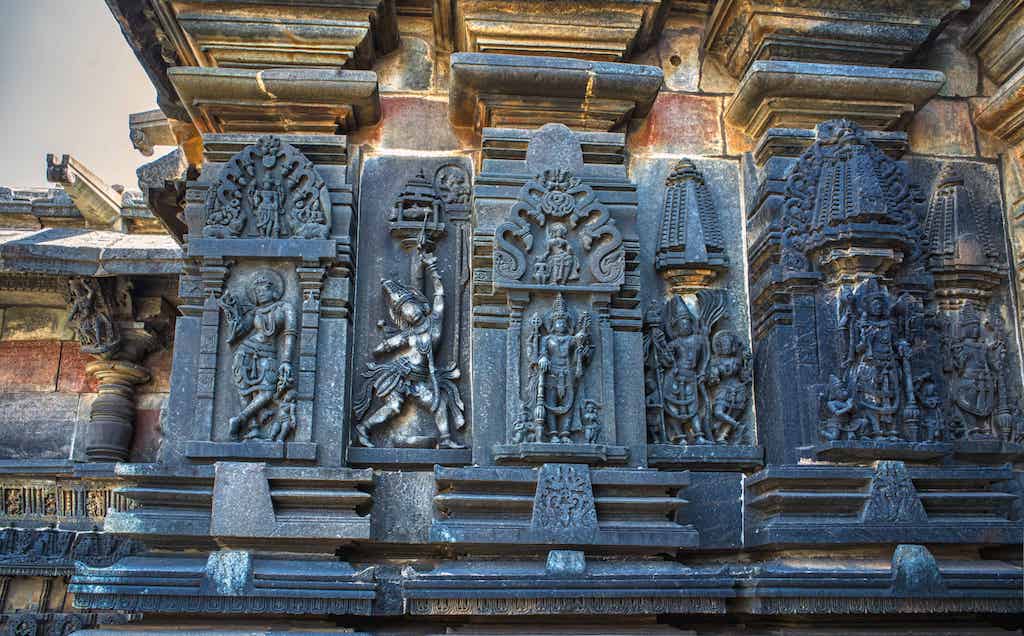
The Chennakeshava Temple is locally referred to as Kalasagar (ocean of artistry) for its breath-taking carvings and fine sculptures. The beauty is so expressive that one can feel life inside these non-living stone structures. It is one of the foremost examples of spiritual expression one can find amongst the numerous treasures that exist in India. That it is a living temple since its consecration, only adds to its greatness.
.
.
Artists
Hoysala sculptures are amongst the first in which artists signed their work in the form of inscriptions. In doing so, they sometimes revealed details about themselves, their families, guilds and place of origin. Stone inscriptions and copper plate inscriptions provide more information about them. Ruvari Mallitamma was a prolific artist to whom more than 40 sculptures are attributed. Dasoja and his son Chavana who were from Balligavi in modern Shimoga district made important contributions. Chavana is credited with the work on five madanikas and Dasoja completed four of them. Malliyanna and Nagoja created birds and animals in their sculptures. Artists such as Chikkahampa and Malloja are credited with some of the sculptures in the mantapa.
.
.
Festivals
The annual Rathotsava is the major festival celebrated in Belur in the month of March-April, twelve days after Ugadi or the Kannadiga New Year. The celebrations last two days when the Utsava Murti is drawn on a huge wooden chariot.
.
How to Reach
The Chennakeshava Temple is located in Belur and is about 35 kilometres northwest of Hassan. The temple is about 16 kilometres from Halebudu temples. Belur has no nearby airport and is 200 kilometres west of Bengaluru, about 3.5 hours drive accessible with a four-lane NH75 highway. Hassan is the closest city near Belur that is connected by the railway network.
.
.
Travel Tips
The preferred months to visit are from October to March, that too in the early mornings. Due to the stone becoming too hot to walk on when temperatures rise.
A good, certified guide is a must, if one does not want to miss out important aspects of the temple.
Hassan is the nearest town with decent and comfortable hotels.
.
.
.
My blogs on the other Hoysala temples we visited can be seen at:
- Chandramouleswara Temple, Arasikere
- Amrutheshwara Temple, Amruthapura
- Lakshmi Devi Temple, Doddagaddavalli
- Sri Veera Narayana Swamy Temple, Belavadi
- Hoysaleshwar Temple, Halebidu
- Kedareshwara Temple, Halebidu
- Parshvanatha Jain Temple, Halebidu
- Chennakeshava Temple, Arakere
- Sri Lakshmi Narsimha Temple, Javagal
.
Note: All photographs displayed above are my exclusive property and copyright; their use is prohibited without explicit consent, in writing.
.
.


12 Responses
Absolutely mercerising visit to these historic places of worship n culture of those times
Decidedly a must visit to these places !
Thankyou Ajay
Yes, definitely a must-see place!
I had visited both place in Jan.2017……You cannot describe beauty of both place.
Thanking you to member my old memories.
You are right, the beauty cannot be described in words. It has to be seen…..
Very nice photographs and it is a wonderful and worth appreciating effort to highlight the beauty of our old temples. Thanks for sharinng
Thank you.
I really appreciate that you posted this blog. After reading it, I want to include this in my bucket list. Thank you.
Thanks for liking the blog.
I had visited Belur & Halebedu temples during 1982-83, but never looked for such minute details of the historical evidence of our rich heritage which goes to prove that our civilisation was much more advanced than it’s perceived to be. The World needs to take note of this.
Yes, these are the vast repository of unknown/hidden wonders that exist in India. Which have never been highlighted till now, for unknown reasons.
Mr.Ajay Singh
Good Evening.
I visited these places when we do not hve any mobile or any othre easy photo taking instrument.
Though I visited almost several ancient Temples in India and abroad, your sincere, pain taking compilation is excellent.
I am 70 years old retired General Manager BHEL, Tiruchirapalli
My special appreciation to you
Keep it up
Thanks for the comments. Hope you manage to go through the other blogs too.